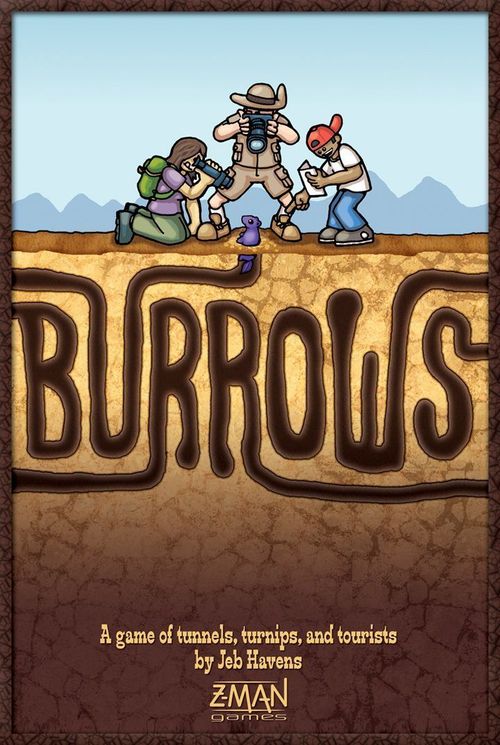
Burrows
Burrows Rulebook
Table of Contents
Table of Contents
Overview
Players are gopher ranchers in the scrub town of Gopher Gulch, each trying to build their own warren of burrows to attract all three types of gophers. It's a delicate balancing act where every tile counts. Build your warren, forming burrows of three different colors. Complete a burrow of a particular color that is bigger than another player's, and their gopher moves into your new burrow; it stays there until it gets lured away again by an even bigger burrow! There aren't enough gophers to go around, so not everyone will be able to host all three gopher types at once.
Every once in a while the tour bus will arrive, and the tourists will be most excited to see the types of gophers promised to them by their tour schedule. If your ranch is missing those particular gophers, you'll get complaints from the tourists. At the end of the tourist season, the rancher with the fewest complaints, wins!
Components and Setting Up
There are 5 numbered Ranch boards. Choose one player to be Player 1, and give them the Player 1 Ranch board. The next player clockwise gets the Player 2 Ranch board, and so on until all players have a board. Any leftover boards are returned to the box. Each board shows a player number, a reserved space, and starting burrows.
There are 12 gophers. Each Ranch board has 2 or 3 starting burrows on it that show which gophers are housed there. Each player should take the matching gophers for their board and place them in the correct burrows. (Red gophers are housed in red (radish) burrows. Orange gophers are housed in orange (carrot) burrows. Purple gophers are housed in purple (turnip) burrows.) Any leftover gophers are returned to the box. Notice that there is one fewer of each color gopher than there are players in the game.
Note that in a 2-player game only, the Orange (carrot) burrow on Player 1's board should not start with a gopher in it; it's marked with a symbol to remind you.
There are 80 Burrow tiles. Shuffle them all together and make several face-down stacks. Flip 2 tiles face-up from random stacks to start the Draw Pool. Tiles show tunnels and may show a red (radish), orange (carrot) or purple (turnip) symbol at tunnel ends, or a bus symbol.
There are 24 Schedule Pages. Arrange the Schedule Pages into one of the formations below, based on the number of players in the game. Whichever formation you are using, follow this process:
A) Shuffle all of the white Pages, and arrange them face-up randomly into the proper formation. Arrange the formation off to the side where it will not get in any player's way during the game.
B) Add the blue Pages face-up exactly as shown (non-randomly) to the formation. Any unused blue Pages (in 2 or 5-player games) are returned to the box. This formation is now the Tour Schedule for this game.
Tour Schedule for 3 or 4 players
The individual white pages are randomly positioned, but this is the Tour Schedule's basic shape. Simply alternate the white pages in columns of 1, 2, 1, 2, 1, 2, 1, 2, 1, 2, then put the blue pages on the ends in the exact positions shown.
Tour Schedule for 2 or 5 players
The arrangement is a bit different for the 2 or 5-player game. Again, the white pages will be in random positions, but this is the Tour Schedule's basic shape. This time, assemble the white pages in columns of 2, 3, 2, 3, 2, 3, then put the blue pages on the ends in the exact positions shown. For a 2-player game, subtract the first blank blue page and return it to the box.
Bus Track
Place the Bus Track near the Tour Schedule with the side up that's marked with the number of players in the game. This side is for 2, 3, or 4-player games; the back side is for 5-player games. Place the Tour Bus "in the city" (the starting space) on the track.
On Your Turn
First, flip over a Burrow Tile from any of the face-down stacks and place it in the Draw Pool, bringing the Draw Pool up to 3 tiles.
Next, you must either a) Reserve a Tile, or b) Build Your Warren.
A) Reserving a Tile
Choose any one of the face-up Burrow Tiles from the Draw Pool and hold it in reserve, face-down on the reserved space on your Ranch board. (Why reserve a tile? A reserved tile can be played on a later turn, allowing you to place two tiles when building your warren instead of one as normal.) You can not reserve a tile that features a Tour Bus symbol. You can only reserve one tile at a time. Reserving a tile counts as your whole turn, play now passes to the next player clockwise.
Example: Player 3 wants to reserve a tile. She can't take the tile with the Tour Bus symbol on it, so she chooses one of the other two tiles and stores it face-down on the reserved space of her Ranch board.
B) Building Your Warren
Choose any one of the face-up Burrow Tiles from the Draw Pool and add it to your warren. (Each player builds their own warren, unconnected from the other players' warrens.) A Burrow Tile may be added to your warren in any position and any rotation, as long as it connects to your current layout along an orthogonal edge, doesn't overlap any other tile, and the pictured tunnels line up correctly. (If you haven't built anything yet, you start building your warren by simply placing the tile you've chosen on the table before you; future tiles will have to follow the rules for connecting.)
Example: A few turns into the game, Player 1 decides to build. He selects a tile from the draw pool, rotates it however he wants, and adds it to his own warren so that the tunnels line up. Two possible placements are shown out of many options; since every tile connects to every other tile, there will always be lots of possibilities for placement.
Using a Reserve Tile
If you are holding a reserve tile on your Ranch board, you can add it to your warren following normal connecting rules in addition to your normal tile (in whichever order you choose). You must place both tiles before you check whether any gophers will move due to completed burrows (see below), and before you move the Tour Bus, if necessary (see below).
Example: Player 2 has a reserve tile and decides to use it. He plays the reserve tile onto his warren, and also selects and plays a tile to his warren from the Draw Pool as normal.
Completing a Burrow
If on your turn you create a closed burrow with the same symbol at both ends, you have completed a burrow and must immediately check to see if any gopher moves in. (See "Moving Gophers", below.) It is legal to play a Burrow tile that would connect two symbols that do not match, but this does not count as a completed burrow.
Example: As seen in the example above, Player 2 created a long closed burrow with a radish at both ends, a completed burrow! He also created a short burrow with a carrot at one end and a turnip at the other; since the symbols don't match, that doesn't count as a completed burrow.
It is possible and legal to complete more than one burrow in a single turn. Evaluate each newly completed burrow separately to see if any gophers move, in whatever order you choose.
Moving Gophers
For each burrow you complete, you must then check to see if a gopher of that type will move in. Burrow length is measured in tunnel segments. When counting segments, start with "1" at a symbol and add 1 every time you cross a tile border until you reach the symbol at the other end. The starting burrows on the players' Ranch boards count as having a length of 1.
Example: The burrows on the Ranch board each have a length of 1. In this sample warren, there is a carrot burrow of length 3, a turnip burrow of length 2, and a radish burrow of length 5. Note the two portions of the radish burrow that count as separate segments even though they are part of the same tile.
If you do already house a gopher of that color in one of your burrows and the new burrow is longer, move that gopher to the new burrow. (If it's shorter, no gopher moves in.)
Example: Player 2 houses a purple gopher in the turnip burrow (length 1) on his Ranch board. On his turn, he completes a turnip burrow of length 2. Since the new one is longer, the purple gopher moves from the old burrow to the new one.
If you don't already house a gopher of that color in one of your burrows, that means that all of your opponents do. Check their gophers of that color to see how long their burrows are. If your new burrow is longer than the shortest occupied opponent's burrow of that color, move that gopher to your new burrow. (If it's shorter, no gopher moves in. If it's longer and there is currently a tie among your opponents for shortest occupied burrow of that color, you may choose which one of those gophers moves into your new burrow.)
Example: Following Player 2's turn shown above, Player 3 completes a turnip burrow of length 3 on her turn. She does not already house a purple gopher, so she checks the other players' warrens. Player 1 has a purple gopher in a length-4 burrow, and Player 2's purple gopher is in a length-2 burrow, as we know. The gopher thus moves from the shortest burrow (Player 2's) into the new, longer burrow in Player 3's warren.
The Tour Bus Symbol
Once you've moved any gophers as necessary, if a tile you just played features the Tour Bus symbol, move the Tour Bus one space towards Gopher Gulch on the Bus Track. If this causes the Tour Bus to arrive at Gopher Gulch, this means that the next batch of tourists has arrived, causing the next stage of the Tour Schedule to be scored. (See "Scoring the Tour Schedule", below.)
Example: A tile with a Tour Bus symbol is played. The bus is moved one space on the Bus Track, which causes it to arrive at Gopher Gulch; time to score!
Scoring the Tour Schedule
When the Tour Bus arrives at Gopher Gulch on the Bus Track, the leftmost stage of the Tour Schedule is scored. (Each "stage" is a vertical column of pages and may have one, two, or three pages. Evaluate each page of the stage separately; the order in which you resolve them does not matter.)
Each page shows a color of gopher; this is the gopher type that the tourists are most excited to see. Give the page to the one player that doesn't house that color of gopher in his warren/ranch. Each page also displays 1-3 Complaint symbols; this represents the number of complaints that player receives from the disappointed tourists. Players keep their accumulated pages in a face-down pile near their own Ranch board.
Example: The Tour Bus has arrived at Gopher Gulch, so we score the Tour Schedule. Several rounds have already been scored, and we are at the 9th stage of the sample 3-player game. This stage has a page with an orange gopher; the player without an orange gopher will get that page with its single Complaint symbol. The other page in the stage has a red gopher; the player without a red gopher will get that page and rack up the two Complaint symbols that it shows.
After all pages in the current stage are scored, the Bus is returned to the start of the Bus Track, and play resumes with the next player clockwise.
At the beginning of the schedule will be one or more blank pages. Blank pages indicate that these tourists are not especially excited about any specific color of gopher, and are happy with whatever gophers they see. Blank pages are not given to any player when scored, and are simply returned to the box.
Scoring Example
We are scoring the 9th stage of the sample 3-player game. This stage is made up of two pages; it doesn't matter what order we resolve them in.
First we'll resolve the orange 1-complaint page. The only player that doesn't house an orange gopher is Player 3; she takes that page and keeps it face-down near her Ranch board. Next we'll resolve the red 2-complaint page. Player 1 is the only player that doesn't house a red gopher (the red gopher in the Starting burrow on Player 3's Ranch board does count), so Player 1 takes that page and keeps it face-down near his Ranch board. Having resolved all pages in the stage, we move the Tour Bus back to the start of the Bus Track, and the game continues with the next player.
Winning the Game
Immediately after the final stage of the Tour Schedule is scored, all players tally up the Complaint symbols on their own accumulated Schedule Pages. Any player that still has a reserve tile on their ranch board subtracts 1 from their total number of complaints. The player with the fewest complaints is the winner! All ties are broken in favor of the tied player whose next turn would have come sooner if the game hadn't ended.
Example: At the game end, Player 1 has 9 complaints, Player 2 has 12 complaints, and Player 3 also has 12 complaints. Player 3 has a reserve tile on her ranch, which allows her to subtract 1 from her score for a final total of 11 points. Unfortunately it's not enough to make a difference, and Player 1 wins with his low score of 9!