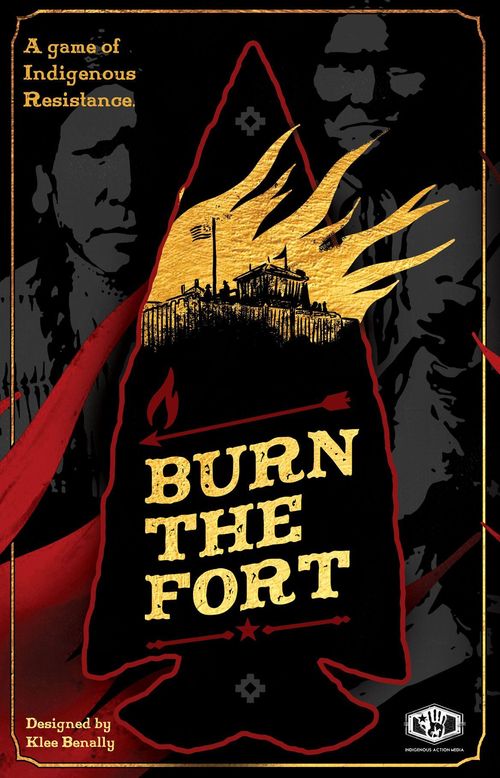
Burn the Fort
Burn the Fort Rulebook
Table of Contents
Table of Contents
- Introduction
- Components
- 4 Player Game Setup
- Overview
- Sequence of Play
- 1. Resolve Colonizer Token Effects
- 2. Join or Rebuild an Alliance
- 3. Draw and Play Cards
- Warrior Player Cards
- Arrowhead Tokens
- Fire Tokens
- 4. Trading and Gifting
- 5. Attack Wagons
- 7. Roll for Wagon Token Movement
- 6. Attack the Fort
- Winning the Game
- Indigenous Resistance Continues
- Terms
Introduction
In Burn the Fort, each player takes the role of a historic warrior fighting to stop colonial invasion of their lands. Players take turns gathering and playing cards, trading, battling wagons, and gathering Fire Tokens and the necessary Arrowhead Tokens to burn the fort.
Everyone starts the game in an alliance but beware, alliances can be broken. To win the game, players can choose how much they wish to work together while facing colonial forces. With each wagon that reaches the fort, the train moves forward towards the Golden Spike which brings mass colonial invasion and an end to the fierce anti-colonial resistance.
Burn the Fort is a semi-cooperative game where you'll face history in challenging and empowering ways.
2 to 4 players, ages 14+, 1-2 hours.
Components
- 5 Game board sections
- 69 Draw cards
- 39 Colonizer cards
- 6 Victory cards
- 4 Reference cards
- 48 Fire tokens
- 40 Wagon tokens
- 6 Player cards
- 1 Arrowhead token bag
- 12 Arrowhead tokens
- 4 Alliance tokens
- 5 US General tokens
- 3 Stick dice
- 1 Fort point tracker
- 1 Colonizer token
- 2 Colonizer dice
- 1 Train token
4 Player Game Setup
- Place the square Game board section in the middle of your table and place the Train Token on the RxR sign at the beginning of the tracks. Place each Game board section around it. You can place the colors in respect to your cultural directions (for Diné, White = East, Blue = South, Yellow = West, and Black = North).
- Players choose a Warrior Player card or randomly select one. Warrior Player cards are placed into the slots of each Game board section. Throughout the game, players will identify with each color on the Game board where their Player card is connected. Each player receives a Reference card.
- Each player receives an Alliance Token corresponding with the color of their Game board section and places them on their Player card. Place the 4 color side of the Alliance Token up.
- Place Arrowhead Tokens in the provided bag and place it within reach of all players. For a 2-3 player game, only include the Arrowhead Tokens matching the color of the Game board sections in play.
- Locate the 3 Railroad Expansion cards and separate them from the deck. Divide the Draw cards into two piles, and randomly shuffle 1 Railroad Expansion card into each pile. The third card will be removed from the game. (In a 2-3 player game, use all 3 Railroad Expansion cards. Divide the Draw deck into three piles and shuffle 1 Railroad expansion card into each pile). Put the deck together and place it face down within reach of all players by the side of the board. Shuffle and place the Colonizer cards face down in the center of the game board. Designate a separate discard pile for each deck off of the game board. Randomly select one Victory card and place it face down at the bottom of the Colonizer card deck.
- Place 3 Wagon Tokens each at the beginning of the trailheads on the player board in each player's section. (For a 2-3 player game, place 6 Wagon Tokens each instead, place less for an easier game). Each player takes turns rolling one Colonizer die for each Wagon Token separately and placing the Wagon Tokens along their Game board trails according to the number of corresponding spaces shown on the dice. (The trailhead symbol marks the start of each trail.)
- Each player draws 5 cards and receives 3 Fire Tokens.
- Place the Stick dice, Colonizer dice and Colonizer Token within reach of each player.
Beginning Players
For a less challenging game, you may remove these cards from the Colonizer deck: Buffalo Hunt, Scorched Earth, Smallpox Blankets, Massacre, New General, Forced Removal, and 1 Alliances Broken card (remove both for an easier game). Also remove Ulysses S. Grant and General Philip Sheridan Tokens. Do not flip the Colonizer Token at the beginning of the game. Set the Fort point tracker to 10, then add the points from the U.S. General Token you've selected. Only place 3 Wagon Tokens at each player's Trailheads. For 3 players, you can follow the 4-player setup for a shorter game.
Overview
In Burn the Fort, players take turns to stop colonizers from invading their lands by drawing and playing cards, collecting Arrowhead and Fire Tokens, and attacking wagons and the Fort.
To win the game, you must gain 3 matching Arrowhead Tokens and enough Fire Tokens to Burn the Fort. If the train reaches its destination before the Fort is burned to the ground, everyone loses! The last person to handle a weapon goes first, and play proceeds to the left (sunwise).
Game variation
After a player draws a Colonizer card, they can choose to block the card by asking other players the trivia question on the card. If any other player gets the answer correct that card is blocked and placed in the discard pile.
Sequence of Play
- Resolve Colonizer Token effects (page 7)
- Join or rebuild an Alliance (page 8)
- Draw and Play Cards (page 9)
Then you may do one of the following actions:
- Trade or Gift (page 13) Or
- Attack wagons (page 13) Or
- Attack the Fort (page 18)
Lastly, at the end of your turn:
- Roll for Wagon Token movement (page 16)
1. Resolve Colonizer Token Effects
Colonizer cards and Token
Colonizer cards bring devastation to your people and lands. They may be drawn as instructed by certain Draw cards. When drawn, Colonizer cards must be played immediately regardless of whose turn it is. If every player must draw a Colonizer card, the active player must read and follow the card's instructions first, then proceed Sunwise (clockwise) with each player doing the same. If additional Colonizer cards are drawn, they must also be played immediately. Once the Colonizer card deck is depleted, reshuffle the cards, leaving the Victory card face down on the bottom.
Certain Colonizer cards will use the Colonizer Token. At the beginning of the game, the Colonizer Token is used to determine the Fort's defense points. The Colonizer Token is also used in the game and is placed on a player's card when a Colonizer card instructs a player to do so. It can be removed by throwing a Stick dice number indicated on the Colonizer card that was drawn (See Throwing the Stick Dice Page 14).
If the Colonizer Token is placed on your play area at the beginning of the game, you can attempt to remove it immediately on your turn. Attempting to remove the Colonizer Token counts as your Attack action. Cards that use the Colonizer Token can stack on your Player card with both effects in play. If 2 Colonizer cards with the Colonizer Token are at play in your area, you have to throw the Stick die to remove them each separately.
Certain Draw cards and special abilities can remove all Colonizer cards and Token on your Player area. Note that some Colonizer cards state that you cannot gain new Fire Tokens but you can still attack Wagons on your turn.
If another player draws a Colonizer card that uses the Colonizer Token in play, then the Token and associated card are removed and the Token is placed on the Player card of the player who just drew the new card. 1 point is then added to the Fort point tracker for each associated card that was removed.
You may use the Colonizer Token to break ties: If there's a tie during any attack, the attacking player calls "Gold" or "Black." Flip the Colonizer Token and if the call is correct the attacking player wins, if not they lose the tie.
2. Join or Rebuild an Alliance
Alliances
Alliances allow players to join attacks and trade during their turns. Every player starts the game in an Alliance with each other. If the Alliances are broken, a player may rebuild or join an existing Alliance. Only allied players can join in a Fort attack (see Winning the Game on Page 19).
To rebuild or join an Alliance:
- Request an Alliance to be formed with another player or multiple players on your turn, the player(s) has to agree to the Alliance.
- If only 1 player is joining to form an Alliance, that player rolls 1 Colonizer die. Players must discard that number of Fire Tokens to establish the Alliance (either player can contribute Fire Tokens). If an Alliance with 2 or more players already exists, both Colonizer dice must be rolled, and players must discard that number of Fire Tokens to become allied. If the players do not have enough Fire Tokens, they can attempt to form or join the Alliance again on another turn (when they have more Fire Tokens or the dice roll(s) is lower). Note: Double 6s with Colonizer dice immediately block the Alliance attempt.
- If the Alliance attempt fails (i.e. players do not have enough Fire Tokens), then add the number shown on the dice to the Fort point tracker.
- Once an Alliance is formed, players trade Alliance Tokens to show their Alliance (for 2-player Alliances). For Alliances with 3 or more players, all players in the Alliance must flip their Alliance Tokens to show the four-color side of the Alliance Token.
Note: Some Special Abilities allow an Alliance to be formed.
If a player is in an Alliance while attacking Wagon Tokens, the allied player(s) may also risk Fire Tokens and play any applicable support cards to support the active player (See Attack wagons Page 13).
Examples:
- The Colonizer dice roll is 5 for an alliance attempt between 2 players. 5 Fire tokens must be discarded to build the alliance.
- 2 Colonizer dice are rolled to join an existing alliance with 2 or 3 players, in this case 7 Fire tokens would have to be discarded to join the alliance.
3. Draw and Play Cards
Draw cards
At the beginning of your turn draw 1 card. Draw additional cards to bring your hand up to 5. Colonizer cards must be played immediately. Play any cards during your turn.
Drawing and playing cards
At the beginning of your turn, draw 1 card. Draw any additional cards to bring your hand up to 5 cards if you are below the hand limit of 5. You can lay your cards face up or down depending on how cooperatively players decide to play.
Players then can play certain Draw cards (including any they have just drawn). If the number of cards in hand ever exceeds 5 as a result of drawing cards (or due to other card's or player's actions) at the end of your turn, you must immediately play or discard cards in excess to the discard pile. Players may choose which cards to discard to reduce their hand to 5 at the end of their turn. Players may play certain Draw cards (including any they have just drawn) instead of discarding them to reduce their hand to 5.
All Colonizer cards must be played immediately regardless of whose turn it is.
If a card instructs you to play it face up, place it next to your Warrior player card. You can stack face-up cards and use all of their benefits. Face-up cards do not count towards your 5 card hand limit.
A player may trade Draw cards for Fire Tokens (See Fire Tokens Page 12).
When the Draw card deck is depleted, reshuffle the cards, including the Railroad Expansion cards, to refresh the deck.
Card anatomy: an Arrowhead icon on a card means it can be used to trade for Arrowhead tokens. Card instructions: some cards have to be played immediately or kept face up. Some cards have facts or other information.
Warrior Player Cards
Each Warrior has special abilities that can be used throughout the game. You can only activate 1 of your special abilities once at any time during your turn. If you're in an Alliance, you may also use your special ability to support one allied player on their turn only once until it is your turn again. For example: You used a special ability on your turn and to support a player you're in an Alliance with, you have to wait until your next turn to use your ability.
There are three notches on the bottom of the cards that are activated from left to right. Arrowhead Tokens must be placed in the slots to activate these abilities. Each ability has various costs listed on the player cards:
- The first ability costs 1 Arrowhead card (or a card with an Arrowhead icon).
- The second ability costs 2 Arrowhead cards (unless noted otherwise), but it allows players to do 2 attacks against Wagon Tokens per turn instead of 1 (at no cost).
- The third ability costs 1 Arrowhead card and 1 Fire Token and allows players to attack up to 3 Wagons per turn. Multiple Wagon attacks do not cost anything though they must be activated (have an Arrowhead Token in place) to use.
Card notes: Multiple Wagon token attacks do not cost anything to use though the slot must be activated. When an Arrowhead token is placed in a slot the Special ability is activated. Each special ability's cost to use is listed on the card.
Arrowhead Tokens
Arrowhead Tokens are needed to activate special abilities on player cards, allow for additional Wagon attacks per turn, and to make an attempt to win the game.
Each time a player gains an Arrowhead Token, they may choose to attack the Fort to weaken its defenses, but they cannot attempt to Burn the Fort until a player has all 3 arrowhead Tokens that match their play area (see Attack the Fort page 17, Winning the Game Page 19).
To gain Arrowhead Tokens, you must spend 3 Draw cards that have Arrowhead icons on them from your hand. (The arrowheads can either be in the upper corner or as separate cards).
When Arrowhead cards are spent, place them in the discard pile and pick 1 random Arrowhead Token out of the bag. Once an Arrowhead Token is acquired, place it in the left-most notch of your Player card. You may also choose to trade an Arrowhead Token you have for another in the Arrowhead Token bag (without looking inside it) — this action will end your turn. This may be necessary to gain matching Arrowhead Tokens to attack the Fort. A player may only have 3 Arrowhead Tokens in their possession at any time.
Arrowhead Tokens still work regardless of mismatched colors for any player's abilities, but players have to get their full set of matching color Arrowhead Tokens to win the game. Players can trade for or be gifted the Tokens (see Trading or Gifting, page 13).
Fire Tokens
Fire Tokens are necessary to attack Wagon Tokens invading your lands and stop them from reaching the Fort (see How to Attack Wagons Page 13). They are also required in attacking the Fort and using some special abilities. Fire Tokens are risked (either gained or lost) in attacks and can also be taken by certain Colonizer cards.
Each player starts the game with 3 Fire Tokens. There is no limit to the amount a player can have but when there are no more Fire Tokens to distribute, they cannot gain more until they become available again. Players may also trade Fire Tokens. Fire Tokens are still required to attack Wagons Tokens. Fire Tokens can also be gifted to other players they are in an Alliance with (see Alliances Page 8, Gifting and Trading page 13).
Players may trade five total cards from their hand for 1 Fire Token as part of a Trade action. This will end their turn. At the start of your turn, if you have no Fire Tokens, gain 1 Fire Token.
4. Trading and Gifting
Alliances enable a player to trade or gift 1 card, 1 Fire Token, or 1 Arrowhead Token with only their allies once per turn instead of attacking Wagons or the Fort. This action will end their turn. It is up to the trading players to determine what their trade is worth and what they would like to trade, although players can gift but cannot trade for Fire Tokens. Players can trade one of their Arrowhead Tokens for another in the bag (without looking), this will also end their turn. Draw cards can be traded for fire tokens, see previous page.
5. Attack Wagons
How to Attack Wagons
- Place the amount of Fire Token(s) you wish to risk on the Wagon you intend to attack.
- A single Colonizer die is rolled by the player to the right of the attacking player.
- Next, the attacking player throws Stick Die against the amount shown on the Colonizer die. The attacking player wins ties, alternatively you can choose to flip the Colonizer Token (See Colonizer cards and Token page 7).
- If the player wins, remove the Wagon Token and gain the number of Fire Tokens that were risked. They then determine how they are distributed.
- If a player loses an attack, they must discard any Fire Token(s) risked and place a new Wagon Token at the beginning of their trailhead.
- An allied player may join in an attack by placing their own Fire Token(s) on the Wagon Token being attacked. If the Active player wins, the allied player receives only the amount of Fire Tokens they risked. If the Active player loses, the allied player loses their risked Fire Tokens and places a Wagon Token at the beginning of their trailhead. The allied player does not throw the Stick dice. An active player may attack a Wagon Token in an allied player's area. If they lose, a new Wagon Token is placed at the allied player's trailhead.
Throwing the Stick Dice
- Place stick dice together in a bundle with black side facing the same direction.
- Hold the stick dice at least 10 inches above the table.
- Drop the stick dice then compare the points to the colonizer dice.
- Highest points win. Player wins ties, alternatively you can choose to flip the Colonizer Token (See Colonizer cards and Token page 7).
Note: If any of the stick dice land on their side, rethrow only that dice.
Stick Dice Points
- 1 black side, 2 white (hand-print) sides up = 1 point
- 2 black sides, 1 white side up = 3 points
- 3 black sides up = 5 points
- 3 white (hand-print) sides up = 10 points
About the stick dice: These dice are called Bitlool and are based on a traditional Diné (Navajo) game called Tsidił, with similar versions made by other Indigenous Nations.
Wagon Attack
Use your Fire Tokens to attack the invading colonizers and stop them from reaching the Fort. You can gain more Fire Tokens by waging successful attacks on Wagon Tokens. Players cannot engage in Attacks without Fire Tokens.
A player may choose to attack only one Wagon at a time in their play area unless they have collected Arrowhead Tokens to activate the ability to do successive attacks. The Colonizer dice and the Stick dice are used in attacks.
The player must place their Fire Token(s) on the Wagon they wish to attack. Each Wagon is attacked separately and the outcome is resolved immediately — remove Wagon Token, gain Fire Token(s), or lose Fire Token(s) and place a new Wagon at trailhead. Some Draw cards may help in assuring defeat of a Wagon Token.
If a player throws 10 with the Stick dice in any Wagon Token attack, they immediately gain a Fire Token in addition to other Tokens they played. This benefit does not apply if the 10 throw is modified by a card or ability.
Allied players may join in attacks and attack Wagon Tokens in other player's areas. If the player is in an Alliance, the allied player(s) may also risk Fire Tokens and play any applicable support cards to support the active player. The supporting player does not throw the stick die in an attack. If a battle is lost, then the player (and allies) lose any Fire Tokens they played. If players win, the Fire Tokens they risked are doubled and the active player decides how the Fire Tokens are distributed. They may listen and consult with other players or make the decision on their own.
On their turn, players may also attack Wagon Tokens in another player's game area that they are in Alliance with.
Examples:
- The Colonizer dice roll is a 5, the player has to throw a 5 or 10 to defeat the Wagon token.
- Since they placed two Fire Tokens for their attack they may lose both or gain two. If the player loses the battle, they must also place another Wagon token at the trailhead.
- The player is in an alliance only with White, so the player with the White game board can join in attacks.
- The player has activated 2 Special abilities and can wage up to 2 Wagon attacks on their turn.
7. Roll for Wagon Token Movement
Wagon Tokens
Colonizers are driving wagons and bringing supplies to further their invasion of your lands.
At the end of each turn, roll 1 Colonizer die for each individual Wagon Token in your play area. Roll first for the Wagon Token closest to the Fort and then the rest. Move each wagon the number of spaces corresponding to the amount shown on dice. If you have a lot of Wagons in your play area this may take some time, use the extra Colonizer dice while play continues.
If all Wagons Tokens are removed from a player's play area, they immediately gain 1 Fire Token, but only for that turn.
If a Wagon token makes it to the Fort, the Train Token moves forward and each player receives 1 Colonizer card (see Train Token page 17).
If you run out of Wagon Tokens from the supply during the game, play continues. Add Wagon Tokens back into play as they are replenished in the supply.
Train Token
Railroads threaten to hasten colonial invasion. When a Wagon Token reaches the Fort, the train Token moves forward 1 space and each player receives a Colonizer card that they must play immediately (starting with the active player then proceeding to their left).
If multiple Wagons reach the Fort on a player's turn, they will still only deal 1 Colonizer card to each player (including themselves), but the train continues to move forward 1 space per Wagon that reached the Fort.
Once the Train reaches the Golden spike space at the end of the train tracks, the Colonizers win and the game ends.
Railroad Expansion cards are randomly placed into the Draw deck: two cards for 4 player games and three cards for 2-3 player games. When these cards are drawn, the train moves forward with the same effect as a Wagon Token reaching the Fort. Each player will draw a Colonizer card, and no action or card can block it.
6. Attack the Fort
Fort Point Tracker and Early Fort Attack
Each time a player gains an Arrowhead Token, they may choose to attack the Fort to weaken its defenses — though an attempt to Burn the Fort cannot occur until a player has all 3 Arrowhead Tokens that match the color of their play area. The Fort's defense points may increase or decrease depending on outcomes of early attacks, the position of the train and certain cards.
How to Attack the Fort (early attack)
- The player on the right rolls both Colonizer dice. The lowest die is set aside and the attacking player throws the Stick dice against the highest numbered Colonizer die. If double 6s are rolled by the Colonizer dice, the Fort automatically wins, the attacking player receives 1 Colonizer card, and 12 points are added to the Fort point tracker.
- If the player wins, they inflict the amount of damage shown on the highest numbered Colonizer die. Set the counter on the Fort point tracker to reflect the damage dealt. They also gain the amount of Fire Tokens shown on the lower numbered Colonizer die.
- If the player loses, they receive a Colonizer card and the highest numbered colonizer dice amount is added to the Fort point tracker.
Notes: Other players cannot join in and support an early Fort attack regardless of Alliances. If doubles are rolled with Colonizer dice (other than 6s), take either die to play against. Player wins ties, alternatively you can choose to flip the Colonizer Token (See Colonizer cards and Token page 7). Face-up cards are not lost in early Fort attacks.
Example: the Colonizer dice show 4 and 2: 4 damage is inflicted on the Fort and the player receives 2 Fire tokens.
U.S. General Tokens
U.S. General Tokens represent the Fort's additional level of defense; these defenses are enhanced by the space the Train Token is on and by other factors during game play.
U.S. Generals each have additional special defenses that only apply in Fort attacks that can inhibit Alliances or add to their defense points.
Example: At the beginning of the game the Colonizer token was flipped 2 times (10 + 10) totaling +20. During gameplay +5 points were added to the Fort's defense. The US General token's defense was added for a new total of +31. The Fort point tracker dials are moved to reflect this number as the Fort's total defense.
Winning the Game
Once a player has gained 3 Arrowhead Tokens that match their player Game board color, they may lead the other warriors to attack the Fort. In a 2-3 player game, all players must acquire matching Arrowhead Tokens to wage a Fort attack, though 1 player still leads the attack. A Fort attack can be made only on the beginning of a player's turn (without drawing cards). If the player's Attack points are higher than the Fort's Defense points, the players win.
- As the active player, begin a Fort Attack on your turn by announcing the attack and taking the Fort point tracker. Add the current number from the space the train is on to the Fort's defense points and add or subtract any player attack or Fort defense bonuses. This total will be the Fort's Defense points. Check the U.S. General token's ability as it may impact the attack.
- The active/attacking player then places their Fire Tokens on the Colonizer card deck with each Fire Token equalling 1 attack point.
- The active/attacking player asks if someone in their Alliance would like to add Fire Tokens to support the battle and if they have any Special Abilities or Fort Attack cards to play. Each player can only play 1 card in support unless they have the ability to use 2.
- The active player then throws the Stick dice and adds this number to the amount of Fire Tokens played; this total represents the Attack points and is compared to the Fort's Defense points. If the player's attack points are higher than the Fort's defense points, the players win.
Notes:
- A tie with the Fort's defense benefits the attacking player. Alternatively you can choose to flip the Colonizer Token (See Colonizer cards and Token page 7).
- Any relevant draw cards played may also impact the outcome of the attack.
- Fire Tokens cannot be added after the Stick dice are thrown.
- All special cards that allow re-throws for Stick dice can be played by allied players.
- Other players may withhold Fire Tokens if they are also planning a Fort attack.
If the attacking player wins by defeating the Fort, the player declares victory and takes the Victory card from the bottom of the Colonizer deck. The card is read out loud to end the game.
If the attack fails, tally half of the total amount of all Fire Tokens played (rounding down if needed) and subtract that amount from the Fort point tracker. All Fire Tokens played are then discarded, the Train moves forward one space, and all players draw 1 Colonizer card each. Additionally, 3 Wagon Tokens are placed in the attacking player's play area at the trailhead, the Colonizer Token is also placed on their Warrior player card, and they can't use their special abilities until it is removed.
To make another attempt to Burn the Fort, the player has to remove the Colonizer Token and make sure they have the three necessary matching Arrowhead Tokens.
Other players may attack the Fort on their turn if they have the necessary requirements.
Example: The Fort defense total is +18. Add +5 for where the Train is on the tracks. The new total is +23. The attacking player has 12 Fire tokens which equals 12, the Stick die throw resulted in +10 which totals +22. Another player plays a support card (Siege: General loses -2 defense points) that reduces the General's defense by -2 to +21. Attacking player wins. In this example only the allied player with the blue alliance token can support the attack. (General William Sherman: Throw at least 3 with Stick die to play any Fort attack cards; due to the General's ability, other players have to throw 3 or higher with Stick die to play a support card.)
Indigenous Resistance Continues
Violent colonial invasion of what is now called the "United States" was initiated in 1492 and has not ceased. During the genocidal "Indian Wars," which occurred from 1609 until 1924, the U.S. waged over 1,500 wars, attacks, and raids against Indigenous Peoples who resisted fiercely. By 1880, more than 115,000 miles of railroad track was laid facilitating movement of US military troops & supplies quickly throughout Turtle Island. Railroad expansion also facilitated a strategy of weaponized starvation with the near extermination of the Buffalo. In the face of mass starvation & incarceration on reservations, many Indigenous Peoples were forced to enter into treaties with the US. Of more than 368 treaties signed, each one has been broken by the occupying colonial forces.
From the 1969 occupation of Alcatraz, the armed liberation of Wounded Knee in 1973, ongoing sacred lands defense, to the mass resistance against oil pipeline development at Standing Rock in 2016, the Red Power Movement of the 1960s re-ignited a spirit of Indigenous Resistance that continues to burn fiercely. Though colonial history books mark an end to the "Indian Wars," the anti-colonial struggle for Indigenous liberation continues to this day.
Terms
- Settler colonialism: A form of colonialism which seeks to violently displace and replace Indigenous Peoples with an invading society of occupying settlers.
- Resource Colonialism: An economic policy of violently conquering a land to exploit Indigenous Peoples, non-human beings, and its resources.
- Cultural Genocide: The deliberate destruction of the cultural knowledge and heritage of a people or nation for political, military, religious, ideological, ethnic, or racial reasons.
- Cultural Appropriation: The act of stealing the customs, practices, ideas, etc of one people or society by members of another oppressive society.
- Turtle Island: This is the name many Indigenous Peoples, including the Lenape, Haudenosaunee, Cherokee, and Ojibwe, have for the continental area identified as North America. This term has been widely adopted in pan-Indigenous struggles for liberation.
- Decolonization: A process in which Indigenous Peoples seek to become free of the oppressor/oppressed regime, its ideas, and its institutions imposed on them by a colonial power.
- Warrior Society: A warrior society is a group comprised of any gender that comes together to defend the people, land, and ways of being. Historically, Indigenous Warrior Societies have been everything from a loose-knit group of fighters defending against a threat, to highly organized groups that specialize in combat training and carry special medicines and ceremonies.