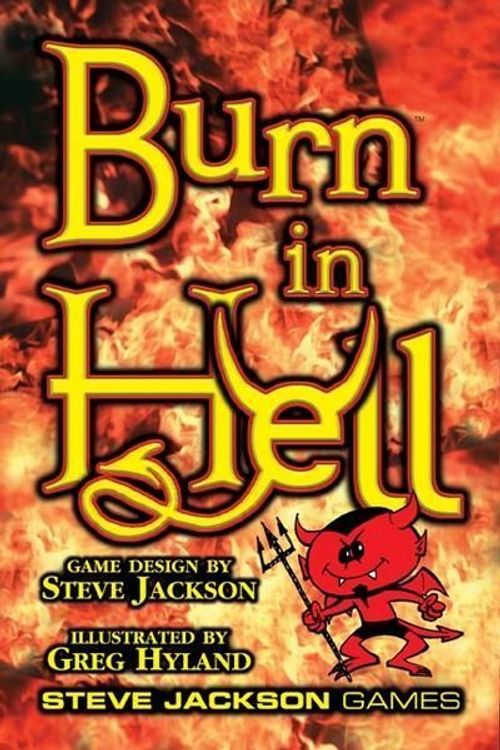
Burn in Hell
Burn in Hell Rulebook
Table of Contents
Table of Contents
- Components
- The Cards
- Starting the Game
- Play Until Hell Freezes Over
- Taking Your Turn
- Things You May Do at Any Time
- Make Circles
- Replenishing Souls
- Interruptions
- Duplicity and Guile
- Ending the Game
- A Circle may consist of any of the following:
- Scoring a Circle
- Optional Rule
- More Options
- Designer's Note
- The Deadly Sins
Components
This game includes this rulesheet, the box, and 168 cards, each representing the soul of a prominent mortal, now doomed to writhe forever in the lake of fire. Pencil and score sheets are included.
The Cards
Each card has the following information:
Name. Just so you know who you're tormenting.
Sins. One or more of the Seven Deadly Sins, representing the reason why that particular soul has been invited to the Permanent Pitchfork Party.
Value. The point value of the card.
Special Abilities. Some cards have special uses. For instance, if you own "Papa Doc" Duvalier, you can trade him for ALL the Gluttons that are currently in the Pit. There are several kinds of special abilities:
- Trade the card for another card or cards. This will also be referred to as "stealing" a card, even though your victim gets to keep the card you used on him.
- Burn (discard) the card. This will have effects defined on the card.
- A few special abilities give you a point bonus if you can get that card, and some specified other(s), in a Circle. You only get the bonus once per Circle, not once per card.
Tag. A card may have up to three "tags" indicating the soul's role in life, such as "General" or "Artiste." Tags are very general. Note in particular that a Murderer is not the same as a Mass Murderer or Serial Killer.
Biography. The back of the card tells the soul's story. This has no game effect, but it's always interesting to get to know the people you are working with.
Example cards shown in the rulesheet:
- "Papa Doc" Duvalier: Avarice, Envy, Gluttony, Lust, Pride, Sloth, Wrath; value 3; Dictator, Mass Murderer. Ability: "May be traded for ALL the Gluttonous souls in the Pit."
- Jack the Ripper: Lust, Wrath; value 8; Serial Killer, Cannibal.
- Adolf Hitler: Avarice, Envy, Pride, Wrath; value 3; Dictator, Mass Murderer. Ability: "May be traded for a card an opponent just stole from you."
Card Management
Your cards are never secret; they are always face up in front of you. You have no "hand."
Players may arrange their cards as they wish, but cards may not be concealed in any way until they are combined into a Circle. At that point, they are safe from everything except the player's own errors.
Starting the Game
One player acts as the Dealer, who hands out the first souls to the leering demons around him. We cannot prevent the Dealer from roleplaying Satan, Overlord of the Underworld, Prince of Lies, and Ruler of All Damned Souls. But we don't insist on it.
The Dealer shuffles the deck and deals five cards, face up, to each player, plus an extra five to the center of the table (the Pit). Cards have the soul's name on both sides, so you will always know what the next card will be.
The deck is then placed, with the cards face up, in the middle of the table.
Choose a player to keep score and to keep track of the temperature of Hell.
The player to the Dealer's left takes the first turn. You may not trade or burn cards until he starts his turn.
Play Until Hell Freezes Over
Hell starts out at a toasty 100 degrees C. The soul each Demon Prince casts into the pit at the beginning of his turn (see Taking Your Turn, below) reduces the temperature of hell by the Value of that card. Keep track of the current temperature on the score sheet. Once Hell gets to zero degrees, the game ends at the end of the round, so each player will get the same number of turns. (In the unlikely event that the deck runs out of cards, complete the round anyway so players have a chance to steal cards from each other or score with the ones they have.)
Note that some cards can increase or decrease the temperature of Hell. However, these cards have no effect after Hell actually freezes over.
For shorter or longer games, start with Hell at a different temperature of your choice.
Taking Your Turn
All that you have to do on your turn is draw three cards and give one of them to the Pit. Everything else is optional.
Start by drawing three cards. No one can steal from you, or announce a Circle of their own, until you have drawn your cards and:
- chosen one to throw into the Pit, and
- taken one other action; see below.
Cast a Sacrifice into the Pit
After you draw your three cards, the first thing you must do is choose one of those three and cast it into the Pit. You must sacrifice one of your new cards.
When you make your sacrifice, say the card's value out loud so the scorekeeper knows how much colder Hell just got . . .
You may now take one action from the list below. No one may steal any of your cards until you take that one "free" action . . . so if you get a new soul that permits you to make a Circle, it won't be stolen from you before you can open your mouth to say "Circle!"
Possible Free Actions
- Say "Circle." Now nobody can steal a card from you until you have made a Circle or given up. It's perfectly all right to say "Circle!" even before you make your sacrifice, if you're certain. If you think you can make a Circle, it's good to announce it as quickly as possible!
- Make a trade. Note that just offering a trade is not an action; if you offer a trade and someone says no, you have not used up your free action.
- Trade with the Pit. See below.
- Use any card's Special Ability.
- End your turn, if you have nothing else you want to do.
After your free action, you may continue to offer trades, use Special Abilities, and make Circles. You may do these things in any order, and keep going until you decide that you're through. When you're done, say "Done," and play passes to the next player clockwise.
There is one action you can take only on your turn: Make Circles (see below).
Trade With the Pit
Once per turn, you can make a trade with the Pit without using a Special Ability. Simply pick a soul from in front of you and cast it into the Pit. In exchange, you may take from the Pit either:
- (a) One soul of any value, or
- (b) Two or more souls whose total value is the same as, or less than, the one you gave up.
Example: If you put a 2 in the Pit, you could take out any one card, even a 10. But if you put a 10 in the Pit, you could take out five 2s, or two 5s, or any other combination of cards that added up to 10 or less.
Various Special Abilities will let you make other trades with the Pit, but you get that one Pit trade per turn, free.
Things You May Do at Any Time
You may take any of the following actions at any time, whether or not it is your turn:
Steal or Burn Cards
"Stealing" is taking a card for yourself. "Burning" is using a special power to discard a card or cards. The only way to discard a card intentionally is to use a special power to burn it. Discards go into a separate pile, not the Pit.
You may use Special Abilities to steal or burn cards at any time, except:
- against a player who has just started his turn (see Taking Your Turn);
- against a player who has announced that he is making a Circle (see Announcing a Circle);
- on cards involved in a pending trade (see Trade With Other Players).
Unless the card specifically limits you to dealing with the Pit, you may steal or burn a card either from the Pit, from another player, or from the top of the deck. (Since you can see the top card, you might as well be able to steal it.)
You may not touch a soul in an existing Circle. But if you see a rival about to form a Circle and he has not said "Circle!", strike while you can!
If someone steals a card from you, they must give you the card that let them steal it.
Each special ability can be used only once per turn. You can make a Circle with that card or voluntarily trade it, but no other player may use that card's special ability until the end of the current player's turn.
Trade With Other Players
Players may make any trade they want, but you cannot give away a card by "trading for nothing." Any player may suggest a trade at any time, but you cannot trade away a card that someone has just stolen or burned. It's gone!
Once a trade has been proposed, no one can steal or burn any of the cards in the proposed trade until the other party accepts or rejects the offer.
When a trade is agreed on, each player picks up the cards he is giving away and hands them to the other player.
Make Circles
If you collect the right souls, you can combine them into a Circle . . . which scores extra and cannot be stolen by your fellow fiends. See the back of the rulesheet for the card combinations that make a Circle.
When you make a Circle, show all the other players the cards and announce what they are worth (see below for how to score). If nobody argues with you, the scorekeeper will write your score on the score sheet.
Now turn those cards over and put them in a stack in front of you. You will put the next Circle on top of it, crossways, and so on.
Each Circle you complete must be its own stack. You may not add to a Circle, or break it up again, after you complete it. You may not use the Special Abilities of any card in a Circle. You may LOOK at your own Circles if you want to.
You can form a Circle at any time you get the right cards, even if it's someone else's turn.
Announcing a Circle
When you have the right cards to form a Circle, or you're sure that you can get them, you may announce "Circle!" At that point, until you complete your Circle or give up:
- no one else may steal a card from you or burn one of your cards;
- no one else may say "Circle!";
- the current turn does not end, so no new cards are drawn;
- you yourself may make your one trade with the Pit if it is your turn;
- you yourself may use special abilities to trade with the Pit or the top card on the deck, but you may not steal or burn cards belonging to other players;
- anyone may take any legal action not prohibited above, such as offering a voluntary trade.
However, if you announce a Circle and then fail to complete one, you must discard the top Circle from your stack and remove its value from your score! This is the only way to lose a completed Circle. (If you have no Circles at all, there is no penalty.)
You may not announce more than one Circle at a time. You must complete one and then, if you can, announce the next one.
How long do you have to complete a Circle once you announce it? We leave this to house rules, but we think two minutes is enough.
Replenishing Souls
Whenever a player loses his last Soul, whether by forming a Circle or having it burned, he may immediately choose one new one from the Pit. If it was his turn, he may continue the turn.
Whenever the Pit runs out of souls, five new ones are immediately dealt into it from the deck.
If the same play empties both the Pit and a player's hand, the Pit is refilled first, and then the player takes one card from the refilled Pit.
Interruptions
Various events in the game can interrupt other events, as follows:
Making a Circle takes precedence over all other types of play. The player making the Circle cannot be interrupted by use of Special Abilities. Other players may continue to make deals, or steal or burn cards other than yours, while you are making a Circle.
Use of a Special Ability interrupts the victim's arranging his cards, deal-making, and the like. If someone steals or burns one of your cards, you must stop what you are doing and give him the card he has stolen. If another Special Ability is played on you in the meantime, you must finish dealing with the first and immediately take up the next one. You may not do anything else between the two. (You may prevent this by saying "Circle" after the first Special Ability is played against you, if you think you'll be able to form a circle.)
Duplicity and Guile
In Hell, he who speaks first plays first. He who hesitates is lost . . . especially if he hesitates before naming the target of his Special Ability, letting other players act first. Demon Princes are not noted for their honesty; if someone asks what cards you have (or looks at them), use your special abilities before he can steal them. If your fellow Demon Princes can't react quickly enough or conceal their intentions well enough, then they need more practice. Surreptitious reading and a reliable memory are valuable skills for an aspiring Infernal Overlord. However, even Demon Princes frown on yelling loudly to preempt another player's action.
If you would prefer not to roleplay Satan, Overlord of the Underworld, Prince of Lies, and Ruler of All Damned Souls quite so realistically, you are allowed to establish house rules about being polite. For friendly games, we recommend pausing after each play (so other players have a chance to use Special Abilities), answering questions about your cards honestly, and NOT using another player's question (or glance) as a cue to strike first. You're still free to lie about your intentions (like we could stop you). Friendly games will play faster.
Ending the Game
When Hell has frozen over and everyone has had an equal number of turns, the game is over. Each player adds up the face value of the souls he has that are not in Circles and adds this to his score. The high score wins.
A Circle may consist of any of the following:
At least FOUR Souls (more than four is all right) which share either:
(a) The same sin – for instance, four souls who all have Wrath. A soul with several sins can match any of them!
(b) The same point value – for instance, four 7s.
(c) The same tag – for instance, four Artistes. If a soul has more than one tag, it can match any of them.
OR
Exactly SEVEN souls, one for each Deadly Sin. Souls with more than one Sin can count for any Sin they committed, but each one can count only once.
Scoring a Circle
The score for a Circle is calculated when it's made, and recorded on the player's score sheet. The BASE score of a circle is:
- A Circle of four or five souls: double face value.
- A Circle of six or seven souls: triple face value.
- A Circle of eight or more souls: four times face value!
You can get bonuses, increasing your score, in three ways:
- If you have a "bonus" pair, like Monroe and JFK, add 30 points (or 50 if you get the triple of White, Thaw, and Nesbit). Add this bonus first, because the bonuses below can multiply it.
- If every soul in the Circle qualifies TWO ways, double the score again. For example, a regular Circle of four Royals counts double face value, but if they were all Slothful Royals, it would count quadruple! Or if you got a Circle of seven different sins, all with the same point value, they would count SIX times face value!
- If all the tags in the Circle are DIFFERENT, double the score again.
Bonus Combinations
There are four pairs of souls (for example, JFK and Marilyn Monroe) who were associated in life and give a bonus if they end up together in the afterlife. If you collect such a pair in the same Circle, add 30 to the base score of the Circle, before bonus multiplication! (The bonus is only added once . . . not to each card.)
There is also one trio of connected souls. Getting any two of them gives the same +30. Getting all three gives a +50!
Optional Rule
This rule makes the game more challenging, and allows for some really high scores, but with new players, it slows things down as people look for the perfect combo. We use this rule when we play, but we recommend you not add it until you have played a few times.
Circles are now worth more if the souls in them match in more ways. If the souls qualify for a Circle in THREE ways, then the total point value is doubled yet again. If they qualify FOUR ways, double AGAIN, and so on. This rule will mean that many Circles will score high but will have only four cards . . . and there will be more souls in front of the players, and probably more in the Pit.
More Options
See the game's web page, at burninhell.sjgames.com, for more optional rules, including the original "fast play" rules.
Designer's Note
You may be upset that I have consigned one or more of your personal heroes to eternal torment. In most cases, I regret the offense. In a few, I revel in it. In all cases, I take great comfort in the fact that under U.S. law, one cannot libel the dead, a provision without which this work of satire would have been impossible. And yes, there are a couple of people in this game who are not provably dead, but I am willing to argue that they are nevertheless in Hell.
The Deadly Sins
This game starts by assuming that there IS a Hell, and whoever is doing the damning is, in the final analysis, concerned with the generic evil of "hurting other people." If you don't like his decisions, argue with him (or your fellow players), and not me.
We have, however, chosen to organize our sinners according to the medieval concept of the Seven Deadly Sins, which we interpret as follows:
- Avarice: also known as Greed. Those who worked evil for simple material gain are damned for Avarice.
- Envy: harm done due to jealousy of others' property or talents.
- Gluttony: all the sins of consumption, and harm done thereby. One might be a glutton for food, for drugs, for liquor . . .
- Lust: evil worked for reasons of carnal desire.
- Pride: to the medieval cleric, anyone who did not credit all his gifts to the power of God was guilty of Pride. We take the (no doubt heretical) position that those who treat others as inferior or worthless risk damnation for Pride, regardless of whom they thank for their own talents.
- Sloth: laziness or procrastination. Those who cause hurt due to inattention or neglect of their responsibilities, or those who waste their talents, are Slothful.
- Wrath: those who harm others out of hate, anger, or religious zealotry are damned for the sin of Wrath. The line between Pride and Wrath is a fine one.