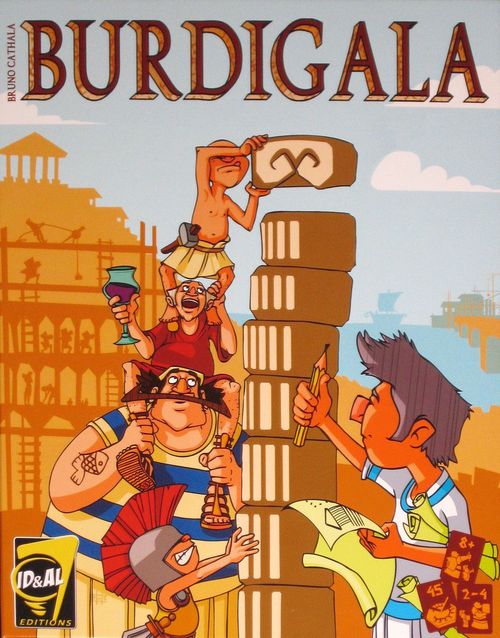
Burdigala
Burdigala Rulebook
Table of Contents
Table of Contents
I. Elements
- 1 board showing Burdigala being constructed. On this board we see 14 districts (1) bordered by the streets and the rivers, which can contain 1 or 2 building sites (2), bonus token emplacements (2b), and check-point squares (3), usually situated at the crossroads where the players' meeples can be placed. Some of the check-points also are port zone square (4).
- There are also streets (5), for moving along, and waterways (6) and express ways (7), which can only be used under certain conditions.
- 21 construction tiles with a building site on one side and a completed building on the other side (8).
- 4 bonus tokens worth 3, 3, 2 and 2 prestige point (9).
- 30 building cubes (10).
- 24 corruption tokens, with a picture on one side and a number from 0 to 5 on the other side (11).
- 21 merchandise cards (12).
- 34 plot cards (13).
- 16 meeples (4 in each of the 4 colours) (14).
II. Setting up the game
- Unfold the board and place it in the center of the table.
- Each player takes 3 meeples in their chosen colour (4 meeples for two players), places one on square 0 of the score path and keeps the others in front of them.
- Mix the construction tiles, with the building site side upwards and place one on each of the different sites on the board. (Replace the spare tiles in the box without looking at them: they will not be used for this round)
- Place the 30 building cubes next to the board.
- Mix the corruption tokens and place them next to the board with their numbered side downwards.
- Mix the bonus tokens and place them at random on their appropriate squares on the board with the number visible.
- Shuffle the merchandise cards and place them in a pile face down beside the board.
- Shuffle the plot cards and place them in a pile face down beside the board.
- Each player takes a plot card.
- The players then throw the 2 dice and the one with the highest score begins. He/she places one of his/her meeples on one of the empty check-points squares, then each of the other players does the same, clockwise until every player's meeple have been placed.
- There can only be 1 meeple per square.
III. The aim of the game
To have the highest number of prestige points at the end of the game.
These points are obtained in 4 possible ways:
- By promoting the construction of buildings on the various sites.
- By finishing a building.
- By the combinations of merchandise cards.
- By collecting certain plot cards.
IV. The game
The game proceeds clockwise, beginning with the first player. When his turn comes, the player throws the dice. Then he must do the following in the correct order:
-
First, move one of his characters forwards along the streets, for the exact number of squares as one of the two dice. Players may not go via the same street twice or to finish on a square which is already occupied.
-
Next, place a cube on a site in a district next to the character that was moved. (The districts are the areas bordered by the streets and the rivers. A district contains 1 or 2 building sites. The check-point squares that receive characters usually adjoin several districts).
- Earning points. The player earns as many points as there are free spaces on the building site tile he/she has chosen and moves his/her meeple forward the same number of squares on the score path.
Stéphane puts a cube on a size-5 site, where one place is already occupied. There are, therefore, 3 places left. Stéphane scores 3 points and moves his meeple 3 places forward on the score path.
- Last cube. If the cube completes the building, the building site tile is turned over to the building side and the player gains the number of points shown on the tile.
- Bonus. Some districts contain a bonus token. For the first building to be built on it, the player gains the bonus points linked to that district.
There are two special buildings:
- The interrupted yard, as its name suggests, does not bring in as many points as the other bigger sites, but allows you to pick up 2 plot cards when it is completed.
- The necropolis does not bring in any prestige points when it is built, but allows to discard all the corruption tokens the player has in front of him at that moment. (Those tokens are discarded face down and mixed up in the pick up pile of the other corruption tokens.)
As soon as a building is completed, all the other characters next to the district where it was built immediately receive a plot card (except when specified otherwise on a plot card). A player may not own more than 3 plot cards, either held in his hand or placed in front of him. Should a player pick a card that makes him exceed that total, he must discard a card so as to have only 3 cards in his hand and/or in front of him.
Blue completes a building. All the other characters next to the district receive a plot card. Blue may not own more than 3 plot cards. He must discard a card.
At any time during his turn, the player may also choose to play a plot card (one per turn only). The purpose of these cards is explained later on.
- If the player cannot carry out the two required actions (legal move forward + placing a cube): He does not move at all and must remove one of his meeple from the board, and it is an other player's turn to play.
Particular cases
-
If the player throws a double: The above rules still apply, but as he has less choice for his move, he gains other privileges:
- He may end his move on a square which is already occupied. He then puts the occupant on any other empty square he chooses.
- He may use the waterways and the express ways during his move.
- Lastly, he may decide to play an other complete turn straight away, provided he picks up a corruption token which he will look at and place in front of him, numbered face down.
-
If the total of his dice adds up to 7 (4 and 3, 5 and 2, 6 and 1): He may elect to be corrupted to gain extra privileges, in which case he picks up a corruption token he places in front of him, numbered face down. Then he chooses:
- either to place an extra cube on the same yard as his obligatory stone, in which case he will only score the points corresponding to the second stone,
- or to pick up a merchandise card.
Be aware that if getting corrupted allows to gain a lot of prestige, it is also a perilous road for corruption shall make you lose a lot of valuable prestige points at the end of the game...
-
If the player ends his/her move on the port zone square: He immediately picks a merchandise card, looks at it and places it face down in front of him.
V. End of the game
The game is finished at the end of a player's turn and:
- when all the buildings are completed,
- or, when a player has no more meeple left on the board,
- or, when there are no more merchandise cards left on the pile.
No other players have their turn. The game is over. Each player shows his/her merchandise cards, and adds to his score the total value of the combinations of all the different cards (1-2-3-4-5 different cards give 1-3-6-10-15 victory points.)
Each player moves his meeple forward 2 spaces on the score path for each plot card placed face up in front of him.
Finally, all the players reveal their corruption tokens and they move back on the score path as many as their corruption tokens are worth. The player with the highest total moves back 5 more squares on the score path (in the case of two or more identical scores, all these players move back 5 squares).
After all these moves, the player with highest score wins the game.
Example: Stéphane owns 8 merchandise cards (3 wine, 2 ceramic, 1 copper, 1 wheat and 1 tin). He can therefore combine them as follows: 5 different cards = 15 points. (He still has 2 wine cards and 1 ceramic card) 2 different cards = 3 points. (He has 1 wine card left). 1 different card = 1 point. This makes a total of 15+3+1 = 19 extra prestige points. He moves his meeple 19 squares on the score path.
Bruno owns 4 merchandise cards (3 different, giving him 6 points and 1 the same as one of the 3 others, giving him 1 point), i.e. 6+1 = 7 extra prestige points.
Helping with the game/plot cards
- Unless otherwise stated, a player may not have more than 3 cards in his hand and/or in front of him.
- A player may play one and only one plot card per turn.
- The cards that show the number 2 surrounded by laurel leaves in their upper corners have a permanent effect and remain in front of the player, face up. They will give 2 prestige points at the end of the game.
- A player may not have two identical cards in front of him.
The printed plot card effects (sidebar on the last page; the card names are printed in capitals):
- CONSUL: +2 prestige points each time a player completes a 2-stones building.
- HYGIENE: +2 prestige points each time a player completes a 3-stones building.
- CART: Allows a player to go from one expressway to another even though he has not thrown a double.
- BOAT: Allows a player to spend one movement point to move along the waterways even though he has not thrown a double.
- GOOD HARVEST: Allows a player to have 5 cards in front of him and/or in his hand.
- IN VINO VERITAS: Each time you have to pick up a plot card you may also choose to pick up a merchandise card provided you pick up a corruption token.
- BETRAYAL: Remove from the game an opponent's plot card (from his hand or in front of him).
- INFLUENCE: Add or subtract 1 from the value of one of your dice.
- INDISCRATION: Secretly get to know the nature of 3 building yards. (Printed as "INDISCRATION" in the source.)
- MERCHANT: Look at the merchandise cards of an opponent and make an exchange of one card with one of yours.
- SAILOR: Pick up 3 merchandise cards. Keep one and mix the other two up with the pick up pile.
- PUBLIUS CRASSUS: Place an extra stone (count only the points of the last stone).
The printed rulebook refers to "F.A.Q. p. 24"; the separate FAQ document is not part of this transcription.