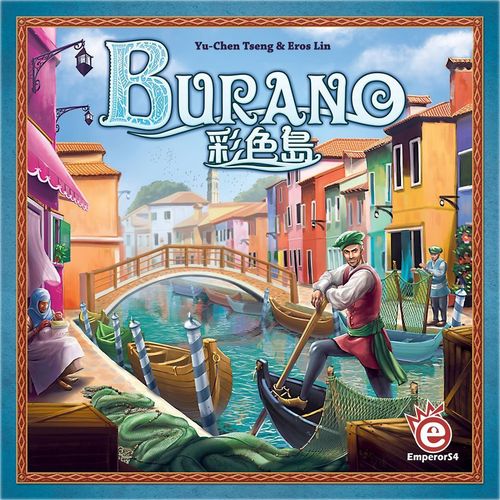
Burano
Burano Rulebook
Table of Contents
Table of Contents
Aim of the Game
The game is played over 4 seasons, 14 rounds altogether. Through the novel "cube pyramid-driven" mechanism, players take turns paying coins to operate their cube pyramid during each round. The operation of the color-coded cubes would trigger certain actions, such as fishing, lace making, and house roofing, which will earn players Victory Points (VP).
At the end of the game, whoever earns the most VP wins the game.
Components
- 1 Game Board — with a Scoring Track, Mooring Areas, Ports, a Workshop Area, the Main Island, and Neighboring Islands
- 1 Action Board
- 1 Main Island Board
- 18 Dock Houses (3 of each action color)
- 12 Lace Workshops
- 120 Cube Houses (20 of each action color)
- 4 Merchant Ships
- 48 Fish Cards (8 kinds, 6 cards of each)
- 33 Coins (5 x value 5, 8 x value 3, 20 x value 1)
- 48 Roof Tiles (4 kinds, 12 of each)
- 4 Season Markers
- 6 Action Color Markers (1 of each action color)
- 1 Round Marker
- 16 Building Cards
Player Components
- 4 Player Boards (1 of each player color)
- 16 Schedule Ring Pieces (4 of each player color)
- 52 Worker Tokens (13 of each player color, 2 sides)
- 1 Starting Player Marker
- 4 Time Wheels (1 of each player color)
- 4 Fishing Boat Tokens (1 of each player color)
Details On The Action Board & Player Boards
The action board holds the Roof Supply, the Privilege Track, the Tips for Clean-up, the Season Area, the Rounds Track, the Action Spaces, and the Tips for Privilege.
Each player board holds the Preparation Area, the Cube Pyramid Area, the Schedule Ring Space, the Tips for Moves, the Roof Spaces, the Sold Fish Area, and the Moves Track.
Setup
(Green texts in the manual indicate special rules for 2- and 3-player games; those are noted inline below.)
-
Unfold the game board in the center of the table. Place the rest of the components on or around the board as depicted.
-
Randomly place the 18 dock houses face up to each square on the "neighboring islands".
-
Pick 6 lace workshops with 4 squares and assemble them together into the "workshop area". You may assemble them as the layout shown in the manual for your first play (a 4-player layout and a 2- and 3-player layout are illustrated).
For experienced players, lace workshops may be assembled by following these restrictions:
- They can't be placed outside the grid lines in the workshop area.
- They may not be overlapped.
- There should remain 4 blanks in the workshop area. In a 2- and 3-player game, there should remain 10 blanks.
-
Randomly place 2 merchant ships on both "ports" of the main island.
-
Remove the vacancy tiles from the main island board and place it on the game board, so that it matches the graphic of the "main island".
Sort the 120 cube houses by color and put them next to the game board as a "cube supply". Randomly place 1 cube in the vacancy below the "Fountain" on the main island board.
-
Place the action board near the game board.
-
Sort the 4 types of roof tiles and stack them face down on the "roof supply" with corresponding symbols.
-
Stack the 4 season markers chronologically (Spring tile on the top) and place them face up on the "season area".
Setup - Player
-
Each player chooses a color, takes the player board of the chosen color and places it in front of himself.
-
Each player takes the 4 schedule ring pieces of their colors, and randomly patches them together in any order on the "schedule ring space" on the player board.
-
Each player takes the 13 worker tokens of their color. One is placed on the space "0" of the "scoring track" and the others are placed on each house symbol shown on the "schedule ring".
-
The player who had most recently been to Italy takes the starting player marker, or determine it randomly if no one had ever been there. In clockwise order, the next player is second, third, and fourth player, respectively.
Each player takes their 3 workers on the pieces of schedule ring labeled with the corresponding letter:
Player 1st 2nd 3rd 4th Letter A B C D And places one each onto:
- The "neighboring island" labeled with the corresponding letter (A~D).
- Space "1" of the "privilege track".
- Space "1" of "moves track".
Sequence of Play
The game goes through four seasons: spring, summer, autumn, and winter. Each season consists of three phases:
- Cube Pyramid Construction: Arrange the cubes that are going to be used in this season.
- Player Turns: Beginning with the starting player and proceeding in clockwise order, each player takes his turns.
- Clean-Up: Gain intermediate points. Randomly rearrange the action color markers for the next season. Refill supplies. Pass the starting player marker to the next player in clockwise order.
The final scoring takes place at the end of winter. The winner is the player with the most Victory Points (VP).
Cube Pyramid Construction
At the beginning of each season, all players must choose 14 cube houses from their "cube reserve" simultaneously, and then stack those cubes in the "cube pyramid area" of the player boards under the following instructions:
- First, place 9 cubes as a 3x3 base.
- Second, stack 2x2 cubes on the second level.
- After that stack the last cube on the top.
After you finish the pyramid, you must remove the remaining cubes from your "cube reserve" to the "cube supply". Each cube you remove gives you 1 coin.
If your cubes are less than 14, you must place base at first until the cubes are run out.
Note:
- Players should finish constructing in one minute. You can add a timer to urge delayed players.
- You may not look at other players' pyramid while you are constructing yours.
Example: The blue player placed 9 cubes as a 3x3 base (1), than stacked 4 cube as a 2x2 level on it (2), and finally put 1 cube on the top of the 2x2 level (3).
Player Turns
Different seasons can have a different number of turns, as listed below:
| Season | Spring | Summer | Autumn | Winter |
|---|---|---|---|---|
| Turn | 4 | 4 | 3 | 3 |
Beginning with the starting player and proceeding clockwise, each player takes one player turn. You may take up to 4 total moves selected from 3 different ways listed below. You may repeat moves and perform them in any order:
A) Pick Up A House: Pick up a cube house from the cube pyramid and put it in any of the three spaces in the "preparation area" on the player board.
B) Build A House: Place a cube house to the "main island" from the "preparation area". And then perform an action corresponding to the cube color. The correspondences between actions and colors are indicated on the action board.
C) Roof Houses: Place a roof tile on the top of 2 cubes on the main island board. And then gain points and bonuses.
You must pay coins before you do the move. The cost is depicted in the following table:
| Move | 1st | 2nd | 3rd | 4th |
|---|---|---|---|---|
| Coins | +1 coin | -3 coins | -3 coins | -4 coins |
| Net (coins) | +1 | -2 | -5 | -9 |
You can do up to 4 moves in a turn. Advance the worker 1 space on the "moves track" for every move you make. After you finish your turn, return the worker to the space "1".
Note: If you can't or decide not to do any move in a turn, you take 1 coin from the bank and end your turn.
Example: The blue player began his turn by picking up a house (1), and gained 1 coin from the bank. Then he decided to make the second move and picked up another house (2), and paid 3 coins to the bank. For his third move, he chose to build a house on the main island with the cube in his preparation area (3), and paid 3 coins to the bank. He chose not to make the 4th move and therefore ended his turn. These three moves cost 5 coins (1-3-3=-5) in total.
A) Details On "Pick Up A House"
Pick up a free cube from the cube pyramid and put it in the "preparation area" on the player board. It makes no difference that you put a cube in any of three spaces in "preparation area".
A cube can be picked up if:
- It's not stacked under other cubes, i.e., a free cube. If there are only 9 cubes on your pyramid, they are all free cubes.
- There is an empty space in the "preparation area".
Note: If there is no empty space or no free cube, you may not pick up a house.
Example: The picture shows a cube pyramid with 4 free cubes.
Example: Since there are already 3 cubes in "preparation area", the blue player may not pick up a house.
B) Details On "Build A House"
Building houses to perform corresponding actions is the main thing you will do in Burano.
There are three actions, each action respectively corresponds to 2 colors. Once a player places a cube to the main island, he/she immediately performs the corresponding action.
The correspondences between actions and colors are not fixed because the action color markers will be shuffled at the end of every season.
Example: In this season, players perform "Fishing" by building a pink or blue house, perform "Lace Making" by building a yellow or green house, and perform "Earning" by building an orange or white house.
Building a house is executed in 3 fixed-ordering steps:
1. Take 1 cube from the "preparation area"
Note: If there is no cube you may not build a house.
Example: Since there was no cube in his "preparation area", the blue player may not build a house.
2. Place that cube on the main island in 2 ways
a) In a square pit, and it should be placed next to at least one other cube, which is already on the main island, corner to corner.
or
b) On a rooftop block, and if the color of the cube matches the rooftop block, you gain 1 privilege point immediately.
Note: If you can do neither A, B, or C, you take 1 coin from the bank and end your turn.
Example: The picture shows square pits that you can build a house on and that you can't.
Example: The blue player placed a cube on the rooftop block and then he gained 1 privilege point because the cube matched the color of the rooftop block.
3. Perform the corresponding action
Refer to the action board for the corresponding action of the color house you just built. Perform the action the matching action color marker is in.
Example: The blue player placed a green cube in a square pit on the main island, and performed "Fishing" because the green action color marker was in "Fishing".
C) Details On "Roof Houses"
Roof houses is executed in 3 fixed-ordering steps:
1. Pick a roof tile from a "roof space" on your player board and place it across 2 cubes on the main island, respecting the following rules:
- You can roof 2 cubes that match the 2 colors of the rooftop block.
- You can roof 2 cubes that are on a horizontal or vertical line.
- You can roof 2 cubes that are in the same floor.
- You can roof 2 cubes that are not in the 3rd floor.
- You cannot overlap roof tiles.
Note: You can't roof houses if there are no cubes that meet the above requirements.
Examples: The roof tile cannot be placed on 2 cubes because the colors don't match; because they are not in a horizontal or vertical line; because they are not in the same floor; because they are in the 3rd floor; or because it overlaps the other tile.
2. Gain bonuses
You may choose to gain 2 privilege points or gain a building card.
- If you choose to gain a building card, take 1 building card from the "building supply", or draw the top card from the "building deck" and place it face up in front of you. Then immediately refill the supply to four building cards from the top of the "building deck" if necessary.
- If you choose to gain 2 privilege points, advance the worker 2 spaces on your "privilege track".
3. Score points for the roof you just placed
There are 4 kinds of roof tiles as follows:
Majority in Neighboring Islands — Gain 2/5/9 Victory Points (VP) if you have the majority on 1/2/3 neighboring island(s).
Note: An island doesn't count if there is a tie for first.
Example: The blue player scored 2 VP for having the majority on the left island only, because the majority on the right island is a tie.
Majority in Lace Workshops — Gain 2/5/9 VP if you have the majority on 1/2/3 lace workshop(s).
Note: A workshop doesn't count if there is a tie for first.
Example: The blue player scored 2 VP for majority on the green workshop only.
Fountains on Schedule Ring — Gain 2/3/5/9 VP if you have 1/2/3/4 visible "fountain symbol" on your schedule ring.
Example: The blue player scored 5 VP because he had 3 visible "fountain symbols" on his schedule ring.
4 Victory Points — You gain 4 VP.
Actions
There are three actions in Burano. Each action corresponds to two colors. During turns, players perform actions by building houses, i.e., place house cubes on the "main island board".
Fishing
Move your fishing boat along a sailing route from your current "mooring area" to a neighboring island or to a port:
A) Neighboring island: send fishermen to gain fish cards. B) Port: trade your fish cards to a merchant ship to score VP.
Note: You must move your boat exactly one space along the sailing route (exception: see building cards).
A) Details on movement to a neighboring island
Movement to a neighboring island is executed in 3 fixed-ordering steps:
1. Match the colors on the schedule ring
Check the colors of the three arrow-pointed houses on your "schedule ring", and match them with the colors of the dock houses in the neighboring island where your fishing boat is moved to.
Note:
- The order of the three pointed houses does not matter.
- If there is no color-matched dock houses in any adjacent neighboring island, you may not perform "Fishing action". (exception see privilege for fishing)
2. Collect fish cards
Gain 1-3 fish card(s) if there are 1-3 matching colors.
There are two ways you can take fish cards in your hand: pick the face up fish cards from the "fish supply", or draw the top card from the "fish deck" and keep it secret from other players. After you take all your rewarded fish cards, the "fish supply" is replenished to the total of 3 cards.
Note: If the "fish supply" is insufficient for the game, you instead gain 2 VP for each fish card.
Example: The colors of the three arrow-pointed houses on the schedule ring of the blue player were yellow, blue, and pink. And the colors of the dock houses in his target island were pink, yellow, and white. Performing "Fishing", he gained 2 fish cards because he got 2 matching colors (yellow and pink). First, he drew a card (lobster) from the "fish deck", and then he picked another card (another lobster) from the "fish supply". Finally, the "fish supply" is replenished to 3 cards.
3. Dispatch workers
Depending on the number of matching colors, two events may occur individually:
a) Match 1-2 colors
Take the worker token from the sector 1 indicated by the time wheel on the schedule ring. Place it "man side" up in the neighboring island where your fishing boat is moved to.
Immediately rotate the time wheel by 1 sector in clockwise direction. The sector 1 of time wheel always points at a worker-stayed house, and the three arrows always point at three empty houses.
b) Match all 3 colors
Take the worker tokens from the sector 1 and 2 indicated by the time wheel on the schedule ring. Place them "man side" up in the neighboring island where your fishing boat is moved to.
Immediately rotate the time wheel by 2 sectors in clockwise direction.
Note: If you match all 3 colors, you can choose to take only one worker from the sector 1, and place it in the neighboring island.
After you dispatched the worker(s) to your mooring island, other players who have workers in that island must each withdraw 1 worker back to the lowest-numbered empty sector on their schedule ring and gain 2 coins.
Note: There must always be at least one worker on your schedule ring. If there are only two left on your schedule ring while matching 3 colors, dispatch 1 worker instead of 2. And if there's only one worker on your schedule ring, you skip dispatching workers.
Example: The blue player moved his boat to his target island (1) and matched all 3 colors of the dock houses. He took the workers from sector 1 and 2 indicated by the time wheel and placed them in the target island (2). Finally, he rotated the time wheel by 2 sector (3).
Example: While the blue player was dispatching 2 workers to the target island, where 2 red and 1 green worker had stayed. The red and green player each withdrew one of their workers and placed them on lowest-number empty sector on their schedule ring (sector 3 for red and sector 7 for green). The red and green players gained 2 coins each from the bank. There were 2 blue and 1 red workers left on the island.
B) Details on movement to a port
Movement to a port is executed in 3 fixed-ordering steps:
1. Choose a merchant ship
Choose one merchant ship in the port where your fishing boat is mooring.
Note: You may not move your fishing boat to a port that has no merchant ship.
2. Trade fish
Trade fish with the chosen merchant ship by playing a combination of fish cards from your hand. This combination must match the requirement of the ship tile and you gain the printed VP (see the tables below).
Fish cards are played face down on the "sold fish area" on your player board.
You can only trade with the merchant ship once per action.
| Combination | VP | Combination | VP |
|---|---|---|---|
| 1 fish card | 2 VP | 1 fish card | 2 VP |
| 2 different cards | 4 VP | 2 identical cards | 6 VP |
| 3 different cards | 6 VP | 3 identical cards | 12 VP |
| 4 different cards | 8 VP | 4 identical cards | 20 VP |
| Combination | VP | Combination | VP |
|---|---|---|---|
| 1 pair | 5 VP | 1 three of a kind | 12 VP |
| 2 different pairs | 10 VP | 2 different three of a kinds | 24 VP |
| 3 different pairs | 15 VP |
3. Move the merchant ship
The merchant ship which you traded with sails to the other port (from the left side to the right side, or vice versa).
Each port may accommodate up to 4 ships.
Example: Trading with the merchant ship, the blue player played 3 tunas and 3 squids and scored 24 VP. After that he moved the merchant ship to the port on the other side.
Lace Making
Dispatch the workers to "lace workshop area" from your "schedule ring" for lace making.
It is executed in 2 fixed-ordering steps:
1. Match the colors on schedule ring
The colors of the three arrow-pointed houses on the "schedule ring" indicate which "workshop area" you can dispatch your workers to.
Note: The order of the three arrow-pointed houses does not matter.
Example: The colors of three arrow-pointed houses on the schedule ring of the blue player were yellow, blue, and pink, which indicated that he may place his worker in the yellow, blue, and pink lace workshops.
2. Dispatch workers
You may place one worker to each lace workshop with matching color.
Take the worker tokens from sector 1-3 indicated by the time wheel. Place them "woman side" up in the color-matched lace workshops.
You may dispatch no more than 3 workers at one time. Apply the following rules to dispatch your workers (Exception: see privilege for lace making):
a) If there isn't any of your worker in the workshop area, you may place 1 worker on any free space of the color-matched workshop. b) If there are already one or more of your workers in the workshop area, you must place the worker orthogonally (in vertical or horizontal direction) adjacent to one of your workers that is already in the workshop space. c) Each space may accommodate only 1 worker. (Exception see building cards.)
Rotate the time wheel by the number of dispatching workers in clockwise direction.
Immediately gain 1 coin if you place your worker in a square with a coin symbol.
Note: There must always be at least one worker on your schedule ring. You may not dispatch the last worker while you are performing "Lace making".
Example: The blue player had matching color of pink, orange, and pink. He started with dispatching the worker from sector 1 to a square of pink workshop (1). Next, he placed the worker from sector 2 to a pink space (2) orthogonally adjacent to the first worker he dispatched. Finally, he kept the worker on sector 3 because there was no orange space adjacent to the workers he placed before (3).
Earning
Earning is executed in 2 fixed-ordering steps:
1. Base
For each visible coin (not covered by workers) on your "schedule ring", you receive 1 coin from the bank.
2. Bonus
In addition you may optionally withdraw any number of workers from the 6 "neighboring islands" and the "workshop area". Place the withdrawn workers back to your schedule ring starting with the lowest-numbered sector. Gain 1 coin for each withdrawn worker.
Example: There were 6 visible coins on the blue player's schedule ring, so he received 6 coins from the bank. After that he withdrew 1 of his workers from a neighboring island, placed it on sector 4, and gained another 1 coin.
Clean-up
After all players finish all their turns, a season comes to an end, and players resolve the following 6 events in the given order.
Note: At the end of winter, only the first and second events will occur. Skip the following events.
1. Score for majority in each neighboring island
(Green texts in the manual indicate special rules for different numbers of players.)
For each neighboring island, the player who has the most number of workers gain 4 Victory Points (VP).
- 3-player game: 3 VP
- 2-player game: 2 VP
Note: In case of a tie, the tied players divide the VP (rounded down).
Example: The blue player scored 12 VP for majority in 3 neighboring islands; the red player scored 8 VP for majority in 2 neighboring islands; the black player scored 4 VP for majority in only 1 neighboring island.
2. Score for lace making
For each of your workers standing in the workshop area, you may return one cube that matches the color of the space where your worker is from your cube pyramid to the cube supply. For each cube returned, you score 2 VP.
Additional VP for unions:
A union is a group of orthogonally adjacent workers which you have paid cubes for scoring. The additional VP for numbers of workers in an union are listed below:
| Union workers | 2 | 3 | 4 | 5 | 6 | 7 | 8 | 9 |
|---|---|---|---|---|---|---|---|---|
| Additional VP | 1 | 2 | 4 | 6 | 9 | 12 | 16 | 21 |
Note:
- The additional VP for union only applies for the workers that you have paid cubes for.
- The additional VP for separated unions are scored individually.
Example: The blue player returned 2 orange, 1 green, and 1 blue cubes for his 4-worker union (they were adjacent orthogonally) in the workshop area. He scored 4x2+4=12 VP.
Example: The blue player returned 1 white, 1 orange, and 1 green cubes for a worker in the green space and for a union formed by the workers in the white and orange spaces. The worker in the green space was not a member of the union because the blue player did not return a blue cube for the worker in the blue space. Since he had a 2-worker union that gave him 1 additional VP, he finally scored 3x2+1=7 VP.
3. Shuffle the action color markers
Renew the correspondences between actions and colors for the next season by shuffling the 6 action color markers in the action fields.
4. Refill house cubes
Beginning with the starting player and proceeding clockwise, each player move cubes remaining in the cube pyramid into he/her "cube reserve".
Then he/she takes a number of cubes of each color from the "cube supply" equal to the number of unrevealed house symbols of each color on their schedule ring (i.e., house symbols covered by workers).
Note: If the color of cubes a player needs is exhausted in the supply, he/she may take a cube of any other color.
Note: The cubes remaining in the "preparation area" stay there.
Example: Having 2 pink, 1 green, 1 yellow, and 1 blue unrevealed house symbols on his schedule ring, the blue player took 2 pink, 1 green, 1 yellow, and 1 blue cubes from the "cube supply" to his "cube reserve".
5. Refill roof tiles
Beginning with the starting player and proceeding clockwise, each player:
- may remove 0-3 of their roof tiles, and after that
- they must refill each of their empty roof spaces of different types new roof tiles from the supply on the action board.
Note: The refilled roof tiles must differ from each other disregarding the roof tiles remaining in the first step. (i.e., there could be roof tiles of the same type after refilling.)
Example: The blue player removed the blue-green "majority in island" roof tile (1), and then refilled the two empty spaces with 1 "4VP" roof and 1 "fountains on schedule ring" roof (2).
6. Pass the start player marker
Remove the current season marker and pass the start player marker to the next player in clockwise order. The next season is ready to begin.
Note: Season markers are stacked from top to bottom as spring -> summer -> autumn -> winter.
End of the Game
The final scoring takes place after the clean-up phase of winter. Players score points for the following:
Coins
Convert all privilege points into coins in 1:1 ratio. Score 1 Victory Point (VP) for every 5 coins.
Fish cards
Score 1 VP for each unsold fish card in your hand.
Building cards
Score the VP from the building cards in front of you.
Example: In the final scoring, the blue player scored: 7 coins — 1 VP; 5 unsold fish cards — 5 VP; building card A — 9 VP; building card B — 8 VP.
Add up all the VP, and the player with the most VP wins the game.
In case of a tie, the following tiebreakers occur in sequence:
- Whoever has the most cubes left on his/her "preparation area" wins.
- Whoever has the most coins left wins.
If it is still a tie, then all tied players share the victory.
Privilege
During your turn, or during the seasonal scoring phase, you may spend your privilege points in four possible ways.
Note: You may spend as many privilege points as you want and have available in addition to your main action.
Privilege for fishing
Before you perform a fishing action, if you are going to move your fishing boat to a neighboring island, you may spend 1 privilege point to swap two dock houses on any two neighboring islands (the islands don't need to be connected by sailing routes).
Example: The colors of three arrow-pointed houses on the schedule ring of the blue player were white, pink, and yellow. He spent 1 privilege point to swap the white dock house in island A with the blue dock house in island B, so that he matched all three colors of dock houses in island B.
Privilege for lace making
When you perform the lace making action, you may spend 1 privilege point to dispatch 1 worker into a color-matched workshop without being adjacent to your other workers and you can place it on the space which has accommodated a worker of another player.
Note: If you place your worker on the space which has accommodated a worker of another player, that player has to withdraw his worker back to the lowest-numbered and empty sector(s) on his schedule ring and gain 2 coins, for each worker withdrawn.
Example: The blue player spent 1 privilege point to dispatch his worker to the, matching but not adjacent, orange space, and he replaced one of the red workers in the space, which made the red player withdraw that worker and gain 2 coins.
Privilege for cubes
Anytime during your turn, you may spend 1 privilege point to take 1 cube of any color from the "cube supply", and stack it on your cube pyramid without moving other cubes and you should stack it as base or on the top of any 2x2 cubes.
Note: If there are already 14 cubes in your cube pyramid, you may not spend privilege point to take cubes.
In clean-up phase, spend 1 privilege point to take 1 cube of any color to your "cube reserve".
Example: In the "score for lace making" phase, the blue player spent 2 privilege points to obtain 1 orange and 1 blue cube for scoring for his 2 workers in lace workshops.
Privilege for coins
Anytime during your turn, you may spend 1 privilege point to gain 1 coin from the bank.
Building Cards
-
Whenever you roof houses, you gain 5 VP for each specific color on the roof tile. The effect can combine with the card on the right (below).
- Type A: Blue or Pink
- Type B: Yellow or Green
- Type C: Orange or White
Note: You gain 10 VP if both colors on the roof tile are the specific colors.
-
Whenever you roof houses, you may ignore the rules of matching colors of the roof tile and house cubes. The effect can combine with the card on the left (above).
- Type A: Blue or Green
- Type B: Yellow or White
- Type C: Orange or Pink
Note: You may place the roof tile on any 2 cubes if both colors of the roof tile are the specific colors.
-
During final scoring, you gain 2 VP for all fish cards with the type in your "sold fish area". (Type A and Type B cards, each showing its fish type.)
Note: Fish cards in your hand do not count.
-
During final scoring, you gain 2 VP for each space of specific colors on which your workers stand in the workshop area.
- Type A: Pink, Blue or Yellow
- Type B: Green, Orange or White
-
Whenever you go fishing, you may move your fishing boat two spaces along the sailing routes.
Note: You may not move it back and forth and you can only fish or trade in the ending island or port.