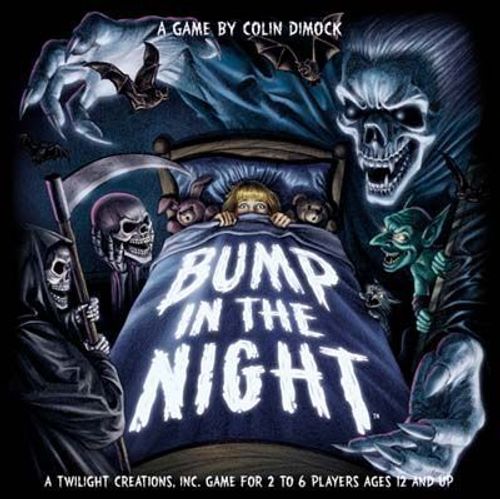
Bump in the Night
Bump in the Night Rulebook
Table of Contents
Table of Contents
Parts List
- Manual
- 36 colored monster miniature figure sets (in red, yellow, mustard, green, blue, and black), each containing:
- A cat (described as a "black cat" in the game text)
- Scary bat
- Goblin
- Poltergeist (scary robed guy holding his head in his hands)
- Ghost (scary robed guy not holding his head in his hands)
- Specter of death (scary robed guy with a sickle)
- 14 white "little girl" miniatures
- 6 double-sided room tiles
- 12 locked markers
- 52 assorted cards (see below)
Cards
| Red Action cards (25) | Yellow Block cards (20) | Purple Bonus cards (7, one each) |
|---|---|---|
| Freedom's Gate (x3) | Bright Lights (x2) | Den of Evil |
| Panic (x3) | A Charm Against Ghosts (x1) | Descent Into Hell |
| Quick, in here! (x3) | I've Got a Key (x3) | Final Resting Place |
| Rattle the Chains (x3) | Protected from Poltergeists (x1) | Infernal Tools |
| Surprise (x3) | Ready for the Goblin's Tricks (x1) | Lost Forever |
| Terror (x2) | Return to the Shadows (x2) | Midnight in the Garden of Goo |
| They're Everywhere (x3) | Revive (x2) | Sleep of the Dead |
| Vision of Death (x2) |
Setup
-
Each player selects a color, then takes the corresponding group of six colored monsters.
-
Assemble the house from the six house tiles, making sure that the house is 2 x 3 (two rows of three tiles), and that green borders on the outside edges of the house.
-
Shuffle all of the cards together to create a deck.
-
Place the 14 "Little girl" tokens using the following three steps. This process is randomized for each game. Roll a six-sided die and consult the tables below.
Note: No dice are included with the game; if none are available, cards may be drawn from the deck instead, as each card shows a number 1-6 in its lower right-hand corner.
Step One: Split the girls into six groups. Roll the die, then consult the Group Creation Chart in Figure 1 to determine how many girls will be in each group. For example, if a three is rolled, the girls would be split into four groups of three each, and two groups of one each.
Figure 1. Group Creation Chart (distribute the Little Girl miniatures according to the chart)
Die Result Girls per group 1 3 3 2 2 2 2 2 3 3 3 2 2 1 3 3 3 3 3 1 1 4 4 3 3 2 1 1
Monster Overview
Each player has a colored group of six monsters, each with its own "scare value" and special abilities. This information is covered in Figure 3.
Figure 3. Monster Information. Monsters, Scare Values, and Special Abilities.
| Monster | Scare Value | Special Ability |
|---|---|---|
| Black Cat | 0 | When placed, it is placed with the Scary Bat as a single monster (they may be placed in the same or different rooms). |
| Scary Bat | 0 | Moves two spaces instead of one. When placed, it is placed with the Black Cat as a single monster (they may be placed in the same or different rooms). |
| Goblin | 1 | Can hide and thus not scare people during a turn. |
| Poltergeist | 1 | Can unlock or lock doors (in addition to normal "lock/unlock" ability of player, and only during the "lock/unlock" step of the player turn). |
| Ghost | 2 | Can move through walls and locked doors. |
| Specter of Death | 3 | If initiating the scare, raises the initial terror level by 1 (only for the first Specter encountered). |
Card Overview
There are three types of cards in the game: "Action" cards, "Block" cards, and "Bonus" cards (the rarest of all!).
Figure 4. Description of the Cards used in Bump in the Night.
- Action Cards are only played during a player's turn and can be used to alter the movement of people, or allow for special monster placements, etc.
- Block Cards are only played at the very end of a player's turn. They are typically used to disrupt other players' plans.
- Bonus Cards refer to a specific room or monster, and can only be played whenever another player uses one of your monsters to scare a person in that room or uses your monster as specified on the card. When this occurs, immediately play the bonus card to gain the extra point. In addition, one person immediately stops moving in that room and cannot be forced to move any farther.
Each player starts with three cards; additional cards are drawn when one player uses another player's monster to scare someone. The player owning the monster draws a card. Note that this can only be done once per monster per player turn.
Player Turn
Each player takes their turn according to the steps below, then play passes clockwise. These steps are explained in further detail in the sections that follow:
- Adjust Locks
- Place, replace, or move 1 monster
- Scare people
- Move 1 monster or 1 person
- Play "Block" cards
- Victory check, reward for scaring people, and turn end
Step 1: Adjust Locks
A player may place or remove one "locked" marker on a door. All doors count as one door, even those with two door frames. Doors with lock markers are locked; doors without are unlocked.
Step 2: Place, replace, or move 1 monster
A player may do one of three things on this step:
- To Place a monster, a player takes one of their monsters not on the board and places it into any room with no people in it (they may be placed into rooms with other monsters). Note that the Black Cat and Scary Bat can be placed simultaneously (either together or in separate rooms) and only count as one monster placement.
- To Move a monster, a player moves a monster already on the board 1 space, but can only move through unlocked doors (i.e., doors with no locks on them). Monsters can be moved into rooms with other monsters or people in them. Note that Scary Bats can move 2 rooms instead of one, and that Ghosts may move through walls and locked doors, but may not move diagonally.
- To Replace a monster, a player must discard any one of their cards, select a monster in any room belonging to another player, remove it and return it to its owner, then place their monster of the same type into that room.
Step 3: Scare people
This is what it's all about! The player chooses any monster (even one belonging to another player!) in a room with one or more people and activates it, thus scaring all of the people in the room. Then the initial scare value is calculated.
Using other players' monsters. If using another player's monster, the player owning the monster draws a card. This only happens once per monster per player turn, but otherwise occurs any time any of a player's monsters is used to scare someone when it is not their turn.
Using other players' Goblins. If using another player's Goblin, the owning player immediately decides whether or not the Goblin is hiding. If a Goblin is hiding, the room is treated as if the Goblin is not there (and the owning player, therefore, may not draw a card if another player tries to use it to scare people). Goblins so hidden remains hidden for the remainder of the current player's turn.
Initial scare value. The initial scare value of the room is the monster's scare value (consult Figure 3) plus 1 for each "Scare" symbol printed on the board in that room. Note that "Scare" symbols only count on people who have not moved and are in their initial room; people who have moved into a room with a "Scare" symbol are not affected by it.
People in large groups are less frightened, so:
- If there is only one person in the room, add one to the initial scare value.
- If there are three or four people in the room, subtract one from the initial scare value. (The source prints "subtract one from the initial scare value" twice here; the Glossary gives the modifier as -1 for 3-4 people.)
- If there are five or more people in the room, subtract two from the initial scare value.
Moving scared people. The initial scare value grants the people being scared "free moves" they can use to run from room to room (initial scare value = free moves). These "free moves" may all be used on one Little Girl pawn, or split among any number of them in the same room. All of the "free moves" must be used, if possible. Scared people must always move out of a room if they are able, and even if the initial scare value is 0. Once calculated, the active player moves the people in the room into other areas using the "Scared People Movement Rules" in Figure 5 below.
Scared people will move until they are all in rooms without monsters and all free move points are used, if possible. If there is more than one equivalent move available, the active player decides which move to take. If there are multiple monsters in a room people move into, the active player decides which monster terrifies the people, scaring them into the next room.
Figure 5. Scared People Movement Rules. When moving, a scared person:
- ...must obey the special effects of cards.
- ...will not go through a locked door unless allowed or required by the effect of a card.
- ...will not go back into a room that they have already been in during the same movement.
- ...will not go into a room containing a monster unless all remaining moves also lead to rooms with monsters in them.
- ...will not stop in a room with a monster in it unless there are no more available moves.
The above rules take precedence in order as listed. Nothing takes precedence over card effects.
The terror level. The terror level describes how terrified a person has become once scared by a monster. When being initially scared by a monster, a person is considered to be at terror level 1. When scared people move into a room with another monster in it, their terror level increases by 1. Additionally, if the monster color is one the scared person has not been terrified yet on this move, and not the active player's color, their terror level increases by 1.
Any person whose terror level reaches 5 is considered to be completely terrified. The active player removes such people from the board and claims them.
Running outside. Three doors lead outside: the Front Door, the Cemetery Gate, and the Garage Door. For purposes of movement, consider "outside" as having a monster in it. Also, the Garage Door and Cemetery Gate are always locked, and can only be opened by special action cards, and then are only open for that player's turn. If a person can be moved outside through one of these doors, they have fled the house in terror and are claimed by the active player, regardless of that person's terror level.
Step 4: Move 1 monster or 1 person
During this second movement phase, a player may choose to move one person or one of their monsters to one adjacent room, observing the movement rules discussed earlier, but they may not move outside during this movement step.
Step 5: Play "Block" cards
During this fifth and final step of the player's turn, a player may play a Yellow "Block" card. These cards typically disrupt the plans of other players.
Step 6: Victory check, reward for scaring people, and turn end
If victory conditions are met, the game ends immediately (see Game End below). Otherwise, the active player draws a card if they scared anyone this turn, their turn ends, and play continues around the table clockwise.
Game End
If at any time during the active player's turn they have 5 or more people claimed from the board (each successfully played Bonus card counts as 1 extra person claimed from the board), the game ends and they win!
Glossary
- Action Cards: Played by the active player anytime during their turn.
- Block Cards: Played by the active player only at the end of their turn.
- Bonus Cards: Played any time card conditions are met.
- Drawing Cards: A player draws a card at the end of any turn in which they scared at least one person, or during another player's turn whenever that player uses their monster to scare someone. When drawing cards for another player using their monster, only one card may be drawn per monster per player turn.
- Free Moves: The number of rooms people can move during a turn when moving from a room without a monster present. Free moves are not used when moving from a room with a monster in it. The number of free moves is equal to the initial scare value.
- Initial Scare Value: Used to determine how far scared people run. The initial scare value is equal to the scare value of the monster, plus any scare symbols in the initial room, modified +/- depending on the size of the group of people (1 person = +1, 2 people = +0, 3-4 people = -1, 5+ people = -2).
- Terror Level: Used to measure how terrified (on a scale of 1 to 5) a scared person is. When people are scared, they start at terror level 1 (2 if being scared by the Specter of Death). Each time a person is scared by a monster of a new color, their terror level increases by 1. Each monster encountered during movement also increases their terror level by 1. People reaching a terror level of 5 are completely terrified and claimed by the active player as a trophy.