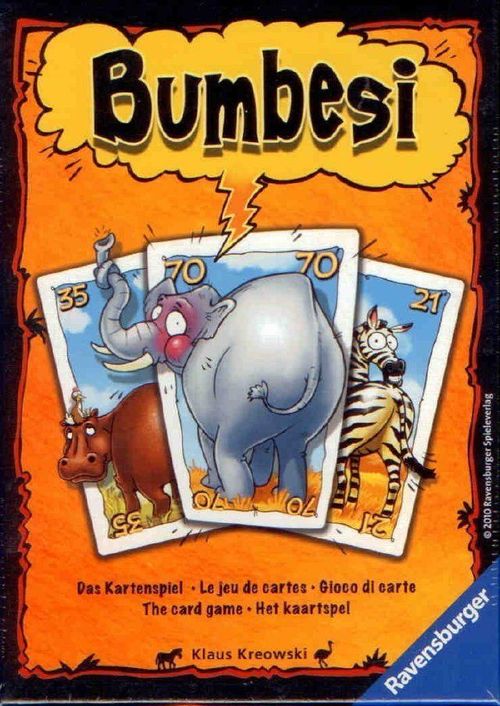
Bumbesi
Bumbesi Rulebook
Table of Contents
Table of Contents
Components
- 70 number cards (numbers 1 to 70)
- 15 special cards (3 special actions)
- 1 arrow card
- 1 marker card
Idea and Goal of the Game
On their turn a player uses 1 of their cards, or - here is the ambush! - puts cards onto their own penalty pile. Each card in the penalty pile gives 1 penalty point. The winner is the player who has collected the fewest penalty points.
Game Setup
Set aside the arrow card and the marker card. The remaining number and special cards are shuffled into a deck and placed face down.
Players take 5 cards each from the deck, without showing their cards to opponents. After that, the top 2 cards of the deck are laid face up on the table. If special cards turn up, they are replaced and shuffled back into the deck. The two number cards laid out are the target cards at the start of the game.
The marker card is placed on the target card that was revealed first. The arrow card shows the direction in which play is passed. It is placed in front of the first player so that it shows clockwise.
Game Play
The player who swears most often starts. First, play passes clockwise. Note: during the game the direction of play can change (see the special card "Change of Direction"). On their turn a player either lays out 1 card (number or special), or takes the pile of cards marked by the marker card when the player does not want to or cannot play a card. Taken cards are placed by the player onto their own penalty pile.
Turn summary:
- A number card is played, or a special card is played, or no card is played (penalty points are taken).
- The hand is refilled to 5 cards.
Playing a Number Card
A number card is laid under one of the two target cards. In this way a pile forms under each target card.
There are 2 possibilities:
- The pile has no cards yet: the player may put there a card that is lower than the target card at the top of the pile (i.e. the target card).
- The pile has at least one card: the player may put there a card that is lower than the target card, but at the same time higher than the top card of the pile. The card chosen in this way is placed on top of the pile.
Example: playing a number card. In the left pile only the card "27" can be placed. In the right pile a number card from 50 to 63 can be placed - the player lays out "51" (1). In place of the played card the player draws 1 new card from the deck (2).
Playing a Special Card
If a number card cannot be laid out, or one does not want to, one can play a special card, and then put it onto one's penalty pile. The action of the special card is carried out; a number card is not laid out on the table.
There are 3 types of special cards:
- Change of Direction (6 cards): When this card is played, the direction of passing the turn changes. As a reminder of the current direction, the arrow card is used. Only 1 "Change of Direction" card can be played at a time; the next player may again "change direction", and so on.
- Theft (5 cards): The player draws, face down, one card from the hand of any other player. The robbed player takes 1 card from the deck and adds it to their hand.
- Raising a Target Card (4 cards): The player lays their own card on top of one of the target cards. The number on the card from the hand must be higher than the number on the target card being covered. The card laid out becomes the new target card in place of the old one, which now lies under it.
Example: raising a target card. The player puts the special card onto their penalty pile (1). Raises the left target card with a card from the hand (2). After that draws 2 cards for themselves (3).
No Card Is Played
If a player does not want to or cannot play a card (neither a number nor a special one), they must take the target card marked by the marker card and the whole pile under it. The cards are put onto the penalty pile and at the end of the game bring 1 penalty point each. Then the marker card is moved to the other target card. After that the player puts any number card from their hand in place of the second target card.
(Special case: if the player cannot lay out a new target card because only special cards remain in their hand, the top card of the deck is taken as the new target card.)
Example: no card is played. The player puts all marked cards onto their penalty pile (1). The marker card is moved to the other target card (2). The player lays out a new target card from the hand (3) and draws from the deck up to 5 cards (4).
Refilling the Hand
At the end of their turn the player takes as many cards from the deck as needed to have 5 cards in hand. If the deck is empty, skip this action. The game is approaching its end.
End of the Game
After the last card has been taken from the deck, the game continues until a player on their turn cannot or does not want to lay out a card. This player takes into their penalty pile (as described above) the cards lying under the marker card.
The game is over. The second target card and the pile under it remain lying on the table and do not take part in the count. The cards remaining in players' hands also do not take part in the count; they are set aside. Now each player counts the number of number and special cards in their penalty pile. Each card gives 1 penalty point, regardless of the number on it. The winner is the one with the fewest penalty points.
Tie
If 2 or more players have the same number of penalty points, it is best to write them down and play another game. If there is too little time, the winner is the player who laid out fewer special cards. If the score is equal here too, there are several winners.
Do You Disagree?
You did not like the result of the first game and want a rematch? Then write down the penalty points after each game. The winner is the one who collects the fewest penalty points over 3 games.