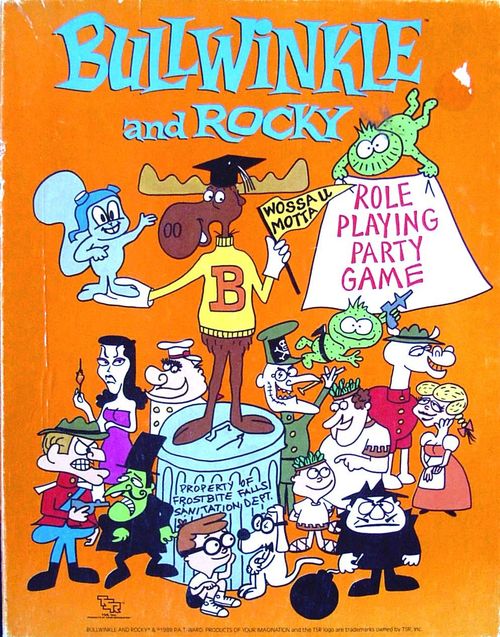
Bullwinkle and Rocky Role Playing Party Game
Bullwinkle and Rocky Role Playing Party Game Rulebook
Table of Contents
Table of Contents
- Inter... (Ahem!) Introduction
- Getting Started
- Mr. Know-It-All's Guide to Not-Very-Serious Roleplaying
- The Narration Game
- The Everybody Can Do Something Game
- Getting Started
- Well, Not Really
- Rule 1: Everything is Make-Believe or What's This Roleplaying Stuff All About, Anyway?
- Rule 2: Every Character is Different or The Powers That Be
- Rule 3: Just About Everything Is Chancy or Taking Your Character For a Spin
- When to Spin
- Rule 4: The Good, The Bad, and The Funny or Bad is Good, the Worse the Better
- Rule 5: Character Goals or What's My Finish Line?
- Rule 6: Tibi Fumus Obsideo Septum Doro (Everybody Can Do Something) or The Violent Art of Narrating
Inter... (Ahem!) Introduction
Welcome, party people. Today's lesson is How to Play the Bullwinkle and Rocky Roleplaying Party Game (whew!), Narration Game version, for fun and entertainment.
Getting Started
To start your own game of the Bullwinkle and Rocky Roleplaying Party Game, read the first 2¼ pages of this book. That'll tell you everything you need to know to play the Narration Game—that's the first, and easiest, version of the Bullwinkle and Rocky Roleplaying Party Game. Once you've played the Narration Game a few times, you can go on to the Everybody Can Do Something Game and the Graduate Game.
But right now, its time for . . .
Mr. Know-It-All's Guide to Not-Very-Serious Roleplaying
And now here's some rules you'll really like from our very own master of misinformation—Mr. Know-It-All!!
The Narration Game
Narrator: When we last left our intrepid heroes they were just about to open a mysterious package, delivered by the Frostbite Falls mail service. Little did they know that the package contained the Bullwinkle and Rocky Roleplaying Party Game (gasp!) sent to them by that sinister spy—Boris Badenov. Overcome with curiosity, our two boys began to read the rules.
The object of the Narration Game is to tell a story. The Bullwinkle and Rocky Roleplaying Party Game (wow, long title!) is not like other games—you don't play to "win" or "lose." You play the game just to have fun. Everyone, man and woman, boy and girl works together to create a story using ideas inspired by cards in your hand. With each card—each idea—you add a little bit to the story, building it round-robin fashion.
Pick a Story, Any Story
The first thing you do is get a bunch of your craziest friends together. Then, you all decide what story you want to tell. You can tell a Bullwinkle and Rocky story, a Peabody and Sherman adventure in history, a tale of derring-do featuring Dudley Do-Right, an Aesop & Son, or a Fractured Fairy Tale. The first few times you play the game, it's a real good idea to use one of the Bullwinkle and Rocky stories. These are found in the Bullwinkle and Rocky Stories book, elsewhere in this box.
The person who chooses the story (or owns the game, if no one will 'fess up to choosing one of these really dumb stories) reads aloud The Story So Far and then The Ending. (Don't worry you'll find these sections in the Stories book.) Now everyone knows how the story will start and how it's supposed to end.
Deal the Cards
After the story has been chosen, shuffle the deck of 108 official Bullwinkle and Rocky Roleplaying Party Game cards (the blue and green cards). If five or more people are playing, deal four cards to each player. Otherwise, deal five cards to everyone. These cards are the heart of the Narration Game. Each card has a person, thing, place, or saying on it. Each is like a little bit of a story.
You use these cards to give you ideas you incorporate in the story you're all trying to tell.
Now, some of the cards, like "Doubledome's Dictionary of Chemistry," for example, are pretty strange. Just how would that fit into the story of, say, Jack and the Beanstalk? You could say that Jack developed the super beanstalk seeds using his Doubledome's Dictionary of Chemistry! Perhaps the giant used Doubledome's Dictionary of Chemistry to perfect a method to change goose eggs to gold! Or your own answer could be even more bizzare. The point is that a card can be or do whatever idea it suggests to you. It's a wide open field.
Once everyone knows the story and has their cards, you can discard any or all of the cards in your hand and draw new ones. It may be that 46 Tons of Bubblegum simply doesn't fit into the story. Now's your chance to get rid of the 46 Tons of Bubblegum card!
How you use your cards is pretty much up to you, but there should be some connection between what's on the card and what you want to happen in the story. The connection can be as tenuous as you want—remember, you're after bad jokes and big laughs here, so the further you have to stretch to connect a card with your story, the worse the pun, the better!
Of course, there are times when you simply can't think of a use for a card. It might not be possible to tell the story of Goldilocks and the Three Bears and work in the Tanks of Helium card. Whenever it's your turn, you can discard as many cards as you like and draw new ones to replace them. Replacement cards can be used immediately.
Storytelling
After everyone has drawn and discarded cards, the player who suggested the story begins the game. He starts the story the way it was described in "The Story So Far," adding a little bit, based on one of the cards in his hand. Somehow, he works the person, place, or thing on the card into the story, laying the card on the table.
Once a card has been played, the next player to the left can jump in at any time, continuing the story and becoming the Narrator. This player picks up the story and adds to it, also playing a card and working in an idea suggested by that card. Once this player plays a card, the next person to the left gets to interrupt and pick up the Narration, and so on around the table.
Ending the Game
The storytelling continues until each player is down to one card. At that point any player who wants to can trade his last card for the top card in the deck. Once everyone's had a chance to do that, the person who thought of the story in the first place counts to three. On "three," each player throws his last card down on the table. The player whose card is on the bottom (in other words, the first player to throw a card) gets to end the story.
Remember that the idea is to end the story the way the cartoons ended—with a really funny twist or a terrible pun. Don't throw your last card just to beat the other players. And if you've got a really terrific ending, jump up and down, wave your card wildly, make whatever kind of commotion you can to convince the other players to let you end the story. Flattery, whining, and bribery are all recommended tactics in this situation. (The Heroes Handbook frowns on threats, however.)
When the player who won the "throw-off" plays his last card, the story is over. Of course, the last player has to bring the story to the ending agreed on at the beginning. Knowing this, the other players should help bring the story around to the desired ending, so that with the play of that last card, the story is over.
Earning Diplomas
Once the story is finished, give out awards to the players. Included in this box are your very own diplomas from those illustrious institutions of higher learning, Wossamotta U. and the Ukranian Safe-Cracking Institute. (You can photocopy these diplomas for your own use.) Note how they have been cunningly left blank—now you can create your own degrees—Magna Cum Loud, Bachelor of Eternity, Doctor of Silliness, and like that. Give diplomas out democratically—vote for "Funniest Gag," "Worst Pun," "Best Ending of the Evening," and so on. Make up any reason you want to give out a diploma. In the Narration Game, diplomas are just neat rewards for good play. In the other versions of the game, they become more important, but we'll get to that later. Now, try playing the Narration Game — the Wossamotta U. Story on page 8 of the Stories book is a good one to start with. After you've played a few times, you can move on to . . .
The Everybody Can Do Something Game
This is the full-blown Bullwinkle and Rocky Roleplaying Party Game (wouldn't want you to forget that title!). Before you play it, you should be familiar with the Narration Game, since a lot of what you learn there is used in this game. In the Narration Game, you worked with the other players and used the cards to tell a story. Now, you're going to add individual Characters (guys like Bullwinkle, Rocky, Fearless Leader, and Snidely Whiplash), Powers (things that make your character special), and Goals (what each character is trying to do).
Getting Started
First, pick the kind of cartoon you want to play. (In the Bullwinkle and Rocky TV show, a cartoon was one of those little bits that, put together, made a complete show—Rocky and Bullwinkle, Dudley Do-Right of the Canadian Mounties, Peabody's Improbable History, Fractured Fairy Tales, and Aesop and Son.)
When you choose your character, take the Character Stand-Up that matches. The Character Stand-Ups are those big things with the pictures on one side and writing on the other. Notice how they can be folded to stand up. It is a good idea to set yours up in front of you. That way everybody else will know what character you're playing. Then take the spinner that has your character's picture on it. You may have to share the spinner with another character. In this case, set it where you can both reach it easily. If there is a puppet for your character, take that too. Stick it on your hand. Wave it around. Have fun. (The puppets don't do anything in the game—we just thought puppets were the silliest things we could put in the box. So there you have it.)
After everyone's chosen a character, spinner, and puppet, deal five cards to every player. Now you're ready to begin.
Well, Not Really
Before you begin playing, there are some differences between the Narration Game and the Everybody Can Do Something Game. These are explained in Mr. Know-It-All's Rules of Roleplaying.
Rule 1: Everything is Make-Believe or What's This Roleplaying Stuff All About, Anyway?
Hello, gamers, Mr. Know-It-All here. When roleplayers play a game, they don't play the game themselves but pretend they are playing a game. Rocky: Huh? Well, Rock, everybody playing the game has a character. The character does all the stuff, while the player pretends what the character is doing. Uh, right, Mr. Know-It-All. But I don't think that makes sense. Well, suppose you pretend your me, Mr. Know-It-All Yeah, but... but you're not really me, you're . . . Bullwinkle, I mean you, and I'm me, Bullwinkle, but I'm pretending I'm . . . Mr. Know-It-All! . . . That's right, Rock! See, you really do understand! But I'm not sure our readers do! So why don't we let them read about this for themselves?
"Everything is Make-Believe" means that you, the player, decide what your character will do. When the rules talk about the character, we're talking about the Stand-Up in front of you. When the rules talk about the player, such as "The player must spin his spinner," we're talking about you!
Your character is nothing but a piece of paper. You (the player) have to use your imagination to make things happen in the game. You have to describe what your character tries to do. To get Bullwinkle to Washington, D.C. in a story, the Bullwinkle player has to say something like, "Bullwinkle takes the Frostbite Falls Mainline Express (4th Class, of course) and goes to Washington, D.C."
In the Narration Game, any player could say what any character was going to do. In the Everybody Can Do Something Game, only you can say what your character will do. Nobody else. The player with the Peachfuzz character can't say, "Boris decides to give me the Goof Gas Gun." Whether Boris gives Peachfuzz the gun is for the Boris player to decide. Of course, other players can try to affect your character (and vice versa). We'll get to that in a bit. But no other player can ever speak for your character. Only you can do that.
Rule 2: Every Character is Different or The Powers That Be
If you look at the character stand-ups, you'll see that one side has a nice picture of the character and a little bit of text. (We wouldn't want to strain anybody.) The other side has the tough stuff on it—some of the character's favorite sayings, and a listing of his Powers. Powers are the things that character can do that are above and beyond the normal. Fearless Leader: Normal! Who are you kidding? Powers are what make each character different from all others.
Of course, each character is different. If they were all alike, you wouldn't be able to tell Rocket J. Squirrel from . . . Boris Badenov!
Horrors!!!
In normal roleplaying games, characters are differentiated by lots of skills, abilities, attributes, equipment, and like that. Each skill, ability (etc.!) is rated, given a numeric ranking. It's all very complicated, kind of like a code. Fortunately, this isn't a normal roleplaying game. We don't need numbers, because this is a silly game, and numbers aren't silly, they're work.
Bullwinkle: Does that mean I can forget all that stuff about skills, abilities, etc.? Rocky: Sure, Bullwinkle! Bullwinkle: Whew!
Okay, so what are Powers and what do they allow you to do? Powers are special things your character does especially well (or especially badly!). Nobody is better at disguises than Boris Badenov, for example. And Captain Peter "Wrongway" Peachfuzz has the Power (if you can call it that) of always being wrong. Obviously, some Powers actually prevent your character from knowing or doing things (but read Rule 4 before you despair!).
The characters' Powers are explained on the back of the Character Stand-Ups (the side with all the writing on it). The description there tells you what each Power allows the character to do. You get to use your Powers whenever using a Power allows your character to do what you want him to. Woodward: That make any sense to you, Chauncey? Chauncey: Not much, Woodward, not much. You can always use a Power when the Narrator asks you a question (don't worry; we'll get to that!) If you want to use a Power during the game, you simply say so, following the instructions on the Character Stand-Up. Some Powers are automatic. Once you say the character is using the Power, it happens. Rocky can always fly. Rocky: Flying's like riding a bicycle—you never forget. Other Powers are chancy. When you use these Powers, you spin your spinner (the one with your character's picture on it). The result of the spin tells whether the Power works or not.
Rule 3: Just About Everything Is Chancy or Taking Your Character For a Spin
Chauncey: Did he say "Chauncy?"
Woodward: No, Chauncy, he said "Chancy."
Just because everything in the game is make-believe and you have a character with a bunch of keen Powers doesn't mean that everything works the way you want it to. Things can still go wrong. In fact, they go wrong most of the time. But, then that's what makes the game fun. (Oops, that's Rule 4!)
Hello game fans, Mr. Know-It-All here. To find out whether something succeeds or not, you use a randomizer. Other roleplaying games use a multi-faceted regular solid randomizer. Rocky: Don'tcha mean dice, Mr. Know-It-All? But, Rocky—remember? This isn't your average roleplaying game. Here, through the wonders of science and packaging technology, we have provided you with six Two-Dimensional Rotating Randomizers. Rocky: Gee, they look like spinners to me.
At the start of the game, you take the spinner that matches your character. You can tell which spinner is yours by the little character faces on each spinner. If a spinner doesn't have your character's face, it belongs to someone else. So give it back!
To operate your Two-Dimensional Rotating Randomizer Rocky: Spinner . . . , cock your index finger. Now aim at the Rotator. Rocky: The little spinner thingie.. Snap your finger to make the little spinner thing . . . uh, Rotator spin. When the thingie Rocky: I thought you said it was a Rotator. stops spinning, read the result in the color band that matches your character's picture. The results can be found on the Useless Spinner Results Table below. Boris: Useless Spinner Results Table moved to back cover of Guide to Frostbite Falls book by Order of Pottsylvanian Central Control. You got problem with that?
When to Spin
If you're obsessed with winning Boris: At any cost!, you won't want to spin your spinner because when you do, bad things might happen. Rocky: But "bad" things are funny things, and that's what the game's about! (I peeked at Rule 4!) Uh, yes, well, sometimes you don't have any choice—you have to spin your spinner Boris: Oy Vey!. So when do you spin?
There are four times when you must use your spinner. The first is whenever your Character Stand-Up says you must (usually to see if a Power works). The second is whenever your character tries to do something that affects another character ("Rocky will grab the secret jet fuel formula from Boris."). Third, you have to use your spinner whenever your character tries something out of the ordinary, something with a real chance your character will fail (that's the Narrator's decision, by the way). Finally, you have to spin your spinner whenever the current Narrator tells you to (Don't worry. We'll explain about being a Narrator soon.)
If it's obvious that what you want your character to do has a chance of failure—Boris attempting to talk Mr. Big out of punishing him, for example—you should spin right away. If the situation is less clear (Boris trying to talk Bullwinkle into giving him a priceless statuette—which Bullwinkle doesn't know is priceless, of course), the current Narrator (which we really will get to in a while) can tell you to spin.
If what you're doing doesn't affect another character, spinning is simple. Spin your spinner and consult the Useless Spinner Results Table. If the "Yes" result comes up, you succeeded. If you get a "No," it didn't work. If you get a black line, spin again.
Doing something to another player's character is a little trickier. In this case, both you and the other player spin your spinners. Then you compare the results. The Useful Little Table below explains what the results mean. Boris: Useful Little Table on back cover of other book, too. What you expect?
You never have to spin your spinner when you play a card. EXCEPT . . .
Well, there are two "excepts," two times when you have to spin after you play a card. The first is when you play your last card to achieve your Goal and win the game (see rule 5). The second is when you and another player both play a card on each other. ("I play my Sheriff Wright card on Boris, and have him arrested." "Oh, yeah? Well, I play my Close Shave card, and get away in the knick of time!" In a case like this, the two players "spin off.") We'll talk more about these exceptions later on.
One more thing about spinning: You can always choose the bad result on a spin, especially if that would be funnier, or it would help to advance the plot. You know you're in the spirit of the BULLWINKLE AND ROCKY™ ROLEPLAYING PARTY GAME when you start choosing bad results!
Rule 4: The Good, The Bad, and The Funny or Bad is Good, the Worse the Better
Okay, what happens when things go wrong?
What happens when things go wrong? Is simple. Ve shoot you. Right, Badenov?
Is this really necessary, Oh Cruel and Heartless, Fearless Leader?
Actually, the Narrator decides just what went wrong for your character. He can either make something up to fit the occasion or use one of his cards. What happens to your character can be logical, sane, or crazy. It's all up to the current Narrator.
Just how badly things go wrong is also up to the Narrator. Suppose the Rocky player is the current Narrator. Bullwinkle has just failed to swim across a river, so the Narrator has to say what went wrong. Probably Rocky doesn't want terrible things to happen to Bullwinkle. Bullwinkle: My buddy Rocky wouldn't let nothin' terrible happen to me on account a 'cause we're buddies. Right, Rock? Uh, Rocky? So the Narrator has Bullwinkle swept a little ways downstream, wet, but no worse for wear. Boris: Roskolnikov! I would send Moose over waterfall! Natasha: Darlink, I love it when you are cruel.
Obviously, Narrators whose characters are Good Guys are going to be nastier to Bad Guys than to other Good Guys (and Bad Guy Narrators will tend to go easier on other Bad Guys). That's okay—everybody gets a chance to help out their friends and be rotten to the opposition, so where's the harm?
Whatever bad things happen to your character, don't despair. There's one thing that just can't happen: No character can be killed or even seriously injured. Gidney and Cloyd: Characters can be scrooched, though! Bombs explode, covering characters with ash or throwing them high into the air. Knives shred clothing, possibly causing personal embarrassment. Bullets cause black, smoking holes in the seat of the pants. That's it.
So you say!
The worst thing the Narrator can do to a character is send him out of the scene for a while. How long? Until the narration passes to the next person, or another player finds a clever way to get the character back into the story. This is all part of the exact science of roleplaying. Suppose Horse is blown up by one of Snidely Whiplash's bombs. Nell: Not Horse! Couldn't it rather be Dudley? Dudley: But, Nell! The Narrator could say that the bomb hurtles Horse through the air and pretty much out of the picture. Horse is now out of the scene. Later, though, just as Snidely is about to escape from Dudley Do-Right, a clever player (but not the Horse player) has Horse fall from the sky, landing right on top of the fleeing villian.
Well done, Horse.
Horse is back in the scene and a hero to boot . . . er, hoof.
While your character is out of the scene, you can't advance the story, achieve your character's Goals, or play any cards. You can suggest funny ideas, plot twists, and puns to other players, however. You can also go get munchies for everyone else.
And what happens if none of the players want to help out and get your character back in the game? No problem—you'll be back as soon as the narration passes to a new player. At that time, your character returns, and you get to decide how. Didn't think we'd leave you stranded, did you?
By now you're probably terrified of using your spinner. After all, it means that somebody else gets to do something mean and horrible to your character . . . but, gee, you get to do horrible things to their characters, too. Snidely: This spinner business might not be so bad after all!
Of course, you don't want to be too mean to the other players. Sooner or later they'll get their revenge on you, and then you'll be sorry. Instead, you want to be funny. In the BULLWINKLE AND ROCKY™ ROLEPLAYING PARTY GAME, characters do things wrong most of the time. Peachfuzz: Some people are wrong all the time! If terrible things happened all the time, nobody would ever get anywhere! How to get around this? Well, Rocky and Bullwinkle live in a world of amazing coincidences. When things go wrong, anything can happen.
When your character gets in trouble, the Narrator tries to think of something funny that would get him out of it (or another player into it!). If he can't think of something off the top of his head, the cards in his hand may help him to come up with a funny answer. Just how does a card for A Ball of String, for example, cause Bullwinkle to fail when swimming the river? Here are some possibilities: He could get tangled up in the string. Or it could unravel in his pocket and one end of it could get caught on a tree branch on the shore, so no matter how hard he swims, the moose doesn't get anywhere. Or, if you're a buddy of Bullwinkle's and, as Narrator, you have to decide what happens, you could have the string get caught in the tree, go tauter and tauter until it snaps Bullwinkle back into the tree, bending the branches back like a spring, and flinging the moose where he wanted to go in the first place! So, you see, the worse the situation gets for Bullwinkle, the better.
So, remember this corollary to Rule 4 (we'll call it related rule 4a): Bad is Good, the Worse the Better.
Rule 5: Character Goals or What's My Finish Line?
Everybody has something they want out of life. Boris, Natasha, and Fearless Leader: Keel Moose! The characters in this game are no different. Every character has Goals which change from cartoon to cartoon. These Goals are provided in the story descriptions in the Bullwinkle and Rocky Stories book.
In each cartoon, there are Good Guy Goals and Bad Guy Goals. The Good Guys want to achieve the Good Guy Goal. The bad guys want to achieve the Bad Guy Goal. Bullwinkle: Gee Rocky, how can you tell the Good Guys from the Bad Guys? Rocky: Gosh, Bullwinkle, I don't know. Boris: Is simple—bad guys have more fun!
To win the game, your character has to achieve his Goal. Snidely: Nya-hah! That should be easy! Not so fast—you can't win unless you also play all the cards in your hand. Snidely: Egad! Foiled again! When you play your last card and achieve your Goal, you have won the game. So if the Good Guys' Goal is to make a batch of the secret rocket fuel for the government, Bullwinkle could win the game by doing this just as he played his last card. If he fails to make the rocket fuel (because of a bad spin on the Rotational Randomizer . . . uh, spinner), Bullwinkle will just have to keep trying.
In case you didn't notice, we've just encountered one of those pesky rules exceptions—when you play your last card, you have to spin to do anything. Notice also that you don't win the Everybody Can Do Something Game by being the first person to throw down your last card. You win by achieving your character's Goals, playing your last card, and spinning successfully. (This may mean group wins are the way to go—after all, what are Bullwinkle's odds of spinning successfully? Better let Rocky spin for the Good Guys. Isn't cooperation swell?)
Again, when you play your last card, the one that will let you achieve your Goal, you have to spin your spinner. If you succeed, you win! If you play your last card and get a bad result on the spinner, you immediately draw as many new cards as you want, up to the number you started with. You have to take at least one. Snidely: Personally, I always keep an extra card or two up my sleeve. Then play continues until another player is ready to play his last card and take a chance at ending the story, thus winning the game.
But wait, you're probably saying, how do you get rid of the cards in your hand? One way to play cards out of your hand is to use them when you're the Narrator. That's all explained under Rule 7, below. You can also use the cards to have your character do something without having to spin the spinner. When you play a card this way, you say what your character is going to do, based on the card. (As in the Narration Game, the card has to fit the story somehow.) As long as the card you're playing isn't your last, you automatically succeed. That's the beauty of the cards—you don't have to spin your spinner, even if you're affecting another character.
Rule 6: Tibi Fumus Obsideo Septum Doro (Everybody Can Do Something) or The Violent Art of Narrating
The Everybody Can Do Something Game needs a Narrator just like the Narration game. And just like the Narration Game, everybody playing gets the chance to be the Narrator. The player who picked the story (or the one who owns the game) starts off, placing the Narrator's Microphone Stand-Up in front of him, right next to his own Character Stand-Up. Each time the the current Narrator plays a card, the narration passes one player to the left, and the Microphone is passed to that player, making him the new Narrator. The Narrator has several special Powers, listed on the Microphone Stand-Up. He can use these Powers whenever he wants. Basically, being the Narrator is like being the boss, but you don't get to be the boss forever. Remember, any time the Narrator plays a card (either for his own character or because someone else failed), the job changes. The Narrator hands the Microphone to the person on the left and that person takes over.
But what, exactly, does the Narrator do in the Everybody Can Do Something Game? The most important thing the Narrator does is try to keep the story moving forward toward the previously agreed upon ending. He does this by asking the other players questions. Some appropriate questions are listed on the back of the Microphone Stand-Up. Basically, the Narrator tries to find out what the other players want their characters to do. Players can jump up and down and wave their hands, but nothing happens until the Narrator calls on them. Bullwinkle: That reminds me of Miss Plumfort at my old school, P.S. 12. After a player says what he wants his character to do, the Narrator can have him spin his spinner, if necessary. Bullwinkle: That's Rotational Randomizing Device to you, bub! If he wants, the Narrator can ask several players what their characters are going to do and then, when he has a good idea of what's going on, decide what happens in the story or ask one or more players to spin their spinners to see what happens.
Suppose Milton Crebnitz is the current Narrator. In addition, he's playing Rocky. Doris Dearhart's character, Boris Badenov, is attempting to learn the secret jet fuel formula (see the Jet Fuel Formula story in the Bullwinkle and Rocky Stories book). Milton asks Doris what Boris will do.
"I vill pose as Swami ben Boris," Doris says, "and heepnotize Squirrel to tell me secret rocket fuel formula."
"Hmmm," Milton, the Narrator, says, thinking feverishly about what the result of Boris' action will be. "Your Disguise Power is automatic. It convinces me—Rocky, that is—that you're a Swami, but you'll have to spin against me to see if you can hypnotize him."
Doris and Milton spin for their characters, but both Boris and Rocky get "No" results. That means the Narrator, Milton, decides what happens (sure it's a conflict of interest, but everybody gets a chance, so where's the harm?) Milton looks at his cards and decides to play one—the "Lullaby in Dreamland or Sound Asleep" card.
"Well, Rocky doesn't know the formula, but that doesn't matter—you goofed anyway," he says to Doris. "Boris manages to hypnotize Bullwinkle by mistake and he proceeds to tell his life story, putting everyone to sleep! By the time he gets to the jet fuel formula, nobody's awake to hear it!"
"Roskolnikov!" Doris says, getting into her role as Boris Badenov.
"No—ZZZZZZZZ, Milton says.
After describing what happens, Milton, having played a card, passes the Microphone Stand-Up to the person on his left, in this case, Merton Squash. Merton now begins his turn as Narrator by saying, "When we last left our heroes, Bullwinkle had managed to put everyone to sleep . . . "
Rule 7: There is No Rule 7. That's All There . . .
Bullwinkle: Wait a cotton-pickin' minute here. There's some stuff I don't understand! Boris: You're telling me?!
Okay, okay, what don't you understand?
What happens if I want to do something that isn't on a card and which isn't covered by one o' my Powers? Answer that! When that happens, the Narrator has to make a judgement call: If he thinks there's a real chance your character might not be able to what you want, he'll ask you to spin your spinner. In Bullwinkle's case, the Narrator might tell him to spin in order to cross a street or tie his shoelaces. Rocky probably wouldn't have any trouble with either of these activities, so he wouldn't have to spin.
And remember—there are some actions which are pretty much impossible. No character can pick up a mountain or jump to the Moon (unless the Narrator decides that would help the story, in which case go ahead and do it). This sort of thing is always up to the Narrator.
Okay, that was pretty good. How about this one: when do I get tuh use my Powers? An' when do I use cards? C'n I use a Power an' then keep tellin' the story until I decide to play a card? (I think I got him this time!!) You can use a Power or play a card any time the Narrator asks you a question or thinks playing a Power is appropriate, but once you use a Power or play a card, the Narrator picks up the story again. Only after the Narrator asks you another question can you use your Powers or play another card.
Bet you think you're pretty clever. Well, here's one about cards an' powers: What happens when two players decide to do stuff to each other, an' one plays a card an' the other uses a power? Or what if two players use Powers on each other?—who wins? That's easy. When cards and powers come into conflict just consult the What Beats What Table below. Narrator: We know, we know, moved to back cover of the Guide to Frostbite Falls . . . Boris: . . . by order of beloved Fearless Leader!
Uh, okay, that one was too easy. How about tellin' me what happens to my character when I'm the Narrator. Can the Narrator's character do stuff? Sure he can. He can do everything any other character can do. When you go around the table asking players what their characters are going to do, ask yourself, too. You might feel a little silly talking to yourself, but the other players will find it amusing, and that's the whole idea.
Here's a stumper: You said before that diplomas were different in the Narration Game and the Everybody Can Do Something Game. What about that? After one of these games has ended, players give diplomas (just like in the Narration Game). Save these diplomas! They're important. In the Everybody Can Do Something Game and the Graduate Game, diplomas help you do things. (Isn't education a wonderful thing?)
When you've collected two diplomas, you can use them to get an extra spin—any time you don't like a spin you made for your character, you can immediately cash-in two diplomas for another chance on the spinner. You can't change the result of this second spin, however. When you get five diplomas, you can do even more—if you turn in your five diplomas before you spin the spinner, your character automatically succeeds! (Unless of course you want to fail.) You can't use a diploma to achieve your goal and end the game.
Well, I'm fresh outta questions. Anythin' else I oughtta know? Well, actually, yes. There is one other thing. You know, all those ordinary guys you and Rocky always ran into during your adventures? The doormen, lumberjacks, inn-keepers, desk clerks, sailors, and so on? Bullwinkle: Sure, they were important to the plot, weren't they? They sure were, and you need to know how to add them to adventures in the BULLWINKLE AND ROCKY™ ROLEPLAYING PARTY GAME.
Anybody can introduce a Minor Character into the plot. The best way is to use a card, because that gets you closer to ending the game at the same time it introduces another helpless dupe, uh, I mean, Minor Character into the story. Once a character's card has been played, any player can use that character in the story. If you don't have a card for a particular character, you can introduce him anyway. Just say, "So-and-So shows up," and describe what he does. The only difference is you don't get rid of a card from your hand. If the Minor Character does something that affects another character, and you have to spin, use your spinner. Other players use their own spinners (not yours) when they have the character do something that affects other players' characters.
Whew! That's a lot o' rules! How'm I gonna keep 'em all straight?
Well let's recap. How do you play this game? First, you pick a story (just like you did in the Narration Game), then you choose characters (one for each player), then you deal out cards (just like you did in the Narration Game), discard and draw new cards (just like you did in the Narration Game). Then, the Narrator starts the story (just like he did in the Narration Game), but this time, instead of playing a card, he asks another player a question about where the story should go and what that player's character is doing. After hearing what that player wants to do, the Narrator can ask other players questions about their characters. If two or more characters come into conflict, or players want their characters to do things with a real chance of failure, he can have them spin their spinners to resolve the action. The Narrator decides when the spinners must be used. The Narrator also decides what happens when a character fails in an attempt to do something. In deciding what happens, the Narrator can just make stuff up or play a card. Any time the Narrator plays a card, he gives the Microphone to the player on his left. Then, you just keep doing this until one or more of the characters manages to reach their Goal, play their last card, and spin successfully. When this happens, everyone stands up and cheers.
The Graduate Game
Mr. Know-It-All: Greetings Roleplaying fans! Today's lesson is How to Do Things Even Dumber Than You've Done So Far and Graduate with Honors. To Graduate With Honors from the BULLWINKLE AND ROCKY™ ROLEPLAYING PARTY GAME (you know, that title never seems to get any shorter!), you Create Your Own Story and Characters. It's a good thing neither of these is too hard!
For some people, being able to play all these great Rocky and Bullwinkle stories and use all these great Rocky and Bullwinkle characters is just not enough. Fearless Leader: Vat? Vere they dropped on their heads? If you're one of these people, the Graduate Game is for you. Once you've mastered it, you can do anything any Bullwinkle and Rocky character can do—and probably worse!
Creating A Character
Most roleplaying games begin by showing you how to create a character. Naturally, we saved that for the end. (Wouldn't want to be like everyone else, would we?) Creating a character takes just a few simple steps.
First, you need a copy of the Blank Character Stand-Up. (It's the card with the outline of a person on it (or what passes for a person in Bullwinkle and Rocky cartoons!) Make a photocopy of the blank card (and if you're really feeling ambitious, mount the copy on a piece of cardboard).
Second, decide if your new character is a person or an animal. Both are possible in the Bullwinkle and Rocky world. (In fact other characters barely notice the difference.) If your character's an animal, give it a name and write this down on the back of card (the side without the character outline). Now, if you're creating an animal, skip the rest of this paragraph. Fearless Leader: You heard ze man! If you want a human character, pick a profession and write this below your character's name.
Selecting Powers
Next, you select your character's Powers. Take the Bullwinkle Spinner and spin it once. If it points to "No," go immediately to the next paragraph. If it points to "Yes," choose one Power from the Good Stuff Table, on the back cover of the Guide to Frostbite Falls book. The character name in parentheses after the Power tells you which Character Stand-Up to check for a complete Power description. Some Powers offer you a choice of descriptions.
Next, take the Rocky spinner, spin, and, if you get a "Yes" result, choose one from the Pretty Good Stuff List. If you get a "No" spinner result, go immediately to the next paragraph.
Now, take the Boris spinner and repeat the process, picking one Power from the Well, I Guess It's OK List on a "Yes" result. Again, a "No" spinner result means you skip this table and go to the next.
This time, spin the Natasha spinner. On a "Yes" result, select a Power from the Powers Man Was Never Meant To Have (And Would Never Want) List. A "No" result means you're out of luck, as always.
Finally, use the Mr. Peabody spinner and, on a "Yes" result, pick from the Oh No, Do I Have To Take One Of Those?! List.
What the Powers Mean
Most of the Powers work just like those found on the various Character Stand-Ups. But just because a Power was described in a particular way on a Character Stand-Up doesn't mean it has to work exactly that way for your character. Natasha drives men wild because of her subtle charm, her seductive personality, and her good looks. Natasha: Vy, tank you, Dahling. Your character may drive men wild because she's so annoying. Your unflappable cool may mean your character is dead from the neck up (especially if he is really dumb!), not perfectly in control. How your Power works can be different from the original Power; what it does remains the same. Take a little time and tailor the descriptions to fit your character.
Making New Powers
Sooner or later, somebody is going to want a Power that isn't on any of the tables. Good. That's what the Graduate Game is all about—creating your own stuff. That person should describe the Power to the other players. What does it do? How does it work? Who does it affect? And so on. If everyone likes it, use it in a game. If they still like it after the game, then it was a good Power. If they don't like it, it was a bad Power and should go away. It's as simple as that. If Milton Crebnitz wants the Power to burrow through the earth like a mole (just to round out his character), more power to him, we say!
One example of a Power you might want to add is Mr. Peabody's Way-back Machine. How it would work is up to you—it might allow the player to take back a bad spin result and spin again, for example. (By the way, we didn't give Mr. Peabody a Way-back machine, because his adventures always begin with the trip back in time, after which the Wolf of Wall Street doesn't use the Way-back at all. Since he never uses it during the cartoons, we couldn't let him do it in the game, but you don't have to worry about being true to the cartoons. If you want him to have a Way-back, give him one!)
Making Your Own Spinner . . . or Not
If you're real ambitious about creating your own, unique character, you can make your own spinner. Decide how smart, skillful, and generally successful your character is—the more often your character succeeds, the bigger the "Yes" area you want on the spinner. That's pretty much all there is to it.
But when you get right down to it, making a new spinner is silly. Bullwinkle: You mean being silly makes a difference in this game? It doesn't much matter how often characters succeed or fail. Even more important, spinner-making is work, and that's no fun! Better you should use one of the spinners we gave you in the box. Lay them all out face down. Randomly pick one spinner. That's the spinner your character will use from now on. Write it down on the back of the Blank Character Stand-Up. More than one character can use the same spinner.
Finishing Touches
Now, complete your character by making up something funny about him and what he has done with his life. Write it down on the back of the Blank Character Stand-Up. There, now you have a background. Keep this up and someday you'll be a world-famous novelist.
Finally, you need to know what your character looks like. To help you draw a picture, we turn to Mr. Know-It-All!
Good evening, culture lovers. Today we'll teach you how to be a brilliant artist by drawing characters the Bullwinkle and Rocky Way.
If your character is an animal, draw a funny-looking animal. Now, wasn't that simple? If your character is a person, draw a melon or a giant zucchini for the head and add something that looks like a squashed Polish sausage for a nose. Above the nose, add two round circles for eyes with little dots in the center for pupils. Note that these are always crossed. Eyebrows (usually straight lines) can be added or left off. Hair is entirely optional. One flattened wad of chewing gum on either side of the head will do for ears. The mouth should be large and open. Teeth are optional, but are always big.
Draw a triangle for the body—ah, ah, ah! No neck! The body comes right up to the head. Under the body draw three straight lines close together. These are the legs. At the end of the legs add two loaves of bread pointing in opposite directions. These are the feet. At the top part of the body, draw two triangles for the shoulders. The arms should be like sticks and end in fat, round hands. You can have three or four fingers, but never five (although sometimes you can get six or seven). Now add little details like buttons, moustaches, beards, and glasses. Look at your picture. Does it look stupid? No? Then try again.
Making Your Own Stories
A roleplaying game needs a story for anything to happen, and in this little way the BULLWINKLE AND ROCKY™ ROLEPLAYING PARTY GAME is no different from the rest. But, other roleplaying games make you write out detailed plots and put in lots of picky rules stuff. None of that in this game, thank goodness! All you do is come up with a nifty beginning and a couple of good endings and you're on your way.
The important thing to start with is the beginning. Bullwinkle: Even I know you start a story at the beginning! This has to be read out loud, so make sure it's fun to read. The beginning should set up a situation for all the characters in the game. Normally these are very strange situations. There is nothing too strange for a BULLWINKLE AND ROCKY™ ROLEPLAYING PARTY GAME. Moon men invade the Earth? It's been done. Six-foot tall giant metal-munching moon mice? Too late. A gas that makes people stupid? Uh-huh. Boris Badenov turning into a nice guy? He got better. What other things could happen?
To help you out, here are some Bullwinkle and Rocky titles you can use (these are real cartoon titles—if you know the real stories, use 'em!):
Rocky and Bullwinkle: Last Angry Moose, Upsidaisyum, Metal Munching Moon Mice, Rue Brittania, Buried Treasure, Three Mooseketeers, Painting Theft, Guns of Abalone, The Treasure of Motey Zoom, Bumbling Brothers Circus, Moosylvania.
Fractured Fairy Tales: Any fairy tale you can think of or . . . Slipping Beauty, Snow White, Inc., Rumplestiltskin Returns, Leaping Beauty, Son of Beauty and the Beast, Speeding Beauty, Snow White Meets Rapunzel, Son of King Midas, The Prince and the Popper, Booty and the Beast, The Ugly Almond Duckling, Sweeping Beauty, The Teeth of Baghdad, Son of Snow White, Jack B. Nimble.
Dudley Do-Right: Foreclosing Mortgages, The Snidely Mounted Police, Inspector Dudley Do-Right, The Lure of the Footlights, Bullet-Proof Suit, Elevenworth Prison, Mountie Without a Horse, The Skagway Dogsled-Pulling Contest, Snidely's Vic Whiplash Gym, Trading Places, The Inspector's Nephew, Matinee Idol, Snidely Arrested.
What's In a Name?
Okay, so what can you do with all these titles? Why, anything! Take for example, "Rue Brittania." Everybody knows that in that show Bullwinkle discovered a strange birthmark on his foot that looked just like the birthmark of the long-lost heir to an English earldom. Gee, Bullwinkle as nobility? But just suppose there were some dastardly brothers who didn't want Bullwinkle to inherit. Egad, what evil deeds might be afoot? What other stories could there be, based on the same title? Well, Bullwinkle and Rocky might discover an old paper that makes Frostbite Falls part of the British Empire! Imagine the possible confusion! Or . . .
Bullwinkle might get it in his tiny brain that the British are invading and go out to fight the American Revolution all over again. Of course, Boris and Natasha (and all of Pottsylvania) would somehow be cast as the British. Or . . .
Rocky and Bullwinkle discover they have an unerring talent for darts and away they go to the dart-throwing championships in London, England. It's kind of like the Wossamotta U. football game all over again!
Or suppose you use the title "Last Angry Moose," which is really about how Bullwinkle takes his life's fortune, which is substantial—to say nothing of being stuffed in a mattress—and goes to Hollywood to become a movie star only to run into you-know-who Boris: Is me! disguised as a movie director.
You could make up an entirely new story about how Moose and Squirrel are picked for jury duty at the trial of guess who! "Upsidaisyum" could be about how Bullwinkle inherits an upsidaisyum mine. Upsidaisyum is the world's rarest metal. Would there be another country interested? Boris: No, never!
"Mucho Loma" might be a story of the time when Rocky and Bullwinkle, on vacation in a sleepy south-of-the-border town, were mistaken for the infamous bandit Zero. (How will our boys get out of this?)
Just think of all the possibilities for humor and chaos in Dudley Do-Right stories. "Inspector Dudley Do-Right": Dudley is promoted and the Inspector is demoted, or Dudley fills in while the Inspector is ill. "The Inspector's Nephew": Dudley is assigned to take care of an obnoxious brat, or the nephew is a better mountie than Dudley! "Trading Places": What if Snidely and Dudley switched brains, or if Snidely reformed and Dudley went bad? There are a lot of possibilities.
Once you pick a beginning, all you have to do is choose an ending. There are normally at least two—one for the Good Guys in which everything turns out right, and one for the Bad Guys in which everything turns out wrong. (Of course the Bad Guys have a different view on all this.) On a few occasions, you may need additional Goals for other characters who refuse to be slotted into the Good Guy or Bad Guy slots. Of course these characters usually turn into Good Guys or Bad Guys before the next show!
So, that's how you create a story for the BULLWINKLE AND ROCKY™ ROLEPLAYING PARTY GAME (have you ever wondered how Bullwinkle got top billing?). That's all you need to know to play.
And now we'd like to thank you all for reading the BULLWINKLE AND ROCKY™ ROLEPLAYING PARTY GAME rules. We hope you enjoy . . .
Ah, why don' you shaddap you mouth and let them play . . . silly squirrel!
Hey, who you callin' silly, you, you . . . Hey, Rock, ya know, I think he's right, fer once. Why don't we let 'em start playin'?