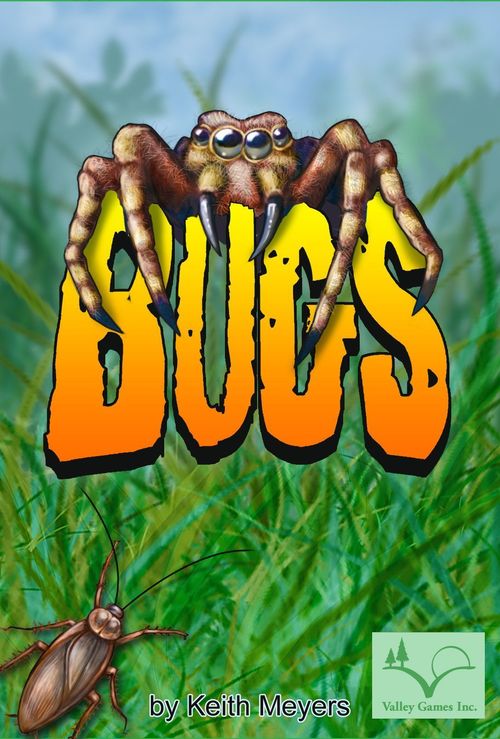
Bugs
Bugs Rulebook
Table of Contents
Table of Contents
The Cards
Bug Cards
Numbers 1 thru 9. They appear in decreasing quantity order, so there are nine of the number 1 card and only one of the number 9 card.
Outbreak – quantity 2. Duplicates any bug it is played with and cannot be played on its own.
Action Cards
- Net – quantity 3. Player is treated as invisible and the swarm passes to the next yard.
- Repellent – quantity 3. Reverses the direction of the swarm sending it back to the previous player's yard.
- Exterminator – quantity 1. Knocks out the swarm and resets the swarm size to zero.
How to Play
The last person to step on a bug deals the first hand. All cards are dealt out – some players may receive more cards than others. The dealer leads off and play proceeds to the left. You are not allowed to hide the number of cards in your hand, they must be visible to all players at all times.
The starting player may play one or more of the same bugs. For example, if you have three '2's (earwigs), you could play one '2' and announce a swarm size of '2' or you could play two 2's and announce a swarm size of '4' or you could play all three 2's and announce a swarm size of '6'. Additionally, you could include an 'Outbreak' card with one or more of those earwigs to make another earwig and adjust the total that you announce by an additional '2'.
These cards are laid down in the center of the playing area and form the current swarm. The next player now has 4 basic options:
A. Increase the size of the swarm by playing one or more of the same bugs played by the previous player. For instance, if the prior player had put down three '3's (robber flies) and announced '9', you could add one '3' and announce '12'. You could put down more than one '3' if desired and simply announce the new swarm size.
B. Beat the current swarm with enough of any other single type of bug that has a swarm size that is greater than the current swarm. For instance, if the prior player played four '2's and announced '8', you could play two '5's (ants) and announce '10', or three '4's (tiger beetles) and announce '12', etc.
C. Play an action card to bypass having to beat the current swarm;
'Net' passes play onto the next person in play order.
'Repellent' passes play back to the person who just played and reverses the direction of play until another 'Repellent' is played.
'Exterminator' knocks out the entire swarm and reduces the swarm total to '0'. All bugs that were on the table remain on the table.
NOTE: All action cards and Outbreak cards get placed in a discard pile and are not placed in the current swarm.
D. If you cannot, or choose not, to perform any of the above actions you must pick up the current swarm and add it to your hand. You then lead off for the next round.
NOTE: Cards in the discard pile are not added to your hand; they are out of play until a new hand is begun.
Limitations to leading off: If the current swarm just picked up was made up of only one type of bug, you cannot lead off with that type of bug next round UNLESS you make the swarm bigger than it was when you picked it up.
Play continues in this manner until one player has played all the cards in his hand. A player cannot go out by playing the Exterminator, Net, Repellent or Outbreak card by itself.
When a player empties his hand the hand is over and scoring takes place (see Scoring/Winning below).
A new hand then begins and the player who had the most amount of points at the end of the hand deals and leads off the next hand. In the case of a tie, the player who had the most low numbered cards (i.e. more '1' cards than any other player or more '2' cards than any other player if multiple players are tied for '1' cards, etc.) deals and leads off. Non numbered cards are not considered for the tie break.
Special Rule – Wipe Out
If it is your LEAD and you have all the bugs of any given type in your hand, you may wipe out the colony simply by showing them all to your opponents and placing them into the discard pile. You then lead off again.
You may wipe out colonies of bugs as many times as you have entire colonies in your hand. For example, you lead off by wiping out all 7 Robber Flies. You then lead off by wiping out the 1 Mantid. You then lead off again…
An Outbreak card can be played when wiping out a colony and the player still leads off again as normal.
Scoring/Winning
When a hand ends all other players score one point for each card remaining in their hand. After six hands, the player with the fewest points wins.
During the play testing of this game, the worst score encountered was an 18 in a 4 player game! Not a record you want to beat!
Entomology
The following notes appear in the printed rulebook as background on the insects depicted on the cards.
- American cockroach: The American cockroach is the largest species of common cockroach and is often considered a pest because it invades homes and urban settings for food and breeding. They are also considered one of the fastest running insects.
- Earwig: The earwig is a common insect worldwide and is characterized by its small, membranous wings that fold up under their forewings. There is a pair of forcep-like structures at the posterior end that are actually cerci. Cerci are sensory appendages. Their name comes from an old wives tale that stated earwigs go into the ears of humans and burrow into the brain to lay eggs. They feed on other insects (like cockroaches), which is why they are often found in homes.
- Robber fly: Robber flies have characteristic "mustaches" on their face that are dense hairs and have long ovipositors at the posterior end of their abdomen. Their proboscis is used to inject saliva that contains neurotoxins to paralyze and digest prey. They then suck the inside of the insect prey out.
- Tiger beetle: Tiger beetles are predators both as adults and larvae. They are considered one of the fastest insects and have large eyes and mandibles and long legs. Tiger beetles are able to catch their insect prey in the air.
- Carpenter ant: Carpenter ants are a large ant that prefers to nest in decaying, moist wood. They are called carpenters because they excavate galleries in the wood of houses and trees for the nests. They feed on other insects and the honeydew produced from aphids.
- Antlion: The 'antlion' refers to the larval form of the family. They form pits in the sand and soil to act as traps. The larva settles at the bottom of the pit and buries itself in the soil so that only the jaws show, once the prey slips down to the bottom it is quickly seized by the antlion. They feed on small insects, including ants.
- Common wasp: The common wasp builds a grey paper nest, usually underground, in an abandoned tree or in a wall crevice. They can be found throughout the Northern Hemisphere. They feed on a variety of insects and nectar.