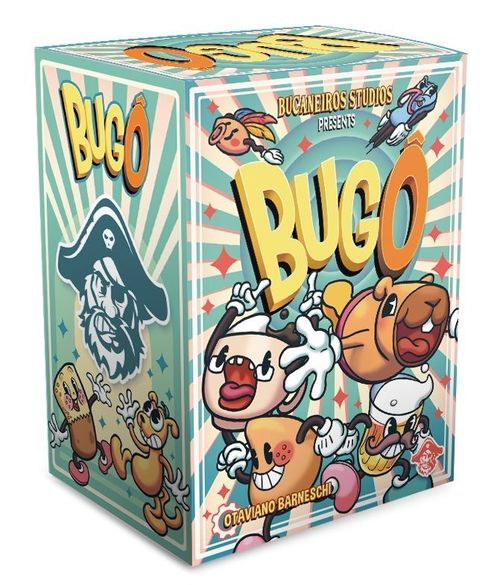
BugÔ
BugÔ Rulebook
Table of Contents
Table of Contents
Components
48 number cards:
- 40 cards: 4 of each number from 10 to 100
- 4 Negative cards: -101 to -104
- 4 Superior cards: 101 to 104
12 Round Rule cards
1 scoring pad
Game Objective
After 5 rounds, the game ends. The player who has accumulated the fewest negative points wins.
Glossary
Trick: Started by the Leader. Each player, on their turn and in clockwise order, plays one card. Once everyone has played a card from their hand, the highest card wins the trick. Some Round Rules may change this logic.
Round: A round ends when all players have played all of their cards.
Setup
Shuffle the NUMBER deck (A) and the ROUND RULE deck (B) separately.
Place 5 Round Rule cards face down in a ROW (C), from left to right. The number of cards each player will receive in a round is set by the next Round Rule card to be revealed (D).
In the first round, reveal the leftmost card. In the following rounds, discard the used card and reveal the next card in the row.
The last person who ate a coxinha (a Brazilian snack) is the first Leader. This person is responsible for revealing the next Round Rule card.
How to Play
Each round is made up of three phases:
- PREDICTION
- DISPUTE
- SCORING
Each player receives the number of cards defined by the Round Rule chosen by the Leader.
Unless the rule says otherwise, everyone must:
A) Look at their cards;
B) Predict how many tricks they believe they will win (one at a time, clockwise, starting with the Leader);
C) Play one card at a time, following the concept of a trick.
1. Prediction Phase
The Leader reveals the next Round Rule card and, based on it, chooses the mode of the round: CAPOEIRA (more strategic) or CARNAVAL (more festive). The choice is announced to all players.
The Round Rule defines:
- How many cards each player must receive (that is, the number of tricks in the round);
- Special rules, such as cards that must be revealed, cards that must be hidden, or different conditions for winning tricks, among other possibilities.
After the Rule has been chosen and the mode of the round has been set, deal the cards according to the instructions (for example, if the Rule says players may not look at their cards, everyone must obey).
Then, STARTING WITH THE LEADER AND CONTINUING CLOCKWISE, each player must declare out loud their prediction of how many tricks they believe they will win.
The manual shows two example Round Rule cards:
- CAPOEIRA card, marked with the number 2: "The 100 also bugs cards greater than 100."
- CARNAVAL card, marked with the number 3: "Do not look at your cards at any time. Play in the dark."
2. Dispute Phase
Tricks are played in the standard way (described in the Glossary), but always respecting the instructions of the Round Rule in effect.
BUGOU
When two or more players play cards with the same value, those cards cancel each other out, that is, they BUG. The remaining cards stay in the dispute for the trick.
Example 1:
-
Bia: 10
-
Carol: 40
-
Fabio: 40
-
The 40 cards cancel out. Bia wins with the 10 card.
Example 2:
-
Otaviano: 10
-
Thiago: 40
-
André: 40
-
Vinicius: 10
-
Xavier: 40
-
The 10 cards cancel out, as do the 40s. Nobody wins this trick.
NEGATIVE AND SUPERIOR CARDS
Negative cards have values below zero (-101, -102, ...). Superior cards have values above 100 (101, 102, ...).
These cards do not have repeated values, and each one can cancel with its corresponding opposite:
- -101 bugs with 101
- -102 bugs with 102
- ... and so on
Example:
-
Marcel: 104
-
Beatriz: 40
-
Bianca: -104
-
Cícero: -101
-
The -104 and 104 cards cancel out. Beatriz wins with the 40 card.
WINNER OF THE TRICK
The player who wins a trick takes all the cards played in that trick, stacks them, and leaves the pile on the table near them. This represents the trick they won. That same player will be the first to play in the next trick.
Example (round with 3 cards per player):
- Fabi wins the 1st trick and stacks the cards.
- Fabi leads the 2nd trick, wins it, and creates a new pile of cards.
- Luise wins the 3rd trick and creates her pile.
- Leo did not win any tricks.
- Round ended.
3. Scoring Phase
At the end of the round, each player checks whether they predicted correctly. Anyone who got it wrong writes down 1 NEGATIVE POINT on the pad, regardless of how far off they were.
Example:
- Ana: predicted 1, won 1 → no negative points
- Dandi: predicted 3, won 0 → 1 negative point
- Lari: predicted 0, won 2 → 1 negative point
- João: predicted 1, won 0 → 1 negative point
NEW ROUND
After recording the points, the leadership passes to the player on the left of the previous Leader. The next Round Rule card is revealed, and a new round begins from the Prediction Phase.
End of Game
After 5 rounds, the game ends. The player with the fewest negative points wins.
TIEBREAKER ROUND
Players who are not tied become GHOSTS, who will hinder the players who are competing in the tiebreaker. GHOSTS do not score, even if they win tricks.
Everyone (players and ghosts) draws 5 cards. Only the players competing in the tiebreaker make a prediction (0 to 5 tricks); from then on, the round begins with everyone looking at their own cards.
The negative score will be the difference between the prediction and the actual number of tricks won.
This process is repeated until there is a winner.
ALTERNATIVE TIEBREAKER
The tiebreaker players look at their cards, make their prediction, and place their cards face down. However, their cards will be played by the GHOST closest to their right, without that ghost seeing them.
Repeat the rounds until there is a tiebreaker winner.
Example:
- Pedro: predicted 0, won 2 → 2 negative points
- Rafael: predicted 3, won 0 → 3 negative points
- Waldyr: predicted 3, won 3 → no negative points
Tip for ghosts: try to bug the cards to disrupt the players' predictions.