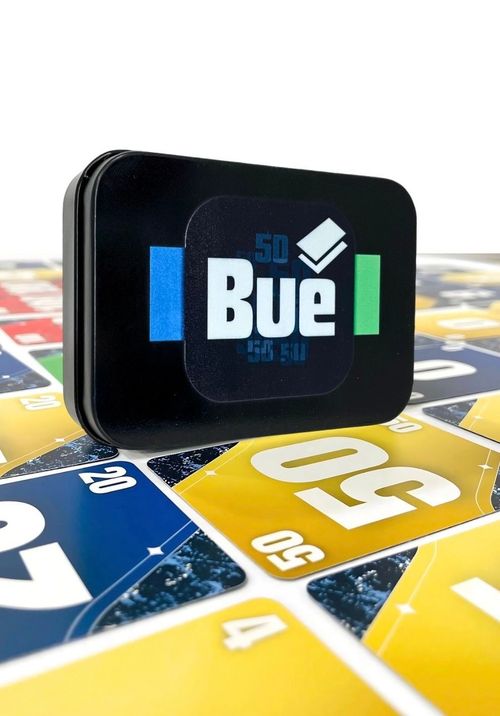
Bué
Bué Rulebook
Table of Contents
Table of Contents
Objective
Several games are played until one player first reaches 110 points or more.
The objective of each game is to obtain, with the values of your five cards, the exact sum of 50.
In this case the player makes a Bué and scores 50 points on the leaderboard.
If a player reaches an exact sum of 50 using only Gold cards, they make a SuperBué and score 70 points on the leaderboard.
The Bué and the SuperBué must be declared out loud and can be made at any time during the game, including immediately after the cards are dealt.
When a Bué or a SuperBué is made, the game ends and the next game begins.
| Example | Result | Points awarded | Other players |
|---|---|---|---|
| Bué (the sum of the card values is exactly 50) | 50 points | 0 points | |
| SuperBué (the sum of the values is exactly 50 with only Gold cards) | 70 points | 0 points |
If neither a Bué nor a SuperBué is made
If, after five exchange turns, no one has made the exact sum of 50, points are awarded to the three players who came closest to 50, whether below or above it.
The criterion is as follows:
- The 1st closest player: 30 points
- The 2nd closest player: 20 points
- The 3rd closest player: 10 points
- All other players: 0 points
Practical example in a 4-player game.
After five exchange turns, players A, B, C and D have their 5 cards face up in front of them. We then calculate the sum of the card values of each player:
| Player | Distance from 50 | Points awarded |
|---|---|---|
| A: sum of cards 41 | not among the three closest players | 0 points |
| B: sum of cards 52 | is the 1st closest player | 30 points |
| C: sum of cards 58 | is the 3rd closest player | 10 points |
| D: sum of cards 44 | is the 2nd closest player | 20 points |
Preparation
Shuffling and dealing
At the start of the game it is decided who will be the first Dealer (Mazziere), responsible for shuffling the cards and dealing them.
The Dealer changes at every game and rotates clockwise; the Dealer card is used to identify the Dealer.
The Dealer deals five cards to each player, including themselves.
The cards must be kept face down on the table so that their values are hidden from opponents.
Players may always look at their own cards and, if they wish, change their order.
The cards not dealt form the exchange deck (mazzo degli scambi) and must be placed in the centre of the table.
The top card of the exchange deck must be turned face up and placed beside the deck. This card has no game value and only indicates where the discard pile (mazzo degli scarti) begins.
If the exchange deck runs out, it is regenerated by shuffling the discard pile.
Play
Each game consists of 5 turns of mandatory exchanges, in which players swap cards to improve their set of cards in order to reach the objective.
Each exchange turn starts on the left of the Dealer and ends with the Dealer.
In each exchange turn, each player must choose between two options:
- Swap a card with an opponent. The player swaps one of their own cards with a card of any opponent. First they choose which of their cards to give, then they indicate which card to take in exchange. The value of the opponent's card may be seen only after the swap has been completed, and it remains hidden from the other opponents.
- Swap a card with the central deck. The player discards one card, placing it face up on the discard pile, and draws the top card of the exchange deck. First discard, then draw. Players may not draw from the discard pile.
Example
To explain the mode of play, let us start with an example with 4 players (Fig. 1).
The same mechanics apply from 2 to 10 players.
Clockwise, starting from the left of the Dealer, each player makes one exchange, and at the end of the first exchange turn all players must reveal one card of their choice. A revealed card can no longer be exchanged (Fig. 2).
The exchanges resume and at the end of the 2nd turn the players turn over yet another card (Fig. 3).
The exchanges resume and at the end of the 3rd turn the players turn over a third card (Fig. 4).
The exchanges resume and at the end of the 4th turn all players turn over the 4th card (Fig. 5).
After the 5th and last exchange turn the players turn over the last card. Now all the cards are revealed (Fig. 6).
In short, in each of the five exchange turns the same sequence is always followed:
- Player 1 (to the left of the Dealer) swaps one card.
- Player 2 swaps one card.
- Player 3 swaps one card.
- Player 4 (the Dealer) swaps one card.
- Everyone turns over one card of their choice.
As noted above, the Bué and the SuperBué interrupt the game, so it is not necessarily the case that five turns are played.
Returning to our example: in the example game no player has made a Bué or a SuperBué, so the game regularly reaches the end of the fifth exchange turn with all players having their five cards face up. At this point, the three players whose sums are closest to 50 must be determined:
| Player and sum of cards | Distance from 50 | Points awarded |
|---|---|---|
| 1: 32 | is the 2nd closest player | 20 points |
| 2: 69 | is the 3rd closest player | 10 points |
| 3: 135 | not among the three closest players | 0 points |
| 4: 61 | is the 1st closest player | 30 points |
The partial leaderboard after the first game is:
| Player | Points |
|---|---|
| Player 1 | 20 |
| Player 2 | 10 |
| Player 3 | 0 |
| Player 4 | 30 |
Games are played as many times as needed to reach the target score of 110 points or more. In our example, suppose player 4 is the first to reach 110 points on the leaderboard and wins by closing the game after four games:
| Player | Game 1 | Game 2 | Game 3 | Game 4 | Final leaderboard |
|---|---|---|---|---|---|
| Player 1 | 20 | 30 | 0 | 0 | 50 |
| Player 2 | 10 | 20 | 10 | 0 | 40 |
| Player 3 | 0 | 10 | 20 | 0 | 30 |
| Player 4 | 30 | 0 | 30 | 50 | 110 |
Notes and Special Rules
Variant for 2 players
In the 2-player configuration, at the end of each game, if no one makes a Bué or a SuperBué, only the player closest to the objective is rewarded, and receives 30 points. The other player receives 0 points.
The points awarded for the Bué and the SuperBué remain unchanged.
Swaps between players: the only prohibition
Within the same turn, to prevent deadlock situations, the same exchange of values between the same two players may not be repeated twice. It is, however, permitted in later turns, or if the cards exchanged are both of different value.
Example: if in the first turn player A swaps their 100 with player B's 4, then in the same turn B may not give A the 100 back and take back the 4. B may swap with A only if the values of the new cards are different from 100 and 4. In later turns this problem does not arise.
Bluff and game psychology
During the exchanges players are free to pretend, suggest or make others believe that they hold certain cards. Players are not obliged to tell the truth: bluffing is part of the strategy.
Deck Composition
58 playing cards, plus one Dealer card and one rules card.
- Blue cards and Gold cards are ordinary cards. A Gold card offers two additional advantages over a Blue card: it allows the player to compete for the SuperBué, and it prevails in cases of a tie.
- 100 cards are penalty cards, as they reduce the chances of winning during a game. However, they can be a strategic resource if used at the right moment against opponents.
- x2 and x0 cards are two special cards that respectively double or cancel the value of a card of the player's choice among those in their possession. Neither can be used to make the SuperBué. The x0 card can also cancel the x2. If a player decides to keep an x2 or an x0, they are obliged to use it. During the game the player may change, as suits them, the card to be paired with the x2 and x0.
- The Dealer card indicates the position of the Dealer and moves clockwise at every game. Its role is crucial in determining the order of exchanges and the moment when cards must be revealed at the end of turns.
FAQ
What happens if two players are the same distance from 50, or achieve the same result?
In all cases of a tie (both for equal distance from 50 and for equal score at the end of a game), the player who, in the last hand, has more Gold cards among their five cards prevails. If the tie persists, the Dealer prevails (if involved), otherwise the player closest to the Dealer in clockwise order. The same criterion is adopted if two players have the same score on the final leaderboard or make a Bué together.
Can I change the order of my cards on the table?
Yes, as many times as you like.
On which cards can the x2 and x0 cards be used?
You may decide to use them on a single card of your choice, according to what suits you. You may use an x2 or x0 card on both revealed cards and cards still hidden. They must be used, and you may change the card to be multiplied or cancelled as the game progresses.
Can the Bué and the SuperBué be declared as soon as they are made, or only at the last turn?
They must be declared immediately, even if they are made in the first turns of the game or right after the cards are dealt.
Questions or doubts? If anything is unclear, contact the designer, who will be happy to help.