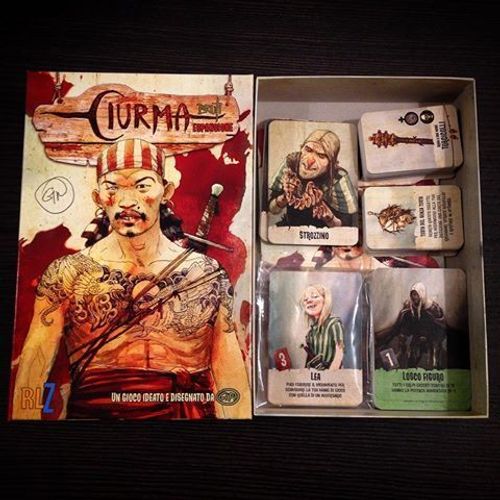
Bruti: Ciurma
Bruti: Ciurma Rulebook
Table of Contents
Table of Contents
- New Game Materials
- All the Cards of Ciurma
- Setup
- The Optional Rules of Bruti Become Official in Ciurma
- Left-Hand Weapons
- Left-Hand Weapons in Attack
- Left-Hand Weapons in Defense
- Combining Different Blows When Defending with the Left-Hand Weapon
- Combining Blows, Parries and Dodges When Defending with the Left-Hand Weapon
- Exhausting and Reactivating the Left-Hand Weapon
- Abandoning a Left-Hand Weapon
- Picking Up a Left-Hand Weapon
- Prized Weapons
- Titles
- Scraps
- Buying and Selling
- The Loan Shark (Strozzino)
- The Idol of the Pit
- Calling Followers
- What Followers Do
- Attacking and Eliminating Followers
- Special Characters
- Scenarios
- Optional Rules
New Game Materials
- 2 Update packs
- 12 Characters
- 2 Special Characters
- 20 "Atrocious Awakening" followers (Seguaci "Atroce risveglio")
- 20 "Hired Killer" followers (Seguaci "Sicario prezzolato")
- 1 Idol of the Pit (Idolo della Fossa)
- 3 Loan Sharks (Strozzini)
- 12 Call cards (Carte del richiamo)
- 17 Titles (Titoli)
- 4 Left-Hand Weapons (Armi sinistre)
- 28 Prized Weapons (Armi pregiate)
- 4 Mystic Invocations (Invocazioni mistiche)
- 8 Special Objects (Oggetti speciali)
- 16 Scraps (Recchie)
All the Cards of Ciurma
Characters: 12 new Brutes that you will play as during the clashes.
Special Objects: 8 new special objects with different effects that can be used in combat.
Left-Hand Weapons: 4 left-hand weapons that you can wield to fight with a double weapon.
Prized Weapons: 28 deadly prized weapons that you can acquire to make your warriors more powerful.
Mystic Invocations: 4 new mystic invocations with very powerful effects that the gods of the abyssal seas may grant you during the clashes.
Scraps: 16 cards representing the ears of the opponents killed in combat. Scraps can be used as currency to obtain prized weapons and titles.
Titles: 17 combat titles that you can acquire with Scraps and that give your characters new and powerful abilities.
Setting Cards: 3 Loan Sharks and 1 Idol of the Pit, which will help you accumulate Scraps and special objects.
Special Characters: 2 legendary pirates: La Signora, the mad captain who loves disguises, and Arkaffè, the drowned undead, whom you may face in mythic clashes in squads in the predefined scenarios.
Call Cards: 6 "Atrocious Awakening" call cards and 6 "Hired Killer" call cards, which you use to bring your followers into play.
"Atrocious Awakening" Followers: 20 followers from the Ciurma of Arkaffè, which you can foist upon your opponents during the clashes.
"Hired Killer" Followers: 20 followers in the pay of La Signora, which you can foist upon your opponents during the clashes.
Setup
Before you start playing you must update some Bruti content. The update packs contain the corrected and improved cards to replace the old versions, and other new cards needed to play Ciurma.
Open the update pack of 16 cards and replace:
In the damage deck:
- 1 damage "All'inferno con me!" with its corrected version
- 2 damages "Intontito!" with their corrected version
- 2 damages "Spossato!" with their corrected version
- 3 damages "Alle braccia!" with their new version
In the combat deck:
- 2 enhancements "In sequenza mortale" with the 2 new moves "Inganno mortale"
- 2 moves "Carica" with their new version
- 2 enhancements "Con destrezza" with their new version
- 2 enhancements "Con presa alle spalle" with their new version
Open the update pack of 11 mini cards and replace:
In the special objects deck:
- 1 special object "Spallaccio del maniaco" with its corrected version
- 1 special object "Pendente della vendetta" with its corrected version
- 1 special object "Olio delle due sante" with its corrected version
In the equipment deck:
- 4 shields with their new version
- 4 armors with their new version
Now take the new Ciurma materials.
Add to the Bruti decks:
- the 12 new characters and the 2 new special characters
- the 8 new special objects
- the 4 new mystic invocations
- the 4 left-hand weapons
And form the new decks:
- of the 28 prized weapons
- of the 20 "Atrocious Awakening" followers
- of the 20 "Hired Killer" followers
- of the 6 "Atrocious Awakening" call cards
- of the 6 "Hired Killer" call cards
- of the 17 titles
Now set aside the 3 Loan Sharks and the Idol of the Pit.
The Optional Rules of Bruti Become Official in Ciurma
Thanks to the introduction of new mechanics and of the buying and selling system based on Scraps introduced in Ciurma, the optional rules of Bruti "Surrender" (Resa), "Favor of the Public" (Favore del pubblico), "Secret Preparation" (Preparazione segreta) and "Scraps Tournament" (Torneo delle Recchie) are eliminated and can no longer be used.
Furthermore, the following optional Bruti rules have become official rules in Ciurma for all effects, and you must use them during your clashes:
Veterans
Warriors who survive a clash become veterans and can be reused in subsequent combats. If a player has a veteran warrior, he is not obliged to take part in the draw of characters at the start of a new game and may use him again.
Veteran warriors keep the special objects they conquered in previous clashes and can choose new weapons, whether or not to use the Shield, the Left-Hand Weapon or the Armor, like all other players, before starting the combat.
Using Scraps
The "Scraps" cards represent the ears cut from defeated enemies and are used as currency to obtain prized weapons and titles. The dealer puts their deck on the table without the need to shuffle it.
The way in which Scraps are won is explained in the paragraph "Earning Scraps".
Breaking and Leaving the Shield
The Shield can be used to add a further point to the defense power even when it is exhausted. But in that case it is considered broken and its card must be removed from the game.
An intact Shield can be left on the game table and possibly picked up by another player. Leaving the Shield or picking it up are both actions that require the player to spend his entire turn.
Simultaneous Combat
If you play in squads or in a brawl you must use the simultaneous combat rule: after a player has declared that he attacks an opponent and has played his blow, the players who are not at that moment involved in the combat, starting from the one to the right of the attacking player, may reactivate the Shield, the Left-Hand Weapon or a card of their own endowment, or swap a card of their playing hand with one drawn from the combat deck.
Left-Hand Weapons
A warrior can face clashes fighting with a double weapon: a one-handed Weapon (in the right hand) and a Left-Hand Weapon (in the left hand). One-handed weapons wielded in the right hand are also called "main weapons".
Left-Hand Weapons are added to the Bruti equipment deck, chosen at will during the preparation for combat, and placed beside the character card.
It is not possible to use a Left-Hand Weapon when using a two-handed Weapon or a Shield. It is not possible to face a combat using only a Left-Hand Weapon: you must always also have a one-handed Weapon in the right hand.
Normally, the use of a Left-Hand Weapon entails a penalty of -1 to the condition of the character, but some prized Left-Hand Weapons (acquirable with Scraps, as we will see later) do not have this penalty.
A player who has equipped his warrior with a Left-Hand Weapon may use it both in attack and in defense.
Left-Hand Weapons in Attack
When you are in attack and you have an active Left-Hand Weapon in your equipment, you may throw two blows of any power in a single attack.
It is not possible to play enhancements when you throw two blows in a single attack.
Example: Franco has equipped his warrior with a Left-Hand Weapon, so he decides to throw two blows in a single attack and tries to hit Stefano with a Diagonal Blow and a Powerful Backhand Blow (1+2) for a total attack power of 3.
Left-Hand Weapons in Defense
Until now in Bruti it was possible to defend against and cancel blows only by playing one of the same type. In Ciurma, characters equipped with Left-Hand Weapons can use them, by exhausting them, to cancel a blow with a different one, for example by parrying a Diagonal Blow with a Chopping Blow.
Example: In this example Stefano attacks Franco with a Diagonal Blow for a total attack power of 1. Franco cancels the attack by exhausting his Left-Hand Weapon and playing a Chopping Blow, for a total defense power of 1.
Combining Different Blows When Defending with the Left-Hand Weapon
When defending using an active Left-Hand Weapon, you may combine the blows played normally in defense with one (and only one) blow of a different type played by exhausting the Left-Hand Weapon.
Example: In this example Stefano attacks Franco with a Powerful Backhand Blow, for a total attack power of 2. Franco cancels the attack by playing a Backhand Blow (1) and adds, by exhausting his Left-Hand Weapon, a Diagonal Blow (1), for a total defense power of 2.
Combining Blows, Parries and Dodges When Defending with the Left-Hand Weapon
When defending using an active Left-Hand Weapon, you may combine blows, parries and dodges played normally in defense with one (and only one) blow of a different type played by exhausting the Left-Hand Weapon.
Example: In this example Stefano attacks Franco with a Diagonal Blow With Fury (1+2), for a total attack power of 3. Franco cancels the attack by playing a Diagonal Blow (1), a Parry (1) and, by exhausting his Left-Hand Weapon, a Thrust Blow (1), for a total defense power of 3.
Exhausting and Reactivating the Left-Hand Weapon
Left-Hand Weapons must not be exhausted when used in attack, but only when used in defense to cancel a blow with a blow of a different type.
An exhausted Left-Hand Weapon cannot be used again, either in attack or in defense, until it is reactivated.
Reactivating a Left-Hand Weapon ends the turn.
Abandoning a Left-Hand Weapon
During his attack turn, a player may, if he wishes, leave his Left-Hand Weapon on the game table and continue playing.
Picking Up a Left-Hand Weapon
During his attack turn, a player may, by spending an entire turn, pick up a Left-Hand Weapon that is present on the game table.
Prized Weapons
The arrival of the pirates of Ciurma has brought great and exotic riches to the world of Bruti. Among them stand out the prized weapons: swords, maces, axes and spears of excellent craftsmanship, able to inflict additional damage when they wound an opponent.
Prized weapons cannot normally be chosen during the preparation phase, but must be acquired before the combat by spending the Scraps present in the player's "Scraps haul" (bottino delle Recchie).
The price in Scraps of each prized weapon is indicated by the number of Scraps depicted on the card that represents it.
Additional Damage from Prized Weapons
When you wound using a prized weapon, you must pay attention to the icons shown on the card that represents it, and compare them with those on the damage cards that have just been drawn. If at least one of the icons shown on the prized weapon is also present on one of the damage cards drawn for the weapon, an additional damage is inflicted by immediately drawing one more damage.
These are the icons found, respectively, on prized weapons and on damage cards:
- Damage to bones (Danno alle ossa)
- Damage to brain activity (Danno alle attività cerebrali)
- Damage to tissues (Danno ai tessuti)
Example: Before the combat, the player controlling Bazza has spent 4 Scraps to buy the one-handed weapon "Orfanante", which allows him to inflict an additional damage if the damage of the weapon drawn shows at least one icon for brain activity or tissues. Having wounded his opponent, the player controlling Bazza draws the damage "Light Wound!" (Ferita leggera!), which shows a tissue damage icon (also present on the card of his weapon "Orfanante"), and so he can inflict the additional damage of "Orfanante". He draws one more damage and draws "Hemorrhage!" (Emorragia!).
A prized weapon always and only inflicts one additional damage, even if its icon appears on two or more of the damage cards drawn.
Example: The player controlling Sukaplyet has spent 3 Scraps to buy the two-handed weapon "Sderena", which allows an additional damage if at least one of the two damages of the weapon drawn shows a bone damage icon. Both damages drawn, "Deep Wound!" (Ferita profonda!) and "On the Arms!" (Alle braccia!), show a bone icon, but the additional damage is always and only one. He therefore draws one more damage and draws "Reeling!" (Spossato!).
Damage Sequence
The additional damages are always drawn at the end of the normal draw of the damages of the main weapon, and are subject to the interruption effects of the damages "Wild Reaction!" (Reazione selvaggia!), "To Hell With Me!" (All'inferno con me!), "Favor of the Gods!" (Favore degli dei!) and "Death!" (Morte!). Drawing one of these damages, in fact, immediately interrupts the draw, even if the icons on the damages and on the prized weapon coincide.
The additional damages of prized weapons apply exclusively to the draw of the weapon's damages and never to those due to the effects of special objects, mystic invocations, characters or anything else. To this end, it is important to follow the correct sequence of damages, as shown below.
Damage Sequence: when you wound an opponent, always follow this order when drawing damages:
- Damages of the main weapon.
- Additional damage of the main prized weapon, or of the active prized Left-Hand Weapon equipped (if active).
- Additional damages due to the effects of special objects present in the attacker's endowment.
- Additional damages due to the effects of the mystic invocations present in the attacker's endowment.
- Additional damages due to the effects of a follower associated with the wounded character.
- Additional damages caused by the attacker's character who wounded the opponent.
Additional Damage from Prized Left-Hand Weapons
Prized Left-Hand Weapons work in the same way as the other prized weapons. In any case the additional damage will always be one only, but having a symbol also on the Left-Hand Weapon will increase the probability of triggering it.
When you wound, you also check the symbol shown on the card of the active prized Left-Hand Weapon, and proceed as for the additional damage of the main prized weapons. Remember that the additional damage of a prized Left-Hand Weapon is considered only if the weapon is active when you wound the opponent. An exhausted prized Left-Hand Weapon never gives its additional damage.
Example: The player controlling Tracina has spent 3 Scraps to buy the Left-Hand Weapon "Luncino", which allows an additional damage if the damage of the main weapon shows a tissue damage icon. Having wounded his opponent, he draws "Light Wound!" (Ferita leggera!), which shows a tissue icon, so he can inflict the additional damage. He draws one more damage and draws "Grazing Blow!" (Colpo di striscio!).
Example: The player controlling Tracina has spent 2 Scraps to buy the one-handed weapon "Stiappacapi" and 3 Scraps to buy the Left-Hand Weapon "Luncino". These allow an additional damage if the damage of the main weapon shows a tissue or brain activity icon. Having wounded his opponent, he draws "Hemorrhage!" (Emorragia!), which shows a tissue icon, and so he can inflict the additional damage. He draws one more damage and draws "Blinded!" (Accecato!). The damage "Blinded!" shows a brain activity icon, which is also present on the prized weapon "Stiappacapi". However, since it is never possible to inflict more than one additional damage at a time, this icon is ignored.
Titles
Pirates who arrive in the land of Bruti come from a life of plunder and illicit wealth, and some of them, greedy for Scraps, can teach warriors particular combat techniques in exchange for a fair reward. These techniques and abilities are represented by titles.
Titles can be chosen and purchased before combat only by spending the Scraps present in the player's Scraps haul, at the cost indicated on the card that represents them.
A purchased title is placed beside the character card, as in the figure below, and grants the ability described on the card itself.
A title is not part of the character's endowment or equipment, but represents an extension of its ability.
A character can possess only one title at a time.
Titles are never exhausted and can never be plundered.
A veteran character keeps the title he had during the previous clash, unless the player who controls him decides to sell it back (see paragraph "Buying and Selling").
The title of a character who is killed must be put back in the titles deck.
Scraps
The Scraps Bank
All the Scraps present in Ciurma make up the "Scraps bank" (banca delle Recchie).
The Scraps won by players during clashes are taken from the Scraps bank and make up the player's "Scraps haul" (bottino delle Recchie).
Earning Scraps
The way in which Scraps are earned in Ciurma varies according to the type of clash:
- In duels, the player who wins earns 1 Scrap, taken from the Scraps bank.
- In squad clashes, the players of the winning squad each receive 1 Scrap, taken from the Scraps bank. In case of a tie at the end, no Scraps are awarded.
- In brawls, 1 Scrap is assigned immediately when a player eliminates another player. In case of victory on points, the winner earns 1 Scrap for each opponent still alive but defeated on points. In case of a tie at the end, no Scraps are awarded.
All Scraps won are taken from the Scraps bank.
The Player's Scraps Haul
In Ciurma, Scraps do not belong to the character who won them but to the player who controls him. A player's Scraps haul is composed of all the Scraps he has earned in the previous clashes, which he may have fought with one or more characters.
The player is free to fight a clash with a character, earn Scraps, change character and spend the Scraps in his possession to equip it.
However, special objects, prized weapons and titles are tied to the character who has won them. They may be resold, but they cannot be transferred from one character to another.
The Scraps present in a player's haul can never be plundered by an opponent.
Scraps as Currency
A player may spend the Scraps of his haul before a clash to buy the prized weapons and titles he prefers, freely choosing them from the respective decks.
A player is not obliged to spend all his Scraps before a clash, and may choose at his pleasure whether to spend more or fewer of them.
Scraps that are not spent remain in the player's Scraps haul for future use.
Buying and Selling
The Scraps price of each title or prized weapon is shown on the card itself.
Normal equipment, such as weapons, shields and armors that do not show a Scraps price on the cards, has no value and cannot be plundered or resold.
Before a clash, players may sell and buy prized weapons and titles in the order established by the selling and buying phases.
The way in which titles and prized weapons are sold and bought changes depending on whether you use a veteran or a new character at its first clash.
Selling and Buying Phases for New Characters
If you use a new character at its first clash, after drawing him according to the normal procedure of play:
- Possibly spend Scraps from the player's haul to buy a title and/or prized weapons.
- Assign to the new character one special object out of two and, if necessary, weapons, shields and armors, as in the normal Bruti preparation phase.
At this point you are ready to fight.
Selling and Buying Phases for Veterans
If instead you use a veteran, before the clash the player may, in this order:
- Sell the prized weapons or title owned by his veteran, at half the value indicated on the card (rounded up), putting them back in their deck and taking the proceeds from the Scraps bank.
- Sell the special objects remaining in the veteran's endowment after the previous clash, for 1 Scrap each, putting them back in the deck and taking the proceeds from the Scraps bank.
- Spend any number of Scraps from his Scraps haul to buy a title (if he does not already have one) and/or prized weapons. The Scraps spent are put back in the Scraps bank.
- Finally, assign the veteran a new special object and, if necessary, weapons, shields and armors, as in the normal Bruti preparation phase.
The special object drawn before the clash is called the "veteran's object" and cannot be sold until the end of the clash for which it was drawn.
At this point you are ready to fight.
All prized weapons and titles that have been sold must be put back in their decks, available for purchase by the other players.
Buying Order
If two or more players wish to buy titles and/or prized weapons, proceed starting from the player who has the most Scraps in his Scraps haul, continuing towards the player who has fewer.
In case of a tie between two or more players, draw lots to decide who may start buying first.
Plundering a Defeated Opponent
At the end of a clash, a player may plunder the special objects and prized weapons of a defeated warrior.
He may decide whether to equip his warrior with the plundered prized weapons, but he must immediately resell, at half the Scraps value shown on the cards (rounded up), those he decides not to use.
Special objects plundered from the defeated opponent may be resold, always at a price of 1 Scrap each, or added to the endowment of the veteran warrior who won the clash (always respecting the maximum limit of three special objects, and reselling the excess ones if necessary).
The player may decide to exchange one or more plundered objects with one or more special objects already present in his endowment, reselling those he wishes, or those that he cannot keep in the endowment of his veteran because of the maximum limit of three objects.
The title of a defeated opponent can never be plundered and is put back in the titles deck.
The Scraps present in the Scraps haul of a defeated opponent can never be plundered.
The Loan Shark (Strozzino)
For a novice, facing a clash against a veteran enriched by multiple victories in the Pit can be a real suicide. In this case it can help to turn to the Loan Sharks of the Pit.
The Loan Sharks of the Pit, in fact, accumulate wealth by lending Scraps only to new warriors who face veteran characters, allowing them to buy prized weapons and titles that they could not otherwise afford. This is a service reserved exclusively for new warriors who face their first clash.
A player may request the intervention of a Loan Shark each time he uses a new character, provided he has not already spent Scraps to equip it, and he may do so regardless of the quantity of Scraps present in his Scraps haul.
However, the intervention of the Loan Shark obliges the player to discard and put back in the bank all the Scraps present in his Scraps haul. For this reason it is advisable to turn to the Loan Shark when you have few or no Scraps in your haul.
It is never possible to resort to the Loan Shark when using a veteran character.
The Loan Shark will provide you with a quantity of Scraps sufficient to equip yourself at best for the clash. In exchange, as we will see later, the Loan Shark will not allow you, in case of victory, to plunder your opponent.
If you decide to turn to the Loan Shark, you must associate his card with your character, placing it on the table beside your character card.
Preparing Characters and Using the Loan Shark
Players who decide to use the Loan Shark must wait until the other players with veteran characters have finished their preparation and any selling and buying phases.
At this point, the players with characters at their first clash may request the loan of the Loan Shark.
The Amount of the Loan
The amount of Scraps you receive from the Loan Shark represents the Loan Shark's loan. To know the amount of this loan, you must first determine the wealth of the veteran character you are about to face.
For this reason, before requesting the Loan Shark's loan, you must wait until your opponent has carried out all the buying, selling and preparation phases before the clash.
Determining the Opponent's Wealth
To determine the wealth of the veteran opponent you are about to face, add together all the Scraps present on the prized weapons and on the title owned by that veteran. The result of this sum represents the opponent's wealth.
The Loan Shark's loan always amounts to, and only to, half of the opponent's wealth in Scraps (rounded up).
Example: Stefano, who has only 1 Scrap in his Scraps haul and who uses a character at his first clash, faces Franco, who controls Luvamaro, a formidable opponent who has become so after many clashes won. Stefano decides to turn to the Loan Shark. He discards all the Scraps in his possession, returning them to the Scraps bank. He determines the opponent's wealth by adding the Scraps on the prized weapons and on the title of Luvamaro (13), and receives a loan from the Loan Shark of 7 Scraps. Any Scraps present in Franco's Scraps haul are not counted for the purposes of the Loan Shark's loan.
Spending the Loan
After receiving the Loan Shark's loan, the player is free to spend the Scraps received as he prefers. All the Scraps that are not spent, however, must be returned to the Scraps bank.
Example: Stefano, who controls Buccia at her first clash against Luvamaro, uses 5 of the 7 Scraps received from the Loan Shark to buy the two-handed prized weapon "Laboccia". He associates a Loan Shark card with his character and returns the remaining 2 Scraps to the Scraps bank.
Having a Loan Shark Associated with the Character
A player with a Loan Shark associated with his character can never plunder defeated opponents at the end of a clash. All the prized weapons, titles and special objects present in the endowment of the defeated warriors are put back in their decks.
However, if the character who turned to the Loan Shark wins the clash, everything bought with the Loan Shark's loan remains his property.
In any case, at the end of the clash, the Loan Shark card is removed and set aside.
The Loan Shark in Squad Clashes
In squad clashes, players who use a new warrior may turn to the Loan Shark as in the rules above. However, to determine the opponent's wealth, you must always choose the richest member of the opposing squad.
The Loan Shark in Brawls
In brawls, players who use a new warrior may turn to the Loan Shark as in the rules above. However, to determine the opponent's wealth, you must always choose the richest warrior among the veterans taking part in the brawl.
The Idol of the Pit
When one warrior wounds another, the Pit goes wild. This is well known among the Bruti. In Ciurma this event is represented by the "Idol of the Pit" card (Idolo della Fossa).
This card is placed, face up, on top of the damage deck at the start of the clash.
When a warrior wounds an opponent, he gains the "Idol of the Pit" card, and the player who controls him associates it with his character.
From then on, during his attack turn, the player may discard the "Idol of the Pit" card to draw a special object. This action, however, immediately ends the turn.
After this, the "Idol of the Pit" card is put back on top of the damage deck, and returns to the disposal of the next warrior who manages to wound another.
If a warrior already has the maximum of three special objects in his endowment, he may still draw another one by using the "Idol of the Pit" card, but he must remove one of those already in his possession by placing it on the game table. This object remains available, eventually, to the other players, who may spend an entire turn to pick it up and equip it.
When a player wounds another warrior, he receives the "Idol of the Pit" card even if it is already associated with another warrior, removing it from that warrior and associating it with his own character.
Calling Followers
In Ciurma there are two types of call cards: "Atrocious Awakening" (Atroce risveglio) and "Hired Killer" (Sicario prezzolato).
Ordinary warriors can obtain these cards by buying the titles "Lacchè de La Signora" or "Leccapiedi d'Arkaffè", and thanks to the power of some special objects and some mystic invocations.
Call cards are removed from the character's endowment at the end of the clash.
The special characters "La Signora" and "Arkaffè" begin the game with one or more call cards, as specified on their character cards.
These call cards allow one or more followers drawn from the relevant deck to enter play.
Followers
Followers enter play following the use of a call card.
If at the start of a clash at least one player controls a character with a call card in his endowment, take the relevant follower deck, shuffle it and place it on the table, within reach.
In Ciurma there are two follower decks of twenty cards each: the "Hired Killer" followers deck (Seguaci "Sicario prezzolato") and the "Atrocious Awakening" followers deck (Seguaci "Atroce risveglio").
Foisting Followers on Opponents
During his attack turn, a player with at least one call card in his endowment may exhaust it to draw a follower from the relevant deck and foist it upon an opponent of his choice. Foisting a follower means placing it on the table, near the opponent's character card.
In squad clashes or brawls, the player who uses a call card may choose which opponent to foist the follower upon, after drawing it from the relevant deck.
Followers must always be drawn from the top of the deck and cannot be chosen.
There are no limits to the number of followers that can be foisted upon a character.
After foisting a follower, the attacking player continues to play.
Call cards are part of all the effects of the character's endowment, and after they have been exhausted you may continue to play.
Reactivating a call card (turning it face up) ends the turn.
There is no limit to the number of call cards that can be in a character's endowment. An attacking player may, if he has them available, exhaust more than one call card and foist more than one follower on the same opponent or on others, as he chooses.
Example: The player controlling Buccia has spent 5 Scraps to buy the title "Leccapiedi d'Arkaffè", which allows him to start the clash with a call card "Atrocious Awakening" in his endowment. During his attack turn, the player controlling Buccia may decide to use the call card, exhausting it (turning it face down), and draw a follower from the "Atrocious Awakening" deck to foist upon an opponent.
What Followers Do
Each follower has on its card the description of the effect it inflicts on the character to whom it has been foisted.
These effects are cumulative and are applied each time the necessary condition occurs.
Some followers show on their card one or more skull symbols with a damage icon. These symbols represent the additional damages that the character to whom these followers have been foisted suffers when wounded.
Example: The player controlling Nontikao has three "Atrocious Awakening" followers foisted upon his character. For as long as he does not get rid of them, he suffers all the effects indicated on the cards. (When an opponent wounds him, he must discard cards from his hand of play, he cannot use or reactivate his Movement, and at the start of his turn he must change all the cards in his hand of play.) Moreover, if he were wounded, he would receive one additional damage because of the skull symbol present on the card "Orrido".
Priority of Follower Effects
The penalties and effects shown on follower cards always have priority over the other aspects of the game. They can invalidate the abilities of the characters themselves, the effects of the combat cards played, the bonuses granted by objects, mystic invocations, and so on.
Example: Aloch is wounded. Because of the presence of "Brutto ceffo" and "Mordigambe", he receives two additional damages. The damage "Grazing Blow!" (Colpo di striscio!) is caused by the opponent's weapon. The other two damages ("Hurt Leg!" (Alle gambe!) and "Favor of the Gods!") are caused by the foisted followers. "Favor of the Gods!" would cancel all these damages, but the penalty inflicted by the "Lettatore" follower, which turns all the damages that interrupt the draw into "Death!" damages, has priority, and so Aloch is eliminated.
Attacking and Eliminating Followers
The number on a follower's card represents its resistance value.
To eliminate the followers foisted upon your character, you must play, during your turn, an attack of power equal to or greater than this value, announcing your intention to do so before playing the attack.
An eliminated follower is put back at the bottom of its deck. The cards used to eliminate it are placed on top of the pile of played cards.
After eliminating a follower, the player who eliminated it remains in attack.
When you attack a follower, you may normally use all the enhancements and any combined attacks due to the character's ability, the use of a Left-Hand Weapon, and so on.
However, it is never possible to eliminate more than one follower with a single attack, regardless of the power of the attack itself.
Example: The player controlling Nontikao has a follower foisted upon his character. During his attack turn, also using a Left-Hand Weapon, he throws two blows in a single attack to eliminate the follower, which has a resistance value of 2. In this way he eliminates it, and the follower is put at the bottom of its deck. After eliminating it, he can continue to play.
Followers in Squad Clashes
In squad clashes, during his attack turn, a player may eliminate a follower foisted upon another player, following the normal rules for eliminating followers. After doing so, he remains in attack.
However, eliminating a follower is not considered a normal attack for the purposes of the simultaneous combat rule.
Followers in Brawls
Eliminating a follower is not considered a normal attack for the purposes of the simultaneous combat rule.
Removing Followers When Wounded
When a character is wounded, all the followers foisted upon him are removed after any effects have been applied, and are put back into their deck, which must then be shuffled.
At that point, the wounded player equalizes his hand of play with that of his opponent, and the combat resumes normally.
Special Characters
There are two very powerful special characters. They are not added to the character deck, but are kept in a separate deck and used in the predefined scenarios.
Special characters, unlike ordinary warriors:
- Bring their hand of play up to the maximum each time they use Movement in attack.
- Bring their hand of play up to the maximum each time they draw and pass the turn.
- Are not affected by the effects of Fickle Gods cards.
Special characters always play first at the start of a combat, regardless of their own condition value and that of their opponents.
Special characters are not prepared like the others: their equipment and endowment are defined by the scenarios.
The alternation of turns in squad clashes in which a special character faces several warriors at the same time follows this rule: every turn of an ordinary character is always followed by a turn of the special character. For example, with three opponents: A/B A/C A/D, where A is the special character and B, C and D are ordinary warriors.
La Signora
La Signora starts the game with a call card "Hired Killer" (Sicario prezzolato) in her endowment for each opponent who dares to challenge her.
La Signora may use a call card "Hired Killer", exhausting it, to foist a follower upon an opponent.
A call card "Hired Killer" can be reactivated like any other card in the endowment. This action ends the turn.
Arkaffè
Arkaffè starts the game with a call card "Atrocious Awakening" (Atroce risveglio) in his endowment for each opponent who dares to challenge him.
Arkaffè may use a call card "Atrocious Awakening", exhausting it, to foist a follower upon an opponent.
A call card "Atrocious Awakening" can be reactivated like any other card in the endowment. This action ends the turn.
Reinforcements
When a scenario indicates a number of reinforcements for a squad, an eliminated player may re-enter the game with a new character drawn from the deck (then following the normal character preparation procedure), for as long as reinforcements are available.
Scenarios
La Signora Against a Squad of 2-3 Warriors
Veteran characters (if available) may be used, or drawn normally.
Reinforcements:
- Two reinforcements in a game against two opponents. One in a game against three. (Normal mode)
- None. (Brutal mode)
Setup:
- Take the special character La Signora from the special characters deck.
- Draw, without looking, five special objects and add them face down to her endowment. La Signora cannot use these objects.
- Take the "Hired Killer" followers deck (Seguaci "Sicario prezzolato") and place it on the table within reach.
- Add to La Signora's endowment a call card "Hired Killer" (Sicario prezzolato) for each adventurer who dares to challenge her.
- Draw at random from the prized weapons deck a two-handed weapon and add it to her equipment. La Signora does not suffer any penalty to her condition due to the use of the two-handed weapon.
- In turn, each player of the squad equips his character, assigns the special objects and calculates its condition.
Victory conditions:
- The squad that challenges La Signora wins when La Signora is killed. The players may plunder her corpse and decide how to divide the haul or, alternatively, if even one player wants it, start a brawl at the end of which only the winner will receive the haul.
- La Signora wins the game when there are no more opponents alive and all reinforcements have been used up.
- The player who controlled La Signora gains the title "Lacchè de La Signora" and the prized two-handed weapon used. He may use both in the next clash among normal warriors, or resell them to add Scraps to his Scraps haul.
Arkaffè Against a Squad of 2-3 Warriors
Veteran characters (if available) may be used, or drawn normally.
Reinforcements:
- Two reinforcements in a game against two opponents. One in a game against three. (Normal mode)
- None. (Brutal mode)
Setup:
- Take the special character Arkaffè from the special characters deck.
- Draw, without looking, five special objects and add them face down to his endowment. Arkaffè cannot use these objects.
- Take the "Atrocious Awakening" followers deck (Seguaci "Atroce risveglio") and place it on the table within reach.
- Add to Arkaffè's endowment a call card "Atrocious Awakening" (Atroce risveglio) for each adventurer who dares to challenge him.
- Draw at random from the prized weapons deck a one-handed weapon and add it to his equipment. Add a Shield to his equipment. Arkaffè does not suffer any penalty to his condition due to the use of the Shield.
- In turn, each player of the squad equips his character, assigns the special objects and calculates its condition.
Victory conditions:
- The squad that challenges Arkaffè wins when Arkaffè is killed. The players may plunder his corpse and decide how to divide the haul or, alternatively, if even one player wants it, start a brawl at the end of which only the winner will receive the haul.
- Arkaffè wins the game when there are no more opponents alive and all reinforcements have been used up.
- The player who controlled Arkaffè gains the title "Leccapiedi d'Arkaffè" and the prized one-handed weapon used. He may use both in the next clash among normal warriors, or resell them to add Scraps to his Scraps haul.
Squad with Arkaffè and La Signora
Arkaffè and an ally against La Signora and an ally. Ordinary randomly drawn characters are used for the allies.
Setup:
- Take Arkaffè from the special characters deck, draw three special objects and add them, face up, to his endowment. Arkaffè may use these objects normally.
- Add two call cards "Atrocious Awakening" (Atroce risveglio) to his endowment.
- Draw at random from the prized weapons deck a one-handed weapon and add a Shield to his equipment. Arkaffè does not suffer any penalty to his condition due to the use of the Shield.
- Take La Signora from the special characters deck, draw three special objects and add them, face up, to her endowment. La Signora may use these objects normally.
- Add two call cards "Hired Killer" (Sicario prezzolato) to her endowment.
- Draw at random from the prized weapons deck a two-handed weapon. La Signora does not suffer any penalty to her condition due to the use of the two-handed weapon.
- Draw at random the ally of La Signora, equip him and assign him a special object as in the normal setup, then give him the title "Lacchè de La Signora".
- Draw at random the ally of Arkaffè, equip him and assign him a special object as in the normal setup, then give him the title "Leccapiedi d'Arkaffè".
Victory conditions:
- The squad that eliminates the other squad wins.
- Ordinary warriors may plunder the corpses of the special characters killed and keep the titles "Lacchè de La Signora" or "Leccapiedi d'Arkaffè".
- The winning player who controlled a special character may keep the special objects and the prized weapons used in the clash.
- He may use them in the next clash among normal warriors, or resell them to add Scraps to his Scraps haul.
Optional Rules
An optional rule may be adopted only if all the participants in the clash agree to it.
Taking a Breath
At the start of his attack turn, a player who has no cards in his hand of play may declare to the other players his intention to "take a breath" (prendere fiato). In doing so, he draws two cards from the combat deck and remains in attack.
All the other players may, at this point, do the same, even if they already have cards in hand, while still respecting the limits imposed by their condition.
Example: Stefano faces Franco. It is Stefano's attack turn and he has no cards in hand. Franco instead has two cards in his hand of play. Stefano announces "Prendo fiato" (I take a breath) and draws two cards from the combat deck. Franco decides to do the same, draws, and adds two cards to his hand of play, reaching four.
Stefano continues his turn normally, playing cards, using Movement in attack, or drawing and passing the turn, and so on.
Attention: it is possible to take a breath only when you have no cards in hand and at the start of your own turn, before carrying out any other game action.
After drawing two cards thanks to the optional rule "taking a breath", you remain in attack and continue the turn normally.