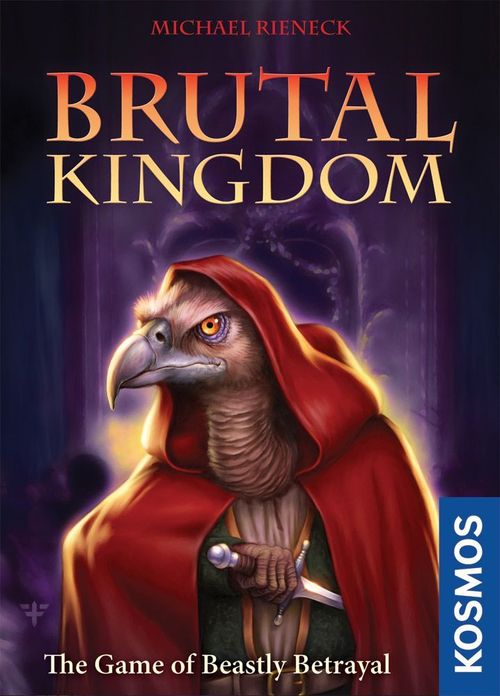
Brutal Kingdom
Brutal Kingdom Rulebook
Table of Contents
Table of Contents
Game Components
20 character cards split into 2 colors:
- 10 cards with a light-colored back
- and 10 with a dark back
1 Chapel card
8 reference cards (4 character reference cards, 4 elimination reference cards)
39 power tokens:
- 13 blue (royal power)
- 13 green (church power)
- 13 yellow (mystic power)
12 elimination tokens (8 worth 1 point, 4 worth 3 points)
1 first player card
Setup
- Before your very first game, carefully separate the tokens from their frame sheet.
- Each player takes two different reference cards and places them face up in front of themselves. These show the characters in the game and a diagram of who can eliminate whom.
- Place the Chapel card face up in the center of the table.
- Place the power tokens and elimination tokens next to the Chapel — this is the general supply. Sort the power tokens by color so that everyone can easily see how many power tokens of each color remain in the general supply.
Important: In a three-player game, remove 2 power tokens of each color from the game.
Character cards with a light-colored back are separated from the cards with a dark back. Shuffle each of the two resulting stacks separately.
Important: In a three-player game, only 16 character cards are used. Characters with ranks 1-4 (Charlatan, Black Knight, Courtesan and Fortune Teller) are removed from the game.
- The oldest player goes first. They take the first player card and place it in front of themselves. Now the game begins!
Course of the Game
- The game consists of 4 chapters. Each chapter is divided into 4 rounds. In each round, every player plays 1 character card face up, placing it in front of themselves. After 4 rounds, the chapter ends. After 4 chapters, the game ends and the winner is determined.
- At the start of a chapter, each player must receive 2 character cards with a light-colored back and 2 cards with a dark back (see "Dealing the character cards" below).
- Each player therefore has 4 character cards available to play in their turn. Once all cards have been played, the chapter ends and the distribution of power tokens begins.
- When a player plays a character card, they place it face up, on top of the cards they have already played, so the last character card they played always lies on top and is visible to the other players. By the end of the chapter, a stack of 4 character cards will have formed in front of each player.
- Some character cards show power icons in the upper corner. At the end of the chapter, players whose stacks of played cards contain characters with power icons receive the corresponding power token from the general supply for each such icon.
Important: During a chapter, one or more character cards may be eliminated by other character cards (see "Eliminations and Consequences"). Eliminated character cards are turned face down. At the end of the chapter, eliminated cards do not yield power tokens.
- The Bishop, if not eliminated, yields 2 power tokens (church power) at the end of the chapter.
- The Witch, if not eliminated, yields 1 power token (mystic power) at the end of the chapter.
- The Fortune Teller, regardless of whether she was eliminated or not, does not yield power tokens, since this character's card has no power icon.
Sequence of Play During a Chapter
Dealing the Character Cards
- Each player is dealt 2 character cards with a light-colored back, face down.
- This leaves 2 light-backed character cards remaining. Both undealt cards are placed face down, next to each other in the center of the table (next to the Chapel card).
- Each player chooses one of the two cards they received to keep. They give the second card to the player on their left so that the other players do not know which card they passed. In this way, each player once again has 2 light-backed character cards.
- Do the same with the dark-backed character cards. Each player receives 2 dark-backed character cards.
- The 2 remaining cards are placed face down in the center of the table (next to the light-backed character cards).
- Each player keeps one of the newly received cards in hand and, this time, passes the remaining one to the player on their right.
- Now each player has 2 light-backed character cards and 2 dark-backed character cards. And each player knows about one card belonging to the players on their right and left.
Table layout after dealing the character cards (in a four-player game)
(A diagram shows, around the table: each player's stack of already-played character cards; the two face-down piles of undealt light- and dark-backed cards next to the Chapel card in the center; and each color's power tokens and the elimination tokens grouped beside the Chapel.)
Ranks and the First Player Card
- The order in which cards are played matters enormously. The first player card and the ranks of the character cards (from 1 to 20) play an important role here.
- The first round of the chapter begins. The player holding the first player card plays a character card from their hand face up in front of themselves. The other players do the same in clockwise order.
- Once all players have played their first card, play returns to the player holding the first player card. They pass the first player card to the player whose face-up character card has the highest rank. Note: if the player holding the first player card also revealed the character with the highest rank, they keep the first player card.
- The second round of the chapter begins. The player with the first player card plays a second character card from their hand face up, on top of the card they played in the first round. The other players do the same in clockwise order. Note: it will regularly happen that the player who played last in a round will play first in the following round.
- This whole process is repeated for two more rounds, for the third and fourth character cards of each player. Don't forget to determine who receives the first player card at the end of each round.
Very important: Once each player has a stack of 4 character cards in front of them, but before power tokens are collected, it is necessary to determine who receives the first player card. This player will start the first round of the next chapter.
This rule must also be observed in the last round of the last chapter, even though players will no longer be playing character cards. The player with the first player card will be first to take power tokens from the general supply. This matters for the last chapter, since power tokens of a certain color in the general supply may run out.
The Chapel and the Saint
- When a player plays the Saint character card, they place any one power token of their choice from the general supply onto an empty space of the Chapel. The token stays there until the end of the game and counts toward that color's power token value when scoring.
- If the Saint was not played this chapter, the current first player places one elimination token from the general supply onto an empty space of the Chapel. This also serves to keep track of how many chapters remain to be played.
Card Effects
- At the bottom of each character card is a text description of its effect. The effect triggers immediately as soon as the card is played.
- If a card's effect description begins with the words "You may", the player may choose whether or not to activate that card's effect. All other effects must be carried out whenever possible.
- Detailed explanations of the character cards' effects can be found at the end of the rulebook.
Eliminations and Consequences
- At the end of a chapter, a player receives power tokens depending on which character cards they played, provided those cards were not eliminated.
- Eliminating characters belonging to other players, which would otherwise yield them power tokens, is an important aspect of the game. By eliminating other players' characters, a player earns points needed to win, while also preventing other players from scoring points.
- If a card's effect eliminates another player's character, that player must turn all played character cards in their stack face down. That is, not only the character card lying on top of their stack is eliminated, but also all character cards they played earlier in the chapter, before it! This means a player may end up receiving no power tokens at all, if the character card they played in the last round of the chapter is eliminated.
Note: If a card that has already been eliminated is eliminated again, it remains face down.
- If a card's description begins with the word "Eliminate", that card's effect triggers immediately as soon as it is played. This card's effect is activated only at that moment, and the elimination can happen only then. Elimination can only be applied to the last character card played by another player: it must lie face up on top of their stack. If the target was not played, or has already been covered by other character cards, nothing happens. Example: The Poisoner is already lying on top of a player's stack. Accordingly, the other players may safely play the Prior and the Bishop, since the Poisoner has already been played and can no longer eliminate them.
- There are three exceptions that do not trigger instantly (see these cards' descriptions): the King, the Queen and the Executioner. Their elimination effect remains active until they are covered by other character cards. The King can eliminate the Queen and vice versa. The Executioner can eliminate any character except the Saint.
- All potential elimination targets are marked with a skull-and-crossbones icon as a warning. Characters that yield more power tokens are generally easier to eliminate.
Note: To remember who can eliminate whom, players may always check their reference card.
- If a player successfully eliminates another player's character, they receive an elimination token worth 1 point, which counts as one victory point at the end of the game. Even if the elimination causes the other player's entire stack of character cards to be turned face down, they still receive only one elimination token worth 1 point.
Note: A player may exchange three 1-point elimination tokens for one 3-point elimination token.
End of a Chapter
- After 4 rounds of play, once players have played 4 character cards each, the chapter ends. It is now necessary to determine who receives the first player card.
- Starting with the player who received the first player card, each player in turn receives power tokens for each corresponding power icon shown on the character cards in their stack that were not eliminated. If a player cannot take a power token because the general supply of that color has run out, they receive nothing.
- If the Saint was not played, the player with the first player card places one elimination token from the general supply onto the Chapel card.
- After this, the character cards are shuffled and dealt again, as described earlier, for the new chapter.
End of the Game
After 4 chapters, the game ends and players tally their points.
- Each power token (green, yellow or blue) is worth as many points to a player as the number of power tokens of that color that remain in the general supply plus on the Chapel card at the end of the game.
Example: If the general supply and the Chapel card have as many tokens left as shown in the illustration, each green power token is worth 3 points, each yellow token 4 points, and each blue token 2 points. If no green power tokens remained in the general supply, each green token would be worth 2 points (because 2 green power tokens are lying on the Chapel). If no blue power tokens remained, blue tokens would be worth 0 points.
- Each elimination token is worth as many points as shown on it (that is, 1 or 3 points), regardless of how many elimination tokens remain in the general supply or on the Chapel card at the end of the game.
The player with the most victory points wins.
In case of a tie, the tied player who holds the first player card at the end of the game wins. If none of the tied players holds the first player card, the tied player seated closest to the player holding the first player card, in clockwise order, wins.
Tactical Tips
- To get better acquainted with the game, play a trial round of the first chapter. This is the easiest way to learn the different characters in the game.
- When drawing cards into your hand at the start of a chapter, think carefully. A player whose hand consists entirely of high-rank cards (potential targets), such as the King, the Bishop and the Wizard, is unlikely to be able to play all of them safely and has a good chance of losing all of them.
- Players should pay close attention to the turn order. The player who plays the last character card in a round has a decent chance of safely playing a high-rank character. If a player, for example, played the King card last in a round and received the first player card, this immediately brings their turn around again. Accordingly, that player can cover the King card with a low-rank character card, such as the Courtesan. This gives the player a good chance of receiving 2 blue power tokens at the end of the chapter.
- Most eliminating cards can be applied to 2 different cards. For example, a player holding both the King and the Queen in hand can play one of them so it gets eliminated by the Assassin, in order to then safely play the second one.
- It isn't too hard to work out which cards are where. Remember which cards you passed to your neighboring players.
- Players should also keep a close eye on the general supply of power tokens, in order to determine which tokens will be more valuable by the end of the game. For example, a player who successfully plays the King at the end of the game, when only 1 blue power token remains in play (and there are no blue power tokens on the Chapel card), will ensure that players who have collected many blue power tokens receive no points at all for those tokens.
- Never give up, even if all your cards were eliminated by the end of a round. It's not uncommon for a player to win having only received power tokens in the last chapters of the game.
- Try to play after the presumed leader.
- It's also important to know which cards are lying face down in the middle of the table. The Fortune Teller, the White Knight, the Monk and the Druid can help with this.
Variant for 3 Players
Remove characters with ranks 1 through 4 from the game. Before each chapter, randomly set aside 2 light-backed and 2 dark-backed character cards without looking at them. These 4 cards will not take part in the game for this chapter only. Before the next chapter begins, shuffle them back in with the rest of the cards.
Additional Character Card Descriptions
Charlatan
If a character card that was returned to play has an effect, it does not trigger. Only one character card is turned face up. The other character cards in that player's stack that were eliminated before it remain out of play. If, during the game, that player's cards become the target of an elimination, all of the cards are turned face down again under the normal rules. If a player has no eliminated cards in their stack of played character cards, the Charlatan is played with no effect.
Black Knight
The player may take 1 power token of their choice at the end of the chapter, even if they received an elimination token during that chapter.
Courtesan
A player may exchange 2 cards with one player, or 1 card each with two different players. During the exchange, the player places a card from their hand face down in front of the player they are trading with. The player they are trading with also places a card of the same back color (light or dark) in front of the player who initiated the trade. The player who initiated the trade cannot look ahead of time at which card they will receive. If a player has no card of the needed back color, that player cannot be chosen for the trade. The player who played the Courtesan may choose whether to trade only one card or two. If that player wants to trade two cards, they must trade cards of different back colors.
Fortune Teller
Cards in the center of the table may only be viewed one at a time, in turn. The player must return the cards they viewed to their original places. A player may not swap the cards' positions.
Poisoner, Berserker, Assassin, Prior
If one of these cards has already been played, the corresponding targets can be played without risk. If both corresponding targets are present in the game, the player must choose which one to eliminate; both targets cannot be eliminated at once.
Druid, White Knight, Monk
The player exchanges both of their cards face down. The player chooses one of their cards and exchanges it for a card of the same back color from the center of the table. In doing so, the player may not look ahead at the card they are taking in exchange, and the other players do not know which card they placed in its stead.
Executioner
The player places the Executioner card on top of their stack and immediately names its target. The Executioner will only eliminate the target if it is played after being named, while the Executioner card is still face up on top of the stack. The Executioner is most dangerous in the last round of a chapter, especially if a player accurately remembers which cards have already been played. If the Executioner is played in the early rounds of a chapter, when players still hold many cards in hand, it is not difficult to avoid.
Intriguer
If the Intriguer is itself the character card with the highest rank, it remains in front of the player and does not lead to an exchange. If the card the Intriguer is exchanged for has an effect, that effect does not trigger after the exchange.
Witch
A player may look at another player's cards only at the moment the Witch is played. The player may not change or reveal to other players which cards they saw.
King, Queen
Unlike other cards, these two cards do not activate their effect immediately. The target of these cards will only be eliminated if this card lies on top of a player's stack and the target is played after it.
Saint
This is the only card that is protected from the Executioner. There is no card in the game that can eliminate the Saint, so the cards lying in a stack beneath the Saint card are protected from elimination for as long as the Saint card remains on top of the stack. If the Saint is covered by another card in the following round, this protection is lost.
Inquisitor
The player holding this card in hand must reveal and show it. During a trade, a player may not look at the card they are trading for the named card. The Inquisitor's card effect triggers immediately (that is, at the moment it is played). If none of the players hold the named character card in hand, nothing happens.
The Inquisitor's rank is either 20 or 0. As soon as the Inquisitor is played, the player must announce which rank they are choosing, the higher or the lower — that is, decide whether they will start the next round (rank 20) or not (rank 0).
Bishop, Wizard
Besides the King, only these two cards, under a favorable set of circumstances, yield 2 power tokens each. For this reason, they are especially popular targets for other players.