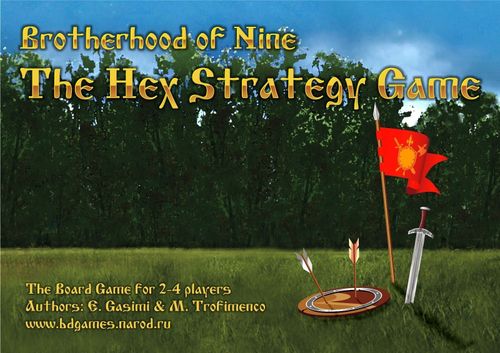
Brotherhood of Nine: The Hex Strategy Game
Brotherhood of Nine: The Hex Strategy Game Rulebook
Table of Contents
Table of Contents
Components
- Game board
- 52 hexagonal warrior tokens (4 sets of 13 tokens, one set per colour):
- 8 Kveblir (cavalryman)
- 8 Linda (archer)
- 12 Surron (berserker)
- 12 Drantul (heavy infantryman)
- 12 Ekvil (light infantryman)
- 4 Shield tokens (one of each colour)
- 4 Flag tokens (one of each colour)
- 40 wound markers
- Rulebook
Setup
Each player receives a set of tokens in one colour: the warrior tokens and a Shield. From the 13 warriors available, each player must choose 9 to take part in the battle. Choose secretly, so that opponents do not know which warriors you have picked.
Once all Brotherhoods are ready, determine by any method who moves first. Only after that is the placement of tokens on the board begun.
The placement of the warbands depends on the number of players taking part, and is made according to the layouts shown in the diagrams for two, three and four players. Also note:
- With two players, only the small (inner) board is used.
- With three players, the small board and the middle ring are used.
- With four players, the game is played on the whole board.
Warrior tokens are placed face down at first, so that opponents do not know until the very start of the game which warriors you took into your warband and how you placed them. This creates what is called the "Fog of War." Within your own battle formation, a player may place their warriors as they see fit.
[Setup diagrams for two, three and four players are not reproduced here; the source document refers to them as pictures, and only the text was available.]
Right before the game begins, once the first player has been determined and all Brotherhoods have been placed, the players turn their warrior tokens face up.
Turn Structure
On your turn you may perform up to three actions. There are several kinds of action: movement, attack and defence.
Each warrior (token) may perform up to two actions during the player's turn, but a warrior may not perform the same action twice (for example, two movements or two attacks).
Example: A Surron performs two actions: it moves one space and attacks an enemy Kveblir (the attacking player declares which of their tokens is attacking and which enemy token it attacks). The Surron has performed two actions, Movement and Attack, and may perform no further actions this turn. The third action may be performed by a different token that has not performed any action this turn.
[The example is accompanied by an illustration in the source, which is not reproduced here.]
Attack
Each warrior token may attack an enemy token that is on an adjacent space (that is, at a distance of one space). The attacking player declares which of their own tokens is attacking which enemy token, and deals one unit of damage. Only the Linda may attack at a distance of two spaces, in any of the six directions.
Movement
Each warrior token may move one adjacent unoccupied space in any direction. Because the spaces on this board are hexagonal, the token may move in any of the six directions. Only the Kveblir may move two spaces (in a single action).
[The movement illustration in the source is not reproduced here.]
Defence
Each player has one Shield token. By spending one action on their turn, a player may protect one of their warriors. A Shield marker may stay on a warrior token indefinitely, until the player removes it from the warrior themselves or the opponent knocks the warrior out. An opponent may knock off a Shield by attacking the protected warrior; in that case the warrior token takes no damage.
Warriors
In the game "Brotherhood of Nine: The Hex Strategy Game," players have access to 5 different types of warrior: Kveblir, Linda, Surron, Drantul and Ekvil. Each type has its own unique abilities, which, when skilfully combined and used, can lead a player to victory. The abilities of each warrior are described in the appendix.
[The appendix is not included in the source text, so the individual warrior abilities are not transcribed here.]
Each warrior token has two or three units of health. During an attack, when a warrior is wounded, 1 wound marker is placed on the token. When the number of wound markers equals the warrior's number of health units, the token is considered "killed" and is removed from the board.
End of Game
The game ends when only the warriors of one Brotherhood remain on the board, or when an opponent surrenders (their whole Brotherhood is removed from the board). The player whose warriors are the last remaining on the board is declared the winner.
Other Game Variants
Variants may be played individually or combined with one another (for example, Allies with Flag Capture).
Allies
This mode is played by four sides. The players are divided into two teams of two Brotherhoods each. Setup is the same as in the standard rules, but the positions of allies are agreed in advance. There are two ways to position allies in this mode: "wall to wall" and "criss-cross."
- "Wall to wall": allied Brotherhoods are set up next to each other, and the opposing allied Brotherhoods are on the opposite part of the board.
- "Criss-cross": allied Brotherhoods are set up across from each other. The opponents' Brotherhoods will then be located to the right and to the left of each player.
Otherwise the game follows the standard rules. The group of allies whose tokens remain on the board wins.
Flag Capture
For this mode, give each player a Flag token. In the period after the Brotherhoods have been set up and before the warrior tokens are turned face up, each player places a Flag token on one of their warriors.
A warrior carrying a flag may attack, but may not move or use a Shield. The goal of the game is to destroy the warrior carrying the flag and capture the flag. In other words, when a player's warrior destroys an opposing warrior carrying a flag, and then remains standing next to the flag token, that player is declared the winner. Otherwise the game follows the standard rules.
Note: If an opposing warrior carrying a flag is destroyed, but the player's warrior is also destroyed, then to win the player must stand next to the enemy flag with another warrior. A Flag cannot move.
Good fighting to you!