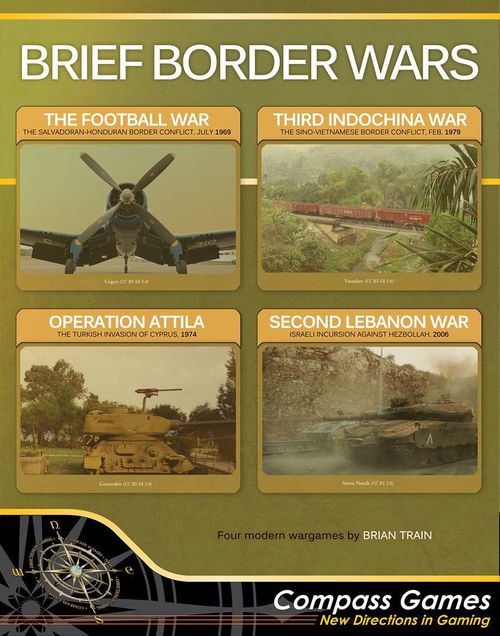
Brief Border Wars
Brief Border Wars Rulebook
Table of Contents
Table of Contents
System Rules (Read these first)
1.0 Introduction
These rules form the common framework for play of the games; each game has an exclusive rules set that will qualify these rules and mechanics to fit the particular historical conflict.
Passages and phrases in italics provide explanation, rationale, extra detail, clarification or "colour" commentary by the designer.
1.1 General Course of Play
The play of the game is divided into a number of Game Turns. Each Game Turn is divided into several Phases. See 4.0 for the Sequence of Play. In general terms, both players will draw a number of cards from a deck of Action Cards, then will expend them alternately to conduct different activities with their counters on the map. The game will end in the Final Phase of the final Game Turn, at which time play stops and players judge victory (see 8.0).
2.0 Game Components and Concepts
Each game comes with a set of counters, a map of the general region where the conflict took place divided into areas, a Player Aid Card, a set of cards, and these rules. Players will also need several six-sided dice (d6).
2.1 Counters
Each game has a set of cardboard counters. They represent military formations, and are moved on the map. These are called "units" and each one has the following information on it:
- Type symbol. This will tell you what type of formation the counter represents. Ground units have a "box symbol" denoting their troop type. Air units have the silhouette of an aircraft representing the majority of plane types in that group. See the Identification Chart in each game's rules (2.2).
- Combat Values. Each unit has a Combat Value (CV) printed underneath its troop type symbol. This is the number of d6 it will roll during combat (6.3). Also, the reverse side of units has a stripe, to denote that it has been disrupted and cannot attack (however, it can defend itself). Players will also note that most, but not all, units have a lower CV when they are disrupted. Air units have a blank back (with a national flag) to show they cannot do anything while disrupted. See 6.2.
- Nationality. Units in the game are coloured to distinguish them by nationality.
- Identification. Units in the game will usually have a distinctive formation number, or an abbreviated title. See the Identification Chart peculiar to the game (2.2).
2.3 Maps, Displays, and Playing Aids
2.31 Map. The map depicts the general region where the conflict took place. During play, units move from one area to another (see 6.2) and conduct combat within them.
- Many areas contain symbols denoting Woods, Mountain or Urban terrain; these are used to denote rough or closed ground that aids the defender in combat.
- Some areas are marked with a Victory Point value, which will be awarded to one player if they control it at the end of the game (see 9.0 for definitions).
2.32 Displays. Each side also has one or more boxes labelled "Rear Area" which represents off-map or otherwise inviolable military bases, logistical sites and garrisons. Units will move from the Rear Area to areas on the map. Each side also has one or more boxes labelled "Damaged Units". Units that have been damaged in combat are placed here and must be moved out of it into the Rear Area by die rolls or play of Special Action cards (6.31, 7.0). In some games, a unit in the Damaged Units box is not actually damaged but will take a variable amount of time to reach the front; see exclusive rules.
2.33 Player Aid. Finally, there is a player aid card containing the Random Events Chart (5.0) for Second Lebanon War, and an alternate scenario for Third Indochina War.
2.4 Game Concepts
- Damage: A unit that takes significant casualties or leadership losses is damaged, and is placed in the Damaged Units Box. Units recover from this state through use of Special Action cards or die rolls in the Final Phase (7.0). Some units in some games are not damaged but are eliminated instead; see the exclusive rules for exceptions.
- Disruption: A unit may be disrupted for a variety of reasons, usually as a result of combat. It is flipped over to show its reverse side. A disrupted ground unit may move but cannot attack; a disrupted air unit cannot do anything. Units recover from this state through use of Special Action cards or die rolls in the Final Phase (7.0).
3.0 Setting Up the Game
- Players agree on which of the four games they will play. One player will be the "designated player" (see the exclusive rules for the game).
- Give the 6 white Special Action cards to the designated player. Give the 6 grey Special Action cards to the other player. Take the deck of 42 Action cards, shuffle them and put them in a stack in a mutually convenient place on the table.
- Sort the unit counters out by nationality and place them as directed in the setup instructions for the specific game. Numbers in the instructions generally refer to the formation numbers marked on the counter (2.1).
- Place the Game Turn marker in the "1" space on the Turn Record Track on the map.
4.0 Sequence of Play
Each Game Turn is organized into the following Phases, performed in order. The body of the rules explain what to do in each Phase.
- Card Selection Phase
- Card Play and Resolution Phase
- Final Phase
- (start next Turn with the Card Selection Phase)
The printed Sequences of Play are specific to each game and contain references to rules changed or added to that particular game.
5.0 Card Selection Phase
One player (it doesn't matter who) draws six cards from the top of the deck. Without looking at them, the player gives the WHITE cards drawn to the designated player, and the GREY cards drawn to the other player. If a Random Event card was drawn at this time, resolve it per the Random Events Chart at the end of each game's rules. (Exception: Remember that the Random Events Chart for Second Lebanon War is printed on the separate Player Aid Card.) Players then examine their hands of cards in secret and frown while planning what they will do during the following Phase.
It is very unlikely, but possible, that sometimes one player will get all the cards and the other player none. Reflect that everyone has a bad day sometimes and that this event is nearly equally probable for either player, so it could have just as easily been you. In fact, the odds of you getting all of them on a future turn have just risen. Meanwhile, you can still play whatever Special Action cards you happen to have in hand (6.3).
6.0 Card Play and Resolution Phase
Players will play one card each in alternating sequence, beginning with the player who received the most cards in the Card Selection Phase (a designated player wins ties). Cards are discarded after playing. The cards have differing effects depending on their icon and number:
- Action cards have two values marked on them: one for movement (marked with icons of marching soldiers) and one for combat (marked with an icon of an AK-47 rifle). They have values of 1 to 8. Players use Movement values to move up to an equal number of units (see 6.1) and Combat values to have up to an equal number of their units attack enemy units in the areas where they are located (see 6.2). An Action card must be played for one, and only one, of its two values: players may not "mix and match" movement and combat on the same card.
- Cards marked "SPECIAL" are Special Action cards. Players start the game holding all six of these, and may play one of these cards instead of one of the newly drawn cards in the Card Play and Resolution Phase. Special Action cards have several functions, see 6.3.
- Cards marked "RANDOM EVENT", when drawn from the deck, denote that an unforeseen event has occurred. After the two players have taken their respective cards, one player (it doesn't matter who) must roll 1d6 on the Random Events Chart and implement the result as directed. Players then proceed with the Card Play and Resolution Phase.
Passing. A player may Pass instead of playing a card. (Random Event cards must be implemented, though.) In this case nothing happens and the other player may now play a card, or Pass. If both players pass in succession the Card Play and Resolution Phase is over. Players discard any remaining Movement or Combat cards and move to the Final Phase (7.0).
6.1 Movement
When a player plays a card for its Movement value, they may move a total number of units on or onto the map up to the value of the card (so, 1-8 units). Units may move from one area to an adjacent area on the map, or from the Rear Area to an adjacent area on the map. The exclusive rules to a game may modify these permissions.
6.11 Movement limits and exceptions.
- A given unit may move only once per card (it may move more than once per Game-turn, though).
- A ground unit that is in an area with undisrupted enemy ground units may not move out of that area. (Some games may have exceptions to this rule.)
- Some areas on the map may not be entered (e.g. countries not involved in the conflict). See the game's exclusive rules.
6.12 Moving from the Rear Area. As part of playing an Action card for its Movement value, units may be moved from the Rear Area into areas on the map. Games may have exclusive rules specifying exactly how this is done.
6.2 Combat
Playing a card for its Combat value will allow a player to engage in combat in up to all areas where his units are co-located with enemy units, with a total number of units up to the value of the card (so, 1-8 units). The player who played the card is called the Attacker, and the other player is the Defender, no matter what the overall strategic situation. Combat is voluntary on the part of the Attacker, that is, they do not have to have combat in all eligible areas. If the Attacker decides to have combat in a given area, they designate the ground units involved on both sides (the Defender may, through a Reaction Move, also add to the number of defending units: see 6.3). Only undisrupted units may attack, and a given unit may attack only once per card (it may attack more than once per Game-turn, though).
6.21 Combat procedure. The following procedure is followed in each area where the Attacker wishes to have combat. Remember the total of attacking units determined by the value of the Combat card played is the total for all ground and air units in all areas, not per area.
- Pre-Combat Step.
- The Attacker designates an area where combat will occur; this is called the Battle area. The Attacker designates all ground units on both sides that that will participate in the combat in the Battle area. They may designate fewer than the total number of Attacker or Defender units in the area, and may have to do this depending on the number of undisrupted Attacker units and the value of the card played.
- The Attacker may also designate undisrupted Attacker air units that are either already in the Battle area or are added from the player's Rear Area, up to the number of designated attacking ground units. Air units may not attack ground units on their own. Instead, each air unit may assist attacking ground units in its area by adding 1d6 per air unit (regardless of their CV), up to the number of friendly ground units involved, after all air-to-air combat is resolved. Again, remember that the value of the Combat card played is the total of all ground and air units that may attack in all Battle areas, not per Battle area.
- The Defender may now add to the battle any friendly air units that were already in the Battle area, up to the number of friendly ground units designated by the Attacker.
- At this time, the Defender may also play a Special Action card for a Reaction Move. The Move may consist of either moving undisrupted air units from the Rear Area to the Battle area, up to the number of designated defending units in the area, or adding a total of up to 2 friendly ground units to the designated defending units, from the Battle area itself or moving into the area from 1 or 2 adjacent areas. See 6.32.
- Air-to-Air Combat Resolution Step. After both players have committed all air units desired to combat in the Battle area, they will conduct air-to-air combat as described in 6.22 if fighter aircraft are present on one or both sides.
- Ground Combat Resolution Step. Both players simultaneously roll a number of d6 equal to the total Combat Value of the units in their designated groups. The defender adds dice for each terrain symbol in the area (+1d6 for each Woods or Mountain symbol, +2d6 for each Urban symbol). Both sides will add +1d6 for each air unit that survived air-to-air combat undisrupted (regardless of the CV of the air unit). A "5" or "6" on a d6 scores a Hit.
- The player inflicting the hits decides which involved enemy units receive how many hits. The Attacker allocates Hits scored on enemy units before the Defender does. What happens next is determined by whether the suffering unit was attacking or defending, and/or was disrupted or undisrupted at the time the hits were inflicted.
6.22 Air to Air combat. If fighter air units (that is, an air unit marked "F") are present in an area with enemy air units, then the fighter units may engage enemy air units in combat before ground unit combat is resolved. Each player with fighter air units present rolls a number of d6 equal to the total CV of their fighter air units simultaneously. A "5" or "6" on a d6 scores a Hit. The player inflicting the hits decides which enemy air units receive how many hits.
- An air unit that receives at least 1 hit, but less than its CV of hits, is disrupted and returns to its Rear Area, face down to show its disrupted (blank) side.
- An air unit that receives equal to or more than its CV of hits is damaged and is placed (face up) in the Damaged Units box.
Any air units that survived the air-to-air combat undisrupted may assist their ground-pounder comrades, each adding 1d6 to the total dice rolled by their side (regardless of the air unit's CV). Note: unlike ground units, air units do not retreat.
6.23 Retreats. In a retreat, a given ground unit will leave the Battle area and enter an adjacent area. A retreating unit cannot retreat into a space with undisrupted enemy units in it.
- Undisrupted defending units may retreat if the Defender chooses. Defending disrupted units must retreat.
- Attacking units may not retreat.
- A unit that must retreat and cannot is damaged instead.
- Certain games may alter or suspend this rule for certain units or situations. See the exclusive rules for that game.
6.24 Exploitation. If at the end of a given battle all Defender units in the entire Battle area have been disrupted or damaged, any Attacker mechanized type units involved in that battle that are still undisrupted may move into one adjacent area. See the exclusive rules for the game for any variations or limitations on this.
6.3 Special Action Cards
A player playing a Special Action card may use it in a number of ways. A Special Action card may be played when it is that player's turn to play a card, or when permitted by the rules. Cards are discarded after use.
6.31 Repairing and refitting units. A player may do the following by playing a Special Action card:
- undisrupt ALL disrupted ground units in any ONE area on the map, or
- undisrupt ALL disrupted air units currently in the Rear Area, or
- move ALL units (ground and air) from the Damaged Units box into the Rear Area.
6.32 Reaction Move. At the end of the Pre-Combat Step, the defender may play a Special Action card to make a Reaction Move. This may take one of two forms:
- Air: a number of undisrupted air units up to the number of designated defending units in the Battle Area may be moved from the Rear Area to the Battle area (this may trigger air-to-air combat); or
- Ground: a total of up to 2 undisrupted friendly ground units may join the designated defending units, from the other units in the Battle area or from up to 2 adjacent areas (that is, 2 from 1 area, or 1 each from 2 areas). In the latter case, the units move from the adjacent areas into the Battle area; they may not move from adjacent areas if there are undisrupted enemy ground units in their original area.
6.33 Other. Certain games may add other functions for Special Action cards: see the exclusive rules.
7.0 Final Phase
When both players have played and discarded all the drawn and Special Action cards they are willing or able to, or if both players have Passed in succession (and so discarded all their remaining cards), the Game-turn enters the Final Phase. If this is the final Game-turn, the game ends and players judge Victory (see 8.0). If not, then:
- All air units return to their respective Rear Areas.
- Units may recover from disruption or damage. Each disrupted or damaged ground or air unit checks individually for recovery by rolling 1d6. On a "5" or "6" a disrupted unit is undisrupted, or a unit in the Damaged Units box is moved to the Rear Area. Exclusive game rules may modify or limit this.
- Advance the Game Turn marker to the next higher numbered space on the Turn Record Track.
8.0 Game End and Victory
The game ends at the end of the Final Phase of the 7th Game-turn (a specific random event may shorten the game by one Game-turn). To judge victory, players examine each area on the map that is marked with a Victory Point (VP) value. One player or the other is awarded the VP for an area if they are the only one with an undisrupted ground unit in it. The player will score a grade of victory depending on their total VP. See the exclusive rules for that game for any additional sources or adjustments of VP.
9.0 Special Rules
Each game will have a set of exclusive special rules to reflect the specialized nature or abilities of certain units in the game, as well as some optional rules players may use to address play balance. See the exclusive rules for that game. The following rules may be implemented for any of the games, by recommendation or mutual agreement of the players:
9.1 Varying player advantage and ability
Players who want to change the balance of the game may do one or more of the following, to show one side's superiority or inferiority in command ability, combat skills, organization or intelligence resources.
9.11 General organizational ability. Have one side or the other start with fewer than 6 Special Action cards. Take as many of these out as players may mutually agree to, but the player so deprived will be given 1 Victory Point in compensation for every 2 cards removed (round up).
9.12 Formation agility. Do not allow one or both players to make Reaction Moves (6.32).
9.13 Intelligence Advantage. Have one player place their hand of Action cards face up (so the other player knows what kind of cards they have, but not necessarily what order they will be played).
9.14 Poorly Trained Staff rule. A player affected by this rule may use Action cards normally, but only for the larger of the two values marked on the card (yes, this will mean that occasionally a player will be able only to move when they would like to fight, or only fight when they would also like to move).
9.15 Skilled Guerrillas. If all attacking units in a battle are Irregulars, and all designated defending units are non-Irregulars, then the Defender does not add dice for terrain symbols in the Battle area.
10.0 Designer's Notes
Here the designer will say in the exclusive rules for each game something about the historical conflict, and the decisions on how aspects of that conflict were incorporated into the game design.
More generally speaking, the system used in this "quad" of games is a development of that used in a game designed in 2016 called The Little War, on the brief frontier war between Hungary and Slovakia in March, 1939. For its basic mechanics this game used a deck of ordinary playing cards: one side got the two red suits while the other got the black ones; one suit was Movement and the other was Combat, with the values from 1 (Ace) to 10; face cards were Special Action cards and the two jokers were Random Events. That structure is kept in this game, which uses a total of 54 cards, but the primary values have been placed on a bell curve with values of 4 to 8, and secondary values of 1 to 3. The movement and combat systems are largely the same. In fact, you could go a step backwards and use a deck of ordinary playing cards in playing any of these games, but keep in mind card values would be quite variable and you could encounter turns in which you had ability to move, but not to fight, or vice versa (though you could still use Special Action cards).