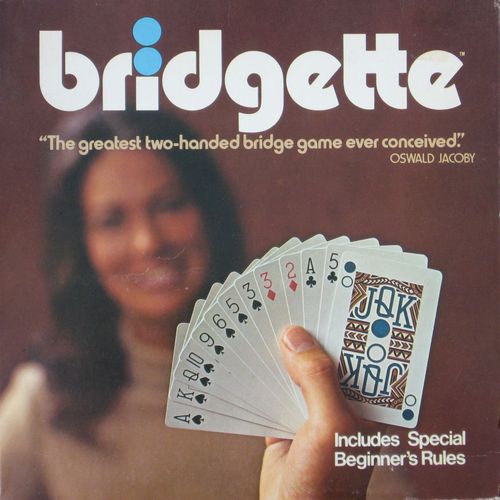
Bridgette
Bridgette Rulebook
Table of Contents
Table of Contents
Basic Rules
The Pack
The Bridgette pack consists of 55 cards, the standard 52 cards (but with the four suits in four different colors) plus three special "colons." There are two of these packs included in the box, but only one is used per deal.
The suits rank: Spades (highest), Hearts, Diamonds, and Clubs (lowest). Within each suit, the cards rank: Ace (highest), King, Queen, Jack, 10, 9, 8, 7, 6, 5, 4, 3, 2 (lowest).
The colons have no actual rank, but each matches with one of three groups of cards in the pack:
- The Little Colon matches all spot cards (2-10).
- The Royal Colon matches all picture cards (J, Q, K).
- The Grand Colon matches all Aces (A).
How To Win
The winner is the player with the higher total score at the end of the match. A match consists of a series of deals, and each deal has five phases:
- Deal: Distribute cards to both players.
- Exchange: Both players improve their original hands by adding and then discarding several cards.
- Bidding: Similar to an actual auction, the players bid orally. A bid consists of two words--a number and a suit. The number refers to how many tricks the bidder expects to win; the suit states what the trump will be. A trump outranks any card in any other suit.
- Play: When each player plays a card, these two cards constitute a trick, and as each player has thirteen cards, there are thirteen tricks in each deal. When the final bid has named a suit as well as a number of tricks, each card of that suit is trump. When a trump is played to a trick, it outranks any card of any of the other three suits.
- Scoring: One of the players records the score on the Bridgette score pad. If the player makes at least the number of tricks called for in the final bid, that player scores points. If the player fails to fulfill the bid, then the opponent scores.
1. Deal
The players take turns dealing. To decide who will deal first, each player picks a card from a Bridgette pack spread face down on the table. The person picking the higher card deals first. If the cards are of equal rank, then the rank of suits decides. If you pick a colon, pick another card.
The dealer shuffles the cards thoroughly (seven riffles are ideal), and the opponent cuts. The dealer then completes the cut and deals thirteen cards to each player, one at a time, face down, beginning with the opponent. The dealer places the rest of the pack face down to one side and turns over the top card, placing it beside the remainder of the pack. This card is called the "upcard."
The players now pick up their cards. It is customary to arrange one's hand by separating the cards into suits; a colon may be placed between any two suits or at either end of one's hand.
2. Exchange
Next, the players improve their original holdings by getting extra cards from the pack. The receiver (opponent of the dealer) always receives two cards first, face down. The upcard determines the number of extra cards that the dealer receives:
| Upcard | Dealer receives |
|---|---|
| 2-10 (Little Colon) | 4 |
| J, Q, K (Royal Colon) | 8 |
| A (Grand Colon) | 12 |
For example, if the jack of diamonds is the upcard, the dealer gives two cards to the receiver before taking eight.
The players sort the extra cards with each player's original thirteen cards, then discard the same number of cards so that the players' hands are back to thirteen cards each before the bidding starts. Place the discards face down off to the side. It is important that after the exchange, the players verify that their hands contain exactly thirteen cards.
3. Bidding
The bidding phase of the game is just like an auction. The two players, in turn, make bids, and the player making the highest bid becomes the "declarer" and tries to fulfill the bid during the play of the cards. The opponent is the "defender" and attempts to win enough tricks to defeat the bid.
As mentioned already, a bid consists of two words: a number and a suit. The number refers to how many tricks the bidder expects to win; the suit states what will be trump. When the bidding ends, the hand is played out and in the play, one of the players takes a card and puts it face up on the table, and the other player does likewise. These two cards constitute a trick. Since each player has thirteen cards, there are a total of thirteen tricks in each deal. When the final bid has named a suit as well as a number of tricks, each card of that suit is trump. A trump outranks any card of any of the other three suits. A bidder who does not wish to name a trump suit bids "No-trump," signifying that all suits are of equal rank during play.
Throughout the bidding, if one player bids a suit or No-trump, the next bid must be higher than the previous bid. The suits rank: No-trump (highest), Spades, Hearts, Diamonds, Clubs (lowest). Thus, a bid of One Heart is higher than a bid of One Diamond, but lower than a bid of One No-trump or Two Clubs.
The number mentioned in the bid indicates how many tricks the player expects to win in excess of six. For example, a bid of One Spade is a contract to win one trick more than six, that is, seven tricks out of the thirteen in all, with spades as trump. This rule of bridge and Bridgette may seem strange, but the idea is to bid for more tricks than your opponent; thus, a player who bids is contracting for more than half of the thirteen tricks. The highest possible bid, by the way, is Seven No-trump, a contract to take all thirteen tricks!
A player may name more than one suit during the course of the bidding, but only the final bid settles which suit (if any) is to be trump. When a player does not wish to bid, he says "Pass."
Two other bids you may make are "Double" and "Re-double." When a player doubts that his opponent can make the bid, that player may say "Double," which increases the scoring values for that hand. When a player doubles, any subsequent bid by the other player cancels the double, and the bidding continues. There is nothing to keep you from doubling again if your double is canceled this way: it is possible for a player to double more than once while bidding. After a double, the other player may say "Redouble," which further increases the scoring for the hand.
The turn to bid alternates. The dealer bids first and may not pass on the first bid.
The dealer's lowest possible bid is Zero No-trump, a contract to take six tricks; it ranks just below a bid of One Club and is the only exception to bidding for fewer than half the tricks.
You may continue to bid even if your opponent passes, for the auction proceeds until there are two consecutive passes. The bidding ends immediately, however if a Pass or Redouble follows a Double.
In Bridgette, you must have:
- At least two cards in any suit that you bid
- At least four cards in any suit for a jump bid (a bid higher than necessary to raise the previous bid, such as bidding Three Diamonds after your opponent bids One Club)
- No void suits to bid No-trump; that is, you must have at least one card in every suit
Bidding examples. In the first example, the dealer starts by bidding Zero No-trump. The receiver elects to bid One Spade, but the dealer bids higher by saying "Two Clubs." When the receiver passes, the dealer decides to bid more, saying "Three Clubs," a bid to take nine tricks with clubs as trump. According to the bidding requirements, the dealer must have no void suits for the bid in No-trump and at least two cards in clubs for the bids in that suit. The receiver, in bidding spades, must have at least two cards in spades.
| Dealer | Receiver |
|---|---|
| 0NT | 1 Spade |
| 2 Clubs | Pass |
| 3 Clubs | Pass |
In the second example, the dealer opens at One Diamond, and the receiver, who could have bid One Heart, decides to make a jump bid of Two Hearts. The dealer, thinking that the receiver will not be able to fulfill this contract, doubles. The bidding continues, and the receiver now bids Two No-trump. The dealer, confident that the opponent will not fulfill this bid either, again doubles. The receiver, equally sure that the bid will be made, redoubles. The final contract is Two No-trump Redoubled. From the bidding, we know that the receiver must have at least four hearts to jump bid in that suit.
| Dealer | Receiver |
|---|---|
| 1 Diamond | 2 Hearts |
| Double | 2NT |
| Double | Redouble |
| Pass |
4. Play
Once bidding ends, the declarer makes the opening lead by playing any card, and the defender then plays a card. The winner of the trick leads to the next trick, and play continues until all thirteen tricks have been played.
Generally, a player may lead any card. When the opponent has led a card, the other player must play a card of the same suit, if possible. Whoever plays the higher card wins the trick. A player who cannot follow suit may play any card. When the final bid is in a suit, that suit is trump, and so, when a player cannot follow suit, the player may play any trump and win the trick. If the player plays any other card, the player loses the trick. Note that you do not have to play a card that will win the trick when you are able to legally play a lower card.
For example, suppose the bid is Four Spades by your opponent. For the opening lead, he plays the Queen of hearts. To win the trick, you may play the ace or king of hearts because both the king and ace outrank the queen. If you have no hearts, then you may play any spade, even the lowly deuce, and win the trick. If you have no hearts and do not choose to play a trump (any spade in this case), you may discard a club or a diamond and let the opponent win the trick. If all you have in hearts is a card lower than the queen, you must play it and lose the trick.
Collecting Tricks
To make play of the hand go quicker, the cards to each trick are not played to the middle of the table. Instead, the players play the cards in front of themselves (either holding the card or placing it on the table), and a card that wins a trick is placed face down to the player's left, and one that loses is placed face down to the player's right. Another advantage of this method is that both players' hands can be reassembled after the play for discussion or to see if any bidding requirements or other rules were violated.
The Colons
The three colons act mainly as defensive cards and add a very important element of skill to the game. As mentioned before, each of the three colons matches with a certain group of cards: the Grand Colon matches aces (A), the Royal Colon matches picture cards (J, Q, K), and the Little Colon matches spot cards (2-10).
Instead of following suit, a player may play the matching colon; that is, the colon from the same group as the card that was led. Played this way, the colon loses the trick, but it bars the opponent from leading the same suit on the next trick. On the next trick only, the opponent must lead a different suit (or one of the two other colons). If he only has cards belonging to the same suit, the colon play has no effect.
To illustrate, you may discard the Grand Colon on the lead of the ace of hearts, whether or not you have any hearts. For the next trick only, the other player may not lead a heart. If he has only hearts left, however, then the colon play has no effect. A player may discard one of the two non-matching colons only when the player has no cards in the suit led, and the play has no effect on the lead to the next trick. For example, if you lead with the queen of clubs and the other player discards either the non-matching Little Colon or Grand Colon, you may continue leading clubs.
Although a colon played to a lead always loses the trick, a colon can win the trick when it is led. When a player leads a colon, the opponent may play any card. If the card played is from the same group as the colon led (a matching card) or is any trump, the colon loses the trick; if the player plays any non-matching card, including either of the other two colons, the colon wins. A good time to lead a colon is on the last trick. If, for example, a player leads the Little Colon at Trick 13, and the opponent's last card is an ace or king, the Little Colon wins.
Colon example 1. In this example, each player has three cards left. The declarer leads the ace of spades, and the defender, instead of following suit, plays the Grand Colon! The declarer takes the trick, but is barred from leading spades to the next trick. Instead, he leads the jack of hearts, and it wins. The declarer now shifts back to spades, and the queen loses to the defender's king.
| Declarer | Defender | |
|---|---|---|
| Spades | A, Q | K |
| Hearts | J | 9 |
| Colon | none | Grand Colon |
Colon example 2. Here, the declarer is in a No-trump bid, and there are seven tricks left to play. Needing five more tricks to make the contract, the declarer leads and wins three easy tricks with his top three diamonds; the defender discards three low spades. The declarer confidently continues by leading the nine of diamonds. Surprise! The defender throws down the Little Colon, losing the trick, but forcing the declarer to shift suits. There is no choice but to lead the king of hearts, which loses to the ace, and now the defender's two remaining little spades will win the last two tricks!
| Declarer | Defender | |
|---|---|---|
| Spades | none | 10, 9, 8, 6, 5 |
| Hearts | K | A |
| Diamonds | A, K, Q, 9, 4, 2 | none |
| Colon | none | Little Colon |
5. Scoring
Traditional bridge scoring for Bridgette is explained in detail in the advanced rules.
Six-Deal Scoring
Because beginners often find regular bridge scoring rather strange, basic Bridgette uses a simpler scoring system that novices and casual players might prefer. It is also popular for experienced players who wish to play a quick match when time is limited or who wish to play a lively game for a stake.
Use the Six-Deal score pad, writing the players' names in the areas below SCORER and OPPONENT. After each deal, one of the players will earn points, and the scorer writes the correct score in that player's column. There is even ample space if the scorer wishes to write down the final bid and result, such as "2NT -1," which means the bid was Two No-trump and the bidder was set one trick (that is, he failed to make his bid by one trick).
After playing six hands, add up the scores and record the totals. If the match is tied, the player who dealt the first hand deals a tiebreaker seventh hand, and the score for this deal is recorded in the area well above where it reads TOTAL.
Offensive Score
The Six-Deal scorecard shows the score earned by the declarer for making the bid, and the amount varies with how high the declarer has bid, from Zero No-trump, which as a "bit-score" earns 100 points, to Seven No-trump, which is a "slam" that earns 2,500 points.
If the bid is doubled and made, the declarer scores 400 additional points, and a redoubled bid made earns 1,000 extra points. For example, a bid made of Three Spades Doubled would score 600; a bid made of Four Clubs Redoubled would score 1,200.
If the declarer makes tricks in excess of the bid, these are "overtricks" and score an extra 100 points, regardless of how many overtricks are made. The bonus for any number of doubled overtricks is 200, and any redoubled overtricks score 500. To illustrate, a bid of Six No-trump Redoubled with an overtrick would score 3,500 points.
Defensive Score
When defeating the bid, the defender's score is determined by how many tricks the bid was set (that is, by how badly the declarer failed to make his bid) and whether the contract was undoubled, doubled, or redoubled. For example, setting any doubled bid three tricks would score 900 points. If a bid is set more than six tricks, use the line "6+" at the bottom of the scorecard.
Hawaii Scoring
In this wild optional variation, the declarer tries not only to make the bid, but also to fulfill it "on the button" (no overtricks) to score 200 extra for an "Exacto!" Another option is for the declarer to attempt to win four or more overtricks, which will earn him 500 extra points for a "Surplus!" See the scorecard for details.
Advanced Rules
Bridge Scoring
While players at all levels of skill can use the easy Six-Deal scoring, bridge scoring is more complex and is for use only by experienced Bridgette players or by those who have a knowledge of bridge.
Bridge scoring for Bridgette is the same as scoring for four-handed bridge, with the following exceptions:
- Zero No-trump bid and made scores 10 points below the line with 30 above for each overtrick. (1NT is still 40: 10+30)
- No points are awarded for holding honors
- The bonus for making a doubled contract is 100 and for making a redoubled contract 200
- 5NT bid and made scores a "sub slam" bonus of 1,000; 6NT scores 1,300; 7NT scores 1,600; a small slam in a suit scores 900; a grand slam in a suit scores 1,500
Bridge players may skip over the next section, which is for beginners, and proceed to Capturing.
Score Sheet
The Bridgette scorecard for bridge scoring has two long columns. Either player may keep score. If you are the scorekeeper, write all of your scores in the left-hand column and all of your opponent's scores in the right-hand column. You can write each player's name under "Scorer" and "Opponent."
The horizontal line that runs somewhat below the middle serves the purpose of separating score "below the line" from score "above the line." Only when you are declarer and succeed in making the number of tricks that you have contracted for do you score below the line. All other scores are recorded above the line. Use the handy Bridgette scorecard for bridge scoring in following along with the explanations below.
Trick Score
Whenever, as declarer, you fulfill your bid, your "trick score" is written below the line. If the contract is some number of clubs or diamonds ("minor" suits), you score 20 points per trick "bid and made." If you make overtricks (tricks in excess of those named in your contract), you score points for these extra tricks above the line. The same procedure governs hearts or spades ("major" suits), but as the scorecard indicates, you score 30 points per trick bid and made below the line. In No-trump, you score 10 points for six tricks bid and made, and then 30 for each trick over six bid and made. Thus, whereas a bid of Two Clubs scores 40, a bid of Two Hearts scores 60, and Two No-trump scores 70. Remember that if you, as declarer, fail to make your bid, you score nothing at all below the line, even if you have won more tricks than the defender. If you fall short of making your contract, you get nothing, and your opponent scores points above the line for setting you. If you take extra tricks in excess of what you bid, these are overtricks and are scored above the line.
Game Hands
You win a "game" whenever you score 100 points below the line, either in a single deal or by adding two or more "part-scores" together. You can score game on a single hand by bidding and making Five Clubs or Five Diamonds, which is game in a minor suit (5 x 20 = 100); or Four Hearts or Four Spades, which is game in a major suit (4 x 30 = 120); or Three No-trump (10 + [3 x 30] = 100). The bonus for winning a rubber is 700 points if your opponent has not won a game or 500 points if he has won one game. A rubber may last only two hands, or it may go on for several hands. When it does end, score the rubber bonus of 500 or 700 above the line and add up the scores that each player has accumulated. The winner is the player with the higher total score, and the difference between the two totals is the margin of victory. A player who has scored one game toward rubber is said to be "vulnerable." The penalties for failing to make one's contract are more severe than when not vulnerable. Vulnerability applies only to the player scoring a game, not to the other player. When both players have won a game, both are vulnerable.
Part-scores
If you score less than 100 points below the line, it is a part-score, and you can add to it by scoring below the line on a later hand, provided your opponent does not complete a game in the meantime. Scoring a game wipes out the opponent's part-score, and both players make a fresh start toward the next game. All part-scores are still counted, however, when the scores are eventually added up.
Slam Bonuses
When a contract of Five No-trump or higher is bid and made, the declarer receives additional points, a slam bonus, as noted on the scorecard.
Undertrick Penalties
When the declarer fails to make the contract, the defender scores points above the line, as a penalty. When your bid goes down, your opponent scores 50 points for each trick you are short of your contract or 100 points for each undertrick if you are vulnerable. The penalty for failing to make your bid is much higher if you are doubled: 100 for the first trick and 200 for each additional trick if not vulnerable or 200 for the first trick and 300 for each additional trick if you are vulnerable. Simply multiply these penalties by two if the contract is redoubled.
Premium Score
All of the rest of the scoring is above the line and is called "premium score." The objective of each player is to score as many points as possible. One way to try to do this is to earn the bonus for winning the "rubber." You do this by winning two games out of three.
Capturing
Either player may capture the upcard by replacing it with the matching colon if that colon has been dealt to the player. For example, to capture the Ace of Hearts, one would put the Grand Colon face up near the pack and take the Ace of Hearts into one's hand. A colon turned up as the upcard cannot be captured, and the option of capturing one ends when you pick up exchange cards.
Cue-Bids
In Bridgette, between 14 and 22 cards are left unseen in the pack after the exchange is over. With a good hand, how does a player know whether or not his opponent has a good hand too? If your opponent does have fine cards, then you, ideally, will want to stop at a lower contract to avoid getting doubled. On the other hand, if your opponent's hand is weak, perhaps you can bid a game or even a slam. By making cue-bids, you can find out information about whether certain suits of your opponent's hand are short or long or whether he has certain high cards, such as key aces or kings. By using cue-bids, a player with a good hand can decide how high to bid for a final contract and which suit (if any) to make trump. Skillful use of cue-bids can mean the difference between an average score or loss on a hand and a big bonus for making a slam.
There is a price for inquiring about information from the opponent, however, for making cue-bids forces up the bidding quickly, and a careless player can easily overbid.
Types of Cue-bids
The player may try to find out about the opponent's short suits, null suits, aces, kings, queens, or jacks. A short-suit cue-bid asks the opponent to bid a suit containing fewer than three cards (a suit of 0, 1, or 2 cards only). A null-suit cue-bid asks the opponent to bid a suit that contains no high cards, that is, no aces, kings, queens, or jacks; the suit may be of any length from a void suit to a long suit headed by, say, a ten or a nine.
How to Cue-bid
To cue-bid, the player raises the bidding by exactly one full level and then adds a keyword to indicate what kind of information the player is seeking. If the player wishes to inquire about the opponent's short suits (by far the most common type of cue-bid), the keyword added is "short." To cue-bid for a null suit, the player adds the keyword "null"; to cue-bid for an ace, king, queen, or jack, the keyword added is "ace," "king," "queen," or "jack."
| Example 1 | Example 2 | Example 3 | |||
|---|---|---|---|---|---|
| Dealer | Receiver | Dealer | Receiver | Dealer | Receiver |
| 0NT | 1 Spade | 1 Diamond | 2 Diamond-ace | 1NT | Pass |
| 2 Spade-short | 2NT-null |
In these bidding examples, the exclamation point indicates a cue-bid. The keyword appears after the exclamation point. In each of these examples, the player cue-bids by raising the last bid suit one level and adding the appropriate word. In the third example, the keyword is "null" to ask for opponent's suit that has no high cards (no aces, kings, queens, or jacks).
A player cannot open the bidding with a Cue-bid, but, rather, must make a natural bid.
Responding to a Cue-bid
The responder may not pass a cue-bid, but must either answer or evade. To answer a cue-bid for a short suit, the responder simply bids the short suit; with more than one short suit, the responder makes the lowest possible short-suit response; with no short suits, the responder bids No-trump. A cue-bid for a null suit, ace, king, queen, or jack is answered similarly.
After the responder answers a cue-bid, the cue-bidder may not pass or double or leave the opponent "hanging;" the cue-bidder must bid again.
The responder can evade a cue-bid, and not answer by giving the information asked, in two ways: by making a jump bid, or by cue-bidding. To jump-bid, the responder bids higher by at least one more level than necessary. To evade with a cue-bid, the responder must have a point-count of 10 or more.
| Example 4 | Example 5 | Example 6 | |||
|---|---|---|---|---|---|
| Dealer | Receiver | Dealer | Receiver | Dealer | Receiver |
| 0NT | Pass | 1 Diamond | 2 Club | 1 Spade | 2 Spade-ace |
| 1NT-short | 2 Heart | 3 Club-null | 4 Club | 2NT |
In Example Four, the dealer cue-bids by saying "One No-trump-short," and the receiver answers with a short suit in hearts (a suit of 0, 1, or 2 cards only). The receiver cannot be short in clubs or diamonds, as one must make the lowest possible response. In Example Five, the receiver answers with a null suit in clubs; as it is the highest possible response, the receiver does not have any other null suit. In Example Six, the dealer's 2NT response shows no aces.
| Example 7 | Example 8 | Example 9 | |||
|---|---|---|---|---|---|
| Dealer | Receiver | Dealer | Receiver | Dealer | Receiver |
| 0NT | Pass | 1 Club | 2 Diamond | 1 Spade | 2 Spade-ace |
| 1NT-short | 3 Heart | 2 Diamond-short | 3 Diamond-short | 3 Spade-null |
In Example Seven, the receiver evades the dealer's cue-bid by jumping to Three Hearts. The receiver must have at least four cards in hearts for the jump bid. The bidding now continues normally. In Example Eight, the receiver evades with a counter-cue-bid, and now the dealer must either answer or evade. In Example Nine, the dealer evades the receiver's ace cue-bid with a null cue-bid. Note that in Examples Eight and Nine, both players have a point-count of at least 10.
Recue-bids
When the responder answers a short-suit cue-bid, the cue-bidder may ask for a second short suit by doubling. The responder then answers with a second short suit and may not evade. If the responder has two more short suits, the lower possible response must be chosen; with no other short suits, the responder bids No-trump. A second null suit, second ace, and so forth is asked for in the same manner: by doubling immediately after the responder's initial answer.
A player may not double again to ask for a third short suit, third null suit, third ace, and so on.
Cue-bidding Requirement
For cue-bids, ignore the bidding requirements of having at least two cards for a suit bid and no voids for a No-trump bid. Instead, the player must have at least a "point-count" of 10 or more. The point-count is computed by adding 4 for each ace, 3 for each king, 2 for each queen, and 1 for each jack. No points are added for long or short suits or colons. It is not important what exact point-count the player has, only that the player has 10 or more. In Example One above, then, the dealer could have any number of spades, or none at all, for the cue-bid of "Two Spades-short," and in Example Two, the receiver could have any number of diamonds for the Two Diamonds cue-bid.
| Example 10 | Example 11 | Example 12 | |||
|---|---|---|---|---|---|
| Dealer | Receiver | Dealer | Receiver | Dealer | Receiver |
| 0NT | Pass | 1 Club | 1 Diamond | 1 Spade | 2 Spade-short |
| 1NT-short | 2 Heart | 2 Diamond-short | 2 Heart | 3 Spade-king | 4 Club |
| Double | 2NT | Double | 3 Club | Double | 4 Spade |
In Example Ten, the dealer doubles for a second short suit, and the receiver answers 2NT to indicate no other short suits. In Example Eleven, the receiver shows short suits in hearts and clubs. In the last example, the receiver shows the king of clubs and the king of spades.
Subsequent Cue-bids
Once the responder answers a cue-bid or recue-bid, the cue-bidder may ask for other information by making a subsequent cue-bid in the usual manner by raising the bidding one level or by making the next higher bid and adding the appropriate keyword (ace, null, and so on). For example, if the opponent answers a short-suit cue-bid by responding Two Hearts, the player can make a subsequent cue-bid to seek information about kings, by bidding Two Spades-king as Two Spades is the next higher possible bid. By making subsequent cue-bids in this manner, the player saves bidding space and finds out more information without getting the bidding up too high.
The responder either answers or evades a subsequent cue-bid, as already described. Note that in a bidding sequence, a player can ask about short suits, null suits, aces, and so forth in any order desired. To illustrate, in the following sequence, a cue-bidder is able to find out information about his opponent's short suits, queens, and aces before proceeding to slam.
| Cue-bidder | Responder |
|---|---|
| 1 Club | Pass |
| 2 Club-short | 2 Spade |
| 2NT-queen | 3 Diamond |
| Double | 4 Club |
| 4 Diamond-ace | 4NT |
| 6 Club | Pass |
| Pass |
In this example, the cue-bidder finds the responder short in spades, having queens in diamonds and clubs, and having no aces. With this information, the cue-bidder confidently bids Six Clubs. Note that both of the cue-bidder's subsequent cue-bids have been made by simply bidding the next higher possible bid and adding the appropriate keyword. In the first case, the cue-bidder bids Two No-trump-queen over the response of Two Spades, and later cue-bidder bids Four Diamonds-ace over the response of Four Clubs.
Transferring
There is one more option open to the cue-bidder after the responder answers a cue-bid. In addition to recue-bidding, making a subsequent cue-bid, or making a regular bid, a player may say "Transfer" to convert the responder's answer to the cue-bidder's own bid. The requirement for transferring is the same as for a jump bid: the player must have at least four cards in the suit named by the responder, or no void suits if transferring in No-trump. After a transfer, the bidding continues, and the responder may pass, double, or make any bid; if the responder passes, the bidding ends.
| Cue-bidder | Responder |
|---|---|
| 1 Diamond | Pass |
| 2 Diamond-short | 3 Club |
| Double | 3NT |
| 4 Club-ace | 5 Club |
| Transfer | Pass |
In this example, the responder is short in clubs and has no other short suits. The cue-bidder asks for aces, and the responder's Five Clubs bid indicates the ace of clubs. The cue-bidder is not pleased with this news and decides to transfer. By saying "Transfer," cue-bidder converts the responder's bid of Five Clubs into the cue-bidder's own bid! When the responder passes, this becomes the final bid.
Strategies in Bridgette
Strategy notes accompanying the rules.
Stacking Your Hand in the Exchange
In looking over the additional cards you draw in the exchange, consider whether to hold an attacking hand or a defensive hand. Aces and kings are still the best cards, but you find that the higher your spot cards are, the better your hand. In stacking your hand for a possible bid in No-trump, ideally you should have at least three of the four suits stopped and either the Royal or Little Colon to halt your opponent's leads in your fourth suit.
The Bidding
Even with many cards left in the pack, you will be surprised how accurately you can judge your hand--and your opponent's as well. Remember, each time your opponent bids, you gain information. If a suit is bid, you know there are at least two cards of that suit in the opponent's hand; if No-trump is bid, then your opponent has no voids. Often, bidding a suit of only two cards early in the bidding is a good technique, not so much for deceptive purposes, but to hold off on bidding, say, a five-card suit--who knows, maybe your opponent will bid your five-card suit first, and then you can double!
For a sound trump suit, generally, you need a solid five-card suit or a good six-card suit. Occasionally you can play a final contract in a four-card suit if you are sure your opponent is short in this suit.
Zero No-trump is a versatile bid. You can bid it as the dealer when you have to open the bidding with a weak hand, or you can bid it deceptively with a strong holding; the only information you reveal is that you have no void suit. A game bid of Three No-trump can often be bid with a long runnable minor suit and a little outside strength. Inexperienced players seem not to bid No-trump enough; actually a No-trump contract has a bigger payoff in points (Three No-trump scores a lot more than Three Clubs), and you do not need four super suits. Since the declarer has the opening lead, this is a great advantage in No-trump, where you can attempt to set up your long suit before your opponent makes damaging leads.
There are plenty of games and slams in Bridgette, but part-scores should not be underestimated. In deciding whether to stop at a part-score or to gamble on a game bid, consider whose deal is coming up next. If you will be the next dealer, you can bid more conservatively, since you will be exchanging more cards than your opponent.
Remember, too, that you can continue to bid even after your opponent passes. Thus, do not rush the bidding; if you bid up slowly, there may be lively, competitive bidding that will give you important information about your opponent's hand.
The Power of the Colons
In Bridgette strategy, the first step is to learn how to use the colons. At first they appear to be rather unimportant cards, since they usually always lose tricks. But there is nothing unimportant about the three colons at all, for they have tremendous defensive value.
In play, the Grand Colon is very valuable when led. Your opponent can take it with the ace or a trump, but only with an ace or a trump. At times, the Grand Colon is also useful when played on an opponent's lead of an ace.
The Royal Colon is used primarily for defense, as it can be effectively discarded on your opponent's picture card lead. When you do this, you preserve your holding in the suit led and also prevent the opponent from leading the same suit again.
The Little Colon is most effective on defense, particularly in stopping an opponent's long suit from being run, and it can sometimes win when led to the last trick.
The Play of the Hand
Usually, you should lead your long suits, not your short ones, and you should lead from sequence or near-sequence whenever you can. As the defender, try to attack the suit that the declarer will trump, for in this manner you drain the declarer's trumps and force a lead in a side suit that may be beneficial to you. Tend to lead high, especially if you are sure your opponent is short in the suit. You can lead low when you are quite certain that your opponent has a few cards of the suit and will likely be leading it to you later.
Generally, you should win the trick when you can, except when you wish to play the matching colon, either to preserve your holding in the suit led or to force your opponent to shift. Another time you can duck the trick is toward the end, where you might be end-played if you win the lead right away.
As the declarer, keep control of trumps. Do not play trumps if you think you might run out of them. Better to use your trumps for ruffing defender's leads. If you are going for a slam, run your longest suit to force your opponent to discard in the dark and perhaps misguess. If you need to win a trick with a colon, save it for the thirteenth trick--your opponent may not save a card of the matching group. The Little Colon wins many a trick this way!
Advanced Strategy—Cue-bidding
My first bit of advice is not to play cue-bids until you are thoroughly familiar with the basic game. Walk before you run! Cue-bidding has to be handled carefully; it is nice to get information about your opponent's short suits and so forth, but keep in mind that reckless cue-bidding can get you to dangerously high bidding levels. If you get an unfavorable response (that is, if your opponent is short in a suit that you are short in too), do not persevere; the opponent may have your long suit stacked and a killing defense with it.
When you have found your opponent to be short in your suit, you need less strength in trumps. Often it is a good idea to say "Transfer" to convert the other player's response to your own bid with only four of the suit, rather than bidding on in a new suit, which could prove to be quite risky.
As the responder, even if you lack a strong hand, try to cramp the cue-bidder by making a defensive bid, preferably at the two-level or higher, leaving the cue-bidder without much room to ask for information. With a powerful hand, you can evade by cue-bidding yourself.
As a dealer with a weak hand, try opening the bidding at the two-level or higher to make it difficult for receiver to cue-bid. If, as dealer, you are strong, start the bidding low so there will be plenty of room to employ subsequent cue-bids for additional information. If the bidding gets to a high level quickly because of evading jump bids or cue-bids, try cue-bidding for a null suit; you might strike pay dirt and find your opponent null in a long suit of yours that has broken strength, say, six hearts to the king-nine-seven.
Cue-bidding for aces, kings, queens, and jacks is usually directed toward slam hands. If you use them for part-scores or game-scores, you are shooting squirrels with an elephant gun.
Scorecard
Six-Deal Scorecard
Offensive score (earned by the declarer for making the bid)
| Description | Score |
|---|---|
| Bit-Score (0NT, 1 Club, 1 Diamond, 1 Heart, 1 Spade) | 100 |
| Part-Score (1NT, 2 Club, 2 Diamond, 2 Heart, 2 Spade, 2NT, 3 Club, 3 Diamond, 3 Heart, 3 Spade, 4 Club, 4 Diamond) | 200 |
| Game-Score (3NT, 4 Heart, 4 Spade, 4NT, 5 Club, 5 Diamond, 5 Heart, 5 Spade) | 700 |
| Small Slam (6 Club, 6 Diamond, 6 Heart, 6 Spade) | 1,400 |
| Grand Slam (7 Club, 7 Diamond, 7 Heart, 7 Spade) | 2,100 |
| No-trump Slams: Sub Slam (5NT) | 1,500 |
| No-trump Slams: Giant Slam (6NT) | 2,000 |
| No-trump Slams: Super Slam (7NT) | 2,500 |
| Bonus for making any Doubled bid | 400 |
| Bonus for making any Redoubled bid | 1,000 |
| Bonus for making any Overtricks: Undoubled |
Hawaii Scoring: for this six-deal option, the Overtricks section above does not apply.
Defensive score (earned by the defender for setting the bid)
| Down | Undoubled | Doubled | Redoubled |
|---|---|---|---|
| 1 | 100 | 300 | 400 |
| 2 | 200 | 600 | 800 |
| 3 | 300 | 900 | 1,200 |
| 4 | 400 | 1,200 | 1,600 |
| 5 | 500 | 1,500 | 2,000 |
| 6+ | 1,000 | 3,000 | 4,000 |
Bridge Scorecard
Trick score (scored below the line)
| Bid | Score | Bid | Score | Bid | Score |
|---|---|---|---|---|---|
| 0NT | 10 | ||||
| 1 Club, 1 Diamond | 20 | 1 Heart, 1 Spade | 30 | 1NT | 40 |
| 2 Club, 2 Diamond | 40 | 2 Heart, 2 Spade | 60 | 2NT | 70 |
| 3 Club, 3 Diamond | 60 | 3 Heart, 3 Spade | 90 | 3NT | 100 |
If bid is Doubled, multiply score by 2. If bid is Redoubled, multiply score by 4.
Premium score (scored above the line)
Each overtrick:
| Trump suit | Undoubled | Doubled, not vulnerable | Doubled, vulnerable |
|---|---|---|---|
| Clubs, Diamonds | 20 | 100 | 200 |
| Hearts, Spades, NT | 30 | 100 | 200 |
Redoubled overtricks: multiply doubled overtricks by 2.
Other bonuses:
| Description | Score |
|---|---|
| Bonus for making any Doubled bid | 100 |
| Bonus for making any Redoubled bid | 250 |
| Rubber bonus: opponent has won no game | 700 |
| Rubber bonus: opponent has won one game | 500 |
| Unfinished rubber: one game won | 300 |
| Unfinished rubber: part score | 50 |
| Slam bonus: 6 of any suit | 900 |
| Slam bonus: 7 of any suit | 1,500 |
| Slam bonus: 5NT | 1,000 |
| Slam bonus: 6NT | 1,300 |
| Slam bonus: 7NT | 1,600 |
Note: the printed scorecard gives the redoubled-contract bonus as 250, while the Advanced Rules text above gives 200. Both are reproduced as printed.
Undertrick penalties
| Down | Not vulnerable, undoubled | Not vulnerable, doubled | Vulnerable, undoubled | Vulnerable, doubled |
|---|---|---|---|---|
| 1 | 50 | 100 | 100 | 200 |
| 2 | 100 | 300 | 200 | 500 |
| 3 | 150 | 500 | 300 | 800 |
| 4 | 200 | 700 | 400 | 1,100 |
| 5 | 250 | 900 | 500 | 1,400 |
If redoubled, multiply doubled penalty by 2.