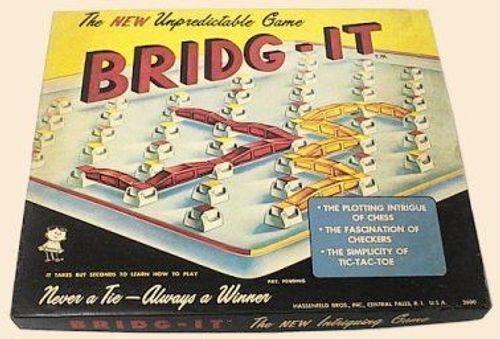
BRIDG-IT
BRIDG-IT Rulebook
Table of Contents
Table of Contents
The Game Board
The game board is a rectangular game board which has on it two sets of alternating rows of markings of different colors, with the rows of markings of each set being equidistant from each other in both directions, and with the markings of the two sets of rows offset so that the markings of each row are exactly halfway between the markings of both the adjacent rows in both directions.
The individual markings of both sets of rows are provided with four sockets or grooves arranged at right angles to each other and in such fashion that the sockets of the adjacent markings of each row face each other, forming pairs.
The number of markings of each row of each series is the same in one direction and different in the other direction. In the same direction, the number of markings per row in successive rows are alternately one more and one less, but the alternate rows have the same number.
As a result of this arrangement of the two sets of markings of different colors, the board can be considered to consist of two oblong boards, each of its own color, offset against each other and arranged in such a way that the rows of the larger number of markings of one color are at right angles to the rows with the larger number of markings of the other color.
The drawing shows the markings of two different colors, blue and red, the blue markings being indicated by horizontal lines and the red markings by vertical lines. On the board illustrated, the blue markings are indicated at B, and the red markings at R. Looking at the board in one direction, there is one less blue marking in each row than there is of red markings in each row. Looking at the board at right angles, there is one less red marking in each row than there is of blue markings in each row.
Board Construction
The game boards may be made of wood, metal, plastic, etc., and the markings with their sockets are advantageously raised above the surface of the board. The sockets of the markings may be depressed below the surface of the board, in which case depressions may also be provided between the sockets for the playing rods or bars. Raised markings with sockets even with the board are advantageous for holding the rods or bars in place when playing.
The different markings are, as above indicated, made of different colors, so as to distinguish the two alternating rows from each other. When the boards are made of plastic, the markings may be inserts of different colors, or may be secured to the top of the plastic at the proper locations. Where the entire board is molded by a single operation from the same plastic, the markings can be painted in different colors to distinguish the two sets from each other. In either case, instead of using different colors, the markings may be distinguished by different shape.
Playing Pieces
For playing a game with the game board, a number of playing pieces or rods are provided of the same color as the two sets of markings and of a length to join together the sockets of the adjoining markings of the same color. Each pair of sockets, unless blocked by the opponent, may thus be joined by a removable playing piece or rod during the course of the game to be played.
The playing pieces will be of the same color as the markings. The blue rods or bars are indicated with lines lengthwise, while the red rods or bars are indicated with lines crosswise of the bars.
Number of Players
The game is played by two players at a time, who are seated at right angles to each other. Or the game can be played by four players, playing as partners, with each two partners facing each other and at right angles with the other set of partners.
Object of the Game
The object of the game is for each player to join the markings of his color across the board by placing a rod or bar of the same color between the notches of two opposite markings, one rod or bar being placed in position alternately by each player.
The aim of each player is to form an uninterrupted line in the long axis of his board, from one end of the board to the other, without ever crossing any of the rods or bars of the opponent. The line need not be a direct connection, but may go sidewise or back and forth, so long as it connects the markings of the same color.
Play
In placing the rods or bars, each player will try not only to form his own line, but also to prevent the opponent from forming his line, by playing his rods or bars so as to block those of the opponent.
Winning the Game
The player who first completes his line will be the winner of the game.
Example Game (Figure 1)
FIG. 1 shows a game played on the board, with the players playing alternately and with an indication of each play by successive numbers. The number 1 shows the first play of a blue rod or bar between two blue markings. Play No. 2 shows a red rod or bar between two red markings. The successive numbers 3, 4, 5, 6, etc., show the successive plays alternately by each player.
The successive plays on the board from No. 1 to 19 illustrate the successive plays, until finally one of the players completes his line, in this case, the blue player.
FIG. 2 is a section through the board of FIG. 1, taken on the line 2–2 of FIG. 1. It is not reproduced here.
Other Board Sizes
It will be evident that the number of alternating rows of each color can be varied. The drawing shows six rows, of five markings each for each of the two colors. Using seven rows of six markings each makes the game somewhat more complex. It will be understood that any number of rows and markings may be employed without departing from the spirit of the invention.
Claim
I claim:
- A game board having two series of rows of markings of different colors, the markings of each row being of the same color and the rows of different colors alternating with each other and with the markings of each row offset with respect to the markings of different color of the adjacent rows, so that the markings of each row are halfway between the markings of different color of both the adjoining rows in both directions, each marking having a top surface at a different level from the surface of the game board and each marking having four sockets at right angles to each other which face only corresponding sockets in markings of the same color, and two sets of bars of the same two colors as the markings and of a length corresponding to the distance between the sockets of adjacent markings of the same color.