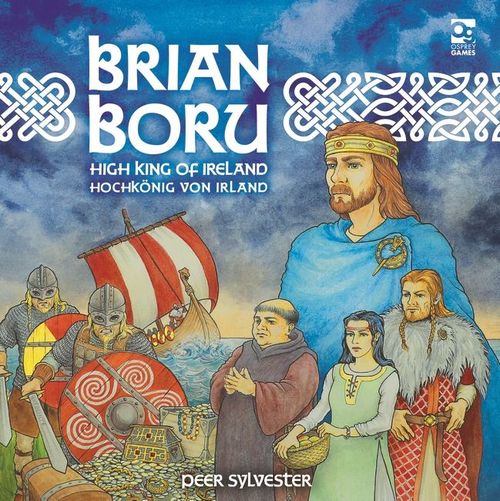
Brian Boru: High King of Ireland
Brian Boru: High King of Ireland Rulebook
Table of Contents
Table of Contents
Historical Note from the Designer
Brian Boru was a High King of Ireland who lived around the year 1000 CE. He made his name as a warrior, repelling the Viking invasions that were frequent in these times and defeating many of his domestic rivals on the battlefield. But it was not his mastery of military tactics alone that led to his legendary status, for he also had a hand for politics. He deftly married off his various family members to forge important alliances – a practice I don't condone or recommend! He also rebuilt many monasteries that had been raided, so he garnered the favour of the predominant church. He died in 1014 at the Battle of Clontarf against the Danes, though his forces won the battle.
You might think that a game about winning majorities in regions stems from a very modern view of democracy or game theory, but something similar actually already existed in the time of Brian Boru. The Irish lived in clans. The privileged members of each clan elected the leader of their clan council, called Ri, who in times of war ruled with absolute power. Each Ri (which equates to a town in the game) was pledged to a king, the Ruiri (not represented in the game). Above the Ruiri stood the ruler of the region, the Ri Ruirech. The different Ri Ruirech in turn battled among themselves for the title of High King of Ireland. I did not use the terms Ri and Ri Ruirech in the game to avoid confusion.
The Danish liked to settle where they had plundered as 'Vikings' before (a term they called themselves when they were on a raid) and even worked with local authorities to gain political power and made deals to ensure their new settlements were left in peace.
Note that the people on the marriage cards are not meant to depict real Irish or Danish royalty.
Components
25 action cards
- Colour: the colour of the card, which is associated with certain actions and towns on the board.
- Battle cards (red) are used to fight Vikings.
- Church cards (blue) are used to gain favour with the church.
- Courtship cards (yellow) are used to arrange political marriages.
- Royal cards (white) are wild, and can be used to claim towns of any colour.
- Value: the value of the card, which determines whether or not it is successful in a trick.
- Primary action: the action the card lets you take when you win a trick. This always involves gaining control of a town.
- Secondary actions: the actions the card lets you take when you lose a trick. You will choose one of the options to resolve in full. Some cards have only one secondary action.
9 marriage cards
- Reward: the benefit gained when you gain the card through marriage.
- The Princess of Denmark is a special double-sided marriage card, which represents an alliance with the Vikings.
- Dänische Prinzessin is only used if you're playing in German, instead of the Princess of Denmark.
7 Viking cards
- Invasion strength: the number of Viking raider tokens placed in the battle area during the preparation phase.
5 reference cards
The reverse side is in German.
Other components
- 125 wooden player discs (25 of each colour)
- 16 monastery tokens
- 60 coins
- 10 Viking control tokens
- 30 Viking raider tokens
- 14 renown tokens
- 8 claim tokens
- 1 active town marker
Discs and tokens are not meant to be limited.
Board
- Regions: Ireland is broken down into eight regions. Each region has a threshold and a point value, which are also shown on the corresponding claim token.
- Towns: each town has a colour, which is associated with the colour of an action card.
- Red, associated with battle cards.
- Blue, associated with church cards.
- Yellow, associated with courtship cards.
- Roads: roads connect some towns, which makes them easier to expand into from adjoining towns.
- Claim token slots: spaces in which to place the claim tokens.
- Marriage track: tracks your efforts to arrange political alliances through marriage.
- Battle area: tracks your efforts to repel Viking incursions.
- Church area: tracks your efforts to gain the favour of the church.
- Score track: tracks your points.
- Region scoring table: a reminder of the endgame points scored for controlling towns in multiple regions.
Setup
- Place the board in middle of the table.
- Sort the coins, renown tokens, monastery tokens, Viking raider tokens, and Viking control tokens by type and place them near the board. This is the supply.
- Give each player all the wooden discs of one colour. Return any unused discs to the box.
- Give each player three coins and one renown token.
- Place a disc of your colour on the first space of the marriage track, and place another one on space 10 of the score track.
- Place all the claim tokens face down on the board in their indicated slots.
- Sort the action, Viking, marriage, and reference cards by type, and place them near the board.
- Find the Princess of Denmark marriage card and place it next to the marriage track. Remove the Dänische Prinzessin card from the game.
- Shuffle the other marriage cards. Then, place the following number of marriage cards face down in pile on top of the Princess of Denmark card, and remove the remaining cards from the game without looking at them.
- Three players: two marriage cards.
- Four or five players: three marriage cards.
- Shuffle the Viking cards. Then, place them face down next to the battle area.
- Give each player a reference card. Note that the reverse of the card is in German.
- Place the action cards near the board.
- Randomly determine the starting player and give them the active town marker.
- In clockwise order, each player places a disc of their colour on a town space. You may not place a disc in the same region as another player's disc.
How to Play
The game is a played over a series of rounds. After three rounds (in a three-player game) or four rounds (in a four- or five-player game), the game ends and the player with the most points wins.
Each round has four phases: preparation, draft, action, and upkeep.
- In the preparation phase, you reveal new Viking and marriage cards.
- In the draft phase, you draft cards to form your hand for the action phase.
- In the action phase, you play cards in tricks and perform primary and secondary actions.
- In the upkeep phase, you arrange marriages, battle Vikings, build monasteries, and claim regions.
Preparation Phase
Reveal the top card of the Viking deck. Place the number of Viking raider tokens indicated by the card's invasion strength in the battle area of the board. Discard that card.
Then reveal the top card of the marriage deck and place it at the top of the marriage track.
If there are no more cards in the marriage deck, this is the final round of the game. This way, the Princess of Denmark is always the final marriage card.
Then move on to the draft phase.
Draft Phase
Shuffle all the action cards. Deal cards depending on the number of players:
- Three players: deal each player eight cards.
- Four players: deal each player six cards.
- Five players: deal each player five cards.
If you are playing with three or four players, place the remaining card face down near the board without looking at it.
From the cards you have been dealt, select two and place them face down in front of you. These will form your hand in the action phase. Once all the players have selected their cards, pass all your remaining cards to the player to your left.
Select two cards from those you have been passed, and place them face down in front of you with the two cards you have already selected. Again, once all the players have selected their cards, pass all the remaining cards to the player to your left.
Repeat this process until all the cards dealt have been placed face down in front of the players. When you are passed only one or two cards from the player to your right, place them directly into your face-down pile.
Take all the cards in front of you into your hand, and move on to the action phase.
You may look at the cards you have already selected, but you may not swap them out.
Action Phase
The action phase is resolved in a series of tricks.
Keep playing tricks until each player has one action card left in hand.
Then move on to the upkeep phase, discarding the remaining card in hand.
Tricks
At the start of each trick, the player with the active town marker places the marker on any town on the board without a disc on it. This is the active town.
Then, they play a card from their hand. The card must match the colour of the town or be a royal (white) card.
In clockwise order, each other player plays one card from their hand. You may play any card, regardless of value or colour. You do not need to match the colour or value of any card that has already been played.
The player who has played the card with the highest value in the same colour as the active town wins the trick. All the other players lose the trick. Royal (white) cards are wild and always count as the same colour as the active town.
The player who played the card with the lowest value (regardless of colour) now takes an action listed on their card:
- If they won the trick, they perform the card's primary action. The primary action is at the top of the card.
- If they lost the trick, they choose and perform one of the card's secondary actions. The secondary actions are at the bottom of the card. Some cards have only one secondary action.
Actions are explained overleaf.
Once they have performed a card action, they place the card into a shared discard pile, and the player who played the card with the next lowest value takes an action in the same way.
Once all the players have taken an action, the trick is over.
You may not look through the shared discard pile.
If players now have only one card left, the action phase ends. Otherwise, the player who now has the active town marker begins a new trick.
Actions
Each primary and secondary action shows one or more symbols. When you take an action, you must resolve all the symbols from left to right.
| Icon | Action |
|---|---|
| Take control of the active town | Take the active town marker and place a disc on the active town. You now control that town. This symbol appears in primary actions only. |
| Gain a coin | Take a coin from the supply. Coins are not meant to be limited. |
| Pay a coin | Return a coin to the supply. If you have no coins, instead lose two points. If you have no points either, this symbol has no effect. This is the only time when points are spent in place of coins. |
| Gain a renown | Take a renown token from the supply. Renown tokens are not meant to be limited. |
| Place a disc in the church area | Place a disc of your colour in the church area. You may then spend any number of coins to place one more disc in the church area for every two coins spent. Coloured discs are not meant to be limited. |
| Take a Viking raider from the battle area | Take a Viking raider token from the battle area. You may then spend any number of coins to take one more Viking raider from the battle area for every two coins spent. If there are no Viking raiders in the battle area, this symbol has no effect. |
| Move up the marriage track | Move your coloured disc up one space on the marriage track. You may then spend any number of coins to move one more space up the marriage track for every two coins spent. If your disc is on the top space of the marriage track, this symbol has no effect. After fully resolving your action, if your coloured disc is on the same space as another coloured disc, move your disc back down until it is either on a space without any other coloured discs or on the first space of the marriage track. |
| Expand into a new town | You may spend five coins to expand into a new town. First, choose a town you control. Then select a town that is connected to it by a road and has no discs on it. Place one of your coloured discs on that town. You now control that town. You may only expand into a town that is connected by a road to a town you already control, with no other towns in between (whether controlled or not). |
| Remove a Viking control token | Remove a Viking control token from the board to reveal the coloured disc underneath. That town is now controlled by the player whose disc is revealed. |
Action Phase Example
Deirdre, Kate, Georgios, and Peer are part-way through the action phase. They have just completed a trick.
At the start of the next trick, Deirdre has the active town marker, so she places it on an empty town in Connaught. As it is a red town, she has to play a red (or white) card. She plays the red 11.
Kate decides she doesn't care about winning the trick, so she plays the red 2. Georgios does want to win the trick, so he plays the white 13. Finally, Peer doesn't have the cards to win the trick, so he plays the yellow 17. Georgios wins the trick, as he played the card with the highest value in the colour matching the active town (because royal cards are wild).
They now take actions in ascending number order, so Kate goes first. She didn't win the trick, so she has to choose one of the card's secondary actions. She chooses the top action, so takes three coins. She then has the option to expand into a new town by spending five coins. Kate decides she does want to do so and as one of Georgios's purple towns blocks the road in one direction, she only has one town she can expand into. She spends the coins and places one of her blue discs in the town connected by road to one of her towns in Leinster.
Next, Deirdre resolves the bottom secondary action on her card, and takes two Viking raider tokens from the battle area. She decides to spend four coins to take another two tokens – for a total of four – as she's currently in danger of losing a town to the Vikings if there's a Viking incursion.
As Georgios won the trick, he takes the primary action on his card. He places one of his purple discs on the active town, and takes the active town marker, which means he will start the next trick. He also takes one coin.
Finally, Peer resolves a secondary action on his card. He decides to move up the marriage track, advancing three spaces. This leaves him on the same space as Kate. He now must either spend two coins to advance another space on the marriage track, or move down one space. However, Georgios is on the space below, so Peer would need to move down another step. He decides instead to spend the two coins to move up one more step on the marriage track, putting him one space ahead of Kate.
As all players have now resolved their cards, the trick ends. They each have only one card left in hand, so those cards are discarded and play continues on to the upkeep phase.
Upkeep Phase
Resolve these four steps in order:
- Marriage
- Battle
- Church
- Claim regions
Then, if there are no cards left in the marriage deck, the game ends.
Otherwise, move on to the preparation phase of the next round.
Marriage Step
If your disc is on the highest space of the marriage track, you have successfully arranged a political alliance! You don't need to be on the topmost space, just above all other players' discs.
Take the marriage card, place it in front of you, and immediately gain the benefits shown. Then move your disc to the first space of the marriage track.
In the rare scenario that all players are on the first space of the marriage track, remove the marriage card from the game and move on to the battle step.
| Icon | Benefit |
|---|---|
| Points (a number) | Gain the number of points indicated. |
| Gain a renown | Take a renown token from the supply. Renown tokens are not meant to be limited. |
| Take control of a town in the indicated region (e.g. Leinster) | Place a coloured disc on any town without a disc in the indicated region. You now control that town. If there are no towns without a disc in the indicated region, this symbol has no effect. |
Marriages are political alliances arranged between members of your own house and other nobles and royals of Ireland.
Princess of Denmark
Arranging a marriage with the Princess of Denmark forges an alliance with the Vikings. Immediately choose one of the following:
-
Military support: Place the Princess of Denmark card with the side indicating military support showing. During the claim regions step, all towns controlled by the Vikings will count as if they are controlled by you.
In addition, at the end of the game, all towns controlled by the Vikings will count as yours for the purpose of scoring face-up claim tokens on the board, but not for scoring the number of regions you control towns in.
-
Establish trade: Place the Princess of Denmark card with the side indicating establish trade showing. At the end of the game, towns controlled by the Vikings will count as yours for the purpose of scoring how many regions you control towns in.
Towns controlled by the Vikings will not count as yours for the purpose of scoring face-up claim tokens on the board.
-
Spurn her: Discard the Princess of Denmark card and gain four points.
Once the marriage card has been resolved, each player gains the benefits shown on the space of the marriage track that their disc is on, if any. The player who resolved the marriage card moves their disc to the bottom of the marriage track, so they gain no further benefit.
| Icon | Benefit |
|---|---|
| Take control of any town | Place a disc in any town on the board without a disc on it. You now control that town. |
| Gain a renown | Take a renown token from the supply. Renown tokens are not meant to be limited. |
| Gain a coin | Take a coin from the supply. Coins are not meant to be limited. |
Battle Step
If there are no Viking raider tokens in the battle area, the Vikings have been repelled! Otherwise, there is a Viking incursion.
If there is at least one Viking raider token in the battle area, the player with the fewest Viking raider tokens loses a town to the Vikings. The player with the most Viking raider tokens chooses one of the losing player's towns and places a Viking control token on top of one of the coloured discs. The Vikings now control that town.
If two or more players are tied for the fewest Viking raider tokens, each tied player loses a town to the Vikings.
If two or more players are tied for the most Viking raider tokens, the player or players losing the towns instead gets to pick the town they lose.
Then, return all the Viking raider tokens in the battle area to the supply and reward the spoils of battle.
Spoils of Battle
The spoils of battle are rewarded whether or not the Vikings were repelled.
First, the player with the most Viking raider tokens gains a renown token from the supply. They then gain one point for each of their renown tokens and return all their Viking raider tokens to the supply. If two or more players are tied for the most Viking raider tokens, no renown tokens or points are awarded and no Viking raider tokens are returned. Instead, skip to the next reward.
Next, the player or players who now have the most Viking raider tokens each gain one point. They then each return one Viking raider token to the supply.
You do not receive any rewards if you have no Viking raider tokens.
Church Step
You are now rewarded for your patronage of the church.
First, the player with the most discs in the church area places a monastery around a town they control, if they can. A town cannot have more than one monastery. The player then takes the active town marker and retrieves all their discs from the church area. If two or more players are tied for the most discs in the church area, these effects are not resolved. Instead, skip to the next reward.
Next, the player or players who now have most discs in the church area each gain one point. They then retrieve one disc from the church area.
Finally, in clockwise order, starting from the player with the active town marker, every player with at least four discs in the church area places a monastery around a town they control, if they can. Every player that placed a monastery then retrieves all their discs from the church area.
Claim Regions Step
You now make your claim on regions where you have the most towns.
For every face-down claim token on the board, count how many towns are controlled in the corresponding region (including towns controlled by the Vikings). If the number equals or exceeds the threshold number (shown in the region and on the token), flip the claim token face up. Otherwise, leave it face down.
For every face-up claim token, whether on the board or in front of a player, check who controls the most towns in the corresponding region. The player with the most towns in the region takes the claim token and places it in front of them, face up.
If two or more players are tied for the most towns in a region, the token stays where it is.
So, if a player gains a claim token, they will lose it only if another player later controls more towns than them.
Monasteries
If a town has a monastery, it counts as two towns for the purposes of flipping claim tokens face up and claiming regions.
Vikings and the Princess of Denmark
If a player has arranged a marriage with the Princess of Denmark and chose military support, all towns controlled by the Vikings count as controlled by that player.
Otherwise, if the Vikings control the most towns in a region, leave the claim token on the board (or return it there if they have wrested it from a player).
Game End
If there are no marriage cards left at the end of the upkeep phase, the game is over and the final scores are tallied.
Scoring
-
Coins: The player with the most coins scores one point. If multiple players are tied for the most coins, no points are scored.
-
Active town marker: The player with the active town marker scores one point.
-
Renown tokens: For every renown token you have, score one point.
-
Claim tokens: For every face-up claim token in front of you, score the number of points shown on the token.
For every face-up claim token on the board, all players tied for the most towns in that region score half the number of points shown on that token, rounded down.
If you have the Princess of Denmark card in front of you with the military support side showing, towns controlled by the Vikings count as controlled by you instead.
Face-down claim tokens do not score.
-
Regions: Score points according to the following table, depending on the number of different regions in which you control at least one town.
If you have the Princess of Denmark card in front of you with the establish trade side showing, towns controlled by the Vikings count as controlled by you instead.
| Number of regions | 1–2 | 3–4 | 5 | 6 | 7 | 8 |
|---|---|---|---|---|---|---|
| Points | 0 | 1 | 3 | 5 | 7 | 10 |
The player with the most points wins.
If there is a tie for most points, the tied player with the most claim tokens wins. If there is still a tie, the tied player with the most marriage cards wins. If there is still a tie, the tied players share the victory.
Quick Reference
Upkeep Phase
Marriage step
- Highest on track: take marriage card and move to bottom of track.
- All other players: gain reward listed on space on track.
Battle step
- Viking raiders in battle area: player with fewest Viking raiders loses town to Vikings. Player with most Viking raiders chooses which town.
- Remove all Viking raiders from battle area.
- Most Viking raider tokens: gain one renown, score one point for each renown, and return all Viking raiders. Skip if tied.
- Most Viking raider tokens after step 3: gain one point and return one Viking raider. All tied players gain this reward.
Church step
- Most discs in church area: place monastery, take active town marker, and retrieve all discs. Skip if tied.
- Most discs in church area after step 1: gain one point and retrieve one disc. All tied players gain this reward.
- Four or more discs in church area: place monastery and retrieve all discs.
Claim regions step
- Each face-down claim token: flip it face up if number of towns in that region meets threshold.
- Each face-up claim token: give it to the player with the most towns in that region. If tied, token stays where it is.
Towns with monasteries count as two towns.
Symbols
| Icon | Action |
|---|---|
| Take control of the active town | Take control of the active town. |
| Gain a coin | Gain a coin. |
| Pay a coin | Pay a coin. If you have no coins, instead lose two points. |
| Gain a renown | Gain a renown. |
| Points (a number) | Gain the number of points indicated. |
| Place a disc in the church area | Place a disc in the church area. Spend two coins per disc to place more discs. |
| Take a Viking raider from the battle area | Take a Viking raider from the battle area. Spend two coins per token to take more tokens. |
| Move up the marriage track | Move a space up the marriage track. Spend two coins per space to move more spaces. You cannot end on the same space as another disc. If the space is occupied, move down to next empty space. |
| Expand into a new town | You may spend five coins to control a town immediately connected by road to another town you control. |
| Remove a Viking control token | Remove a Viking control token. |
| Take control of any town | Take control of any town. |
| Take control of any town in the indicated area (e.g. Leinster) | Take control of any town in the indicated area. |