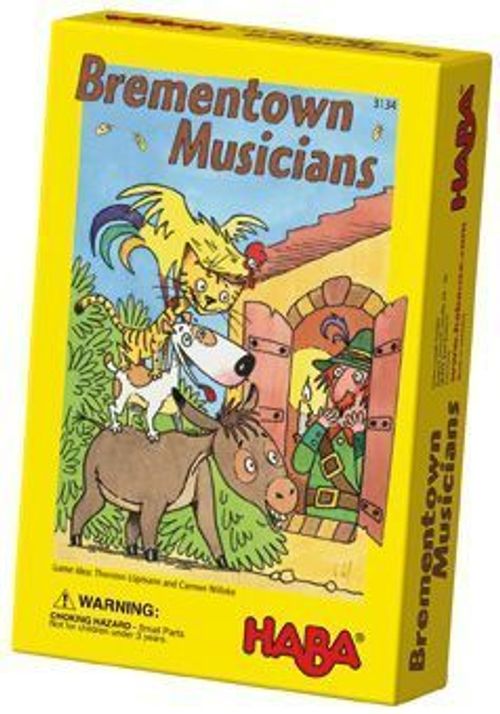
Brementown Musicians
Brementown Musicians Rulebook
Table of Contents
Table of Contents
Components
- 2 thieves
- 48 animal cards
- 2 control cards
- 6 gold coins
- 1 rulebook
Object of the Game
Which animal will be the fastest and be the first to collect two gold coins?
Setup
The players sit at a table, facing each other. Each player takes a control card and places it in front of them on the table, with the pink side facing up. Prepare the gold coins.
There are 48 animal cards in total: 32 cards with adult animals and 16 cards with baby animals.
At the start of the game, remove the 16 baby animal cards and return them to the box. They are only used in the "Duel of the Baby Animals" and "Big and Small Animals" variants.
Shuffle the remaining animal cards and form two piles of 16 cards each. Each player takes one pile and places it in front of them on the table, face down.
Each thief has both expressions: a green smiling face and a red unhappy face. Place the thieves in the middle of the table, leaving a gap of about two hand widths between them. Each player must see one smiling face and one unhappy face.
Playing the Game
The first round begins. The players always act at the same time. Before each duel, the players give the start signal: "1, 2, 3 Beware of the brawl!" (the French call "Gare à la bagarre" translated). At the signal, each player simultaneously turns over the card on top of their pile and places it in the middle of the table.
Which animal is stronger and wins the duel?
- The donkey beats the dog and the cat.
- The dog beats the cat and the rooster.
- The cat beats the rooster.
- The rooster beats the donkey.
Then both players must react very quickly and catch the correct thief. Each player may catch only one thief.
Which thief is the correct one?
- If your animal beats the other player's animal, you must catch as quickly as possible the thief with the smiling face, printed in green.
- If your animal loses to the other animal, you must quickly catch the thief with the unhappy face, printed in red.
Who caught the correct thief first?
Great! As a reward, you take all of the animal cards turned over so far. Place the cards you collected beside you in a face-up pile.
Return the thief to the middle of the table. Each player must again see one smiling face and one unhappy face on the thieves. A new duel begins.
Important rules for catching a thief:
- If you catch the wrong thief, the other player automatically takes all of the turned-over animal cards. The thief is returned to the middle of the table and a new duel begins.
- If both players have the same animal on their card, neither of them catches the thief. If one player catches a thief anyway, the other player takes the cards. Otherwise, these cards stay face up on the table and a new duel begins. The new cards are placed on the cards already turned over. The winner of the next duel takes all of the animal cards.
End of a Round
When the last card of both piles has been turned over, the round is over. After this last duel, each player counts the animal cards they have collected. The player with the most animal cards in their pile wins the round and takes one gold coin as a reward.
In case of a tie, there is a tie-breaking duel. Each player takes a new pile of cards, face down. The player who collects the next card wins the tie-breaking duel and takes the gold coin.
New Round
The animal cards are then shuffled again and divided into two piles of 16 cards each. Each player takes one pile and the next round begins.
End of the Game
The game ends as soon as the first player has collected two gold coins. That player is the winner of this animal duel.
Variant: "The Strong Rooster"
This variant is played using the rules of the base game, but the control card is placed with the light blue side facing up. The strength of the animals has changed:
- The rooster beats the cat and the dog.
- The cat beats the dog and the donkey.
- The dog beats the donkey.
- The donkey beats the rooster.
The game ends as soon as the first player has collected two gold coins.
Variant: "Big and Small Animals"
For a more complicated game, shuffle all 48 animal cards and form two piles of 24 cards each. Each player takes one pile and places it in front of them, face down.
The game is played as in the base game, with these additional rules:
- When animals are from the same family, the adult animal beats the baby animal (for example, the big donkey beats the little donkey). If both players have an identical card (for example, two big donkeys), no player may catch a thief.
- If the animals are from different families, the winning animal is the one indicated by the control card. But be careful: a little dog, for example, beats a big cat.
The game ends as soon as the first player has collected two gold coins.
Variant: "Duel of the Baby Animals"
The game is played according to the rules of the base game, but this time with the 16 baby animal cards. Gold coins are not used. Each player takes eight baby animal cards and places them in front of them in a face-down pile. When a player wins a duel, they do not set the cards aside but put them back under their own pile.
The winner is the first player to have all 16 cards in their pile.
Tournament Variant: "One Against the Other"
A tournament for two to four valiant players.
Two players always play one round according to the rules of the base game. The winner of a round takes one gold coin as a reward. Play as many rounds as needed so that each player has played one round against every other player. Who has collected the most gold coins at the end of all the rounds? In case of a tie, there are several winners.