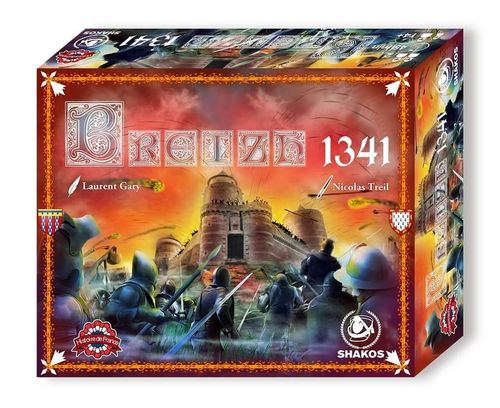
Breizh 1341
Breizh 1341 Rulebook
Table of Contents
Table of Contents
Contents
- 1 rulebook
- 1 game board showing Brittany in 1341, divided into 8 regions
- 42 Event cards
- 8 Special Event cards
- 16 Character cards
- 10 Variant cards (8 Region and 2 Allocation cards)
- 40 Troops cubes (20 blue and 20 red), hence referred to as "troops"
- 40 Partisan cylinders (20 blue and 20 red), hence referred to as "partisans"
- 29 Castle markers
- 8 Domination markers
- 3 Highwaymen markers, hence referred to as "highwaymen"
- 1 Castle +2 marker
- 1 Turn marker
- 1 die showing 1/2/3
Definitions
- Active Player: the player whose turn it is to play a card.
- Battle: an action involving engaging in direct combat.
- Besiege: the action of carrying out a siege against a castle in order to take control of it.
- Blois: the Franco-Breton camp, associated with the colour blue and its coat-of-arms.
- Castle Strength: a value used to resolve sieges.
- Discard: completely remove a card from the game.
- Fight: the action of making a surprise attack or skirmishing.
- Hand: all of the cards in a player's hand. A hand is made up of Event cards, a Special Event card and Character cards.
- Highwaymen: a marker representing soldiers who are not affiliated to any particular army and are in search of employ.
- Montfort: the Anglo-Breton camp, associated with the colour red and its coat-of-arms.
- Neutral Castle: a castle without a Castle marker from either camp.
- Order: an effect described on an Event card.
- Partisan: a cylinder representing the nobles aligned with each player.
Event Cards
Each Event card shows: the epoch, the event name, a historical note, the order, the actions, and the card number.
The Event cards are divided into 2 types:
- 8 Special Event cards, which have an illustration on both sides.
- 42 other Event cards with identical backs.
These cards are played either to give an order or to take an action. If the card is played to take an action — Recruit, Rally, Fight or Besiege — only one of the actions shown may be taken.
The background colour of a card shows which side the order is favourable to when issued:
- Blue: favourable to Blois — the order may only be given by Blois.
- Red: favourable to Montfort — the order may only be given by Montfort.
- Favourable to both sides — the order may be given by either side.
- No order.
- The order affects both players.
Character Cards
Each Character card shows a name, a historical note and a bonus.
The 16 Character cards are placed in 2 separate piles according to their affiliation (Blois, Montfort). When an Event card is played, each player may play one, and only one, Character card. The number of Character cards which may be played in the same turn is unlimited and they do not count towards the Event card limit of the turn.
The use of a Character card must be announced before giving the order on, or using an action from, the Event card. The active player's character is played first. The card is then immediately discarded.
The scope of the application of any bonus or penalty conferred by the card changes according to the current action:
- Besiege: the bonus or penalty only applies to 1 siege.
- Battle: the bonus applies to each round of the battle.
- Rally or Recruit: the bonus applies to the order or the action.
If they are not used, Character cards are not discarded between turns and are kept in the player's hand.
Setup
Before the start of the game, the Turn marker should be placed on the first box of the Turn track. Once the players have chosen their sides, set up the board as detailed below.
- Blois: 1 Partisan in Saint-Brieuc; 1 Partisan in Trégor; 1 Castle marker in Guingamp.
- Montfort: 1 Partisan in Nantes; 2 Troops in Nantes; 1 Castle marker in Guérande.
Prepare the decks of cards as follows: 1 deck of Character cards per player and 2 shared decks — one of Special Event cards and the other of the regular Event cards.
Character decks. Each player shuffles their 8 cards and places them face-down in front of themselves. (Only 6 will be used during the game — 1 per turn.) The cards for each player may be distinguished by the coat-of-arms on their reverse.
Special Events deck. The 8 Special Event cards should be shuffled and placed in a separate deck. This deck may be distinguished from the others by the symbol on the reverse.
Events deck. The Event cards should first be sorted by epoch, according to the number of ermine symbols shown on the front (1st epoch: 1 ermine; 2nd epoch: 2 ermines; 3rd epoch: 3 ermines). Each of the 3 decks should be shuffled separately. As can be seen on the Turn track, the first turn uses the 1st epoch cards. Later turns use the deck indicated by the ermines on the appropriate turn box.
Sequence of Play
The game is played over a maximum of 6 game turns, according to the following sequence:
- Prepare the deck of Event cards
- Build each player's hand
- Determine the 1st active player
- Play Event cards
- Discard Event cards
- Place highwaymen
- Determine dominated regions
- Check victory conditions
- Advance the Turn marker
1 - Prepare the Deck of Event Cards
The deck of Event cards is made up as follows:
- In turn 1, it contains only the Event cards from Epoch 1.
- In turn 2, the remaining cards from Epoch 1 are shuffled with the cards from Epoch 2. This new deck is used for turns 2-5. At the beginning of each turn, any Event cards in the players' hands which remain unplayed from the previous turn are shuffled into the Event cards deck.
- In turn 6, the remaining Event cards from turn 5 plus those left in the players' hands are shuffled together. The 6 cards for the 3rd Epoch are placed on top of this deck.
2 - Build Each Player's Hand
At the start of each turn, the players build their hands. Each hand is made up of:
- Character cards: each player draws 1 Character card. Any Character cards which were not played in the previous turn remain in the players' hands.
- Special Event cards: at the start of turns 2-5 only, each player draws 1 Special Event card. This card must be played during the current game turn.
- Event cards: each player in turn draws a number of Event cards based on the current game turn as explained below:
- Turn 1: 7 cards per player.
- Turn 2-5: 1 card plus 1 extra card for each dominated region.
- Turn 6: all the remaining cards are divided equally between the players. If there is an odd number, the extra one should go to the player who dominates the most regions. If there is a tie then the card should be discarded.
(The Turn 6 line is as printed in the main rules; the summary page says the extra card goes to the player with the least regions — see the Game Sequence Summary.)
3 - Determine the 1st Active Player
In turn 1, the 1st active player is Montfort. In subsequent turns it will be determined using the following list of priorities:
- The most regions
- The most partisans
- The most Castle markers
- If there is a tie for all of the above then the 1st active player is determined by a roll of the die.
The 1st active player will play the first Event card of the turn. After resolving the order and/or the action, the other player will become the new active player and so on.
4 - Play Event Cards
Each player takes it in turn to play 1 Event card until either of the following occur:
- Either the maximum number of cards allowed for the turn is reached: 5 cards each on turns 1 and 6; 3 cards each on turns 2-5.
- Or the player has played all of the cards from their hand.
In either case a player may continue to play cards up to the limit imposed by the turn even if their opponent can no longer play any more.
When an Event card tells a player to draw a card from their opponent's hand, the opponent should temporarily remove the Special Event and Character cards to prevent them from being chosen.
Each Event card played should be placed face-up on one of the marked spaces on the edge of the board (there is one set of spaces per player). This allows both players to monitor the progress of the turn and to avoid playing more cards than is allowed.
Playing an Event card allows an order to be given and/or an action to be taken according to its background colour:
- If the card is favourable to the active player they may: either immediately take one of the actions, or give an order.
- If the card is favourable to one's opponent, then the opponent first gives the order. The active player then takes one of the actions — Rally, Recruit, Besiege or Fight. This is considered to be favourable to the active player.
- Cards favourable to both sides: the order is resolved and affects both of the players immediately. The active player then takes one of the actions.
- No order: the active player takes one of the actions.
Each player must play their Special Event card during the course of the current turn.
The number of partisans and troops which each player can have on the board is limited to 20 by the available cylinders and cubes. If, after playing an Event or Character card which requires the player to rally 1 partisan or recruit 1 troop, there are no more cylinders/cubes available, then another should be taken from a different region and placed in the selected one.
5 - Discard Event Cards
All Event and Special Event cards played during the turn are discarded. Any Event cards which are still in a player's hand at the end of the turn are shuffled into the new Event cards deck at the start of the next turn.
6 - Place Highwaymen
If there are no troops on the board skip this step.
Otherwise, each player counts the number of troops which they have on the board. The player with the least receives 1 Highwaymen marker and places it in the region of their choice, even if this region already has 1 or more highwaymen. If there is a tie for the number of troops then this step is ignored.
All of the troops belonging to both sides are now removed from the board.
If a region contains highwaymen then it cannot be counted as being dominated when the players build their hands in turns 2-5. With the exception of the "Great Plague" card which removes all of them, highwaymen are only ever eliminated through a Fight action.
The highwaymen are placed on top of a Domination marker in a region. If a region changes side, the Highwaymen marker stays in place.
7 - Determine Dominated Regions
Dominance of a region is determined by counting the Castle markers and partisans of each camp. In order to dominate a region, a player must have at least 1 Castle marker and 1 partisan there. The player with the greatest number of Castle markers and partisans in a region, while meeting these minimum requirements, places a Domination marker of their colour there. (If only one player has both a Castle marker and a partisan in a region they automatically dominate regardless of how many Castle markers/partisans their opponent has there.)
The strength of a castle is not taken into account when checking for dominance.
If there is a tie, neither camp has dominance in the region. Each region which is dominated and contains no highwaymen will provide 1 Event card when the players build their hands on turns 2-5.
8 - Check Victory Conditions
There are 2 different ways to achieve victory and become crowned Duke of Brittany.
- If, at the end of a turn one camp dominates 7 regions then they are victorious.
- Otherwise, the victor is determined at the end of the final turn, based on the number of partisans, Castle markers and Domination markers. Each cylinder or marker of a player's colour is worth 1 point. A Domination marker is only counted if there are no highwaymen on it.
In the case of a tie at the end of the game, it is a draw.
9 - Advance the Turn Marker
If the victory conditions are not met, the Turn marker advances one space. A new turn may now begin.
Actions in Detail
Rally
This action allows a player to rally 1 partisan of their colour and possibly take the bonus conferred by a Character card. A player can place a maximum of 1 partisan in each region per action.
Some orders allow a player to rally multiple partisans, while others allow partisans to be eliminated. In either case only 1 partisan per region may be placed or eliminated.
Recruit
This action allows a player to recruit 3 troops of their colour and possibly take the bonus conferred by a Character card. The recruited troops may be freely distributed on the board. This is the only action which can initiate a Battle action.
Battle
The Battle action is automatically triggered when a region contains troops from opposing camps totalling at least 5. A battle occurs when a player recruits troops and chooses to put them in a region which already contains opposing troops.
Before resolving the battle, the players, beginning with the active player, may play a Character card in order to benefit from its bonus. Only 1 Character card per camp may be played in a single battle. The bonus applies to every round of the battle.
Battle Resolution: Each player calculates their force's strength by totalling:
- The number of their troops
- +1 for Montfort (thanks to the English archers)
-
- character bonus
-
- a roll of the die
The outcome of a battle is determined by the difference between the 2 forces' strengths.
- Less than or equal to 2 — each camp loses 1 troop.
- Greater than or equal to 3 — the player with the weakest force loses half of their troops, rounded up, with a minimum loss of 1 troop. The player with the stronger force then loses half the number lost by their opponent, rounded up, with a minimum loss of 1 troop.
The players then count the total of how many troops remain in the region.
- If the total is 4 or less, or one camp has no troops remaining, then the battle is over.
- If the total is 5 or more, the battle continues. The process above is repeated until there are 4 or less troops or 1 camp is eliminated.
The eventual winner will be the camp which has a force's strength at least 3 points greater than their opponent's one in the last round of battle, or is the only camp to have any troops remaining in the region. If there is a winner, they automatically rally 1 partisan in the region. If the battle interrupted an event then any remaining effects of that event should now be applied.
Battle: example. An Event card allows Blois to recruit 9 troops. He chooses to put 3 in the Vannes region, where Montfort already has 3 troops. He puts 6 others in Nantes, where Montfort, again, already has 3 troops. 2 regions now contain 5 or more troops of opposing camps.
Blois first chooses to engage in battle in the Vannes region. Montfort's strength: 3 (troops) + 1 (archers) + 3 (die roll) = 7. Blois' strength: 3 (troops) + 1 (die roll) = 4. Blois loses half of his 3 troops rounded up, so removes 2 of them. Montfort then loses half of Blois' losses, so he removes 1. There are now only 3 troops left in the region, so the battle stops. The force's strength of Montfort was 3 points greater than Blois' one. Montfort wins as it was the last round of battle and rallies 1 partisan into Vannes.
Blois now turns his attention to the battle in Nantes. Montfort plays the William de Bohun Character card. Montfort's strength: 3 (troops) + 1 (archers) + 1 (character bonus) + 1 (die roll) = 6. Blois' strength: 6 (troops) + 3 (die roll) = 9. Blois wins by having 3 more strength than Montfort, who loses 2 of his troops (half of 3 rounded up). Blois then loses 1 troop (half of 2).
Since there are still 6 troops in Nantes, a second round is fought. Montfort's strength: 1 (troops) + 1 (archers) + 1 (character bonus) + 2 (die roll) = 5. Blois' strength: 5 (troops) + 1 (die roll) = 6. The difference in forces' strengths is now only 1. Each camp loses 1 of their troops. Blois claims victory since all of Montfort's troops have been eliminated. Blois now rallies 1 partisan in Nantes.
Fight
This action allows a player to eliminate enemy troops and highwaymen. The maximum number of troops or highwaymen to be removed is determined by a roll of the die and may be modified by a Character card. The number of troops or highwaymen affected is limited to 2 per region.
Besiege
This action allows a player to besiege any number of castles in any regions. The siege is resolved identically whether the castle is neutral or controlled by the enemy. The active player chooses the order in which the sieges are undertaken and the troops who are involved. To besiege a castle requires:
- For a castle of strength 1: 1 or 2 troops
- For a castle of strength 2: 2 or 3 troops
- For a castle of strength 3: 3 or 4 troops
If the attacker does not have the required number of troops to besiege the castle then no siege takes place.
The active player may play a Character card whose bonus will aid them in one (and only one) siege. Their opponent may then do the same. Sieges are resolved one after another by following the sequence below.
The active player calculates their strength by adding:
- the number of troops besieging the castle
-
- or - a bonus or penalty conferred by a character
-
- a roll of the die
The active player successfully besieges the castle if their strength is at least that of the castle +2. If so, then the Castle marker is turned over to the attacker's side, with possible supplementary effects:
- Strength 1 Castle: a siege is won if the besieging force has a strength of 3 or more. (no supplementary effects)
- Strength 2 Castle: a siege is won if the besieging force has a strength of 4 or more. The attacker may eliminate 1 of their opponent's partisans in the region, or rally 1 friendly partisan there.
- Strength 3 Castle: a siege is won if the besieging force has a strength of 5 or more. The attacker may eliminate 1 enemy partisan and rally 1 friendly partisan in the region.
Regardless of the outcome of the siege, all besieging troops are eliminated.
Besiege: example. Following on from the previous example, Blois has recruited 7 troops and placed 3 of them in the St-Malo et Dol region and 4 in Rennes. After playing an Event card he chooses to take a Besiege action. He announces the order in which the sieges will take place and that 2 troops will besiege Dinan (strength 2), 1 will besiege Dol (strength 1) and 4 will besiege Rennes (strength 3). He plays the Robert de Beaumanoir Character card for the siege at Dinan.
- Siege of Dinan (strength 2 castle): he rolls a 1 on the die. This gives a strength of 2 (troops) + 1 (die) + 1 (character bonus) = 4, allowing him to take the castle. Control of Dinan passes to Blois, who chooses to add a partisan to the region rather than eliminate one of Montfort's.
- Siege of Dol (strength 1 castle): he rolls 1 on the die again and so Montfort successfully repels the siege since Blois' strength is 1 (troop) + 1 (die) = 2. He needed at least 3 to win.
- Siege of Rennes (strength 3 castle): the strength required for a successful siege means that Blois does not need to roll the die, 4 (troops) + die roll of at least 1, so Rennes falls. 1 of Montfort's partisans is eliminated and Blois adds 1 of his own to the region.
All of the besieging troops, 7 in total, are removed from the board.
Variant Setup Rules
The 10 Variant cards are sorted into 2 piles, one with the 8 Region cards and one with the 2 Allocation cards. Each player receives 1 random Region card and 1 Allocation card, and places cubes, cylinders and Castle markers according to the instructions on the cards.
A roll of the die is used to determine the 1st active player.
Tips for Your First Play
For your first play, discovering the game will be easier if both players have a balanced hand of cards on the 1st round. Each player's hand is built by following this procedure:
- Split the cards from epoch 1 according to their background color: blue, red and white.
- Shuffle the 3 decks. Each player, in turn, draws 3 cards with a blue background, then 3 with a red background and finally 1 with a white background.
- Follow the normal rules for the rest of the game.
Game Sequence Summary
1. Prepare the Event cards deck. Turn 1: only epoch 1 cards. Turn 2-5: add epoch 2 cards and shuffle with unused cards from the previous turn. Turn 6: place unused cards from turn 5 on the bottom and add epoch 3 cards on top.
2. Build the player hands. Turn 1: 7 Event cards + 1 Character. Turn 2-5: 1 + number of dominated regions Event cards, 1 Character + 1 Special Event. Turn 6: half the Event cards* + 1 Character. (* If there is an uneven number of Event cards, the extra one goes to the player with the least regions, otherwise discard.)
3. Determine 1st active player. Turn 1: Montfort. Turn 2-6: in order of priority, the player with the most: 1) regions, 2) partisans, 3) castles, 4) dice roll.
4. Play Event cards. Turn 1: max. 5 cards each. Turn 2-5: max. 3 each including 1 compulsory (Special Event). Turn 6: max. 5 cards each.
5. Discard Event cards.
6. Place highwaymen.
7. Count dominated regions.
8. Check victory conditions.
9. Advance the Turn marker.
Actions
- Rally: Place 1 + Character bonus partisans. Max. 1 per region.
- Recruit: Place 3 + Character bonus troops. Engage in battle if total troops in region is 5 or more.
- Fight: Remove (die roll) + Character bonus troops and/or highwaymen. Max. 2 troops/highwaymen per region.
- Battle (5 or more troops of opposing camps):
- Calculate strength: troops + 1 (Montfort) + Character bonus + die roll.
- Compare strengths: difference <= 2: lose 1 troop each. Difference >= 3: weakest loses half of troops (round up); strongest loses half of opponent's loss (round up); minimum loss for both sides is 1 troop.
- Battle again if total troops in region >= 5.
- Determine winner: winner if you won the last round with a difference of at least 3, or sole survivor. Rally 1 partisan in region.
- Besiege:
- Assign troops to each siege: Strength 1 castle: 1 or 2 troops; Strength 2 castle: 2 or 3 troops; Strength 3 castle: 3 or 4 troops.
- Calculate strength: troops + Character bonus + die roll.
- Resolve the siege: success if player strength >= castle + 2. Replace Castle marker and: Strength 1 castle: no supplementary effect; Strength 2 castle: rally 1 or eliminate 1 partisan here; Strength 3 castle: rally 1 and eliminate 1 partisan here.
- Remove all besieging troops.