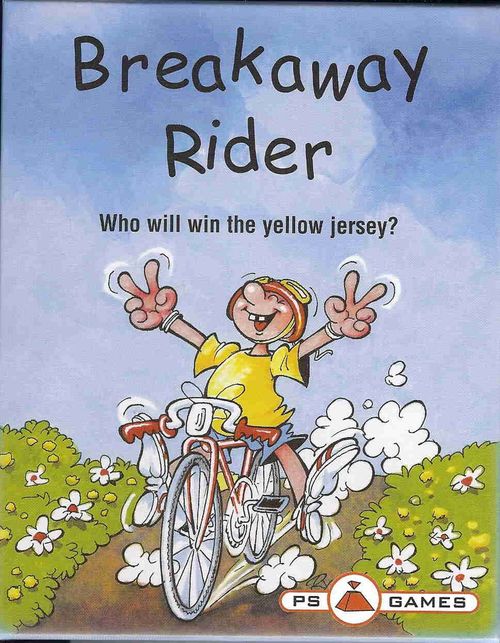
Breakaway Rider
Breakaway Rider Rulebook
Table of Contents
Table of Contents
Components
The game consists of 99 cards:
- 84 speed cards with values from 39-50 km/h;
- 5 climb cards with the no-passing sign;
- 5 headwind cards with -2 in a red triangle;
- 5 sprint cards with +2 on a blue background.
To mark the breakaway rider (i.e. the stage leader):
- 1 yellow jersey.
For counting penalty minutes:
- 20 blue chips worth 1 penalty minute each;
- 20 red chips worth 5 penalty minutes each.
Setup
- Before the 1st stage, each player draws a card from the well-shuffled deck. Whoever draws the highest speed card is the stage leader at the start of the 1st stage and deals the cards.
- All players receive 6 cards in hand. The rest of the cards form a face-down deck in the middle of the table. Any headwind cards that were dealt out are immediately sorted out face up, and new cards are drawn from the deck to replace them.
- The stage leader places the yellow jersey, which marks him for now as the breakaway rider, on the table in front of him.
- The penalty-minute chips are set out and managed by one of the players.
Start of the 1st Stage
- The stage leader with the yellow jersey begins. He first draws a card from the deck and then plays one of his speed cards. This card shows the speed at which he, as breakaway rider, sets the pace.
- Each player places the cards he plays directly in front of himself, in an open discard pile.
- Now the next player takes his turn. He too first draws a card, then plays whichever card seems suitable to him.
He then has three options
- He plays a card that has the same speed, or is up to 2 km/h lower, than the breakaway rider's. In this case the player stays in the slipstream, and the next player takes his turn.
- He plays a card that is at least 3 km/h lower than the breakaway rider's. He is now dropped and collects penalty minutes in the form of chips: 1 penalty minute for each 1 km/h of difference from the breakaway rider. Then the next player takes his turn. Example: breakaway rider A rides at 45 km/h and player B only at 40 km/h. Player B now receives 1 red chip, worth 5 penalty minutes.
- He plays a card that is higher than the breakaway rider's. He now becomes the breakaway rider himself and takes over the yellow jersey. This card now sets the pace for the following players.
Attention: whoever forgets to draw a card before the next player's turn may not draw a card to catch up! He must then continue playing with a reduced number of cards.
Help, I Have Penalty Minutes!
When a player has been dropped, he must now set his own pace and can no longer ride in the breakaway rider's slipstream.
To avoid collecting further penalty minutes, he must ride at least at the same speed as the breakaway rider. For every km/h of difference below that speed, he receives 1 penalty minute (= 1 blue chip). He will therefore try to shed all his penalty minutes, in order to regain the advantage of riding in the slipstream.
Reducing Penalty Minutes
If a player with penalty minutes rides faster than the breakaway rider, he can reduce them. For every km/h faster he rides, he may return 1 blue chip. As soon as he has no more penalty minutes, he can once again ride in the slipstream without collecting penalty minutes. Naturally, only a player who has no penalty minutes when he plays his speed card can become the breakaway rider! It is not possible to reduce penalty minutes and become the breakaway rider in the same turn.
Advantage and Risk of the Breakaway Rider
When it is again the turn of the holder of the yellow jersey, he can safely play any lower card he likes. He sets the pace and, in this case, collects no penalty minutes. However: the lower his speed becomes, the greater the risk that one of the following players will overtake him. That player can then take over the yellow jersey and set the pace himself.
The Special Cards
These make the game far more interesting and add some spice to the race.
Climb
The climb card has a double meaning:
- The mountain road becomes narrow and winding, so that the breakaway rider cannot be overtaken by any other rider. Whoever plays a higher speed card in this situation cannot take over the lead. Penalty minutes can, however, still be reduced.
- The climb card suspends the rule of riding in the slipstream. Now even a player riding 1 or 2 km/h slower collects penalty minutes.
Climb cards can be played at any time:
- By the breakaway rider, in addition to a speed card. This climb then applies until it is his turn again. The card is placed crosswise on his own discard pile, for emphasis. The cards in hand are then replenished back up to 6, i.e. an additional card is drawn.
- By any other player out of turn — immediately after the breakaway rider has played his speed card. The player places his climb card crosswise on the breakaway rider's pile and immediately replenishes his own cards back up to 6. This climb then applies until it is again the breakaway rider's turn.
Sprint
A sprint card lets you increase your own speed by 2 km/h — up to a maximum of 52 km/h. If it is a player's turn, he may play one or more sprint cards in addition to a speed card, whenever it seems advantageous to him. He then replenishes his hand back up to 6 cards with additional cards.
Exception: during a climb, 50 km/h may not be exceeded! Whoever plays a 49-km/h card together with a sprint card in this situation is only credited with 50 km/h.
Headwind
The headwind card reduces your own speed by 2 km/h. Whoever draws a headwind card from the deck during the game must immediately place it crosswise on his own pile and replenish his cards back up to 6.
If he draws further headwind cards this way, these too must be placed down immediately. A speed card is then played as normal, its pace now reduced by 2 km/h for each headwind card.
Sprint and headwind cards cancel each other out.
Exception: a headwind card is drawn as the replacement for a played climb card. In this case it must also be placed down immediately (crosswise, ideally), but only takes effect when the next speed card is played.
Tip: anyone who wants to can sort out these special cards completely at the start, giving a simplified version of the game.
End of a Single Stage
The single stage, or round, ends the moment a player picks up the last card from the deck and plays a card. All cards not yet played now become invalid and no longer have any meaning.
The result of the stage is recorded according to the following scheme:
- The player who is the breakaway rider and holder of the yellow jersey at the end of the stage is credited with 1 minute, and begins the next stage.
- Players who have no penalty minutes at the end of the stage receive 0 points.
- Players with penalty minutes have these recorded as minus points.
Winning the Game
The game is played over 3-5 stages, the number of which can be freely agreed before the game begins. The overall winner of the race wins the game.