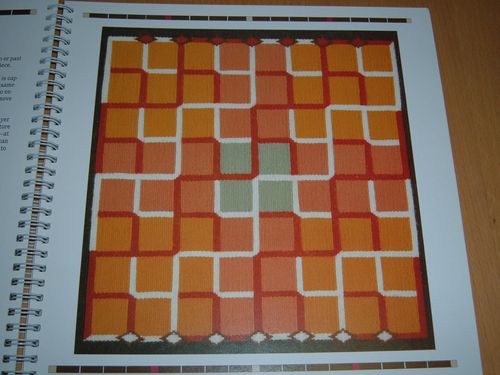
Brax
Brax Rulebook
Table of Contents
Table of Contents
Equipment and Board
- Board. The board is laid out in a series of adjoining square figures (spaces), arranged somewhat like a chess-board. It may be made of pasteboard, wood, metal, or other material, and it may be folded one or more times for storage or carrying.
- Borders. The margins or borders of the square figures are drawn as two series of readily distinguishable lines, in two colours or styles, with lines of the same thickness. Each square has three sides formed in one colour or style and the fourth side in the other colour or style. The two halves of the board are arranged precisely alike, or are constructed on a regular and uniform plan: each border of one colour on one half of the board is offset by a border of the other colour in a similar position on the opposite side of the board, so that the chances of the two players are exactly even.
- Starting borders. The opposite sides of the board from which each player's pieces begin are marked by border-lines of the same colour as that player's pieces, extending around one half of the board at or near its margin.
- Pieces. There are two sets of pieces, or men, one set of each colour or form. Blue and red are the two preferred colours, for both the borders and the men. Each piece has one side plain or smooth and the other side ornamented or marked, by dies or otherwise. The side that is up is used in the multi-player games described below.
Setup
The opposing pieces are placed at the intersections of the outside base or back margin-lines of their respective sides of the board, as shown in Fig. 1 of the patent.
Movement
- The chief rule. A piece may move in any direction on the lines bordering the squares (forward, backward, or sideways) along lines of its own colour, for a distance equal to the length of two sides of a square. A piece may move only the length of one side of a square along lines of the opposite or other colour. A "space" is the length of one side of one of the square figures.
- Example. The pieces D may be moved on the lines B of their own colour for two spaces, that is, a distance equal to the length of two sides of any one of the squares. They may move only one space on the lines C of the other colour. The pieces E may be moved two spaces on the lines C of their own colour and only one space on the lines B of the other colour.
- No passing. No piece can pass over a point occupied by another piece.
Capture
- Object. The object of the game is to capture all the opposing pieces.
- How capture happens. A piece is captured when an opposing piece moves to a point occupied by it. The captured piece is removed from the board.
- Capture is optional. Neither player is forced to take an opponent's piece.
- Threats. A piece is said to threaten another when it is in a position from which it could, in one move, capture it.
Calling Brax
- The call. A player who threatens an opponent's piece may, if he chooses, call out "Brax." This compels the opponent to move the threatened piece at once.
- Timing. A player can call Brax on an opponent's piece only immediately after he has moved one of his own pieces or men.
- Moving the braxed piece. A player forced to move in response to Brax may move the threatened piece in any direction on the lines bordering the squares. If it is within his reach, he may capture the piece which braxed him, since no piece can pass over a point occupied by another piece.
- More than one threatened piece. When a player who calls Brax threatens two or more of his opponent's pieces, the opponent may move whichever threatened piece he wishes. The player who called Brax cannot call Brax again until after he has moved one of his pieces or men.
- Holding the call. A player who threatens an opponent's piece may reserve his right to call Brax until it is to his advantage to do so. If the pieces are still in the same positions, he may, after moving one of his pieces, call Brax and compel his opponent to move the threatened piece.
- Moving into a threat. A player may move a piece to a point threatened by his opponent. The opponent, after moving one of his own pieces, may, if he chooses, call Brax and so force the threatened piece to move.
- Mutual threats. A player may move a piece to a point from which he threatens another piece and is in turn threatened by it, and immediately call Brax. Alternatively, the two pieces can remain mutually threatening. [OCR damage: the source is partly illegible at the end of this passage. The legible words are "piece loses its power of braxing its opponents." The rest of the sentence could not be reconstructed from the OCR and is not supplied here.]
- Use of Brax. The patent notes that by judicious use of Brax a player can often gain a move, or save one of his own pieces from capture, and obtain other advantages.
Ending the Game
- Draw. If only one piece of each side remains on the board, and after five moves on each side neither piece has been taken, the game is a draw.
Three- and Four-Player Games
- Four players. Two players on a side are allies. Each player uses three pieces, disposed along one side of the board, so that all four sides of the board are used. The players move in turn. The three pieces held by one player of a side are blue and played with the ornamented or marked side up. His ally plays three blue pieces set plain side up. The opponents play with red pieces: three with the ornamented side up and three with the plain side uppermost.
- Three players. Two persons play as allies, each using three pieces of the same colour. Their pieces are played respectively with plain and ornamented faces uppermost. The third person plays against these two allies with five pieces of the other colour, and makes two moves with different pieces each time it is his turn to play.
- Braxing in these games. The general rules are the same as regards the ability of the opposing pieces to move one or two spaces. The patent states that modified rules as to braxing an opponent will probably be adopted to make these games more interesting, and it does not give those modified rules.
One-Player Game
An interesting game may also be conducted by one player. The player endeavours, with one piece of one colour, to capture all the opposing pieces of the other colour, which are moved in a predetermined manner.
Board Variants
The game-board is preferably laid out in square figures, as in Fig. 1, but the patent allows other arrangements:
- Triangles. Figures of triangular form, as in Fig. 2, each having two sides bounded by a border of one colour or style and the third side by a different, readily distinguishable border.
- Diamonds. Four-sided diamond-shaped figures, as in Fig. 3, three sides of one colour or style and the fourth side a readily distinguishable border.
- Hexagons. Six-sided figures, as in Fig. 4, four sides with borders of one colour or style and the other two sides with borders of a readily distinguishable colour or style.
- Octagons. Octagonal figures, as in Fig. 5, six sides with borders of one colour or style and the other two sides with borders of a readily distinguishable colour or style.
- Curved or dotted borders. As shown diagrammatically in Fig. 6, the borders need not be straight. They may be curved, wavy, dotted, or double. The only requirement is that the borders be readily distinguishable from each other, so that each figure has part of its border in one colour or style and the rest in another.
Example of Play
The patent illustrates the braxing rule with the following sequence, referring to the points marked on Fig. 1. The figure itself is not reproduced here.
- The second right-hand piece D is moved on the heavy line for two spaces, to the point marked 1.
- The third opposing piece E is moved one space on a heavy line B, to the point 2.
- The piece D is then moved one space only on a light line C, to the point 3.
- The piece E is then moved two spaces on a light line C, to the point 4.
- The piece D is then moved two spaces on heavy lines B, to the point 5.
- The piece E is next moved, by preference, one space on a light line from 4 to 6. In this position it could capture the opposing piece at 5 on the next move. The player moving the piece E may, if he wishes, call Brax. This compels the shifting of the piece D from the point 5, at least one space to the right, to the left, or backward, should the player moving the piece E find it to his advantage to compel that movement.