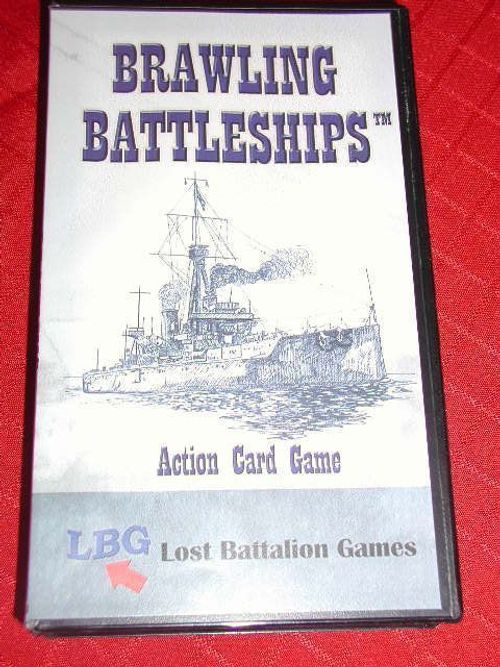
Brawling Battleships
Brawling Battleships Rulebook
Table of Contents
Table of Contents
Game Parts
BRAWLING BATTLESHIPS uses two different decks. One is the "Dreadnought Deck," which has a blue back. The cards with the yellow backs are the "Playing Deck." Two dice and some markers are also required for play.
THE DREADNOUGHT DECK CARDS: Each "dreadnought card," usually referred to simply as a "dreadnought," contains a picture and information about a different historic ship from the First World War.
THE PLAYING DECK CARDS: There are many different types of playing cards included in the Playing Deck and most are "double-use" cards that can be used more than one way. Most playing cards are "open fire" cards that contain information used when the dreadnought cards are used to "attack" and "fire" their big guns at each other. Their use is explained in detail later in the rules. The other types of playing cards all have rules for their use printed right on them and are only briefly summarized in these rules.
DICE: The two six-sided dice, one red and one white, are used to determine results. When these dice are rolled together, the red die number is always read first, and then the number on the white die. For example, if a red "3" and a white "2" are rolled, the number is read as "32." Using this system, the lowest number that can be rolled is "11" and the highest that can be rolled is "66."
MARKERS: The markers for the game are in three colors and are used to mark hits. If temporary shortages arise, any coins, buttons, etc. may be used for additional markers. Although any colors may be used to mark hits, normally the best visual effects occur if a red marker is used to mark a fire critical hit, a gold marker is used to mark a bridge critical hit and a blue marker is moved along a flotation hit track to record flotation hits.
Sortie Setup
Players should be seated around a table in the same arrangement for all Sorties in a game. In team games, the opposing players should alternate their seating arrangement. For example, a player from side "A" should sit next to a player from side "B" and then a player from side "C" and then another from side "A," etc. Players can play as individuals or the players can be divided into teams. In team games, the number of players on a side must be equal (i. e., either four or six players are required for team games). A six-player game may be played between six individuals, two teams of three players each or three teams of two players each.
A "Sortie" consists of running through the Playing Deck one time and most games consist of playing three Sorties to complete. For the first Sortie, the game owner shuffles the Playing Deck and any enemy player shuffles the Dreadnought Deck.
At the start of other Sorties, the decks may be shuffled by any players on different sides. Let an opponent cut a deck after it is shuffled before dealing.
DEALING: Deal each player six dreadnought and six playing cards. The remaining cards from the two decks should be placed inverted near the center of the table to be drawn from during the game.
SETUP: The dreadnought cards dealt to each player constitute that player's "squadron" and should be arranged face up in front of the player. To save space, many players like to arrange their dreadnought cards in two rows, as shown in the diagram below, although any arrangement that allows the dreadnought cards to be seen by all players is acceptable. The playing cards dealt to each player constitute that player's "hand" and are kept hidden from all other players, including friendly ones. It is suggested that the double-use cards be held with the picture sides up and the open fire sides to the left, permitting the players to see the colors and shapes of the firing boxes in the upper left of their cards.
Playing the Game
The normal course of play during a Sortie has the players taking "Turns" using playing cards to attempt to damage and eventually "sink" enemy dreadnoughts. In a basic game, each player plays alone and all other players are the "enemy." In a team game, the players are divided into teams and only the players on the other team or teams are the "enemy," while all players on the same team are "friendly." If a player loses an entire squadron and has no dreadnoughts left, that player's Turn is skipped for the remainder of a Sortie.
PLAYER TURNS: For the first Sortie, the owner of the game takes the first Turn. For later Sorties, the player with the least victory points or, for team games, any player on the side with the least victory points takes the first Turn of a Sortie (disputes can be settled by comparing dice rolls). After that, individual players take their Turns in a clockwise direction around the table. A player taking a Turn draws one card from the Playing Deck and adds it to his or her hand. Then, one card from the hand must be played (possibly more than one card, if single-use cards are involved - see below) or discarded, and, after play is complete, one or more cards may have to be discarded or drawn to bring the hand to its proper size. Many cards have two ways in which they can be played and most cards that are played require the dice to be rolled to determine a result. A player may never deliberately do anything that might sink or damage a friendly ship (encountering a confusion card is not deliberate).
SPECIAL RULES FOR TWO-PLAYER GAMES: BRAWLING BATTLESHIPS works best with three or more players but can be played with only two players if the two confusion and three dud cards are removed from the playing deck and not used during the game.
USING THE PLAYING CARDS: Different playing cards have different capabilities which are shown on the cards.
Double-Use Cards: Most cards have two different possible uses, are called "double-use cards" and may be used in one of the two ways, as desired, when played. They have a tan or light green background color with a dark brown stripe on the left side. For example, a playing card with "Pursuit Aeroplane" in one view and "Open Fire" in the side view may, when used, be played as either a pursuit aeroplane card or as an open fire card. When a double-use card is played, the side of the card actually being used is shown by being placed closest to the squadron where it is being used.
Single-Use Cards: All cards with only one use (great leader, internal explosion, radio intercept, sea plane, second rate leader, secret agent and storm), are called "single-use cards," have a yellow background color and must be played at the first opportunity during a player's Turn before any double-use cards may be played from that player's hand and they may never be discarded. However, after all single-use cards from a hand are played, a player is always allowed to play another card from his or her hand, as long as there is a card to play. Note that this does mean that a player can play one single-use card after another until all in the hand are played, and then play a double-use card. If a hand contains no single-use cards, only one double-use card may be played.
Card Rules
(Heading added for navigation; the rulebook has no heading here, the card entries below follow it in the printed order.)
AIR CARDS: An air card (double-use Zeppelin or single-use sea plane) can remain placed in front of a squadron to improve the squadron's gunnery (score more flotation hits when firing) while placed there. Multiple air cards in front of the same squadron provide multiple advantages. Note that the advantage of great leader cards may be added to the advantages of one or more air cards also placed in front of the squadron and the disadvantages of a second rate leader card may nullify the advantage of one air card placed in front of the squadron. Air cards add only to the number of flotation hits scored using open fire cards. For example, if a squadron with a sea plane card placed with it uses an open fire card to secure "1" flotation hit, a second flotation hit is also marked because of the sea plane card. If a squadron with a sea plane and a Zeppelin card placed with it uses an open fire card to secure "0" flotation hits, two extra flotation hit are marked because of the two air cards.
REACTION (ARMORED CRUISER, BATTLE TURNAWAY, CRUISER SCREEN, DESTROYER ANTI-SUB FLOTILLA, DUD AND MINESWEEPER) CARDS: These cards are all double-use cards, all have a light green background and they may be used to automatically cancel specific other playing cards, as explained in the text on the individual cards. They are always played during an enemy player's Turn to prevent the use of a card when an attempt is made to play it. The play of a reaction card must be announced before the dice are rolled. In team games, all of these may be played in defense of any friendly squadron, except for the dud and confusion cards, which a player may use only when his or her own squadron is attacked. When played, the reaction card and the card cancelled are both discarded. A dud card may not be used to cancel a confusion card.
COASTAL FORT, CRUISERS ATTACK, DESTROYER FLOTILLA ATTACK, MINES AND SUBMARINE CARDS: These cards can be used for attacks on enemy dreadnought cards, as covered and restricted in the text on the individual cards. These cards all require specific dice rolls to be successful.
CONFUSION CARDS: This is a reaction card that does not cancel an enemy player's card. Instead, a confusion card automatically allows a player to turn an enemy's open fire card against their own dreadnoughts and is played during an enemy player's Turn. The play of a confusion card must be announced before the dice are rolled. The usual rules for firing apply (each ship may fire only once, each ship may be a target only once, no ship fires at itself and leader and air cards may change the number of flotation hits scored) except that the firing player must take all possible shots from dreadnoughts of his or her own squadron at ships of that same squadron (the same dreadnought may fire and then be a target or vice-versa). A dreadnought may not be used to fire at itself. In team games, if there is at least one friendly squadron still present and it is not covered by a lay smoke card, the player must fire at a (player's choice, if more than one) friendly squadron instead of his or her own.
INTERNMENT CARD: An internment card allows an "interned" dreadnought to be possibly (if the required dice roll is made) taken from an enemy squadron and added to a friendly squadron.
MUTINY CARD: A mutiny card allows a "mutinied" dreadnought to be possibly (if the required dice roll is made) removed from an enemy or friendly squadron and placed at the bottom of the Dreadnought Deck (i. e., the dreadnought card is removed but it is not "sunk" and no one gets any victory points).
INTERNAL EXPLOSION: When played, an internal explosion card may possibly (if the required dice roll is made) "sink" some or all dreadnoughts that currently are marked with fire critical hits. This applies to all dreadnoughts, friendly and enemy, with fire critical hits, and a separate roll is made for each.
GREAT LEADER AND SECOND-RATE LEADER CARDS: These cards represent squadron leaders and can help (great leader cards) or hinder (second-rate leader cards) a squadron. If both leader cards are played on the same squadron, they cancel each other and both cards are immediately discarded. Every time a leader card's squadron has a dreadnought eliminated (not lost through mutiny or interned), the player controlling the squadron must roll the dice (always a "51+" needed) to see if the "leader goes down with the ship" and is discarded. Great leader cards work the same as air cards and the advantage of a great leader card may be added to the advantages of one or more air cards also placed in front of the squadron. The disadvantages of a second rate leader card may nullify the advantage of one air card placed in front of the squadron or may reduce the number of flotation hits by "-1" ("0" flotation hits remains a "0") if placed there alone. Note that it is possible to score a critical hit, if the dice number is large enough, even if the only flotation hit is nullified by a second-rate leader card.
PURSUIT AEROPLANE: A pursuit aeroplane card can be played to automatically eliminate one enemy air card (zeppelin or sea plane) during a player's own Turn but they may not be used to cancel an air card during an enemy player's Turn (they are not reaction cards).
RADIO INTERCEPT CARD: A radio intercept card allows a player to automatically take the top two cards in the discard pile and add them to his or her own hand before discarding the radio intercept card. Less than two cards are taken if fewer cards are in the discard pile.
REINFORCEMENT CARDS: A reinforcement card allows a player to draw one or two cards from the Dreadnought Deck, if the required dice roll is made, and add that dreadnought or dreadnoughts to any one friendly squadron.
REPAIR CARDS: A repair card allows a player to automatically eliminate all flotation hits on one friendly ship (in any friendly squadron, in team games).
LAY SMOKE CARDS: Lay smoke cards are placed in front of a friendly squadron (any friendly squadron, in team games) and automatically protect that squadron as written on the lay smoke card until the squadron with the smoke card's next Turn, at which time the lay smoke card is discarded.
SECRET AGENT CARDS: A secret agent card automatically allows a player to randomly remove two cards from an enemy player's hand and add them to his or her own hand.
STORM CARDS: When played, a storm card automatically eliminates all fire critical hits and eliminates all air and lay smoke cards currently in play on the table.
Open Fire Cards
OPEN FIRE CARDS: The numbers required to make hits on dreadnought cards, acquire reinforcements, etc., all work in the same manner, as is explained for the open fire cards, below:
-
When an open fire card is played, the text in its firing boxes can be used. The shape and color of a firing box used must be the same shape and color as the firing box color of a dreadnought card in the player's squadron. The square tan firing boxes represent the smallest guns, the circular blue firing boxes represent medium-size battleship guns and the hexagonal green firing boxes represent the largest guns. Each box on an open fire card can be used once.
-
For each firing box that can be used, a separate friendly dreadnought in the player's squadron is used to attack a separate enemy dreadnought. All dreadnoughts attacked using the same open fire card must be in the same enemy squadron. Each attack from the same open fire card must use a different friendly dreadnought (from the player's squadron) against a different enemy "target" dreadnought. Any firing boxes that cannot be used are simply ignored. The open fire card is discarded after all possible firing boxes are used.
-
Announce an enemy dreadnought card to be attacked.
-
Roll the dice for the result. The results depend on the numbers in the firing boxes on the attacking dreadnought card. The top line of a box shows the number or more that must be rolled with two dice and the bottom line of a box shows the number of flotation hits that can be scored if that number or more is rolled. The numbers of hits in the boxes are added together when the higher numbers are rolled. For example, for these sample firing boxes from a dreadnought card:
- Since these boxes are green hexes, a firing box on the open fire card must also be a green hex to attack using this dreadnought card.
- If the roll is "11" or "12" (any number less than "13"), the firing missed and the attack had no results.
- If the roll is "13" or more, the firing causes 2 flotation hits on the enemy dreadnought.
- If the roll is "26" or more the firing causes 1 additional flotation hit (for a total of 3 flotation hits) on the enemy dreadnought.
- If the roll is "56" or more the firing causes 1 more additional flotation hit (for a total of 4 flotation hits) on the enemy dreadnought.
- The green hex firing box on the open fire card that was used to activate the firing dreadnought indicates that a critical hit may also occur. In the first example shown, if a "41" or more is rolled, a bridge critical hit is also scored. In the second example shown, if a "31" or more is rolled, a fire critical hit is also scored. If a critical hit occurs of a type that is already marked on the target dreadnought card, mark one extra flotation hit, instead. For example, if a bridge critical hit is scored on a dreadnought card that already has a bridge critical hit marked, an additional flotation hit is marked instead.
Hits
HITS: Place a marker over the appropriate flotation hit and/or critical hit symbols to show the number of hits or the type of critical hit. For example, a dreadnought taking a bridge critical hit would have a marker placed in the circle containing the bridge critical hit symbol. The number of flotation hits is recorded by moving a marker that number of circles to the right on the dreadnought's flotation hit track. If a dreadnought already has a flotation hit or hits marked, new ones are added to the ones marked previously by shifting the marker the appropriate number of spaces to the right. A dreadnought card "sinks" when the marker on its flotation hit track is moved off of the flotation hit track's final space. For example, a dreadnought with six circles on its flotation hit track would require a total of seven flotation hits to "sink." Up to six flotation hits could be marked but the seventh would move the marker off the track and "sink" the dreadnought.
Sinking Dreadnoughts
SINKING DREADNOUGHTS: Unless instructed otherwise, a dreadnought card that "sinks" should be placed face down in a victory points pile near the player who inflicted the final damage.
Ending a Turn
ENDING A TURN: When a player completes a Turn, count the number of dreadnought cards in that player's squadron that do not have bridge critical hits. The number of playing cards in a player's hand after the player takes a Turn must equal the number of dreadnought cards without bridge critical hits in that player's squadron. Playing cards must be discarded or additional playing cards drawn, as needed, at the end of a player's Turn to match the number of unhit bridge critical hit symbols in a player's squadron. For example, if a player's squadron has six dreadnought cards and two of them have bridge critical hits marked, the player must discard or draw playing cards to produce a hand that contains exactly four playing cards.
Ending a Sortie
ENDING A SORTIE: A Sortie ends when all but one player (or side, in team games) is eliminated or the last card is drawn from the playing deck (when that last card is drawn, the Sortie ends immediately without that card or any other card being played).
Scoring a Sortie
SCORING A SORTIE: Victory point totals should be recorded on a piece of paper. Victory points are scored as follows:
- When a Sortie ends, all players should total the victory points in their own victory point piles. The victory points for a card are the yellow numbers on the dreadnought cards that were sunk. In team games, the scores for each team are recorded instead of for each individual player, although each player should still maintain a separate victory points pile.
- A player who lost all dreadnoughts in his or her squadron gets "0" victory points for the Sortie, regardless of the number in that player's victory points pile and their victory points are not added to a team's score.
- In a basic (non-team) game, if all but one player lost all dreadnoughts during a Sortie, that surviving player gets a "+10" victory points bonus. In a team game with only two teams or in a two-player game, if all dreadnoughts on a side are lost, the other side automatically wins the game. In a team game with three teams, there are no bonus victory points for survivors if both squadrons on one team are eliminated, although that eliminated team would get "0" victory points for that Sortie. In a team game with three teams, if all squadrons on two teams are eliminated, the surviving team wins the game.
- In a two team game, a team gets a "+10" victory point bonus if one or more enemy squadrons lost all dreadnoughts.
Winning the Game
WINNING THE GAME: Unless one team is annihilated during a Sortie, providing an automatic victory in a two-team game or two-player game; the player or side with the most victory points at the end of three Sorties wins a game. In the event of a tie after three Sorties, all players participate in additional Sorties until the tie is broken or someone wins an automatic victory.