Branches and Twigs and Thorns
Branches and Twigs and Thorns Rulebook
Table of Contents
Table of Contents
Equipment Needed
- One monochrome stash of Icehouse pyramids per player
- Chessboard or grid big enough for large pyramids laying on their sides
- A collection of tokens (about 10 per player; non-player color pyramids work well too)
Definitions
Null Square: a single token in a square representing a hole in the board where no one may play. Adjacent pyramids may not point at a null. A null may not be placed so as to completely isolate any part of the board. Every square must remain connected. Diagonals do not count.
Root Square: a cluster of four tokens (or a single token in a different size or color) representing safe squares which adjacent pyramids may point towards for no penalty. It is legal for a root to isolate a part of the board. Roots are not holes.
Setup
Four players
- Play on a full chessboard or 8x8 grid.
- The first and second players each place a null on the board.
- The third and fourth players each place a root on the board.
Three players
- Play on a 7x7 grid.
- The first player places one root on the board.
- The second player places two nulls.
- The third player places a second root.
Two players
- Play on half a chessboard (i.e. a 4x8 grid).
- The first player places a null.
- The second player places a root.
Other numbers of players (requires one Martian Chessboard section per player)
Six players: the first three players place nulls, the next three place roots.
Five players: the first two players place nulls, the other three place roots.
Three players (alternative): the first player places a null, the other two place roots.
Game Play
Each player starts with a stash of fifteen pyramids and five scoring tokens. Note that there are exactly as many unoccupied spaces as there are total pyramids in all the players' stashes.
Players take turns. On your turn, you place one pyramid in an empty square. The pyramid must be adjacent to a square which is occupied, either by a root or by another pyramid. You must place it lying down, and pointing at the adjacent occupied square. You may not place a piece in, or pointing at, a null square.
If there is more than one adjacent occupied square, you decide which one to point at. Diagonals don't count.
Scoring
- When you put down a piece pointing at the root, that's safe.
- When you put down a piece pointing at another of your own pieces, that's also safe.
- When you put down a piece pointing at an enemy piece, you take a penalty, and the opponent you pointed at gets a bonus.
- You are penalized according to the size of the enemy piece you are pointing at: one, two, or three points. Put that many tokens into the pot.
- The player you pointed at is rewarded according to the size of the piece you pointed at him. He takes one, two, or three tokens from the pot.
- If you need to pay more tokens to the pot than you currently have, every player including yourself should take five more tokens from the pot. This does not change the standing of the game, since only relative scores matter.
At the end of the game, whoever has the most tokens wins!
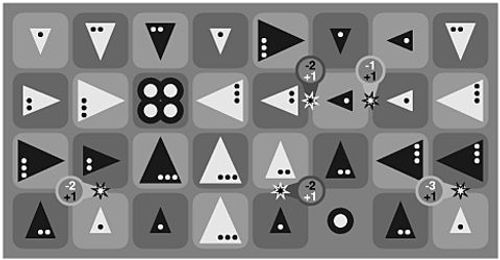
To determine the final score, remember that each player started with five tokens. Then add in the penalties and bonuses for each player. The result: White 1, Black 4. Black has won.
Strategy
Obviously, pointing at the enemy is bad. You want to spread a tree of your own pieces across the board, so that you can always add new pieces to your own tree, and never be forced to grow off your opponents' trees.
If you can surround an open area, so that you're covering more than your fair share of the board, then eventually an opponent will be forced to play inside that area, growing from one of your pieces.
Every time an opponent plays a small pyramid, he's making himself vulnerable. Do you want to jump on it, choking off his tree and giving yourself more space, for a mere one-point penalty? If you wait, you may have to do it later, on your opponent's terms, perhaps losing two or three points.
Of course, you have small pyramids too. You want to play a small pyramid when you attack a vulnerability, so that your opponent gets only a one-point bonus. But then your piece is vulnerable as well. You have five vulnerable pieces, five average pieces, and five strong pieces. Eventually you'll have to play them all. The strategy is deciding when and where.
Aggressive play is not always rewarded, but neither is very defensive play. The last few moves are critical, as the last few open areas are filled in, and players are forced to play their last pyramids.
Example Finished Game
This is a completed two-player game of Branches and Twigs and Thorns. The null square (marked with one token) is on the right-side bottom edge; the root (marked with a four-token cluster) is near the top left. As you see, play starts at the root and grows outward. White moved first.
In this game, there are only five moves in which one player pointed at the other. Black made two of these; White made the other three.