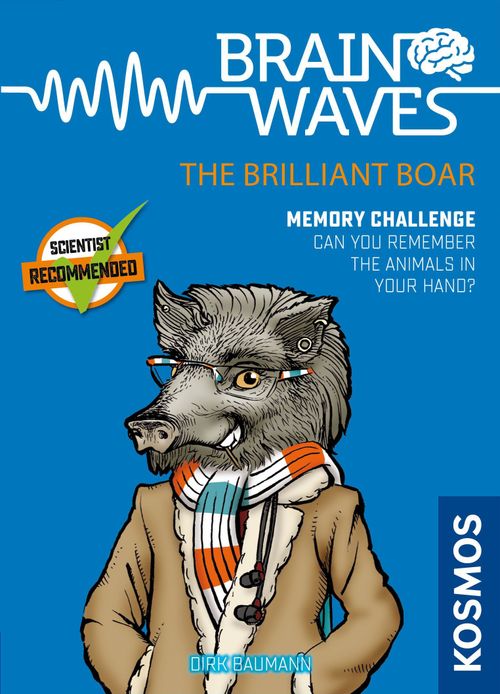
Brainwaves: The Brilliant Boar
Brainwaves: The Brilliant Boar Rulebook
Table of Contents
Table of Contents
Game Idea
For 1 – 4 players, ages 8 and up.
Each player takes cards, whose animal sides they see at first, into their hand with the backs facing themselves, and first memorises which motif is on which card, in order to later form as many animal pairs as possible. By laying out and drawing new cards, the motifs in your hand constantly change over the course of the game. And that is exactly what is meant to stimulate the brain cells in the frontal and parietal lobes that are especially important for mental abilities (see also the information at the end of the rulebook).
Components
- 54 animal cards with 9 motifs
- 1 pad for noting points
- 1 rulebook with information on the memory study
The cards have an animal side and a back side (blue).
Setup
Depending on the desired difficulty, different numbers of cards are used.
| Difficulty level | Name | Motifs used | Cards used | Set aside |
|---|---|---|---|---|
| 1 | Beginners | 6 | 36 | 3 motifs of 6 cards each, e.g. 6 foxes, 6 hares and 6 mice |
| 2 | Advanced | 7 | 42 | 2 motifs of 6 cards each, e.g. 6 foxes and 6 hares |
| 3 | Experienced | 8 | 48 | 1 motif of 6 cards, e.g. 6 foxes |
| 4 | Experts | 9 | 54 | none |
Tip: Begin with the lowest difficulty level and increase the challenge step by step.
The cards chosen for the difficulty level are shuffled and placed in the middle of the table as a draw pile, with the animal side visible and facing up.
The pad is only needed at the end of the game, to note the points.
Gameplay
The youngest player begins; play then continues clockwise. On your turn you must choose one of the following actions:
-
A) Take a card from the draw pile
-
OR B) Play a card from your hand
-
If you have no card in hand, only action A is possible (this is the case, for example, on each player's first turn).
-
If the draw pile is empty towards the end of the game, you must choose action B for as long as you have cards in hand.
A) Take a Card from the Draw Pile
The player draws the top card of the draw pile. They note which animal motif is on the card and take it into their hand, back side facing themselves. Their turn then ends.
Now the other players see which animal the player has in hand. The player himself or herself may no longer look at the animal side and sees only the blue back.
If the player already has cards in hand, they add the new card at the end of their hand of cards.
- The player sees the backs of the cards they take into hand during play.
- The cards should be held fanned out in the hand, not pushed too tightly on top of one another, so that the other players can see the animal motifs. The game is more fun that way.
B) Play a Card from Your Hand
The player takes one of their hand cards and lays it face up in front of them, animal side up, in order to try to form an animal pair. Hopefully they have remembered their hand cards well and play the right animal!
Match: If the animal played matches the animal on the top card of the draw pile or – as explained below – another card lying face up, the player takes both animal cards and places them face down in front of them as points. The player then takes another turn (action A or B), and with repeated success, further turns.
No match: If there is no match, the animal card played stays face up on the table and can be used by all players to form pairs. In this way, several animal motifs may end up lying in the middle of the table. The player's turn ends.
End of the Game
The game ends as soon as the draw pile is empty and only one player still has cards in hand. That player counts one minus point for each card still in hand. All other players have no cards left and therefore no minus points from their hand.
The player with the most collected cards (minus the number of hand cards for the player who still has cards in hand) wins the game.
Example: At the end of the game Klaus has 9 pairs and 2 hand cards, Andrea has 7 pairs and no hand cards, and Iris has 9 pairs and no hand cards. 2 cards are still in the middle. The draw pile is empty and the game ends. From the 18 cards Klaus has won, the 2 hand cards are subtracted. That gives him 16 points. Andrea has 14 points and Iris 18. The points are noted on the pad so that they can be compared with later results. Iris wins the game.
| Klaus | Andrea | Iris |
|---|---|---|
| 16 | 14 | 18 |
Notes on Special Situations
- If a card is played in action B (e.g. the wolf) that makes no match, it stays on the table. It can then happen that, through action A or B, the top animal of the draw pile is taken and an animal beneath it becomes visible that already lies on the table (e.g. the wolf). A player on turn who plays a matching animal from their hand, here the wolf, decides whether to take the wolf from the draw pile or the one lying in the middle to form the pair.
- Play continues when the draw pile is empty and more than one player still has cards in hand. Since no new cards can be drawn, drawing a card is omitted. Only the action "Play a card from your hand" is possible. If you still have cards in hand, you must play one, even if nothing or nothing matching lies in the middle. Players who have no hand cards left take no further action and wait for the end of the game.
- At the moment the game ends, the player with the last hand cards is often tempted to play them out. They may not do so, even if they could still achieve a match with an animal lying face up.
Variant "Name a Card"
Before the game, the players can agree that they must name the animal when playing a card. If several cards lie in the middle, lucky hits are thus ruled out.
Solo Variant for 1 Player
The player chooses the difficulty level to play at and shuffles the corresponding card stack. The game runs as described above.
Whenever the player plays a wrong animal card, this card and the top animal card of the draw pile are placed on a separate stack to the side (the "error stack").
When the draw pile is empty, the game ends. The player counts their won cards and likewise the cards of the error stack. The cards of the error stack and the remaining hand cards are subtracted from the won cards, and the result is written down.
After further solo games, the player can compare the results and see whether they have tended to improve.
These motifs are included in the game (German name, English name in brackets): Dachs (badger), Wolf (wolf), Eule (owl), Fuchs (fox), Maus (mouse), Hase (hare), Ente (duck), Hirsch (stag), Wildschwein (wild boar).
Scientific Study
The games of the BRAIN TO GO series are small and very fine games. But why?
Scientists at the University of Ulm (working group Clinical and Biological Psychology) examined the BRAIN TO GO series as part of a study. The question was which brain functions are exercised by the game series. The demands on the working memory (simultaneously storing and processing new information), on the long-term or episodic memory (as the brain's lasting storage system) and on fluid intelligence (logical thinking) were examined.
The diagram in the rulebook shows the three functions studied:
- Fluid intelligence: logical thinking
- Working memory: simultaneously storing and processing new information
- Episodic memory: a lasting storage system
Brain regions shown in the diagram:
- Prefrontal cortex: part of the cerebral cortex of the frontal lobe
- Posterior parietal cortex: part of the cerebral cortex of the parietal lobe
- Medial temporal lobe: part of the temporal lobe including the hippocampus
The games studied were: Schwein oder nicht Schwein (Brainwaves: The Brilliant Boar), Gans schön verdächtig (Brainwaves: The Astute Goose) and Der lila Wal.
Result of the scientific study: The BRAIN TO GO series exercises all three examined brain functions (fluid intelligence, working memory, long-term memory) and is therefore, from the scientists' point of view, suitable for training mental abilities.
Other known memory games are generally "static" – the motifs often do not change position. The BRAIN TO GO series is quite different. Here the contents of memory must be constantly updated, because the card motifs in the hand and in the display change with every turn. The player must therefore delete motifs already memorised for a particular position from their mental workspace and memorise new motifs for that position again and again.
The game series exercises several important brain functions in the process: a good and simple "brain jogging" that is quick to play. And the games are a lot of fun – alone, and even more so in a social group with others. Good for young and old.
Conclusion: Simply play more often – and train your memory along the way!
What is actually …
Fluid intelligence? Fluid intelligence or fluid thinking is the ability to think logically. This ability is needed, for example, to solve new problems.
Working memory? Working memory allows us to temporarily store information and at the same time manipulate it. Working memory is needed, for example, to remember the beginning of a sentence at its end, so that one can understand its content.
Episodic or long-term memory? Episodic memory is the part of long-term memory that stores memories over the long term. Episodic memory is needed, for example, to remember a conversation that took place several hours ago.