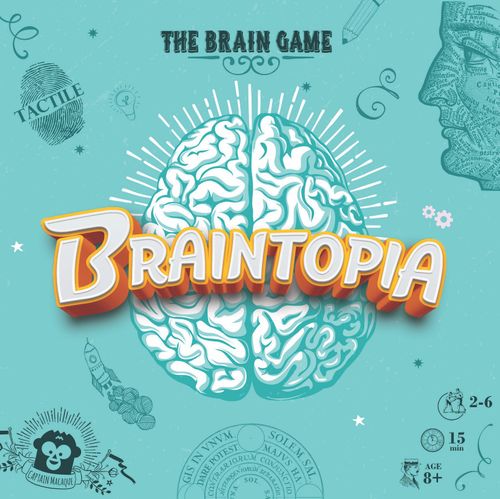
Braintopia
Braintopia Rulebook
Table of Contents
Table of Contents
Contents
- 90 cards (74 Test cards, 6 touch Challenge cards, 10 raised touch cards)
- 6 brain jigsaws (24 pieces)
Aim of the Game
All players compete against each other using the 8 different tests that exercise different brain functions. The first to win 4 brain pieces and complete their brain jigsaw is the winner.
Setup
Lay the 10 touch cards on the table. All the players look at them and feel them for about 30 seconds. The pack of touch cards is then set aside. Shuffle the Test and Challenge cards and put them into a single stack, face down, in the middle of the table. The type of test to come when the card is turned is shown on the back (the tests are described below).
Playing the Game
The youngest player starts by turning over the top card in the centre stack. All players look at the card and try to find the answer. When a player thinks they have found the answer, they immediately put their hand over the card. They give their answer and uncover the card to see if it is right. Remember, a player is only allowed one answer per round.
Right Answer
The player takes the card and puts it in front of them, face down. A player may have no more than 4 cards at any time. If a player wants to keep a card they have just won but already has 4, they must give up one. When a player has two cards the same (same back), they can exchange them for a brain-twister piece.
Wrong Answer
If the answer is wrong, the player must give up the card and cannot give an answer in the next round.
Game Over
The first player to complete their brain jigsaw wins the game.
Description of the 8 Types of Test
1 - Memory
Tap the card and, without removing your hand, name the 5 things on it (e.g. opposite: bow tie, glasses, key, umbrella, hot-air balloon).
2 - Maze
From the arrow, where is the exit to the maze? A, B, C or D? (e.g. opposite: C is the way out).
3 - Colour
Which word is written in its own colour? (e.g. opposite: PINK is written in pink).
4 - Coordination
On the back of the card is a colour for each hand and a number for each finger. Once flipped, the card shows which finger or fingers in which hand you must place on the area shown in the picture (e.g. opposite: you must put the middle finger of your right hand on your forehead and tap the card with your other hand, that is the left).
5 - Duplicates
Which of the illustrations on the card is repeated? (e.g. opposite: the rhinoceros is in duplicate).
6 - Frequency
Which side of the dice occurs the most often on the card? (e.g. opposite: side 1 is shown 4 times).
7 - Reasoning
Which shape fits exactly into the main diagram? (e.g. opposite: only shape A will fit into the diagram).
8 - Touch Challenge
This card allows the player who has won the previous card to go for the touch challenge. The other players choose a card from the pack of 10 touch cards and hand it, face down, to the challenger. The player then has 10 seconds to recognise the texture using only their sense of touch. There is only one answer (e.g. opposite: a basketball).
If the answer is right, the player wins another brain twister piece. The touch challenge card is returned to the others. If the answer is wrong, the game carries on as before with the next card.
Notes
If a player gives a wrong answer to the test before a Challenge card, they put the Challenge card back in the stack and shuffle it again. If there are two Challenge cards in a row, put the second one back in the stack and shuffle it.
The 10 raised textures are: teddy bear - leather - rope - wood - peach - basketball - bread - zebra - strawberry - moss.