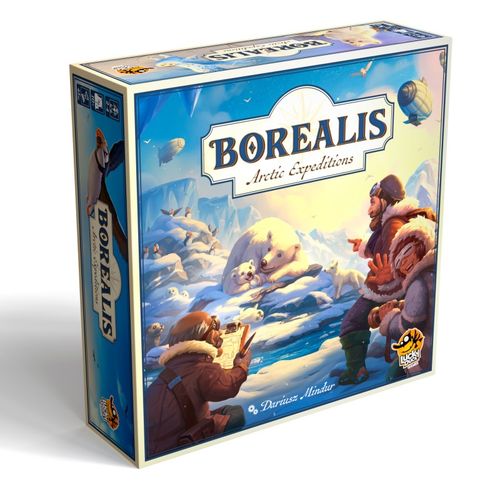
Borealis: Arctic Expeditions
Borealis: Arctic Expeditions Rulebook
Table of Contents
Table of Contents
Components
- 4 player boards
- 1 rulebook
- 100 animal cards (63 x 88 mm)
- 12 objective cards (63 x 88 mm)
- 10 scoring cards (63 x 88 mm)
- 4 player aid cards (63 x 88 mm)
- 1 first player token
- 36 scientist meeples (12 of each type, differing in color and the item they carry)
- 12 flag tokens
- 1 score pad
- 24 scoring tokens worth 1 point each
- 12 scoring tokens worth 3 points each
- 12 scoring tokens worth 5 points each
Animal Cards
- A – scientists that must be moved in order to play the card
- B – species' Latin name
- C – species icon
- D – additional victory point (only present on some cards)
- E – vehicle icon
There are 5 different species that appear on animal cards: polar bear, Arctic fox, snowy owl, harp seal and Atlantic puffin.
There are also 5 different vehicles: sleigh, zeppelin, submarine, kayak and skis.
There are an equal number of each species and each vehicle in the animal cards deck.
Scoring Cards and Objective Cards
Scoring cards describe additional rules for scoring at the end of the game.
For each game, 2 scoring cards are chosen at random.
Objective cards are divided into 3 types:
- animal objectives (paw icon),
- scientist objectives (meeple icon),
- vehicle objectives (flag icon).
Each objective card describes a goal that players compete to be the first to achieve during the game.
For each game, 3 objective cards (1 of each type) are chosen at random.
Player Board
A player board has 3 locations where different species (animal cards) are observed by the scientists (wooden meeples). Each location has its respective exploration track below, divided into 8 spaces used to track your advance through uncharted territory. There are also two camps where the scientists may rest.
All 4 player boards share an identical pattern of vehicle icons on side I, but each has a unique pattern on side II.
- A – location with scientists and animal cards in play
- B – exploration track
- C – camp
- D – scientist
- E – flag
Setup
Refer to the setup illustration on the next page.
Shuffle all the animal cards to form the animal deck and place it face down on the table (A).
Reveal 4 animal cards from the deck and place them face up in the middle of the play area to form the pool of available cards (B).
Choose at random 2 scoring cards and place them face up on the table (C).
Choose at random 1 objective card of each type (3 in total), place them face up on the table and then, next to each, place a number of 5-point scoring tokens equal to the player count (D).
Put the rest of the scoring and objective cards back in the box.
Each player:
- takes a player board (E) and places it in front of them with side I or side II up, as agreed
- puts 3 scientists of different colors in each location on their board (F)
- places a flag on the starting space of each of their exploration tracks (G)
- takes 2 scoring tokens worth 1 point each (I)
- draws 4 animal cards from the animal deck to form their hand (H), which they don't show to their opponents.
If a player is not satisfied with their starting hand, they can discard some or all of their cards and draw an equal number of cards from the deck. A player can do this only once.
Give the 1st player token (J) to the player who lives northernmost (or you can choose who goes first in any other way you agree upon).
Gameplay
Players take turns sequentially, starting from the 1st player.
On their turn, a player must perform one of the following actions: OBSERVE AN ANIMAL or REGROUP.
Action: Observe an Animal
- Play an animal card from your hand, placing it in a location containing the scientists matching those printed on the card. Each new card in a location should be placed on top of the previous one, covering its upper part but leaving the bottom part with species and vehicle icons visible. All the cards in all your locations are collectively described as "your cards in play".
- Move the scientists as directed by the arrows printed on the card. Each scientist goes to an adjacent location or camp to observe the animal from a distance, while not scaring it off. Scientists moved to a new location can be moved in the following rounds after playing a card, while those moved to a camp stay there until the player performs a REGROUP action.
- If the vehicle on the card matches one of the vehicles on your respective exploration track one space below your flag, move the flag down one space.
- Take a card of your choice from the pool of available cards and refill the pool with a card from the animal deck.
IMPORTANT: If you are not satisfied with the available cards, you can either
- draw the top card from the animal deck instead or
- pay 1 point to discard all 4 available cards forming the pool and replace them with 4 new ones from the deck before choosing your card (you can do this only once a round)
Action: Regroup
- Discard as many animal cards as you want from your hand (this can be 0 cards)
- Draw that many cards from the animal deck
- Take as many 1-point tokens as scientists you have in your camps
- Take all your scientists from both camps and put them all in a single location of your choice
Once all the players have performed their actions, the round ends and a new one begins, starting from the same player.
As a result of players discarding animal cards from their hand or the pool of available cards, a face-up discard pile is formed.
If the animal deck is exhausted, shuffle the cards from the discard pile to form a new one.
Example
In his turn, Ootah plays an animal card onto the right location (it's the only one with scientists matching the card). The arrows on the card show that he has to move one amber scientist left (to the middle location) and one amber scientist right (to a camp).
Because the vehicle icon on the card matches one of the vehicle icons printed on the next space on the right exploration track, Ootah moves his flag one space forward.
In his next turn, Ootah plays an animal card onto the middle location and moves an amber scientist left and a mint scientist right, as shown by the arrows on the card.
The vehicle icon on the card doesn't match any of the vehicle icons on the next space of the middle exploration track, so this time Ootah doesn't move the flag.
In his next turn, Ootah decides to perform the regroup action.
On top of discarding a chosen number of cards from his hand and drawing that many from the animal deck, he moves all his scientists from both camps to a single location.
He chooses the left location.
He gets 4 points for moving the 4 scientists there.
Claiming an Objective
Once a player fulfills the requirements printed on an objective card, they claim it and take one of the point tokens lying next to it. After a player claims an objective, other players have until the end of the current round to claim it, too. Once the turn ends, both the objective card and all its remaining 5-point tokens are removed from the game.
If a player realizes they already fulfilled an objective requirement in one of the previous rounds and didn't notice, they may instantly claim the objective if the objective card is still in play. The other players have until the end of the current round to claim this objective as well.
End of the Game
The game end is triggered when one of the players has 7 cards in one of their locations. Then the current round is played until the end, so each player has played the same number of turns. Finally, the players count their victory points using the scoring pad.
Scoring
Your final score is the sum of the following:
- Victory points awarded for the sets of animals of the same species you have in a single location. Each species in each location is scored independently according to the table shown below, which is also printed on the player boards.
| Number of animals of the same species in a location | Victory points |
|---|---|
| 1 | 0 |
| 2 | 1 |
| 3 | 3 |
| 4 | 6 |
| 5 | 10 |
| 6 | 15 |
| 7 | 21 |
- The sum of the victory point values printed on exploration track spaces you have flags on
- The sum of the victory points printed on the animal cards you have in play
- Victory points calculated from the scoring cards. Scoring conditions for each card are explained in detail on pages 11-12.
- Total value of the scoring tokens you have collected
The player with the highest total score wins. In case of a tie, the player with the flag furthest down the exploration track wins the tie. If still tied, the player with most points on their scoring tokens wins the tie. If even this doesn't settle the tie, the players must live with the fact they don't know who was better this time.
Scoring Example
The illustration below shows the situation on Britta's board at the end of the game.
For the animal sets she collected, Britta gets 12 points:
- left location: 3 harp seals worth 2 points and 1 polar bear worth 0 points
- middle location: 5 snowy owls worth 10 points, 1 polar bear worth 0 points and 1 Atlantic puffin worth 0 points
- right location: 2 Atlantic puffins worth 1 point and 1 polar bear worth 0 points
On the exploration track she scores 12 points, as her flags are on spaces worth 3 points, 6 points and 3 points.
2 of Britta's cards have the victory point symbol printed on it, so she scores 2 points.
The scoring cards chosen for this game were Interspecies Relationships and Mating Season.
Britta has 2 locations with exactly 2 species of animals (harp seal + polar bear in the left one and polar bear + Atlantic puffin in the right one), so she scores 6 points for Interspecies Relationships. She has 3 pairs of animals of the same species (2 harp seals in the left location, 2 snowy owls in the middle one and 2 Atlantic puffins in the right one), so she scores 6 points for Mating Season.
By returning scientists from camps and completing objectives, Britta gathered tokens worth 16 points.
Britta's total score equals 54 points.
Achievements
Below is a list of additional achievements you can complete while playing Arctic Expeditions. Write your name on top of the achievement track of a chosen color (up to 6 players can simultaneously track their progress). After each game, draw an X mark in the snowflake next to the achievement you completed. If you completed multiple achievements in a single game, mark them all.
The more achievements you score, the more prestigious the title you bear:
| Achievements | Title |
|---|---|
| 0-4 | Tundra Tourist |
| 5-8 | Arctic Amateur |
| 9-12 | Boreal Backpacker |
| 13-16 | Experienced Expeditioner |
| 17+ | Polar Pro |
Achievement list:
- win a game
- score 50+ points
- score 60+ points
- score 70+ points
- score 80+ points
- have a flag token at the last space of an exploration track
- have 7 animals of the same species in a single location
- claim all 3 objectives in a single game
- win a game without claiming any objectives
- score 12 points from the Common Destination scoring card
- score 15+ points from the Expansive Species scoring card
- score 12 points from the Farewell Party scoring card
- score 9 points from the Interspecies Relationships scoring card
- score 14+ points from the Mating Season scoring card
- score 14 points from the Outer Lands scoring card
- score 12+ points from the Popular Vehicle scoring card
- score 15+ points from the Safe Return scoring card
- score 18 points from the Territorial Animals scoring card
- score 10+ points from the Untrodden Path scoring card
Scoring Cards Explained
Common Destination
12 points if you have all 3 flags in a horizontal line or 5 points if you have 2 of them in a horizontal line.
Example: your left flag is 3 spaces from the start, the middle flag is 4 spaces from the start and the left flag is 3 spaces from the start. Two flags (the left and the right) are in the same horizontal line, thus you score 5 points.
Expansive Species
5 points for each horizontal row of 3 animals of the same species.
A horizontal row consists of three animal cards, each in a different location, that are adjacent to each other horizontally.
Example: you have the following sequences of animals in your locations: the 1st (bottom) card in all 3 locations is a polar bear and the 3rd card in all locations is an Atlantic puffin. For these two horizontal lines (3 polar bears and 3 Atlantic puffins), you score 2 x 5 points = 10 points.
Interspecies Relationships
3 points for each location with animals of exactly 2 species.
If in a given location there are animal cards of exactly 2 different species, you score 3 points for this location.
Example: you have animals in your locations such that only the middle location holds exactly 2 species. You score 3 points for the middle location and no points for the remaining two.
Outer Lands
7 points for each location with more animal cards than the middle location.
Example: you have 5 cards in the left location, 5 cards in the middle one and 6 cards in the right one. As you have more cards in the right location than in the middle one, you score 7 points.
Farewell Party
2 points for each scientist in a location of your choice at the end of the game.
At the end of the game, choose 1 location and score 2 points for each of your scientists there. Remember that a camp doesn't count as a location.
Example: you have 4 scientists in the left location, 1 scientist in the middle location and 2 scientists in the right one. You choose the left location for scoring and get 4 x 2 points = 8 points.
Mating Season
2 points for each set of exactly 2 animals of the same species next to each other in a location.
Points are awarded for each pair of cards with animals of the same species, in the same location and touching each other. While there can be other cards with this species in this location, they can't touch the scoring pair. You score for all such pairs in all your locations.
Example: in the middle location you have the following sequence of cards: polar bear, polar bear, Arctic fox, Atlantic puffin, Atlantic puffin, polar bear, polar bear. Two pairs of polar bears fulfill the condition, so you score 2 x 2 points = 4 points for this location. You also score for whatever pairs you have in the other two locations, of course.
Safe Return
3 points for each scientist in a camp at the end of the game.
You take the total number of scientists in both camps.
Example: you have 2 scientists in the left camp and 3 scientists in the right camp. You score 5 x 3 points = 15 points.
Popular Vehicle
2 points for each card with your most common vehicle type.
Your most common vehicle type is the one which appears most often on your cards in play. If there are 2 or more vehicle types that are considered most common, you score only for one of them.
Example: you have 1 zeppelin, 3 submarines, 3 skis, 4 kayaks and 4 sleighs on your cards in play. You score 4 x 2 points = 8 points.
Untrodden Path
Points equal to twice the value of your least-scoring flag.
If 2 or more flags are tied as least-scoring, you use the value of just one of them while calculating your Untrodden Path score.
Example: your flags are at spaces worth 3 points, 4 points and 5 points. The least-scoring flag is worth 3 points, so you score 2 x 3 points = 6 points from the Untrodden Path card.
Territorial Animals
6 points for each location with no animals of the same species adjacent to each other.
You take into account only the animals adjacent in the same location - it doesn't matter if there is a horizontally adjacent animal of the same species in a neighboring location.
Example: you have sequences of animals in which only the left and right locations fulfill the scoring condition, as there are 2 polar bears adjacent to each other in the middle location. You score 2 x 6 points = 12 points.