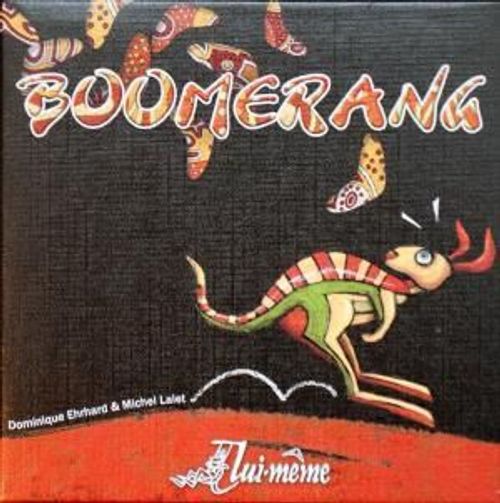
Boomerang
Boomerang Rulebook
Table of Contents
Table of Contents
Components
- 54 cards. Each card shows an animal and two hunting Territories.
- 5 sheets of 12 Boomerangs.
- 5 sheets of 5 Territory tokens.
- 1 black cord.
- This rulebook.
Principle of the Game
The players are hunters who, throughout the game, try to capture as many animals as possible. At the end of the game, the player who has the most cards of a given animal species scores that many points. The other players score no points for that species.
The game is played over several rounds. In each round, every player may hunt in only one Territory, chosen secretly.
The Boomerangs are used to determine the order in which players reveal their chosen Territory and capture the animals: the player who wagers the most Boomerangs is served first.
Setup
- The cord is tied into a circle (loop) and placed in the center of the table.
- The cards are thoroughly shuffled to form the draw pile, placed face down beside the circle.
- Each player takes a set of 5 tokens sharing the same back symbol. Each token shows one of the 5 hunting Territories on its front.
- Each player receives 12 Boomerangs, placed clearly visible in front of them. In a game with 3 or 4 players, the leftover tokens and Boomerangs are set aside, out of the game.
A game is made up of a certain number of rounds and ends when the draw pile is exhausted.
Sequence of a Round
A. Drawing the Animals
- The first card of the draw pile is placed face up around the circle formed by the cord. Cards continue to be drawn and placed face up around the circle until 5 different hunting Territories are represented among these cards.
- From the second round onward, it can happen that animals from the previous round were not captured and remain around the circle. These cards stay in place, and more cards are added from the draw pile until the visible cards together show all 5 different hunting Territories.
- If there are not enough cards left in the draw pile to show 5 different hunting Territories, a final round is still played with the cards available. If there are no cards at all left in the draw pile, even though cards from the previous round remain, the game ends.
B. Choosing Hunting Territories
Each player secretly chooses one of their Territory tokens and places it face down in front of them, sliding it toward the center of the table. This choice determines which cards the player wants to recover at the end of this round. The four remaining tokens are placed face down in a pile beside their Boomerangs and will not be revealed.
C. "Throwing" the Boomerangs
- For the first round, the first player is the one whose home is closest, as the boomerang flies, to the Aboriginal homeland. For subsequent rounds, the first player is the one who was left in until the end of the Boomerang throw in the previous round.
- The first player throws a Boomerang into the circle. The following players do likewise, in turn, clockwise. Turns continue around the table in this way, each player on their turn adding a new Boomerang to the circle for as long as they wish or are able to.
- If a player no longer wants or is no longer able to add a new Boomerang, they place the Territory token they had chosen, still face down, on top of the draw pile. They then pick up all the Boomerangs lying in the circle and add them to their reserve.
- Play continues without that player, in the same way as before, with each remaining player throwing one Boomerang into the circle on their turn.
- Each time a new player decides to stop throwing Boomerangs, they place their Territory token, still face down, on top of the token of the player who stopped before them, then pick up all the Boomerangs placed in the circle. This continues until only one player has not given up the hunt.
- Special case: if a player has no more Boomerangs and the circle is empty when their turn comes, they stop playing, place their Territory token on the pile, and pick up no Boomerangs. The player is not "eliminated," since they may (perhaps!) recover Boomerangs in the following round.
D. Capturing the Animals
- When only one player remains, that player does not throw an additional Boomerang and immediately reveals the Territory token they chose at the start of the round. They then pick up all the cards placed around the circle that show the symbol of that hunting Territory.
- The player whose token is at the top of the pile then reveals their token and likewise picks up all the cards showing the indicated Territory.
- This continues in the same way, from top to bottom of the pile of Territory tokens.
- When all the Territory tokens have been revealed and all players have taken the cards owed to them, a new round begins.
- Note: it frequently happens that the players "at the bottom of the pile" recover no cards at all, since they have all been taken by the earlier players!
- The cards collected by players are placed face up in front of them, sorted by animal species.
- Each player takes back their Territory token before the next round.
End of Game and Scoring
- The game ends when, at the start of a round, the draw pile of cards is exhausted.
- For each animal species, the player (or players, in case of a tie) with the greatest number of cards of that species scores that many points. The other players score no points for that animal.
Examples
- One player has 5 fish, another 3, another 1. The first player scores 5 points, the others score nothing.
- Two players each have 4 turtles, a third has 1 turtle: the first two players each score 4 points, the third scores nothing.
- Each player also scores 1 point for each complete set of 6 Boomerangs remaining in their possession.
Examples
- 8 Boomerangs are worth 1 point.
- 14 Boomerangs are worth 2 points.
- The player with the highest total score wins the game. In case of a tie after this count, the winner is the player with the greatest number of Boomerangs remaining in their possession.