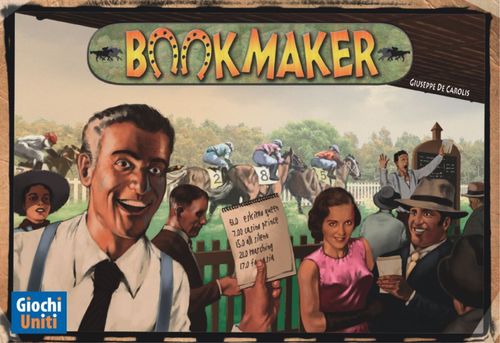
Bookmaker
Bookmaker Rulebook
Table of Contents
Table of Contents
Components
- 1 deck of 80 race cards (in four colours), numbered for each colour in two series from 1 to 10
- 2 joker cards
- 4 horse tokens (in four colours)
- 1 board
- 480 banknotes
- 16 wooden tokens (4 per colour)
- 2 erasable whiteboards
- 2 note pads
- 2 markers
- 2 pencils
Objective of the Game
At the end of the race programme, during which the players take turns in the roles of bookmakers (Bookmaker) and bettors, the player who has earned the most money wins the game.
Setup
At the start of the game the race programme is decided. The number of races to be run must be such that all players have an equal chance of taking the role of bookmaker.
Then the board is placed in the centre of the table, equidistant so that it can be easily reached by all players. The horse tokens can now be placed on the board in the space where the starting grid is drawn.
Finally, each player is given the sum of 1,000.00 dollars in denominations of their choice.
Gameplay
Each race takes place in two phases:
A) the bets B) the race
The Bets
In the betting phase it is decided which players will take the role of bookmaker. There are two bookmakers for each race. In the first race the role of bookmaker is taken by the oldest player and the player to his left; in the other races the players take turns in clockwise order. In games with fewer than 4 players only one bookmaker is chosen per race.
First the deck of 80 cards is shuffled, excluding the joker cards, which are used only in the Joker race.
The first bookmaker places 4 face-up race cards on the board in the corresponding space so that everyone can see them, and deals 4 face-down race cards to each player, including the bookmakers themselves. In games with fewer than 4 players the only bookmaker receives 6 cards instead of 4.
The cards received by each player are confidential information about the horses in the race, while those on the game board are public information.
Each player looks at the cards they have received and keeps them in hand without showing them to the others. After seeing their own cards, the two bookmakers exchange two cards between them (naturally this does not happen in games with fewer than 4 players, where there is only one bookmaker).
At this point every player will have seen their own four cards plus the four face-up cards on the board, for a total of eight cards, while the two bookmakers will also have seen two of the cards received by the other bookmaker, for a total of ten cards. (In games with fewer than 4 players the only bookmaker sees their own six cards plus the four face-up cards, for a total of ten cards.)
The deck with the remaining cards is now placed in the centre of the table.
Important: since only these cards will be used in the race, it is clear that the more cards of one colour are among those dealt to the players or lying face up on the board, the less chance that horse has of winning the race.
Setting the Odds
Each of the two bookmakers now secretly decides the odds they intend to give to each of the four horses and notes them on the whiteboard at their disposal. If a horse is given odds of 3, this means that if that horse wins, the player who bet on it will win three times the stake in addition to the return of the stake. (E.g. if they bet 10 dollars, they receive back their 10-dollar stake and are paid winnings of 30 dollars, for a total of 40 dollars.) The bookmakers may freely decide the odds of each of the four horses, but no horse may start with odds lower than 1, and the sum of the four odds must never be less than 10. (E.g. two horses at 3 and two horses at 2, or one horse at 1 and three horses at 3.) The bookmakers reveal and display their respective whiteboards with their odds at the same time, making them public.
Place Your Bets
Now the players may bet with one and/or the other bookmaker, backing the horses they prefer. Betting is compulsory and each player must make at least one bet. The bookmakers may also bet on one or more horses with the other bookmaker but, unlike the other players, they are not obliged to do so.
The minimum bet is 10 dollars, but bookmakers may accept higher bets if they wish. Bookmakers may not refuse bets and may not lower the odds of a horse unless they have received at least one bet on that horse. Only after receiving at least one bet on a horse may a bookmaker decide not to accept further bets on that same horse, reducing its odds to 0. In any case, whenever the odds of a horse are lowered, the odds of another horse must be raised, so that the sum of the odds never falls below 10.
(E.g. if a bookmaker has given two horses odds of 3 and two horses odds of 2, after receiving a bet on a horse they gave odds of 3, they may lower its odds to 2, but in this case they must raise the odds of one of the two horses at 2 to at least 3.)
If two players bet on the same horse with the same bookmaker at the same time and the bookmaker does not wish to accept both bets, the bookmaker must give priority to the player nearest to their left, and only after accepting that bet may they change the odds.
The bookmakers collect the sums bet by the players and record in their own note pad the name of the bettor, the bet, the colour and the odds of the horse bet on.
The betting phase ends when all players declare that they do not intend to place any more bets. The race then takes place.
The Race
The first bookmaker takes the deck of remaining cards, turns over the first card and moves the horse token of the colour matching the face-up card forward by one space along the track. They then turn over the other cards one after the other, moving forward each time the horses of the corresponding colours, until one of the horses reaches the finish corresponding to space 10, thereby winning the race.
At this point the players who bet on the winning horse collect their winnings due to them.
Once the first race is over, the second race begins with a new betting phase, in which the role of bookmaker is taken by the two players to the left of the previous bookmakers.
At the end of the prescribed race programme, the player who has earned the most money wins the game.
At any time during the game a player may borrow money from the bank, but at the end of the game, before the final count of money, they must repay it to the bank with 10% interest added. If a bookmaker is unable to pay winnings, they must borrow from the bank the money needed to honour the payments.
Bets During the Race (optional rule)
The bookmakers, if they wish, may propose and accept bets during the race as well.
The Brocco (optional rule)
At the start of the game the players may decide to remove one card from the race deck and set it aside face down so that nobody can see it. It is clear that the horse of the colour matching that card will have a slight disadvantage compared with the others, and will therefore be called "the Brocco".
At the end of the game, before counting the money earned, each player must bet 10 dollars by placing them in the centre of the table, and secretly write on a slip of paper the colour of the horse that they believe is the Brocco. The player who guesses the Brocco takes all the money bet. If more than one player guesses the Brocco, the winnings are divided into equal parts and any remainder is paid to the bank. If no player guesses the Brocco, all the money bet is paid to the bank.
Optional Special Races
At the start of the game the players may decide to include special races in the race programme:
- the Joker race
- the Trot race
- the Joker-Trot race
The Joker Race
This requires the two special Joker cards. At the start of the race, after the 4 face-up cards have been placed in the centre of the table and before the cards are dealt to the players, the two special Joker cards are added to the deck of 80 cards. During the race, if the Joker card is turned over, it takes on the colour of the card turned over immediately before it and moves the same horse forward by one further space. Likewise, if a Joker card is in a player's hand, it may be played by that player immediately after a card has been turned over from the deck, to move the horse that has just moved forward by one further space.
The Trot Race
16 tokens are added to the game (4 for each colour).
Before the bookmakers set the odds, the first bookmaker draws four cards from the race deck (if two cards with the same number and colour are drawn, the bookmaker draws another card in replacement). For each card drawn, the bookmaker places a token of the corresponding colour on the track space bearing the same number as the card drawn. Immediately afterwards the cards are returned to the race deck, which is shuffled again. During the race each token indicates the risk that the horse of the corresponding colour may break its gait at the point of the track corresponding to the number shown on the token. If the horse of the token's colour reaches that point of the track with a card bearing the same number as the track space, it breaks its gait and is immediately disqualified.
(E.g. if before the race a red token is placed on track space no. 3, the red horse breaks its gait and is disqualified if, when it is on track space 2, a red card bearing no. 3 is turned over.)
The Joker-Trot Race
For this special race the rules of the Joker Race and those of the Trot Race set out above both apply.