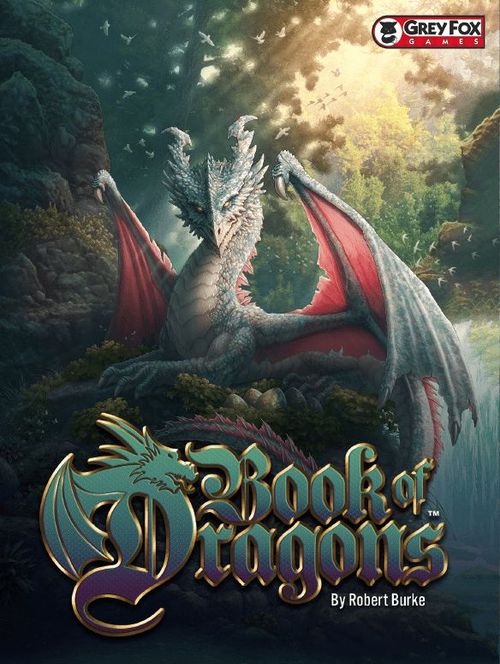
Book of Dragons
Book of Dragons Rulebook
Table of Contents
Table of Contents
- Don't Poke the Dragon!
- Dragon's Bluff
- Dragon Duel
- Dragon Inquisition
- Dragon Mystery Rummy: The Case of the Rare Dragon
- Dragon Scat
- Dragon Trick
- Dragonkin
- Pentawar
- The Last Hydra
- Calling All Dragons
- Dragon War
- Dragon Head Poker
- Tailslap
- Dragon Memory Match
- Wyvern's Knot
- Dragon Pass
- Dragon Flight
- Dragon Master
- The Lost Dragon
- Subitus Wyrm
- Age of Dragons
- Year of the Dragon
- Reflections
- The Rut
- Thunder
- Shifting Winds
- Formation Flying
- Dragon's Brood
- Bite Me!
Don't Poke the Dragon!
Number of Players: 2 to 5
Summary: A family-style, push-your-luck game of poking dragons for fun. Just don't poke a Shadow dragon, or a Hydra. They don't like that, and they will eat you.
Mechanic: Push-your-luck
Objective: Capture 21 dragon cards, or have the most dragon cards when the deck runs out.
Setup
- Shuffle the whole deck and place it in the middle of the table where everyone can reach.
- The first player to state they are the first player, becomes the first player, otherwise the youngest player goes first.
Gameplay
Players take turns in clockwise order drawing cards from the central deck, starting with the first player.
On a player's turn they must draw at least 1 card, but may draw as many as they like. Each player must flip each card they draw face up, one at a time.
The player can stop drawing at any time they wish. When they stop, if they have drawn at least 1 dragon card, and have not drawn a Shadow dragon or a Hydra, they win the card(s), and place them in a personal point pile. Cards banked to your points pile are safe for the remainder of the game.
When a player draws a Shadow dragon or a Hydra, their turn ends immediately, and they must deal out all the cards they just drew (including the Hydra or Shadow dragon) to the other players one card at a time, starting with the player to their left. Those players keep the cards as points in their personal point piles, and you get nothing. Cards may not be evenly distributed.
Note: In a 2 player game, just give all the cards drawn to your opponent.
Game End
If at any time any player has banked 21 dragon cards, they immediately win the game.
or
When the deck runs out, the player with the most dragon cards wins.
In the case of a tie, the player with the least number of Hydras and Shadow dragons wins. If there is still a tie, it's a tie.
Dragon's Bluff
Number of Players: 3 to 4
Summary: A game of bluffing and cunning misdirection. Try to get the most cards aligned to your secret identity, or work to end the game early for a win with a Hydra.
Mechanic: Bluffing, Secret identities
Objective: Have the most Victory Points (VP) at the end of the game.
Setup
Pick out 6 pairs of dragon cards – it does not matter which ones, apart from the three-headed Hydra. Pick out 1 three-headed Hydra. Take 1 dragon from each of the 6 pairs, and place them on display, face up, in a row where all players can reach them.
Take the other 6 cards, and shuffle together with the three-headed Hydra card. Deal out 1 to each player randomly. These cards can be looked at by their owners, but remain secret from other players. They should be placed face down in front of the player's position. This card represents each player's secret scoring objective.
Take ALL of the remaining cards, including the ones not dealt out earlier, and shuffle them together. Deal out seven cards to each player. Remaining cards are not examined.
The first player to claim they are the first player, becomes the first player. Otherwise the youngest player is the first player.
Gameplay
In player order, each player plays 1 card face down below 1 of the cards in the display. After a player has placed a card, each player in clockwise order from the active player has the option to call their bluff. If called, the active player reveals the card. If it does not match the face up card it was played under, that player must retrieve the card, and place it face up in front of their position. If it does match the card, then the challenger takes the card and places it face up in front of their position. This card is now a penalty card.
Alternatively, a player can choose not to play a card under a display card, but instead place it face down in front of their position. Be careful not to confuse this card with your secret ID.
If a player has the three-headed Hydra card as their secret ID, and 3 or more face up penalty cards in front of them, they can reveal themselves, and end the game. However, they can only do this if they do not have the most penalty cards (Total: face up and face down).
Game End
The game continues until all players have either played all of their cards, or the three-headed dragon player has chosen to reveal themselves.
Players reveal their secret objective cards. Each card under your objective card in the display is worth 3VPs (they do not have to match).
If a three-headed Hydra player ended the game early, then they score 10VPs. Otherwise, they score 1 VP per face up card in front of all other players combined.
Each face-up penalty card in front of your position loses you 2VPs. Each face down card loses you 1 VP.
The highest final score wins, even if the highest score is 0 or a negative number.
Long Variant
Play 3 rounds with the highest total score from all 3 rounds winning.
Dragon Duel
Number of Players: 2
Summary: In Dragon Duel, players will place dragons on three different battlefields (left, middle and right) in order to defeat their opponent. When a battlefield is won, the winning player collects all the cards on that battlefield – their own, and their opponent's – then places them all in their win pile off to the side. The first player to 21 dragons, or to have the most dragons when the deck is expended, wins.
Mechanics: Area control, hand management, take-that
Objective: Acquire 21 dragons or the most dragons by game's end.
Set-Up
- To start the game, shuffle, then deal out all dragon cards so that each player starts with 20. Each player then shuffles all their dragon cards together, and randomly draws 5, creating a draw deck with their remaining cards.
- The first player to state they are first player, is the first player, otherwise the older player is the first player.
Gameplay
- The first player places a single dragon card on 1 of 3 battlefields – Left, Middle or Right. There is no board, so you'll need to imagine the battlefields. Just separate the table into three sections in your mind – left, right and middle. Alternatively, you can create the battlefields by using pencils, string, or any other handy items that can be used as battlefield borders. You will need 2 dividers to create 3 battlefields. (Need to add Graphic.)
- After the first player places 1 dragon, their opponent must play 1 dragon on their side, on any battlefield they wish. A player may always play on any battlefield they wish as long as there is room.
- Play alternates back and forth like this 1 card at a time until all 5 cards in hand have been played by both players.
Details
A player may not play more than 2 cards on any one battlefield.
While good dragons are stronger, when an evil dragon is played, a special ability is triggered. Be sure not to forget to use them! (See the Evil Dragon Special Abilities section.)
Once all dragon cards are placed, each battlefield should be resolved by the first player from their left to right (Left, Middle, Right). Once resolved, if there is no winner, both players draw 5 more cards, and play another round with the second player from the previous round becoming the first player.
Use the following dragon rank and resolution rules to resolve each battlefield.
Scoring: Dragon Ranks and Resolution
Evil – Lowest rank to Highest: Undead, Ice, Shadow, Sun, Hydra.
Good – Lowest rank to Highest: Forest, Platinum, Citrine, Moon, Star.
Resolve each battlefield using the following ranks.
- One dragon vs. one dragon (Strongest to weakest)
- Highest ranking good dragon
- Highest ranking evil dragon
- Any pair beats any one dragon
- Pair vs. Pair (Strongest to weakest)
- Highest ranking pair of identical good dragons
- Highest ranking pair of identical evil dragons
- Highest ranking good dragon in a non-identical good dragon pair
- Highest ranking evil dragon in a non-identical evil dragon pair
- Highest ranking good dragon in a good/evil dragon pair
- Highest ranking evil dragon in a good/evil dragon pair (If good dragon is the same)
- Any opposing identical single dragon or pair is a tie – discard these cards out of the game.
Evil Dragon Special Abilities
- Undead Dragon – Place an undead dragon – draw a card from your deck, then reshuffle any card from your hand into your deck. If you have no cards to draw, the Undead dragon does nothing.
- Shadow Dragon – You may replace a dragon on your opponent's side with your Shadow dragon – take the dragon you have taken from your opponent, and place it on your side anywhere there is room. The ability of the dragon you take does not trigger.
- Hydra – Also counts on an adjacent location where only one of your dragons exist.
- Ice Dragon – Prevents any and all future opponent evil dragon abilities at this location from occurring, including preventing an opponent's Hydra, at the same location as the Ice dragon, from counting at an adjacent location.
- Sun Dragon – Place a Sun dragon – draw a card from your points pile, then discard a card from your hand to your points pile. If you have no points, the Sun dragon does nothing.
Game End
As soon as a player reaches or exceeds 21 dragon cards in their win pile, they immediately win the game. If no player has 21 dragons in their win pile after the deck has been expended, the players with the most dragons wins.
If all cards are played, and each player has the same number of dragons, the player with the most good dragons wins. If still tied, the player with the most star dragons wins. If it is still tied, it's a tie.
Variant
Instead of randomly dealing 20 cards to each player during set-up, each player starts with 2 copies of each dragon, so they start with the exact same deck.
Dragon Inquisition
Number of Players: 3–5
Summary: A great war is brewing between the Dragons loyal to light and the preservation of life, and the sinister faction of dragons hellbent on destroying it. One player within your group of loyal Dragon Masters is actually a traitor, allied with drakes who are evil incarnate. Can those of you who follow the light sort out the traitor before they cause the war to be lost?
Mechanics: Hidden traitor
Objective: Be the side who completes the most missions.
Terms
- Loyalty Deck: Shuffled pile of face down cards: The Citrine and Shadow dragons are placed into a mini deck to determine who is the traitor.
- Loyalty Card: The card you keep face down that is dealt to you from the loyalty deck. This determines if you are loyal or a traitor.
- Loyalist: A player with a Citrine dragon loyalty card.
- Traitor: The player with a Shadow dragon loyalty card.
- Dragon Deck: Shuffled pile of face down cards comprised of a select number of each type of dragon (excluding Shadow dragons, which are never in this deck).
- Discard Pile: Place where killed/used dragons (cards) go to die.
- Mission: One round of play.
- Scoring Row: This small row acts as a reminder of if the loyalists or traitor won a mission.
Set-Up
- Loyalty Deck: Remove the Citrine and Shadow dragon cards from the dragon deck, and set the remaining cards in the dragon deck aside. Form a Loyalty deck of Citrine and Shadow dragons as indicated below:
| Number of Players | Number of Citrine Dragons | Number of Shadow Dragons |
|---|---|---|
| 3 | 2 | 1 |
| 4 | 3 | 1 |
| 5 | 4 | 1 |
Return the remaining Citrine dragons to the dragon deck and remove the remaining Shadow dragons from the game, returning them to the box.
-
Deal Loyalty Cards: Shuffle the Loyalty deck and deal each player 1 card face down (this should be all cards in the loyalty deck). Players should examine these loyalty cards, careful to keep them secret from the other players. A Shadow dragon loyalty card indicates that you are the traitor, while a Citrine dragon loyalty card indicates that you are a loyal dragon master. These cards will remain face down in front of each player until the end of the game.
-
Dragon Deck: Set aside a number of Evil or Good dragon cards depending on the number of players shown below, then shuffle the remaining dragon cards to form the Dragon deck. See "Dragon Types" in the Book of Dragons Concepts booklet for details on dragon names and alignments. In Dragon Inquisition, the Forest dragons are considered Evil as opposed to Good. So there are 6 Evil dragon types and 4 Good dragon types. (You can easily remember this because all left facing dragons will be considered Evil and right facing dragons are considered Good.)
| Number of Players | Number of Good Dragons to Remove | Number of Evil Dragons to Remove |
|---|---|---|
| 3 | 3 | 0 |
| 4 | 0 | 1 |
| 5 | 0 | 4 |
Gameplay
Mission/Round Sequence
- Deal – Deal each player 3 Dragon cards from the Dragon deck, face down.
- Discard – Each player takes their hand of 3 cards, and discards 1 card of their choice to the discard pile, face down.
- Pass – Each player then passes the remaining 2 cards to the adjacent player, face down. The first turn pass clockwise, alternating pass direction each round.
- Play – Each player plays 1 card to the middle of the table face down, indicating the card they wish to resolve. The remaining card in hand is discarded face down to the discard pile.
- Reveal – Take the face down cards played and shuffle them, then reveal the cards one at a time.
- Resolve – After all cards are revealed, for each Moon dragon revealed, discard one Evil dragon face down to the discard pile. If at least one Evil dragon remains in the revealed cards, the Traitor succeeded. Otherwise, the Loyal players succeed. If the Traitor succeeded, place one of the Evil dragons face up as a reminder in the center of the table in a scoring row. If the Loyal players succeeded, place one of the Good dragons face-up as a reminder in the center of the table in a scoring row. Any and all Moon dragons that are revealed should be discarded out of the game and not to the discard pile (you may use one in the score row if the Loyalists won). (Need a graphic of this reveal).
Details
Dragon Deck
If you run out of cards to deal from the Dragon Deck, shuffle the discard pile and form new Dragon deck, and continue dealing.
Evil Dragons
Evil dragons are trying to infiltrate and destroy the kingdom, and are represented by dragons facing left (Clarification: The Hydra Dragon faces left and is Evil). The Traitor player is trying to get Evil dragon cards resolved and scored, failing the loyalist's missions (and thus completing theirs). Remember: The Forest Dragon in Dragon Inquisition has chosen to switch sides, and is evil instead of good.
Good Dragons
Good dragons are trying to save the kingdom and aid the Loyal Dragon Masters. Good dragons are represented by dragons facing right. The Loyal Dragon Master players are trying to get Good dragon cards resolved and scored, prevent Evil dragon cards from being played, and succeed the missions.
Moon Dragons
Moon dragons possess the powerful ability to see disguises, and can negate an Evil dragon. Each Moon dragon played in a mission negates 1 Evil Dragon. Once used, Moon Dragons are removed from the game.
Game End
When one side has won 3 missions, the game ends and you continue to the Accuse Phase.
Accuse Phase
In the Accuse Phase, at the count of three, each player will point and accuse one player of being the Traitor. If the majority of players accuse one player, flip that player's Loyalty card. If there is a tie, skip the remainder of the Accuse phase. If the Traitor is successfully accused, award the Loyal players an extra 1 mission win. This may win the game for the Loyal players even if the Traitor player won 3 missions in the game.
Winning
Each game is played until one side has won 3 missions. (Need a graphic of the Scoring Row here). Then, each player will vote to accuse a Traitor, and if the Traitor is successfully accused, the Loyal Dragon Masters get an extra mission win added to their score. The winning team is the team that has won the most missions.
The Loyal players win ties.
Dragon Mystery Rummy: The Case of the Rare Dragon
Number of Players: 2–4 players
Summary: A unique twist on traditional Rummy games that can be equally enjoyed by traditional card game fans, families, and serious gamers.
Mechanics: Hand management, set collection, push your luck
Objective: Acquire the most victory points from dragons in your tableau.
Set-Up
- Shuffle the 40 cards in a single deck.
- If 2 players are playing: deal 8 cards to each. If 3 players are playing: deal 7 cards to each. If 4 players are playing: deal 6 cards to each.
- Now turn over the top 2 cards of the deck and place them face up near the play area. If the 2nd card drawn is the same dragon as the first, shuffle it back into the deck and draw till you get a different dragon.
- The card on the left is the dragon that will allow you to draw 2 cards when you play one of these dragons from the deck face up in your play area. The other dragon is this hand's rare dragon.
- Now put the deck of dragons face down in the middle of the play area.
- Turn over the top card and place it next to the deck to start the discard pile. As cards are added to the discard pile they must be overlapped so you can see all cards in the pile. (Need to add Graphic.)
- The first player to state they are the first player, is the first player, otherwise the oldest player is the first player.
Gameplay
- On Your Turn: You must either:
- Draw a card from the top of the dragon deck, or
- Take cards from the discard pile. When taking cards from the discard pile, you must play the card furthest back in the group you take. You must take every card from the card you want (that you must play), and all cards on top of it.
- You may play the following from your hand to your tableau:
- 1 of the draw 2 dragons for this hand
- 1 of the rare dragon for this hand
- 1 of any dragon that already is in play
- Any set of 3 or more of the same dragon (see details below)
- You must then discard one card from your hand, and place it in the discard pile, being sure not to completely cover up the card(s) beneath it. Play then continues clockwise to the player to your left, repeating steps 1–3.
- End of Hand: The hand can end in 2 ways. A player ends their turn by discarding the last card in their hand. This ends the hand immediately. This is the only way a player can get rid of the last card in his hand. The hand also ends immediately after the turn of the player who draws the last card in the dragon deck.
Details
Draw 2 Dragon: You may play 1 of this dragon per turn. Place it face up in front of you and draw 2 cards from the top of the dragon deck and add them to your hand.
Rare Dragon: You may play 1 of the rare dragon per turn. When you play it you also take any other copies of the rare dragon that are in play. (Do not take the card indicating which dragon is the rare dragon for this hand.)
1 of any Dragon that has a set of 3 in play already: When you play this dragon take 1 of the set of 3 and place it with the 1 you have played so you now have a set of 2 of this dragon as does the person who you took the dragon from.
Set of 3 or more Dragons: You may play a set of 3 or 4 of the same dragon in front of you.
Scoring
Cards in hand after end of hand score nothing. Every copy of the draw 2 dragon for this hand in your play area is -1 point. Every copy of the rare dragon for this hand in your play area is 3 points. Every other dragon in your play area counts 1 point.
Game End
Write your scores down and continue playing hands until someone has 50 or more points at the end of a hand.
Winning
The player with the most points wins. If there is a tie you share victory. You can set any number of points you want to for shorter or longer games.
FAQ
Can I go back into the discard pile to get the Draw 2 dragon or rare dragon, or the 4th of a set and play them? Yes, you may do that. The only requirement is that you play the card that is furthest into the discard pile that you take.
Dragon Scat
Number of Players: 2 to 5
Summary: A light, family-style bluffing game. Try to keep a straight face as you lie through your teeth in this game inspired by traditional playing card bluffing games.
Mechanics: Bluffing
Objective: Be the first player to get rid of all your cards.
Setup
Place 3 cards face up, in a row, in the middle of the table. If you have any duplicates, discard the second (and third if one exists) duplicate, and place new cards. Do this until you have 3 completely different dragon cards face up in the middle of the table. Shuffle any discards back into the deck.
Place 2 dragon cards, face down under each of the face up dragon cards.
Deal out the rest of the deck evenly to all players. Put any remaining cards aside, they will not be used in the game.
Gameplay
You must perform one of these two actions on your turn.
- Play Face Down: Play any card, or any number of cards face down on a face down pile under any face up dragon in the center of the table created during set up.
- Play Face Up: Play one card from your hand, and place it as a new face up card in the center of the table. All other players may then immediately play ANY one card from their hand as a face down card under the face up card you just placed.
Play Face Down: When you play a card or cards face down under a face up dragon, the cards you play must match the face up card. However, you may bluff, and play any card(s). If you are not called on your bluff, you have successfully removed the cards from your hand. Tip: Don't let go of your cards and place them in the face down pile until all other players have granted your placement.
After you choose your cards and placement, every other player must either say "Granted" or "Scat." "Granted" means the player is NOT challenging the placement. "Scat" means the player IS challenging. The first player to call "Scat" is the challenger. In the case of simultaneous "Scats" the player who said "Scat", and is the closest to the current player in clockwise order is the challenger.
If you are challenged you must reveal your card(s). If the card(s) you were attempting to place do not ALL match the face up card where you were trying to place them, you must take ALL of the face down cards under that face up dragon, and the challenger may then place any one dragon card from their hand face down in their place.
If you are challenged, and the card(s) you played DO match the face up dragon card where you were trying to place, the challenger must pick up the whole face down stack including the cards you were trying to place. You may then place any one card from your hand face down in their place.
Play Face Up: Instead of playing cards from your hand face down under a face up dragon, you may instead choose to place one new dragon face up in the center that does not match a dragon already in the center. When you do this, all other players may immediately place any one card from their hand face down under the dragon you placed, in clockwise order from the current player.
End of Game
The first player to get rid of all their cards is the winner of the game.
Dragon Trick
Number of Players: 2–4 Players
Summary: Each player represents scavengers collecting valuable parts from dragons who are having a war in the sky overhead. Players are attempting to assess which dragons are the most likely to win each fight and move near their spoils. But if two or more scavengers move to the same area, they lose out. The player who collects the most fallen dragons (in the form of tricks) in the end wins.
Mechanics: Simultaneous play, trick-taking, area control
Objective: Be the player who has collected the most tricks of dragons by the end of the game.
Terms
- Hand: The cards given to each player (kept hidden, but can be seen by the player).
- Trick: A group of dragons won each round.
- Rank: Power level of a given dragon.
- Rank Line: Determines the rank of the dragons.
- Round: A playing of the game till all players have played all cards from their hands.
Set-Up
- For 4 players, remove all Shadow and Forest dragons from the deck, and place them aside, they will not be used.
- Remove 1 of each dragon type from the deck.
- Shuffle these cards (10 cards in a 2–3 player game, or 8 cards in a 4 player game). Layout these cards face up in a line in front of the players. This is the RANK LINE and determines the rank of the dragons. The most powerful dragon is on the left and the least powerful dragon is on the right. (Need to add Graphic of Rank Line.)
- Shuffle the remaining cards, and deal out the cards evenly among the players to form their hands (kept secret from the other players).
Gameplay
- All players simultaneously select a card from their hand and place it face down in front of them.
- Once everyone has selected a card, turn them face up at the same time. a. Any dragons that match in the trick nullify each other. They do not count AT ALL. If all dragons have a match, no one wins the trick, and no one may switch dragon ranks. Place those cards to the side, out of the game for this round. b. For example: In a 3 player game, if the highest ranking dragon is Moon, and Sun is lower on the rank line, and 1 Sun dragon, and 2 Moon dragons are played, the Sun dragon would win, even though it has a lower rank, because the Moon dragons cancel each other.
- The player that played the dragon with the highest rank (the leftmost in the rank line) gets the trick.
- The player with the lowest ranked dragon can switch the order of any two adjacent dragons in the rank row. This can be the same as the highest rank dragon if it is the only one not nullified. a. The highest and lowest rank dragons (farther to right and farthest to the left) are considered ADJACENT!
- End of Round: The trick winner should collect the cards one and place them in a pile as a scoring reminder. Continue play till all dragons are expended.
Scoring
(If any) – Write down the number of tricks each player obtained.
Game End
Play three rounds.
Winning
Players with the most total tricks over 3 rounds, wins.
Dragonkin
Number of Players: 2–4 Players
Summary: The last royal family line has died and the royal dragon houses now fight for influence. It's up to you to build the strongest alliance of royals, to gain control over all of the dragon kin.
Mechanics: Hidden knowledge, hand management, tableau building, set collection, deduction
Objective: Build the strongest Dragon Alliance!
Terms
- Set: A set is the 4 cards with a given dragon picture.
- Royal Line: The 7 most powerful dragons in the kingdom (face down). Note: not all dragon types will be in the royal line.
- Gallery: The discarded dragons (face up).
- Hand: The cards given to each player (kept hidden, but can be seen by the player).
- Kin: The 0–4 cards each player places in front of themselves (face down). At the end of each round these cards will be compared to the royal line to score points.
- Dealer: The player who shuffles & deals the cards during the round.
- Starting Player: The player to the left of the dealer.
Set-Up
- 2 players: Remove 4 sets of dragons (16 cards). 3 players: Remove 2 sets of dragons (8 cards). Place these cards back in the box, they will not be used this game.
- Randomly choose a dealer. The dealer shuffles the remaining cards and deals each player 8 cards.
- Form the royal line, by dealing 7 cards face down in the center of the play area. Deal these cards side by side. From left to right, they will represent the most powerful to least powerful dragons in the kingdom.
- The remaining card must be placed under the royal line, this area will be called the gallery. When new cards enter the gallery during play, dragons from the same set should be placed on top of each other. The contents of the gallery should never be hidden.
- Foresight: The starting player looks at the most powerful dragon in the royal line without revealing. The 2nd Player at the 2nd Most Powerful and so on until everyone has viewed one hidden dragon. For 2 player games, the starting player looks at the most and least powerful dragons (cards 1 & 7) while the dealer looks at the 2nd most & 2nd least powerful dragons (cards 2 & 6).
Game Play
Proceeding clockwise, each player takes a turn (so the dealer will be last in a round). Players with no cards in hand are skipped. Play continues until all players are out of cards.
On a Turn
- You must discard a dragon face up to the gallery.
- Choose one (and only one) of the following actions: a. Gain Kin: Play a card face down in front of you. b. Interfere: Turn one of another player's kin face up. c. Scry: Look at one card in the royal line without revealing. Note: Players may always re-look at cards in the royal line they have previously viewed. d. If and only if you have one card in hand: Open Alliance: Take a dragon from the gallery, and add it face up as one of your Kin.
Details
Once all players have no cards in hand:
Reveal the royal line: Take the dragon with the most cards in the line, and move the set to the front of the line. Repeat for all other dragons. If there is a tie in quantity, the set with a dragon farthest to the left originally owns the tiebreaker.
Scoring
For each dragon a player has in front of them, compare it to the royal line. It scores points equal to the total number of matching dragon cards in the royal line, +1 point for each dragon to the right in the royal line.
- Thus in the "Final Royal Ranking" example (shown as a graphic on the sheet), each Forest dragon held would score 7 points (2 Forest dragons, plus 5 dragon cards to the right), each Ice dragon would score 5 (2 Ice dragons plus 3 dragon cards to the right), 3 for 3rd, etc.
- Coup: if you have 3 or 4 dragons of the same type in front of you, and none are in the line, they score 5 or 10 total points for the set respectively.
- The round concludes and dealer passes to the left.
Game End
Options:
- Play a single round
- Tally points over an agreed to number of multiple rounds
- Play until someone reaches 50 points
Winning
The player with the most points wins, once game end is reached.
Pentawar
Number of Players: 2–5 players
Summary: Players work to create a 5 card tableau (flight wing) before other players by taking one of 4 actions on their turn over a series of rounds. Actions include hand building, strategic actions that change the battlefield, tableau-building, and direct conflict.
Mechanics: Area control, hand management, take that, tableau building
Objective: Acquire the largest number of dragons in your flight wing, while preventing other players from doing so.
Terms
- Set: A set is 4 cards with a given dragon picture.
- PentaWar (The War): A pentagram of 5 face-up cards.
- Deck: Shuffled pile of face down cards.
- Flight Wing: 1–5 face up cards laid on top of each other in front of each player.
- Shared Tableau (Wardrakes): Face up cards anyone can use next to the deck.
- Hand: The cards given to each player (kept hidden, but can be seen by the player).
- Discard Pile: Place where killed/used dragons (cards) go to die.
Set-Up
- Shuffle the cards into a 40 card deck and deal 5 dragons face up in a pentagram as shown (see the diagram on the sheet).
- Deal each player 2 cards face down, then place 2 cards face up next to the deck (The Tableau), within easy reach of all players.
- Randomly choose a starting player.
Gameplay
Proceeding clockwise, each player takes 1 of 4 actions on their turn. Play continues until one of the game end conditions is met.
On a turn each player must do one (and only one) of the following:
- Gather Forces: Draw a face down card from the deck to their hand. Then draw a second card from the deck and place it face up in the shared tableau. The shared tableau can grow or shrink to any size as cards are added, and used.
- Strengthen Flight Wing: Place one card from their hand or the tableau, into their flight wing.
- Only dragons in the current pentawar can be placed into a flight wing.
- Row 1 must be built before row 2, and row 2 completed before row 3 is started.
- Kill: Play a card from their hand, or the shared tableau to kill a dragon in another player's flight wing, placing both in the discard pile.
- The dragon played must be in the current pentawar, and can only kill dragons across the field of battle.
- Dragons in flight wing covered by 1 or more other dragons are protected and cannot be killed.
- For example: In the diagram on the sheet, a player plays a Citrine dragon from their hand, and targets the example flight wing. Normally the Citrine or Sun dragons could be killed. However, the Sun dragon is covered by a Forest dragon and is protected. The player only has one legal choice, the Citrine dragon in the flight wing. Then both Citrine dragons are discarded.
- Alter War: Play a card from the shared tableau, or their hand to replace any card in the pentawar. The replaced card is discarded.
- Then, they may immediately play a second card from either their hand or the shared tableau to do a Kill action. Note: This is the only time a player can play two cards on the same turn.
- For example: The next player uses the alter war action; replacing the Sun dragon in the pentawar with a Forest dragon from the tableau (the Sun dragon is discarded). They then play a Shadow dragon from their hand to kill the Forest dragon in the example flight wing (the Shadow dragon from their hand and the Forest dragon from the flight wing are discarded).
Game End
The game ends when:
- At the start of a player's turn they have 5 dragons in their flight wing, OR
- At the end of a player's turn the deck is out of cards.
- 2–3 Player Game: The deck does not reshuffle.
- 4–5 Player Game: The first time the deck is out of cards, reshuffle the discard pile to form a new deck. The second time the deck is out of cards, the game ends.
Winning
The player with the most dragons in their flight wing wins.
- 1st Tie Breaker: Flight wing with the most dragons in the final pentawar wins.
- 2nd Tie Breaker: Player with most cards in hand wins.
- 3rd Tie Breaker: Shared victory.
The Last Hydra
Public Domain Family Games sheet.
Number of Players: 2–5 players
Summary: A dragon-themed version of Old Maid for kids and families.
Mechanics: Hand management, set collection, take-that
Objective: Don't be the last player holding a single Hydra card.
Set-Up
- Remove 1 Hydra card (3-headed dragon) from the deck. It will not be used in this game.
- Shuffle the remaining cards.
- Deal 1 card to each player in clockwise order until all the cards are dealt out. Players do not need to have an equal number of cards.
Gameplay
- After you receive your cards, all players must make pairs of matching dragons, and place them face up in front of them. Only pairs can be made. Players may not place 3-of-a-kind. If a player has 3-of-a-kind, they may only play 2 of the 3. 4-of-a-kind may be played, but as 2 separate pairs.
- Once all players are done playing their pairs, the youngest player goes first.
- The player to the right of the first player fans their hand out, and the first player picks one randomly. If the first player can make a pair with the card drawn, they may play the pair face up. If not, they add the card to their hand and then fan their hand out for the player on their left.
- Play continues this way with each player picking 1 random card from the hand of the player on their right, and playing pairs if possible, until only 1 player has 1 card left, a 3-headed Hydra. This player is the Last Hydra.
The player with the last Hydra is the loser.
Calling All Dragons
Public Domain Family Games sheet.
Number of Players: 2–5 players
Summary: A dragon-themed version of Authors for kids and families.
Mechanics: Set collection
Objective: Have the most sets of 4 matching dragons at the end of the game.
Set-Up
- Shuffle the whole deck.
- Deal 1 card to each player in clockwise order until all the cards are dealt out. Players do not need to have an equal number of cards. The oldest player goes first.
Gameplay
Beginning with the first player, each player requests a desired card from any player they wish. Example: "Give me a Shadow Dragon." See "Dragon Types" in the Book of Dragons Concepts booklet for details on dragon types.
If the opponent has the card, they must hand it over.
The player's turn continues so long as the player receives the card requested. If not, the turn passes to the left.
As soon as a player collects four matching dragons, such as 4 Moon dragons, they lay them face down.
The game continues until all cards have been laid down. The player with the most cards, or the majority of cards wins.
Dragon War
Public Domain Family Games sheet.
Number of Players: 2 players
Summary: A dragon-themed version of War for kids and families.
Mechanics: Take-that
Objective: Win all the cards in the deck.
Set-Up
- Shuffle the whole deck.
- Alternate dealing 1 card to each player until the whole deck is dealt out. Each player should have 20 cards.
Gameplay
Each player turns up a card at the same time, and the player with the higher ranked dragon card takes both cards and puts them, face down, on the bottom of their stack. See "Dragon Types" in the Book of Dragons Concepts booklet for details on dragon ranks.
If the cards are the same rank, it is War. Each player counts out 3 cards face down, and the next card turned face up by each player determines the winner of all the cards. Alternatively, you may take out 1 dragon of each type and put them in a line to show the dragon ranks. These cards will be for reference only, and cannot be won.
Play until 1 player has all the cards, and that player is the winner.
Dragon Head Poker
Public Domain Family Games sheet.
Number of Players: 2 to 9 players
Summary: A dragon-themed version of Indian Poker for kids and families.
Mechanics: Deduction, bidding, player elimination
Objective: Win all the things.
Set-Up
This game requires bidding, so each player should start with an equal number of poker chips, pennies, candy, peanuts or whatever you have handy for betting.
- Remove 1 of each dragon type from the deck, shuffle them, and place them 1 at a time face up in a row on the table. The leftmost dragon is the highest ranked dragon, the second dragon is the second ranked, etc.
- Shuffle the remaining deck and deal a single card to each player.
Gameplay
On the count of 3, each player simultaneously lifts their card, placing it on their forehead so that all of the other players can see it, but the player cannot see their own. All players then ante 1 (whatever you are using to bet into the pot). Starting with the youngest player, and moving clockwise there is a round of betting. The youngest player may bet 1 or more, or can pass. If the opening bidder passes, they are out and the opening bid passes to the next player in clockwise order. Once the bidding is opened, each player that has not passed, may match or raise the bet. Play continues until all players have matched the highest bid, or have passed.
When a player passes they are out of the round and cannot win. They may look at their card.
If a player does not have enough to match the highest bid, they may stay in the round as long as they put all their remaining things (pennies, chips, candy, etc.) into the pot.
The winner takes the whole pot. In the case of a tie, the tied players split the pot evenly, with any extra going into the pot for the next round.
Play until 1 player has all the poker chips/pennies/etc., and that player is the winner.
Tailslap
Public Domain Family Games sheet.
Number of Players: 2 to 5 players
Summary: A dragon-themed version of Slapjack for kids and families.
Mechanics: Dexterity
Objective: Win all the cards.
Set-Up
The oldest player is the dealer. Deal cards one at a time face down, to each player until all the cards have been dealt. The hands do not have to come out even. Without looking at the cards, each player squares up their cards into a neat, face down deck in front of them.
Gameplay
Beginning on the dealer's left, each player lifts one card at a time from their pile and places it face up in the center of the table. When the card played to the center is a Hydra, the first player to slap their hand down on the Hydra takes it, as well as all the cards beneath it. The player winning these cards turns them face down, places them under their pile of cards, and shuffles them to form a new, larger pile.
When more than one player slaps at a Hydra, the one whose hand is directly on top of the Hydra wins the pile. If a player slaps at any card in the center that is not a Hydra, they must give one card, face down, to the player of that card. When a player has no more cards left, they remain in the game until the next Hydra is turned. The player may slap at the Hydra in an effort to get a new pile. If the player fails to win that next pile, they are out of the game.
Play until one player has all the cards. That player is the winner.
Dragon Memory Match
Public Domain Family Games sheet.
Number of Players: 1 to 6 players
Summary: A dragon-themed version of Memory Match.
Mechanics: Memory
Objective: Have the most cards at the end of the game.
Set-Up
Shuffle the whole deck and create a face down grid of cards that has 8 columns, and 5 rows. The first player to state they are the first player, becomes the first player. Otherwise the oldest player is the first player.
Gameplay
Starting with the first player, each player may flip over 2 cards in the grid. If these 2 cards match, the player may take them, and put them in their personal points pile, and then may take another turn. If the cards flipped do not match, play passes to the next player in clockwise order.
Game End
Play until the last 2 cards in the grid are taken. The player with the most cards wins.
For solo games, try to clear all the cards in the least number of turns.
Wyvern's Knot
Number of Players: 3 to 5
Summary: Players are mages charged with protecting a dragon hatchery from rival dragons. Working together, they must identify the proper enhancements required to protect, and save the eggs before strike dragons consume them.
Mechanic: Cooperative
Objective: Save at least 12 dragons from the raid. (For an easier game, play to save 10, or 8 if playing with young children; for a harder or extreme challenge, try for 14 or 16 respectively.)
Setup
- Divide the deck into two decks of 20 cards each. Each stack should have 2 copies of each dragon.
- Shuffle one deck, and randomly place 16 cards, face down in a 4x4 grid (4 columns and 4 rows). Place the remaining 4 dragon cards face down, in a column on the left side (Column 0) in landscape orientation (sideways); these are the "Strike Cards."
Grid layout (rows A–D; columns 0–5):
| Row | Column 0 | Column 1 | Column 2 | Column 3 | Column 4 | Column 5 |
|---|---|---|---|---|---|---|
| A | Strike dragon 1 | Face Down Dragon | Face Down Dragon | Face Down Dragon | Face Down Dragon | (empty) |
| B | Strike dragon 2 | Face Down Dragon | Face Down Dragon | Face Down Dragon | Face Down Dragon | (empty) |
| C | Strike dragon 3 | Face Down Dragon | Face Down Dragon | Face Down Dragon | Face Down Dragon | (empty) |
| D |
[The sheet's layout illustration is reproduced here as the table above.]
- Shuffle the other deck, and deal out the cards face down as evenly as possible in front of the players. The distribution does not have to be equal. Each player may not look at these cards, and must place them in a straight row to create a tableau. The first player to state they are the first player, is the first player, otherwise the youngest player goes first.
Gameplay
Players take turns in clockwise order, and perform one of the following actions on their turn, starting with the first player.
- Research: Look at a card in front of another player, and then turn it face up (if not already face up) OR look at a face down card in front of another player, and then point to a card in the grid, or a strike dragon, to indicate they match. Place the dragon back as it was, face down. OR point to a face up card in front of another player, and a card in the grid, or a strike dragon, to indicate they match. Then advance a strike dragon regardless of which action was taken.
- Scout: Look at a card in the grid, and place it back, face down as you found it. You may not say anything about it. Then advance a strike dragon.
- Attempt Enchantment: Choose a dragon in front of you (face up or face down), and a dragon in the grid, and turn them face up (if not already). If they match, place your dragon on top of the dragon in the grid. It is saved! A strike dragon will not harm it if it passes over.
- If they do not match, discard both from the game, then choose a strike dragon from the game and remove it, reducing your total number of moves.
- Distraction: If you have a face up strike dragon in front of you, you may discard it, and move the matching face up Strike Dragon back one space. If a strike dragon is lost (due to a mismatch), or makes it back to column 0, it is removed from the board (discarded) and can no longer be moved.
- Wild Enhancement: You may attempt a wild enchantment by trying to match a face down dragon in front of you, and a face down dragon in the grid. If the dragon in front of you is revealed to be a strike dragon, you may place it on top of ANY dragon (egg) in that face up strike dragon's row. That dragon egg is now saved! If it is not a strike dragon, it must match the dragon you selected from the grid, place your dragon on top of the dragon in the grid. It is saved! If it does not match, you must discard them both, and discard a strike dragon from the game.
Advancing a Strike Dragon
When you advance a strike dragon, you should place it directly on top of the dragon in the grid immediately to its right. Each advance will move it one card, until it moves off the dragon in column 4, and into column 5, which contains no dragons. Once a strike dragon moves off the last dragon in the row, flip the strike dragon over, indicating it has made it all the way through the row. Once face up, the strike dragon will move back to where it started from right to left one column at a time.
If there is a face down dragon card in a column where a revealed strike dragon lands, remove that dragon from the game permanently. (This is bad, try to avoid this!)
When advancing a strike dragon, the player has the choice to move any of the strike dragons they wish. When all 4 strike dragons make it to the end of their row, and all the way back to column 0, the game ends.
Special Rules
- Dragons in the grid under a strike dragon cannot be looked at or revealed.
- When a strike dragon gets to row 5, it is revealed. It now moves left instead of right when you have to move it.
- You can't move a strike dragon in column 5 back with a Distraction.
Game End
The game ends when all Strike dragon cards are gone or the target number of dragon eggs have been saved.
Dragon Pass
Number of Players: 3 to 5 Players
Summary: A drafting game where you attempt to minimize other players' abilities to match dragons while matching as many as possible for yourself.
Mechanics: Drafting, Set Collection
Objective: Be the first player to deplete their hand or have the least number of cards in hand when the deck is exhausted to win a round. First player to win 2 rounds, wins the game.
Setup
- Deal all players cards. In a 3 player game, everyone gets 8 cards; in a 4 player game, everyone gets 7 cards; in a 5 player game, everyone gets 6 cards.
- Flip 3 cards from the deck face up in a row in the middle of the table.
- Randomly choose a player to go first.
Gameplay
You must perform these two steps in order on your turn.
- Pass a card and draw a card.
- Play cards in front of you, OR pass a card and draw a card again.
Details
Pass a card and draw a card
You must always start your turn by choosing one card from your hand and passing it face-up to another player.
If the player you passed to has at least one matching card, they play the card you passed, plus at least one matching card from their hand, as a face up set in front of them.
If the player you passed to does not have a matching card, they must take your passed card into their hand.
Regardless of what the other player chose, you must now draw a card into your hand. You may draw one of the 3 face up cards into your hand, or you may draw the top card of the draw deck. If you draw one of the 3 face-up cards, immediately replace it with the top card of the deck, face-up.
Important: You may not pass a card to the player on your right that shows the same Dragon that the player to your right just passed you in their previous turn.
Play cards in front of you
You may now play cards of the same dragon face up in front of you. You may play as many cards as you'd like, as long as they're of the same type; however, if you don't have any face up dragons of the type you're playing, you must play at least 2 cards.
...or, pass a card and draw a card again
If you don't want to or can't play a set, you must pass a card and draw a card again. Follow the procedure described above, except you must pass a card to a different opponent.
Round end
There are two ways the round can end.
First, the round ends immediately when a player has no more cards in their hand. This could happen when passing a card or when playing a set. The player who ran out of cards wins the round.
Second, the round ends at the end of a player's turn in which the draw deck is empty, regardless of whether there are still face-up cards available to take. In this case, the player with the fewest cards in their hand wins. If there's a tie, the player with most face up dragons in front of them wins the round. If there's still a tie, all tied players win the round.
If the game hasn't ended (see below), shuffle all cards and deal out another round. The player to the left of the winning player goes first. If multiple players won the previous round, then choose the first player randomly among the players who have won the fewest rounds.
Game End
The game ends when one player wins 2 rounds. If multiple players win their second round simultaneously, they all win.
Dragon Flight
Number of Players: 2 to 8 players
Summary: A dexterity game. Try to get the most cards on by landing cards you toss onto face up sets of dragons.
Mechanic: Dexterity
Objective: Have the most dragon cards at the end of the game.
Setup
- Shuffle the deck and place one face down dragon card for each player onto the center of the table. The cards should be placed approximately 1 foot away from each other, and should be as close to the center of the table as possible.
- Then deal each player two dragons.
- With everyone around the table, the player to your left is the player who goes after you. The first player to state they are the first player, becomes the first player, else the oldest player goes first.
Gameplay
Each turn, players will take turns tossing a dragon card from at least 1 foot above the surface of the table, but must release the card with no part of their body over the table. That includes every part of your body! In other words, you have to toss it without reaching over the table. You can walk around the table.
- In addition, each of the Evil dragons requires you to throw it in some distinct way.
- Immediately after tossing the card, if a good dragon, the player must then use the dragon's power if face up. If there are 3 or more face up dragons touching each other, the player takes all dragons and places them into their scoring pile. When manipulating cards, the players should do their best to maintain the position of all remaining cards.
- After you toss your cards, and collect any face up cards touching, draw back up to 3 cards and the next player goes.
Details
Each Dragon has a special power and Evil dragons require you to throw them in some distinct way.
Evil Dragons
- Undead: You must toss the card over your shoulder while facing away from the table.
- Ice: You must toss the dragon with your elbow touching your chest.
- Shadow: You must toss the card with your eyes closed.
- Sun: You must toss the card while standing on one foot.
- Hydra: Choose a second card from your hand. Toss both at the same time. Each from a different hand.
Good Dragons
You must flip up all dragons the good dragon touches after it lands.
- Forest
- Platinum
- Citrine
- Moon
- Star
If a card lands anywhere but on the table, it is removed from the game.
Game End
When a player cannot play a dragon card, the game ends immediately and each player counts their dragons in their score pile. Ties go to the player closest to the start player.
The Unsilly Variant
If you don't like the silly Evil dragon abilities, you can play by just throwing them normally.
Dragon Master
Number of Players: 3 – 5 Players
Summary: You are a Dragon Master, trying to build up the most impressive horde of dragons. Auction off your Dragons and trade with other players as you attempt to collect the finest sets of dragons anyone in the kingdom has ever seen – lone dragons are much less glorious!
Mechanics: Auction, set collection, hand management
Objective: Acquire the most victory points over 3 rounds auctioning.
Set-Up
- To start the game, shuffle, then deal out all dragon cards, discarding any excess cards. These become the players' hands.
- The first player to state they are the first Dragon Master (Auctioneer), is the first Dragon Master, otherwise the older player is the first Dragon Master to do their auction.
- All players choose 3 different dragon type cards (2 cards in a 5 player game) and secretly "hoard those cards" in their scoring area face down.
Gameplay
The game is played over 3 rounds, with each round consisting of each player getting to be the Dragon Master (Auctioneer) 3 times.
- If you are the Dragon Master, place 1 or more cards from your hand face up in the center of the play area for all other players to see. These cards are your auction set. The minimum number of cards you can auction is always 1 (unless you have no cards in hand). The maximum number you can place is based on the number of times you have auctioned this round. a. Your first round your maximum auction is 1 card. b. Your second auction your maximum number of cards you can auction is 2. c. Your 3rd auction each round can have a maximum of 3 cards you can auction. d. If you do not wish to auction anything from your hand, you may discard 1 card from your hand and your turn is over. e. If you have no cards in hand for your auction, you pass.
- Starting with the player to your left and rotating clockwise, all other players must make a bid of 1 or more cards from their hands (unless they have no cards in hand). Bids are made face up and can contain any number / types of Dragon to a maximum of double the auctioneer's number of cards (generally, 2/4/6 dragon cards depending on the number of times the Dragon Master has auctioned this round).
- Once all other players have made a bid, you will express interest in one player's bid, indicating that you're considering their bid strongly. a. The other players now have a chance to increase their bid (but not beyond the maximum). b. Players cannot change the card that was bid – they can only add to it. c. Note that the player whose bid you are considering cannot raise or retract their bid at this time.
- You now indicate which bid you are considering most strongly again. Your consideration may switch to another player. This consideration / increasing of the bids continues until all other players do not increase their bid.
- The Dragon Master must take the bid that they were considering in exchange for the cards you put up for auction. Place the contents of the winning bid in your play area face up (known as your tableau). The winning bidder places the contents of your auction set in their tableau. Effectively you both traded your cards and all cards involved went into each player's scoring tableau.
- The role of the Dragon Master then passes clockwise.
- The round ends when all players have had 3 times as the Dragon Master, or when only 1 player has cards left in hand.
Details
Round Scoring
The game is played over 3 rounds. Each Round is added to the previous rounds score for each player.
Each player reveals their facedown cards then separates the cards in their tableau into sets.
-
Single Dragons are worth 1 point each.
-
2 of the same Dragon = 3 points
-
3 of the same Dragon = 7 points
-
4 of the same Dragon = 12 points
-
Record the scores for each player.
-
The player who has the least total points over all Rounds can hoard 1 more card in the next Round. (The bottom player hoards 2 extra and the second lowest scorer 1 extra in a 5 player game.)
In the case of a tie for lowest, both hoard 1 (2 in a 5 player game). If in a 5 player game two players score for second lowest, they each hoard 1.
Game End
The game is over when you've played 3 rounds. The player with the highest score total is the winner. If there's a tie, then the player who won the final round wins. All other ties are considered friendly and tied players share in the glory of victory!
The Lost Dragon
Sheet version 1-4 (dated 11.30.17).
Story
As dragon keepers for the kingdom's vast dragon stable, it's our duty to develop, train, and protect the dragons. It's an honor that comes with heavy responsibility in a prestigious kingdom like our own. So you can imagine our horror when we recently discovered that one of the dragons has gone rogue. With the healthy hatchery and numerous active dragons it can be challenging to keep an accurate inventory, but we've never lost one before. Naturally, accusations and bickering arose among the keepers. How could this happen? Which dragon is missing? Furthermore, the Royalty have also caught word of this oversight and have decried that, while there is a reward for the keeper that finds and returns the lost dragon, the other keepers will meet a much less favorable fate.
Goal
Bring glory to the kingdom by being the first player to find the missing dragon using deduction and hand management.
Components
40 Cards (10 dragon types of 4 cards each)
Setup
- Create a 10 card Inventory deck made up of 1 of each type of dragon. Set this deck aside face down.
- Shuffle the remaining 30 cards. Randomly set aside 1 card face down next to the Inventory deck. This is the Lost Dragon and should remain secret until the end of the game.
- Place 3/2/1 cards face down into the play area in front of each player in a 2/3/4 player game. These dragons make up each player's Rest area. Players may always look at the face down cards in their own Rest area. However, they may not look at the face down cards in other players' Rest areas.
- Deal 5/4/3 cards to each player as their hand in a 2/3/4 player game. These dragons are Active.
- Place 7/5/5 cards face up in the middle of the play area for a 2/3/4 player game. These dragons make up the Stable.
- Place the remaining cards as a face down Hatchery deck in the middle of the Stable area.
- Reveal the top card of the Hatchery deck and place it face up on top of that deck.
- Choose a random start player. This player will take the first turn, then play proceeds clockwise.
Game Turn
On your turn, you must perform the following steps in order:
-
Draw from the Hatchery (if possible).
-
Play 1 Action.
-
Retire 1 card to the Stable.
-
Reveal the next Hatchling (if possible).
-
Draw from the Hatchery: Draw the top face up card from the Hatchery and add it to your hand. Do not reveal the next card of the Hatchery deck yet. If the Hatchery deck is exhausted, skip this part of your turn.
-
Play 1 Action: Perform one of the available actions (see Actions).
-
Retire 1 Card to the Stable: Place one card from your hand face up into the Stable area. If this card matches a card already in the Stable, then place them together so that everyone knows how many of that type of dragon are in the stable.
-
Reveal the Next Hatchling: Lastly, flip over the top card of the Hatchery deck and leave it face up on top of that deck. If the Hatchery deck is exhausted, skip this part of your turn.
Actions
- Reveal 1 Card Face Up: Reveal 1 card from your hand face up. Each player must privately show you 1 card. The card they show you must match your revealed card if possible. If a player cannot show you a matching card, then they show you any card in their hand. Then return your revealed card back to your hand.
- Place 1 Card Face Down: Place 1 card from your hand face down into your Rest area. This card must be a unique dragon type that is not already face up in the Stable. Draw one other face down card from any player's Rest area, including your own, and add it to your hand. You may not draw from the Hatchery deck.
- Place 2 Cards Face Down: Place a set of 2 cards of the same dragon type face down into your Rest area. Place this pair of cards so that they are overlapping each other in order to signal to the other players that it is a pair. Draw 2 other face down cards from any player(s)' Rest area, including your own, and add these to your hand. You may not draw from the Hatchery deck.
- Make a Guess: Make a guess by searching the Inventory deck for a card matching what you believe is the lost dragon. Place that card face up in front of you for all to see. This card is not a part of the Rest area, nor the Stable. NOTE: This action is only available if you are unable to draw from the Hatchery deck at the beginning of your turn.
Game End
The end of the game is triggered at the end of the round in which all players have 1 card remaining in their hand or all players have made at least 1 guess each. This means that each player will have an equal number of turns. At that point, each player in turn order will make 1 final guess using the cards remaining in the Inventory deck. Now reveal the Lost Dragon card. The player that matches the Lost Dragon card with one of their face up guess cards WINS! If no player matches the Lost Dragon, then the dragon continues to be lost and all players wallow in shame.
Subitus Wyrm
Number of Players: 3 to 6 Players
Summary: A personal interaction bluffing game, where you attempt to deceive a single player at a time.
Mechanics: Bluffing
Objective: Be the first player to acquire 3 of a kind Matching Dragons or the most dragons total once the deck is depleted.
Setup
- Shuffle the Deck.
- Deal 3 cards to each player.
- Each player selects 2 and discards 1 face up to a discard pile.
- The most untrustworthy player goes first, or alternatively, the oldest player.
Gameplay
- The first player (the passer) chooses any other player (the receiver) to make a claim to. a. Subitus: If you have less dragons than every other player, you can demand the right of Subitus, and the passer must choose you as the receiver this round. This cannot be used twice in a row.
- The passer passes 2 cards, face down on the table to the receiver and makes a claim about the 2 cards that links them together such as:
- Both of these dragons face to the left,
- One of these dragons has three heads one does not,
- Both of these dragons have glowing eyes,
- One of these dragons faces left and one faces right,
(You may not make a claim that requires the first card to be revealed in order to verify the second. i.e.: "Both of these cards are exactly the same." Instead, you would need to say something like, "Both of these dragons are 3-headed Hydras".)
The player whom the cards are passed to has a few choices:
- Believe the player and say "I believe you" – and then flip over BOTH cards.
- If the passer's statement was TRUE you win both cards and place them face up in front of you.
- If the passer's statement was FALSE the player who passed you the cards wins both cards, and places them face up in front of them.
- Call the player out and say "I don't believe you" – and then flip over BOTH cards.
- If the passer's statement was FALSE you win both cards and place them face up in front of you.
- If the passer's statement was TRUE the player who passed you the cards wins both cards, and places them face up in front of them.
- Believe or call out the claim, and flip over only ONE card – you must announce you are only flipping one card (i.e.: "I do not believe you have two red dragons", "I do believe you have two 3-headed dragon", "I do not believe both of your dragons face to the left", "I do believe both of your dragons are facing left", etc.) Tip: Be specific!
- If the card you flip over proves you are correct, you take the card and put it face up in front of you, and may then trade any card you have won (including the one you have just won) for any other face up card on the table in front of ANY player.
- If the card you flip over proves you are incorrect, the passer takes the card and puts it face up in front of them.
- If the card you flip over does not prove you correct or incorrect, leave it face up. It remains, and will be won in the next step.
- Now the passer may look at the remaining card again, and make a claim about it (it could be the same OR different). This claim only applies to the one remaining card.
- You must either agree or disagree with the claim.
- If you are correct (either way) you gain the card, or both cards if the first card is face up and unclaimed. Put the card(s) won face up in front of you.
The last player to be correct in the chain is now the passer for the next round, and the previous passer draws 2 cards.
End of Game
The first player to gain 3 matching dragons wins. If all cards are played, and no player has won, the player with the most cards wins. If there is still a tie, tied players win.
For a longer game, play to gain 4 matching dragons. In this case, if the deck runs out, reshuffle the discard, and play until someone has 4 or the deck runs out a second time.
If there is any argument about a claim (That dragon is not facing left!) all non-involved parties vote with a thumbs up or thumbs down, and the simple majority decision is final. If tied, rock, paper scissors between the passer and receiver decides.
Age of Dragons
Number of Players: 2 Players
Summary: Mighty Dragons Rule the Land. To those who control them, the young, while the weakest, have the highest long term value, while the powerful ancient dragons show incredible strength, but are not long for this world. In Age of Dragons, all other dragon lords have been vanquished and now it is only you and another fighting to gain total, final control over all dragons forever.
Mechanics: Strategy, war, head to head
Objective: Age of Dragons is a strategy game in which the objective is to have the greatest treasure value in your sealed lairs at the end of the game.
Set-Up
- Shuffle and place the 40 card deck sideways and facedown on one side of the play area in the middle of the table. This pile will be referred to as the Hatchery.
- Reveal dragons from the top of the Hatchery, setting aside any duplicates, and placing the first one closest to it with each following card next to the previous until there is a display of five different dragons beside the Hatchery.
- Shuffle in any duplicate dragons back into the Hatchery and then place the top card face-up in a discard pile to be known as the Boneyard. Players may look through the contents of the Boneyard at any time, but may not change its order. Turn this card sideways to distinguish it from the five dragons in the display. This dragon may be a duplicate of a dragon in the display.
- Deal out five cards to each player.
- Use any method you desire to determine a starting player.
- Both players select a dragon from hand to place face down in their play area and reveal them simultaneously.
Gameplay
Players take turns, each turn consisting of performing 2 actions.
Each Game Turn consists of a series of phases:
Draw Phase: A player begins each turn by drawing the top two cards in the Hatchery. If a player is unable to draw due to the Hatchery being depleted follow the rules for Game End (see below).
Action Phase: The active player may now perform any two actions listed below or any one action twice.
- Summon a Dragon: Choose any dragon in hand and place it in your dragon area. These are known as active dragons.
- Hoard: Place one card from hand underneath one of your dragons. Players may look at the cards in their hoards at any time. You may then repeat this for each of your active dragons, with no more than 1 card allowed to be placed under each dragon per Hoard action used.
- Age Dragons: Place the dragon in the display furthest from the Hatchery into the Boneyard. Next, move each other dragon in the display one space closer to the Boneyard. Lastly place a dragon from hand that is not currently represented in the display nor is it the top card in the Boneyard in the space closest to the Hatchery. All changes to strength and treasure value as a result of this action are immediate.
- Seal a Lair: You can do this in one of two ways.
- Remove one of your dragons from play and place it on your side of the play area next to the Hatchery along with any hoarded cards underneath it. No actions may be taken by any player to affect dragons in sealed lairs. Players may look at the cards in their sealed lairs at any time. Only cards in the hordes of sealed lairs will count for points at the end of the game.
- Place an active dragon with 1 or more horde cards adjacent to a matching dragon in the display on your side. It acts in all ways as a sealed dragon and no actions can be taken against it. However, at the end of the game in addition to the horde underneath, the dragon will score points equal to the location it was sealed, regardless of the dragon in that display location at the end of the game. So a dragon adjacent to the youngest dragon location (right next to the hatchery) in the display would be worth 5 points at the end of the game, while a dragon next to the oldest slot (right next to the boneyard) would be worth 1 point. Each player may only seal a lair next to each age display location once each game.
- Magic: Set aside a number of cards from hand equal to or less than the number of cards remaining in the Hatchery and then draw that many cards. Afterwards, shuffle the set aside cards into the Hatchery.
Details
Play Area
The display between the Hatchery and the Boneyard is used to determine the current strength of all adult dragons and their current endgame treasure value. The dragon closest to the Hatchery has a strength of 5, but only a treasure value of one. The dragon closest to the Boneyard has a strength of 1, but a treasure value of 5. This is because, each space on the display that a dragon progresses from the Hatchery its strength drops from 5 by 1 and its treasure value increases by 1 from 1.
Any dragons not shown in the display are considered Hatchlings and have both a strength and treasure value of one half. Note: These half points do not round up or break ties. However, if two halves are added together for strength in a raid/attack or treasure value at game's end they do equal a whole point.
Game End
When the Hatchery is depleted, the player whose turn it is when the Hatchery is depleted takes a turn as normal. Then each player takes one more turn in order without drawing and with the Age Dragons action no longer available. Following the completion of the 2 last turns the game is over. Both players place all of their cards not in sealed lairs into the Boneyard as they will count for nothing in Final Scoring.
Final Scoring
Players now reveal the cards hoarded in their sealed lairs. The dragons who sealed their lairs next to an age category are worth points equal to that age category. The other dragons on top of hoards are worth zero points, but are important in the event of a tie. Hoarded cards are worth a treasure value as represented by their current position in the display. Any cards not currently displayed are only worth a half point and are worth nothing unless combined with another half point. The player with highest total treasure value is the winner. In the event of a tie, compare the total strength of both player's dragons that sealed lairs not next to age locations. The highest total breaks the tie and wins the game.
Year of the Dragon
Number of Players: 1 Player
It's the Year of the Dragon! The Master Dragon tours the land for 12 months to recruit underlings, send away rivals, and eventually choose a successor.
Mechanics: Solitaire
Objective: Score as many points as possible by discarding sets of cards, and emptying the grid.
Setup
Shuffle the cards and arrange them in a 3x3 grid of face down stacks. The top row should have 6 cards in each stack. The middle row should have 4 in each stack. The bottom row should have 3 in each stack. This leaves one card leftover. This is called the "master." Place it above the left column, face up.
Flip the top card of each stack face up.
Gameplay
You will take one turn at a time, representing one month in the Year of the Dragon. Each turn, you may do one of the following actions: Recruit, Fly or Rest.
Recruit: You may do this action only twice throughout the length of the game. Take 1 card from a row or column that the master currently occupies into your hand.
Cards in your hand are called "underlings."
Fly: Take a set of matching cards as noted in the list below. When you make a set, you must place it in a separate pile in front of you, face down (except if you used the master, in which case, place the pile face up). Your sets will be scored at the end of the game, so keep your piles separate.
Your set MUST include a card from the row or column that the master currently aligns to. Your set MAY include the master, or any underlings. Your set MAY include dragons anywhere else in the grid. If you cannot make a set, you must Recruit; if you cannot Recruit, you must Rest.
Score points based on the type of set shown below. This score is modified by whether the master was included in that set. You may not create sets except for those listed here. Note: If a set is not listed below, you may not create it! (i.e.: no Three Pairs, no Full house, no Three 3-of-a-kind, etc.)
| Set | Base Score | Including Master |
|---|---|---|
| Two 4-of-a-Kind (AAAABBBB) | 50 | +30 |
| 4-of-a-Kind (AAAA) | 30 | +15 |
| Two 3-of-a-Kind (AAABBB) | 15 | +10 |
| 3-of-a-Kind (AAA) | 10 | +5 |
| Two Pair (AABB) | 5 | +2 |
| One Pair (AA) | 2 | +2 |
If you used the master, place it in your won pile face up. Then choose any remaining face up card in the grid to become the new master. Place the new master in the same space as the previous master.
Rest: If you cannot do either a Recruit or Fly action, you take a rest action. This action can only be taken if you have no other possible actions (so if you can make a pair, you must). When you take the rest action, you may swap the master dragon for any other face up dragon.
Note: Sometimes figuring out how to rest is the most powerful way to increase your final score.
End of Turn
To end the turn, do the following steps in order.
- Falling Cards: After taking an action, check to see if you emptied a space. If so, move the top card from the stack above the empty space down to fill that space. If this results in another empty space, move the top card from the next higher stack down to fill that space.
- Clearing Spaces: Eventually a space will be emptied with no more cards remaining to fill it. If so, you earn bonus points at the end of the game.
The grid diagram on the sheet labels the top row as scoring 5 points when emptied, the middle row 10 points, and the bottom row 15 points. The diagram also notes that where the spaces in the right-hand column are empty, the card in the space above falls down to fill it. Empty spaces with no card above it remain empty.
- Reveal New Cards: Flip over any face down cards so they're now face up.
- Move The Master: The master moves to the next space clockwise around the grid. The master always stops at the next column or row, never at the corners. Thus there are 12 spaces around the grid where the master stops, as noted in the diagram on the next page.
Move the Master diagram
The master starts above the left column (Turn 1 position) and moves clockwise around the outer edge of the grid: Turns 1–3 across the top, Turns 4–6 down the right column, Turns 7–9 along the bottom, and Turns 10–12 up the left column. The game ends immediately after Turn 12. The diagram labels a face-up pile as "Master used" and a face-down pile beside the grid.
Game End
The game ends immediately after the 12th turn, a full "Year!" You should now determine your score.
- First add up your points for any spaces you emptied; 5 for each top pile, 10 for each middle and 15 for each bottom pile.
- Look at each of your piles and score them. For each pile that is face up because a master was used, score the bonus points for using a master.
Total your points from spaces, and piles to gain your final score.
Winning
The first time you play, write down or remember your final total score. For all future games, you win if you find a way to score higher than your previous top score!
Variants
You can play Year of the Dragon without scoring by using one of the following variants.
- Easy: Completely clear the whole top row by the end of the game to win.
- Hard: Completely clear a whole column by the end of the game to win.
Reflections
Number of Players: 2 Players
Summary: Two dragon masters face off on either side of a magic mirror, but which one is real? The one that can prove they are more good or more evil than the other by collecting particular numbers of dragons from within the mirror itself, that dragon master is no illusion.
Mechanics: Linked Mahjong Style Drafting, Set Collection, Take That
Objective: The goal is to have the highest absolute score at the end of the game. That is, be further from 0 than your opponent. For example, a -8 is better than a +7.
Terms
- Mirror: The pool of cards from which to select.
- Reflection: The card across the mirror that is in the corresponding reflected location.
- Alignment, Good/Evil: This game uses the Good/Evil classifications intrinsic to the deck.
- Set: A number of dragons collected that are the same, from 0 to 4 dragons.
Set-Up
Shuffle all 40 cards together. Start by dealing 2 separate rows of 4 cards face up in the middle of the table. Then deal lines of 3 overlapping cards onto each of the 4-card rows away from the center. Add another pair of overlapping lines of 4, then another of 3. Your result should look like the image on the next page (the Mirror Setup diagram). All 28 of these cards are face up. With the 12 remaining cards, deal 4 to each player, and then set the last 4 aside for the duration of the game without looking at them. Each player may look at their hand, but should keep it secret from the other player.
Gameplay
Players alternate taking turns. On your turn, you may choose any card from the Mirror that is completely uncovered by other cards. As cards are removed, more options will become available. Pick up the card and its Reflection. Choose 1 to keep for yourself and 1 to give to your opponent. Collected cards go into each player's score piles, which will eventually grow to up to 10 stacks of cards (or possibly fewer), 1 for each different dragon, with multiples stacked on top. Score piles and their contents are public knowledge.
Game End
After each player has taken 7 turns, the Mirror will be empty. At this time, the players add all 4 cards from their starting hands into their score piles as well, stacked upon the corresponding dragons.
Scoring
Every Set of dragons in each player's score pile is scored according to the size of the Set and the Alignment of the dragons. See the Final Scoring Chart below.
| Number of Dragons in the Set | Good | Evil |
|---|---|---|
| 0 | 0 | 0 |
| 1 | +1 | -1 |
| 2 | -2 | +2 |
| 3 | +3 | -3 |
| 4 | -1 | +1 |
Note that Sets of 4 score either as a positive or a negative 1. Score these after all the others and use the less favorable result (the one that brings your score closer to 0).
Winning
The player with the highest absolute score is the winner.
FAQ
Q: My table is too small for the Mirror to fit the way pictured. Can I rotate it 90 degrees?
A: You sure can! This has no bearing on the gameplay, only on the thematic face off.
Q: Are there any scoring shortcuts?
A: Yes, you can easily cancel Sets of 1, 2, and 3 that are of the same size, but are of different Alignments. This should leave you with fewer Sets to count.
Q: Are there any strategy tips for first-time players?
A: Try these! You will have to collect dragons of both Alignments. The idea is to collect Sets of 2 in one Alignment and Sets of 3 in the other. The singles in either Alignment will be less consequential. Avoid going over these numbers at all costs, but if you do early enough, be prepared to switch to the opposite Alignment strategy. Choosing your initial Alignment strategy should be based on noting the quantities and positions of the dragons matching those in your hand within the Mirror, and deciding how complicated it will be to achieve your goals. Finally, if you can guess what your opponent is doing, destroying their strategy is sometimes better than working on your own. If you can tip them to 4 dragons, do it.
Q: Are there any starting Mirror variations for seasoned players?
A: Indeed! Instead of a 4-3-4-3 Mirror, you can try 3-4-3-4 or 2-3-4-5 or 5-4-3-2.
The Rut
Designer's draft (v7, January 2018) from the publisher's Dropbox; no later revision was obtained.
Number of Players: 2–4 Players
Summary: The dragon rut has begun, and each dragon master has released their drakes into the wild to round up females. The widest variety of female dragons collected will ensure genetic diversity and the health of the weyr. But duplicate does just mean more dragon chow to buy and more dragon poo to clean up. Besides, dragon sisters fight.
Mechanics: Push your luck, bidding
Objective: Acquire the most different does (dragons) during mating season for their drakes.
Set-Up
Each player receives one each of: the Hydra, Star and Sun dragons. These are the drakes. Any remaining drakes are taken out of the game.
The Hydra drake is more powerful than (trumps) the Star drake which is more powerful than the Sun drake.
Shuffle the remaining cards to create the draw deck and place it face down in the center of the playing area. These are the females.
The player to last visit a dragon hatchery or standard farm goes first. Otherwise the youngest player goes first.
Gameplay
- Reveal a card from the draw deck. The first player may either play one of the drakes from their hand to claim the doe or pass. If they pass, play proceeds to the next player and another doe is revealed from the draw deck. The second player may either play one of their drakes to claim the females or pass. Continue in this way until one of the players plays a drake to claim the revealed females.
- When a player plays a drake to claim the females the other players, in player order, may play a more powerful drake to steal the females away. If this occurs, continue for as many rounds as necessary until everyone, including the player that first claimed the females, has passed.
- Once a player passes they cannot rejoin the bidding. A three-headed dragon cannot be trumped.
- The player that played the most powerful drake wins the collection of females and displays the females face up in front of them. The winning drake stays with his females and cannot be reused. Turn the drake sideways to denote he has been used.
- The player that successfully claimed the females starts the next turn.
- Repeat steps 1–5 until only one player remains with a drake, then proceed to steps 7 and 8.
- When a player is the only one left with drakes, turn over one doe at a time until they decide to play a drake to claim the collection of females that have been revealed. Repeat as necessary.
- Unclaimed females are taken out of play.
Game End
The game ends when every player has played all of their drakes.
Scoring
Each player looks at their collection of cards to determine their score.
- Drakes are worth zero points.
- Each single unmatched doe is worth 10 points.
- A pair of identical females is worth 8 points (four points each).
- A set of three identical females is worth 6 points (two points each).
- A set of four identical females is worth 4 points (one point each).
The player with the highest score wins.
Thunder
Designer's draft (v7, January 2018) from the publisher's Dropbox; no later revision was obtained.
Number of Players: 5–12 (or up to 24 with optional two deck rules)
Summary: The dragon factions are at their primes with years of unsteady peace slowly forming more and more into skirmishes and petty squabbles. Just as the leaders of both the Good and Evil clans, god-like ascended beings of immense power, were coming to an accord for renewed peace, both die. A strike of magical lightning from the heavens killing both. Now comes the Thunder. In Thunder, each player will be of the Good, Evil, or in rare cases a Neutral dragon. The goal is through deduction, help your faction to obtain more ascended dragons than the other.
Mechanisms: Social deduction, take-that, hidden teams
Objective: Be the team which has the final ascended Thunder (Flock of Dragons).
Set-Up
Good: Citrine (Gold), Platinum, Moon, Star (Purple). Evil: Shadow, Sun (Fire), Ice, Undead (Lightning).
Evil dragons face left, Good dragons face right (except the Forest Dragon and Hydras, obviously).
Graphic Designer Note: Place the Good and Evil dragon blocks here, with the Forest and Hydra dragons off the side with the words Neutral Rogues denoting them. If you do, the two lines in red above are not needed.
In this game, Hydras and Forest Dragons have gone Rogue. They are bad for ANY PLAYER. Place one of each in the middle of the table at start.
Place aside a number of dragons based on the number of players.
- 4 Players: Set aside 2 Good and 2 Evil dragons.
- 6 Players: Set aside 3 Good and 3 Evil dragons.
- 8 Players: Set aside 4 Good and 4 Evil dragons.
- 10 Players: Set aside 5 Good and 5 Evil dragons.
- 12 Players: Set aside 6 Good and 6 Evil dragons.
If you have an odd number of players, place a Forest dragon aside.
Shuffle the cards placed aside and deal 1 face down to each player (place this card sideways). This represents your faction.
All players show their faction card to the player on their RIGHT. Then place these cards sideways or otherwise away from the game area, so they do not get mixed up with the cards in your hand. You and the player to your right can always look at your faction card.
Note: If you're the Forest Dragon you are neutral. You want to Ascend or Survive. Good Luck.
Shuffle the remainder of the cards; they form a draw deck. When the deck is out, shuffle the discard; this becomes the new deck.
Game Play
Round 1
In round 1, deal 2 cards to each player which they keep secret. Each player then places one of them immediately face down in front of them. Players may ALWAYS look at the cards in front of them.
Starting with the player who had to wait the longest to play and proceeding clockwise, each player does one of the following with their remaining card:
- Gift: Pass the card face down to another player, placing it in front of them.
- Discard: Discard the card face down in a centrally located discard pile and then do one of the following:
- Bequest: Look at a card placed in front of you. You may then pass it to any other player, face down.
- Steal: Look at a card face down in front of another player. You may take the card and move it in front of you.
- Swap: Without looking at the other player's card, swap one of your face down cards for one of theirs.
NO PLAYER CAN HAVE MORE THAN 3 CARDS IN FRONT OF THEM.
During this phase other players are encouraged to talk about what the active player should do or not do.
End of Round
Once all players have gone, the end of the round occurs.
Any player with 3 cards in front of them will now reveal all of them, in turn order. When you reveal, flip over your three cards and then your identity card. If there are more of their allied faction than the enemy faction + Hydras and Forest dragons, they ascend as one of the Thunder! They cannot be harmed and count towards winning the game. Their non-identity cards are discarded.
When you Ascend, place your identity card off to the side. You are not out of the game, but cards can never again be placed in front of you.
If they have more of the opposing faction than allied (include Forest AND Hydras as opposing), they are killed. However, they now get to place their dragon in the center, replacing either the Forest or Hydra. Their other cards are discarded. The displaced Forest or Hydra is sent to the discard pile.
Details
The Forest dragon: Only Forest dragons, Hydras and any Assassins in the middle count as allies for you. If you Ascend, the game ends immediately and you are the sole winner. Otherwise, if you're still alive when the game ends, you win jointly with whatever team wins.
A Good or Evil dragon in the Center: Once the Hydra or Forest dragon are knocked out of the center, they become free agents, counting as allies instead of adversaries. The Good or Evil face up dragon in the center is now an assassin. Whenever a player reveals an assassin (for having 3 cards), if they are on an opposing faction to the assassin, they automatically die (and place their identity in the center, replacing one of the two in the center just as per a normal death).
Check for a winning side: The game ends when one side no longer can exceed the other team's number of ascended dragons. With the first dragon to ascend being the alignment faction tie breaker.
For example: If playing with 8 players, if 3 Evil dragons have ascended and 2 Good dragons are killed, the Good dragons no longer have any chance to exceed (as there are only 2 left), so the game ends. Likewise even if they had 1 ascended, they could still win if it was the first dragon ascended, but not if it was second or later (since the first ascended dragon breaks ties).
If the game continues: Deal each player 1 card for each future round and play proceeds as normal EXCEPT, the player who went last the previous round now goes first this round and the play is counter clockwise. Each round alternates this way until the game ends.
Ascended and Killed Dragons: You still get dealt a card, participate in discussions, etc., but can no longer use the Swap action, as you can no longer get cards placed in front of you.
Game End
The game ends when one team has enough ascended dragons to win the game or if playing with the Forest dragon(s), one ascends (or dies in the Mean Variant).
Variants
Mean Variant: The Forest dragon Wants to Die! In this variant if you die, you win. But if you have any Forest, Hydras or assassins among your three cards when you reveal, you're killed. When killed, place your Forest dragon back in the center, replacing an assassin, Forest or Hydra there.
Forest Variant: When playing with 10 or more players. Play with 2 Forest Dragons. They win if both of them are killed. When the first is killed, they replace a center card as normal just like before.
13–24 Players Variant: Play as normal except use 2 decks. Note: This can be slow if playing with inexperienced players.
The Dual Pendulum Variant: Have both the player who played the longest and the players to their right play their cards at the same time, then the player to their left and right respectively play at the same time, ending at the opposite end of the table. In odd player games, the odd player out (last to go) goes by themselves last. Then the next round, they and the person to their right are the starting two players. Note this is extremely hectic on purpose. Yelling, whispering, and trying to get information past others is part of the fun.
Simultaneous actions: Players decide at the same time. If one is trying to watch the other each secretly tells a player next to them what they are doing, then they both do their actions at the same time.
Shifting Winds
Designer's draft (v7, January 2018) from the publisher's Dropbox; no later revision was obtained.
Number of Players: 2 Players
Summary: A magical family-style matching game where the Dragon Tamer who has the most sets of three dragons rules the land. But just remember, the Hydra always breaks a tie.
Mechanics: Set collection, push your luck, divide and split
Objective: Have the most sets of three matching dragons
Set-Up
- Shuffle all dragons in one deck.
- Take two cards off the top of the deck and place one to the left and the other to the right of the deck, both face up.
- Randomly decide the first player.
Gameplay
- The first player takes a card from the top of the deck and decides to play it face up either on the left or right of the deck.
- Then the second player takes a card from the top of the deck and decides to play it face up either on the left or right.
- If when placing a face up card on the stack left or right the new card makes a second copy of a card in the stack, that player immediately takes the stack of cards and places it in front of them, and the other player takes the opposite stack and places it in front of them.
- The player that took the first stack takes the top two cards of the center deck and places them left to right of the deck, and then the other player takes their turn, repeating steps 1–4.
- If a stack has four or more cards in it, a player may opt to take the stack instead of drawing a card from the center deck. If a player takes a stack, the opposite player takes the other.
Game End
The game ends when either:
- The deck has no cards remaining.
- A player has four stacks of three matching dragons in front of them.
If the center deck has run out of cards and there is a stack to the left hand or right, the players who did not draw the last card get to pick a stack to take regardless of size. The other player gets the remaining stack.
Tie Breakers
If the deck has run out of cards and someone does not have four stacks of three, the person with the most stacks of three wins. In case of a tie, the person with the most Hydra cards wins. In case of a draw again, the person with the least single cards wins.
Formation Flying
Designer's draft (v7, January 2018) from the publisher's Dropbox; no later revision was obtained.
Number of Players: 2 (or teams of any number of players in the variant)
Summary: One of the most majestic sights to ever be seen are the dragons at play. Soaring between spires and through clouds they weave between each other in a synchronized dance that has very little room for error. If 1 dragon missteps, the other must be able to adjust their flight to avoid any mishaps. Sometimes though, both dragons falter and when that happens it is rare that even one of them survives. In Formation Flying, each player is trying to help the other player know what dragon they are holding, so they place that dragon at the correct location.
Mechanics: Clue and deduction, pattern matching, hidden information, cooperative
Objective: Work with your partner to match up cards from your deck to the row of dragons using abstract clues and have at least one of match each of 10 dragons.
Setup
- Place 1 of each type of dragon in a center row, face up in a row between the two players.
- Give each player a deck of cards which contain 1 of each type of dragon, which they then shuffle.
- Put back in the box the last set of 10 different dragons; they are not used.
Choosing a Category
Before the game begins, players must choose a category from which they will give clues to help identify what dragons the players are trying to place. Below are some examples to help you along, but players can choose any. With small children (5–7 years old), "any clue but its name" can act as a "Very Easy" mode.
- Easy (for playing with children)
- Normal Difficulty
- Hard
- Colors
- Mythology
- People
- Cartoons
- Emotions
- Board Games
- Numbers
- TV / Movies
- Art
- Food
- Animals
- Elements
Gameplay
On a player's turn they flip the top card of their deck up so their partner can see the face of the card and they cannot. Their partner then gives a clue as to what the card is based on the category chosen by both players before the start of the game. The player then places their card face down, on their side of the row, next to the dragon they think matches their card. The player may also discard the card if they think that they made a mistake and already placed a card from a previous turn into the space they think their current card matches. Play then passes to the other player who repeats this process. The game ends when there are no more cards left to place.
Details
Giving Clues
When giving clues there are a few rules:
- A player may not use a clue already used in the game.
- Clues cannot directly refer to a card.
- All clues must fall within the chosen category.
If a player violates one of these rules, the card the clue is being given for is discarded.
Game End
The game ends once all players have played their cards.
The cards are now flipped over, one column at a time, to reveal if they were placed properly. Starting at one end, players check to see if their card matches the center row. As long as at least 1 of the cards played matches the dragon in the center then the players are successful and move to the next dragon. If both players fail to match a dragon then the players lose as their dragons aren't in sync and crash into each other. If all 10 dragons have a match on either side, the players win!
Variants
All for All Variant: Play as per the two player game, but have any number of players on each side and let different players give clues and deduce where a dragon goes each round.
Challenge Mode!: Take the remaining 10 cards, shuffle them and give 5 each to each player to shuffle into their decks. At the end of the game, two cards must match each dragon in the center row to progress to the next dragon.
Dragon's Brood
Designer's draft (v7, January 2018) from the publisher's Dropbox; no later revision was obtained.
Number of Players: 3–8 players
Summary: In the dying days of dragons, there was one last effort to keep the beast, and magic in the realms, alive. But which group of dragons will survive extinction? In Dragon's Brood, players will draft dragons to their Caves in hopes of obtaining eggs to increase their brood. The player who has the most eggs at the end is the victor.
Mechanics: Drafting, take-that, set collection, simultaneous actions.
Objective: Be the first player to complete his or her dragon's brood by collecting three eggs in a 3–5 player game or two eggs in a 6–8 player game.
Terms
- Brood: Collection of egg cards (victory points) which are kept face down.
- Cave: Collection of face up cards, used for round scoring.
Set-Up
Shuffle the 40 card deck. Each player draws 4 cards which form their hand (kept secret).
Gameplay
On the first round, the starting player is the player who most recently won any dragon-themed game. On subsequent rounds, the player who most recently collected an egg is the starting player.
Beginning with the starting player and then proceeding clockwise, each player takes one of the following actions on his or her turn.
- PASS: The player declares that all players must pass 1 or 2 cards left or right. The player may only ask for 2 cards to be passed when players have 3 or 4 cards in hand. Cards should be passed simultaneously. If a player has no cards in hand as a result of the place action, he or she is excluded from the pass action.
- EXCHANGE: The player exchanges one card from his or her hand with one card from his or her cave (face up) or with one card from his or her brood (face down). The exchange action is only possible when a player has at least one card on the table.
- DRAW: The player draws one card, then discards one card face down. If the draw pile is empty, shuffle the discard pile to form a new draw deck. In the unlikely event that there is no draw pile, the draw action is not possible.
The following actions are only available once a player holds 2 or less cards in their hands (Place) or no remaining cards (Skip).
- FORCE: The player forces another player of his or her choice to perform an Exchange action. The force action may only be used against a player who has at least one card on the table and has as many or more eggs in their Brood than the current player.
- PLACE: The player places one card face up in his or her cave.
- SKIP: If a player is holding no cards as a result of the place action, he or she skips the turn and takes no action.
After each player has taken one turn, each player must place one card face down to his or her cave. When all players have done so, simultaneously reveal the cards.
Repeat steps 2 and 3 until all players have placed all of their cards.
Once all players have placed their final card, the winner of the round is determined. The player with the highest-ranking set wins the round.
Details
Scoring Each Round
From highest to lowest:
- Four of a kind
- Two pairs, same alignment
- Two pairs, opposite alignment
- Three of a kind
- One pair
- All cards same alignment
Graphic Designer Note: Insert Good and Evil Dragons Graphic Here.
The winner of the round picks up his or her hand and secretly selects one dragon to add to his or her brood as an egg. This card is placed face down in front of the player and is effectively out of the game unless the player swaps it with a card in his or her hand during an EXCHANGE or FORCE action.
In the unlikely event that no player achieves one of the above sets, the round is declared null and no one is declared the winner. Begin a new round (starting player remains the same).
In case of a tie both players are winners. The first player for the next round in this case is the starting player from the previous round.
Game End
Play continues in a new round. The game continues until one player completes his or her brood by collecting a third egg (3–5 players) or a second egg (6–8 players). If multiple players win at the same time, the player with the most good dragons in their brood wins ties. If both have an equal number of good dragons, they share victory.
Bite Me!
Designer's draft (v8, from the publisher's Dropbox; no later revision was obtained).
Number of Players: 2–5 Players
Summary: Bite Me! is a dragon-summoning push-your-luck card game where you will be looking at face down cards in a grid and trying to acquire as many of them as possible through deception and pushing your luck.
Mechanics: Deduction, bluffing, strategic memorization.
Objective: Be the first to summon all the dragons in this tense summoning battle of nerves and risk management. Will you be able to become the champion summoner of dragons, or will you go down in history as just a bite mark?
36 Dragon cards (remove the 4 Undead dragons). See end of rules for Undead variant.
Setup
- Remove the 4 Undead dragons.
- Shuffle the remaining cards.
- Deal each player 1 dragon card face up in front of them.
- Lay the rest of the cards in a grid in the middle of the playing area, face down. Decide on a starting player, preferably the player who most recently got bitten.
Gameplay
Players take turns drawing from the grid of cards, trying to be the first player to summon all 9 dragon types or to have summoned the most dragons by the end of the game. On a player's turn, they draw cards to their hand and end their turn by summoning dragons (placing them face up in front of them) or by losing a challenge to another player. The game ends when 1 player has summoned all 9 dragon types (8 for 4 players, 7 for 5 players) or when the grid has run out of cards.
Game Turn
Beginning with the start player, players take turns trying to summon as many dragons as possible. On a player's turn, the following simple steps are taken:
- Draw a card and choose a type of dragon to summon (Law / Chaos / Evil / Good).
- Say/repeat the type chosen in 1.
- Pause for a second (other players may interject here with "Bite Me!").
- Players have a second to interject "Bite Me!"
- Draw another card into their hand.
- (Steps 2–4 may be looped indefinitely.)
- Stop and summon dragons, ending the turn.
Details
The steps are explained in detail below.
Step 1. First, draw any card from the grid and look at the card in secret. They then must choose from 4 options, their option deciding what they will draw for the rest of the turn. These 4 options are: Law, Chaos, Evil and Good (refer to the appendix at the end as to which exact dragons belong to which categories). During this current turn, you will be able to summon dragons belonging to this category.
Steps 2, 3 and 5. They then say the word out loud to all the other players, (Step 3) pause for a second, and (Step 5) then draw another card from the grid into their hand. They may choose a different category on the same turn (i.e. if you have called "Law", you may say "Law" or any other of the 3 remaining types each time you draw a card).
Step 4: Bite Me!
- Other players may feel that the active player's hand may not consist entirely of cards belonging to the category that has been called. In this case, any player may shout out "Bite Me!" as a challenge during the 1-second pause (after this pause, once the card is in the player's hand, they may not be challenged until they call it again). If more than one player shouts this and the earlier player cannot be determined, the player closest clockwise is the challenging player. The active player immediately shows their hand to all players, and the challenge is won by the challenging player if not all cards belong to the category that has been called (Note: Forest dragons are wild and belong to ALL four categories). Otherwise, the active player wins the challenge.
Winning a Challenge
- The winner of the challenge may pick either a face-up card from the opposing player's display or a face-down card from the grid; they now own and have summoned this dragon (possibly allowing them to win the game immediately). Face-down cards from the grid are NOT turned face up and remain hidden, though the player who acquires them may look at them at any time.
If the active player loses the challenge, they must immediately place the cards from their hand back to the grid face down, foregoing step 6 this turn. However, they may choose where they place each card, using the information for future turns. If the active player wins the challenge, they may choose to proceed immediately to step 6 or return and repeat the process starting with Step 1.
Step 6. The active player may choose to stop and summon dragons from their hand. They may summon ALL of the dragons from their hand if all of the dragons correspond to the type they called in the step they stopped on. If not, they have to choose any one of the dragons in their hand to summon to their display (it may be a dragon not corresponding to the type called). They then place the other cards back to the grid face down, choosing where they place each card. The turn is now over and the next player begins their turn.
Sample turn: Pascal draws his first card from the grid (it is a Citrine dragon). He then chooses and says "Law." He then draws another card (Hydra). He then says "Law" again, then draws a Platinum. He then says "Good", this time challenged by Lily who says "Bite Me!" a millisecond before Scott. Pascal shows his hand and wins the challenge, stealing one dragon of his choice from Lily's display. He then chooses to draw one more card (Shadow) and says "Law" again and no one challenges him. He now ends his turn and chooses 1 of the 3 dragons (Hydra) to summon from the type he called and places the other 3 (Citrine, Platinum, Shadow) back to the grid where he can locate them for the next turn. If the Shadow dragon had instead been an Ice dragon, he could have placed all 4 in front of him. At any time during the process he could also have changed to a different Type (Good for example).
Game End
The game ends immediately when 1 player has summoned all 9 different dragon types (Note: 8 in a 4-player game and 7 in a 5-player game). That player is the winner. The game may also end if no player has obtained all the different types and the grid has run out of cards. In this case, the player who has summoned the most total dragons is the winner, ties broken by the LEAST number of types.
Undead Variant (Advanced)
You may include the Undead dragons for a more challenging and interactive game. Shuffle the Undead dragons in during setup. If a player draws an Undead dragon and is challenged by "Bite Me!", they will always lose the challenge. However, if a player moves on to Step 5 without being challenged, they may summon the Undead dragon by removing it from the game and stealing another player's dragon (their choice). This may be done in addition to the regular summoning.
Graphic design note: Amp this up and make it look pretty please.
Appendix of Dragons
The category table below is read row by row from the draft's appendix table (the columns are Evil and Good by facing; Law and Chaos by background). Forest dragons are wild and belong to all four categories.
| Evil (facing left) | Good (facing right) | Law (non-black background, element related) | Chaos (black background, astrology related) |
|---|---|---|---|
| Hydra | Citrine | Citrine | Moon |
| Ice | Moon | Hydra | Shadow |
| Shadow | Platinum | Ice | Sun |
| Sun | Star | Platinum | Star |
| Forest (Wild) | Forest (Wild) | Forest (Wild) | Forest (Wild) |