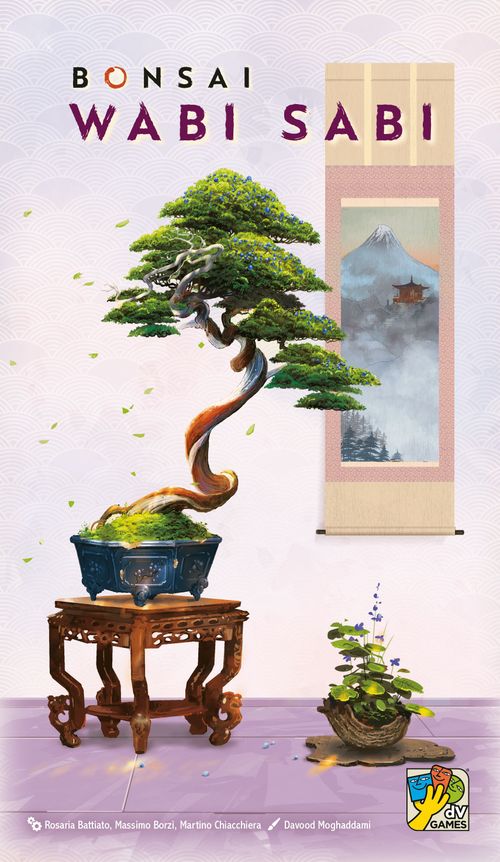
Bonsai: Wabi Sabi
Bonsai: Wabi Sabi Rulebook
Table of Contents
Table of Contents
Contents
- 6 Shitakusa tiles
- 9 new Goal tiles — 3 sets of 3 Goal tiles
- 8 Goal Randomizer cards
- 12 new Zen cards — of 2 types: Watering and Fertilizing
- 5 additional Zen cards
- 1 new Board — for the 5th player
- 1 Pot tile, 1 Seishi starting tile, 1 Summary card — for the 5th player
- 28 extra Bonsai tiles — 7 wood, 7 leaf, 7 flower, 7 fruit
- 1 Declaration token — to be used only with the Vigorous Growth and Specialists expansion (sold separately)
- 1 new Score pad
Setup
Follow the setup and the rules of the base game, with the following exceptions.
Module 1: The Shitakusa
Literally "under grass", but also known as complementary herbs, Shitakusa are displayed alongside a bonsai. Shitakusa is meant to reflect one of three elements of a broader narrative, the ground, while a scroll, called kakejiku, is used to depict the sky, and a bonsai to represent humankind.
Contents to use: 6 Shitakusa tiles, 1 new Score pad.
Additional Setup
At the end of the standard setup, add the following:
- Shuffle the 6 Shitakusa tiles, face down.
- If you are playing with 3, 4, or 5 players, draw 4 tiles randomly and place them face up in the 4 intersections formed by the Goal tiles (see image a).
- If you are playing with 1 or 2 players, draw only 2 tiles and place them in the 2 intersections (see image b).
- Put the unused Shitakusa tiles back in the box.
- Use the new Score pad at the end of the game to track the Goal and Shitakusa tiles.
Rules
When you claim a Goal tile, you may take 1 of the Shitakusa tiles that is connected to it; i.e., one that is in an intersection adjacent to the claimed Goal tile. Taking a Shitakusa tile is optional.
The Shitakusa tile, when taken, must be attached to the Goal tile just claimed (see image c). Once attached, a Shitakusa tile may not be moved or discarded.
Each Shitakusa tile has a requirement that you must fulfill at the end of the game. If you meet the requirement, you double the points provided by the Goal tile attached to it. However, if you don't, the Goal tile provides 0 points! Be careful when taking Shitakusa tiles!
Reminder of how it works:
- Completed: Score 2 × the Goal tile.
- Not completed: Score 0 for the Goal tile.
- Artwork.
- Requirement that you must fulfill.
- Minimum number of these tiles you must have.
Example: Simon claims the yellow intermediate Goal tile worth 12 points. There are 2 Shitakusa tiles adjacent to that Goal tile: I and II. Simon can take either of them to attach to the Goal, and he chooses II. At the end of the game, Simon must meet the requirement on the II Shitakusa tile (in this case, to have the same number of Helper and Master cards in his face-down pile, and at least 2 of each) to score 24 points. If he doesn't meet the requirement, he will score 0 for the attached Goal tile!
You can find an explanation of the Shitakusa tiles on page 6 of this rulebook. (See "The Shitakusa" under The Cards and Goals section below.)
Module 2: 5th Player
Contents to use: 1 Pot tile, 1 Seishi starting tile, 1 Summary card, 1 new Board, 5 additional Zen cards, 28 extra Bonsai tiles, 1 new Score pad.
Additional Setup
Place the new board on the table, replacing the one from the base game (setup, point a). The new board has an additional space on the right. This space lets you take 1 leaf and 1 tile of your choice when drawing the associated card.
Prepare the deck of Zen cards by using all the cards from the base game and the 5 additional Zen cards (setup, point d). This ensures a more balanced game with 5 players. These cards are marked with the rosette icon; remember to remove them when playing with a different number of players.
Starting with the first player and proceeding clockwise, each player takes from the common supply the Bonsai tiles shown in the following table (setup, point f):
| Player | 1st | 2nd | 3rd | 4th | 5th |
|---|---|---|---|---|---|
| Starting tiles | 1 wood | 1 wood, 1 leaf | 1 wood, 1 leaf, 1 flower | 1 wood, 1 leaf, 1 flower, 1 fruit | 2 woods, 1 leaf, 1 flower, 1 fruit |
"Promising Stub" Setup
This alternative setup gives you more freedom on how you can grow your bonsai. This setup was designed for a 5-player game, but you can also use it with fewer players.
| Player | 1st | 2nd | 3rd | 4th | 5th |
|---|---|---|---|---|---|
| Starting tiles | 1 wood | 1 wood, 1 leaf | 2 woods, 1 leaf | 2 woods, 2 leaves | 3 woods, 2 leaves |
Module 3: New Goals
Contents to use: 3 new sets of Goal tiles (9 tiles total), 8 Goal Randomizer cards.
Additional Setup
Add the new Goal tiles to the pool of available Goal tiles. In order to choose 3 colors at random (setup, point c), you may shuffle the 8 Goal Randomizer cards face down and reveal 3 of them. Use the Goal tiles represented on the revealed cards.
You can find an explanation of the new Goal tiles on page 7 of this rulebook. (See "The Goal Tiles" below.)
Module 4: The Techniques
Naturalness, or Shizen, is one of the principles of wabi-sabi. The bonsaist, when working on their tree, must strive for a natural look to the plant, devoid of artificiality. Reaching this goal is hard, because it requires the mastering of different techniques. In the advanced working stage, there should be no visible trace of the work done.
Contents to use: 12 new Zen cards (Watering and Fertilizing).
Additional Setup
Prepare the new Zen cards as follows, then add them to the deck (setup, point d):
- 5 players: use all 12 cards (total deck size: 64, all cards!)
- 4 players: remove the 4 cards for 5 players, marked with the rosette icon (total deck size: 55)
- 3 players: remove the 6 cards for 4 and 5 players, marked with the rosette icons (total deck size: 49)
- 2 players: remove the 8 cards for 3, 4, and 5 players, marked with the rosette icons (total deck size: 36)
Remember to include the 5 additional Zen cards when playing with 5 players (see Module 2).
Rules
When drawn, keep Watering and Fertilizing cards face up in front of you. You can use them before or after your "main" action (meditate or cultivate) on any of your turns, even the current one. Using a Watering or Fertilizing card does not count as the "main" action of your turn. You can have as many of these cards as you want in front of you, and you can use as many as you want during the same turn.
Once used, add these cards to your face-down pile. At the end of the game, if you have unused Watering or Fertilizing cards still in front of you, add them to your face-down pile. Each pair of Watering and/or Fertilizing cards, in any combination, is worth 7 points at game end.
Example: These pairs are worth a total of 14 points.
Example: Lisa has taken a Fertilizing card in one of her previous turns. During her current turn, she decides to use it, before taking her action. She adds the card to her face-down pile (step 1) and then she takes a Helper card from the display (but not the Bonsai tiles associated with that space) (step 2). She refills the row of cards in the display, then she performs the action provided by the Helper card just taken. As her "main" action, she decides to meditate, so she takes a Master card (step 3) and collects both the tiles from that card and those shown below that card's space.
You can find an explanation of the new Zen cards on page 6 of this rulebook. (See "The Cards" below.)
Module 5: Solo Expansion Game
Seijaku is the last of the 7 principles of Zen, thus necessary for achieving wabi-sabi. It encompasses the values of silence, quietness, and tranquility. Finding calm in the chaos is key to understanding the deep meaning of this philosophy.
If you include the Shitakusa tiles (Module 1) or the new Zen cards from The Techniques (Module 4), refer to the table below:
| Level (Difficulty) | Gakusei (Low) | Senmon (Medium) | Sensei (High) | Yūsha (Extreme) |
|---|---|---|---|---|
| Points to beat | 80 | 100 | 120 | 140 |
| + The Shitakusa (Module 1) | +20 | +25 | +30 | +35 |
| + The Techniques (Module 4) | +10 | +15 | +20 | +25 |
| Total to beat with both | 110 | 140 | 170 | 200 |
Additional Solo Scenarios
When playing these Scenarios, include the new Zen cards for 2 players from The Techniques (Module 4) in the Zen deck.
The Sound of Cicadas (6)
- Setup: Use the Goal and Shitakusa tiles shown here, in the same arrangement. (The arrangement is shown in the printed diagram.)
- Rules adjustments: None.
- Goal: Score at least 160 points. Claim one Goal per color.
A Poppy Blooms (7)
- Setup: Use the Goal and Shitakusa tiles shown here, in the same arrangement. Put a flower and a fruit tile on top of each Goal tile.
- Rules adjustments: As soon as you claim one of the Goal tiles, take the flower and fruit tiles on it and add them to your personal supply. Remember to respect your capacity limit.
- Goal: Score at least 180 points. Claim all Goals and all Shitakusa tiles.
The Cards
Watering Cards: When you use a Watering card, choose whether to place the tile depicted with a black border in your bonsai, or take the tile depicted with a white border from the common supply and add it to your personal supply. If you add a new tile to your bonsai using this card, you can claim a Goal in the same turn, if you meet the requirements.
Fertilizing Cards: When you use a Fertilizing card, take 1 card from the display that matches one of the card types shown on the Fertilizing card, then immediately slide the other cards and refill the display as normal. Do not take the tiles shown below that card. You cannot use this card if none of the types shown are in the display (you cannot take Watering, Fertilizing, or Parchment cards). If you take a Master or Helper card, trigger it immediately and add it to your face-down pile as normal. If you use multiple Fertilizing cards in the last turn, it may happen that no cards are left in the display. In this rare case, players cannot perform the meditate action anymore.
The Shitakusa
Each Shitakusa tile shows its requirement, which you must fulfill at the end of the game. The requirements are:
- Your bonsai must have more fruit than flower tiles, AND at least 3 flowers.
- Your bonsai must have an odd number of leaf, flower, and fruit tiles, AND at least 3 of each.
- Your bonsai must have more leaf than wood tiles, AND at least 9 woods. Remember that the starting bud tile counts as a wood tile.
- Your bonsai must have the pattern shown here (2 adjacent leaves with 1 flower in between), not touching other leaves, at least 3 times.
- You must have more Parchment cards than any other player in your face-down pile. Ties for the most cards count in your favor. In a solo game, discarded Parchments are considered to belong to the other player.
- You must have the same number of Master and Helper cards in your face-down pile, AND at least 2 of each.
The Goal Tiles
Takozukuri Style Goal
-
The total number of Growth and Tool cards you have is 4/5/6. Kabudachi Style Goal
-
Your bonsai includes the depicted pattern. The pattern can be rotated. You can have other tiles attached to the ones in the pattern, but to count for the Goal, the pattern must have at least the tiles shown, in the same position.
Note: If you include the starting bud in your pattern, you will be able to claim only the low and intermediate Kabudachi Goals.
Hokidachi Style Goal
The tiles that count towards these Goals must not protrude (not even partially) beyond the pot of your bonsai.
- The total number of leaf and flower tiles not protruding from the pot of your bonsai is 4.
- The total number of leaf and fruit tiles not protruding from the pot of your bonsai is 6.
- The total number of flower and fruit tiles not protruding from the pot of your bonsai is 8.
The Wabi-Sabi
Wabi-sabi (侘寂) is an aesthetic concept belonging to eastern culture: those who experience it are often unable to express it in words. Wabi-sabi is a fusion of two words: wabi (侘) and sabi (寂), which represent two different concepts. "Wabi" may be associated with simplicity, poverty, and solitude, but seen as enriching and positive qualities. The word "sabi" instead refers to the beauty expressed by the changing state and decline from the passing of time. These concepts are very far from the western aesthetics principles and emphasize the deep acceptance of the impermanence and imperfection of everything.
The wabi-sabi is foundational to many eastern artistry practices, from ikebana to the tea ceremony, and of course even bonsai. In particular, a famous quote from the tea master Sen no Rikyu helps us comprehend the deep meaning of wabi-sabi more closely:
"The Way of Tea is nothing more than this: first you boil the water, then you make the tea and drink it."
Wabi-sabi, in relation to bonsai, may be expressed through the 7 principles of Zen, described by Shin'ichi Hisamatsu in his famous book "Zen and the fine arts" (1971):
- Fukinsei, or asymmetry: The bonsai is harmonious through the proportion between empty spaces and the plant volume. This asymmetry, together with the apparently unbalanced pose of the plant, gives the bonsai movement, in stark contrast with the sense of staticity evoked by the tree.
- Kanso, or simplicity: The enrichment of the bonsai through frills and the use of precious materials for the pot is unadvised. It's preferred to use natural and simple materials that give better emphasis to the characteristics of the plant.
- Shibumi, or sublime austerity: Essentiality and minimalism are central to the vision of the bonsai. Thanks to its simple and elegant pose, it efficiently drives the right sensations. A Bujin-ji styled bonsai, with a highlighted barkless trunk, deeply embodies this principle.
- Shizen, or naturalness: The idea that mankind and nature live in harmony is core to understanding this principle. The human intervention in bonsai growth is often necessary, but it must not be visible. In the bonsai art it's important to hide the artificiality that was necessary for the maintenance of the plant.
- Yugen, or subtle grace: A careful look at the bonsai provokes inner thoughts and hidden suggestions. The majesty of the plant, with the passage of time, and the workmanship of the bonsaist become more evident by sharpening our own sensitivity.
- Datsuzoku, or freedom from attachment: Sensations of curiosity and discovery that comes from trying something new, from exploring new styles, and by moving in uncharted territories. The art of bonsai is not static: it requires willpower and detachment, to express at the fullest.
- Seijaku, or tranquility: The sense of deep calm given by the observation of the bonsai. Well-known bonsai of international fame are capable of delivering this sensation through the royal bearing that they embody.
These principles may be cultivated and improved thanks to constant practice and through a critical vision in the realization of your own bonsai.