Bombay Bazar
Bombay Bazar Rulebook
Table of Contents
Table of Contents
Goal of the Game
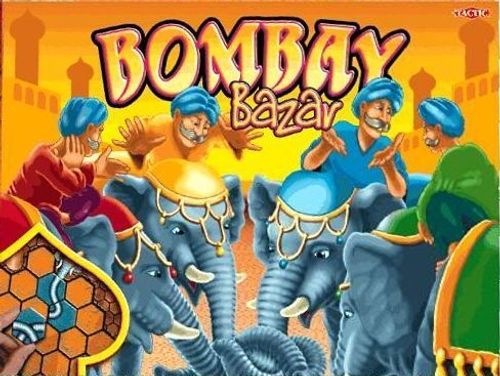
Great chaos reigns in the Bazaar of Bombay. The trunks of the elephants lie all tangled together while their owners argue over which elephant has the longest trunk. Each player tries to make the trunk of his elephant longer while preventing his fellow players from doing the same.
Setup
- Place the game board on the table.
- Sort the trunk pieces by picture and stack them on top of each other, trunk side facing up, on the matching spaces on the board.
- Each player then chooses an elephant to start with. If you are playing with two players, use elephants that face each other.
- If you play with two or three players, finish the trunks of the unused elephants with an end trunk piece.
- The first player is chosen at random.
- Play proceeds clockwise.
Note: the sheet prints "slufkant" for the trunk side; this is read as the trunk side ("slurfkant").
Contents
Printed as a box at the foot of the rules sheet; placed here.
- Game board
- 68 trunk pieces and 4 end trunk pieces
- 12 elephant medals
Determining Who Starts
In a manner customary at an Indian bazaar, gambling decides who starts. Each player takes 3 trunk cards in hand and hides one, two or three of them under the other hand. In turn, each player guesses whether the total number of cards hidden under the hands is even or odd. If everyone has guessed right or wrong, a new round follows. Players who guessed wrongly drop out and the remaining players guess again until there is a winner, who may start the game.
Rules of Play
- On their turn, a player chooses a trunk piece, places it on the space next to the start of his trunk and orients it however he likes.
- Each new piece must make the trunk longer; there may be no opening in the trunk. See Fig. 1.
- A piece can have 1, 2 or 3 trunk segments.
- When placing a trunk piece, you must follow 3 rules:
- No trunk segment or end piece, even an unused one, may extend off the board. See Fig. 2.
- No trunk segment may be connected to an opponent's trunk: the two trunks would then form a single trunk with two heads, which is impossible.
- Each trunk segment must connect logically to every "opening" of the player's trunk. Deliberately blocking an "opening" is not allowed. See Fig. 3.
- Each trunk piece can be used only once and by only one player.
- A trunk piece consisting of several segments may be used more than once by the same player if there are knots in his trunk, or by his opponents if their trunk path passes through it.
- Sometimes, by placing a piece, a player can connect his trunk to an unused trunk length. His own trunk then becomes that many trunk segments longer, and he will place his next piece at the end of the new trunk length. See Fig. 4.
N.B.: When trunk pieces of a certain shape have run out, you will have to make do with other shapes.
Eliminating Players
- If a player cannot place any of the remaining available pieces without breaking the rules above, he places an end trunk piece on the space next to his trunk. By doing so he ends the game for himself and stops playing.
- The game continues for the other players. When only one player remains, that player continues alone until he too cannot go any further.
- Then the game ends.
N.B.:
- End trunk pieces are the only pieces that may be placed without regard to unused "openings".
- Several end trunk pieces may be placed on the same space.
Winner
- When all end trunk pieces have been placed, each player counts his trunk segments, from the piece next to the head, along the trunk path to the end trunk piece. If the trunk path passes through the same piece two or three times, he counts it two or three times.
- The player with the largest number of trunk segments is the winner.
- A tie is possible.
Bombay Bazar Tournament
To play the Bombay Bazar Tournament, the game contains 12 elephant medals. For example, you can play four rounds: the winner of each round receives a gold medal, the second-placed player wins silver and the third bronze. The medals make it easier to see who wins the tournament. The winner is the player with the most gold medals! In case of a tie, the other medals are counted to determine the winner.
Solo Game
- The player places the end trunk pieces on the three unused elephants.
- He extends his trunk according to the placement rules.
- He stops playing when he can go no further.
- He counts his trunk segments as in the multiplayer game.
- From this score he subtracts the number of empty spaces and unused "openings".
- And he tries to match his score in a following game…
Good luck!