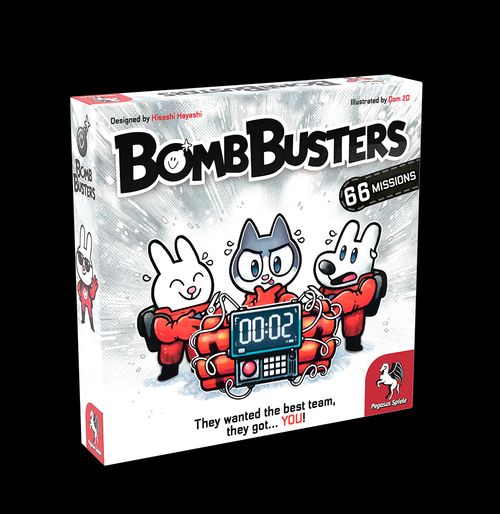
Bomb Busters
85 questions players ask about Bomb Busters, answered in plain words and graded by where the answer comes from. See also the full rulebook.
Updated 2026-10-29.
85 questions players ask about Bomb Busters, answered in plain words and graded by where the answer comes from. See also the full rulebook.
Updated 2026-10-29.
The rulebook text covers this directly, and forum players apply it the same way.
No — sort your tiles in ascending order and space them as evenly as you can. Clustering equal numbers or leaving gaps tells teammates about your hand, which the communication rules forbid.
The rulebook text covers this directly, and forum players apply it the same way.
Yes — you draw the mission's red and yellow wires, show their values by placing the markers on the board, then shuffle them in with the blue wires. Only the blue wires remain unknown to everybody; in play red and yellow wires are just "red" and "yellow".
The rulebook text covers this directly, and forum players apply it the same way.
Draw all the listed tiles, mark their values with the question-mark side of the markers up, shuffle them facedown, add only the required number to the blue pile and set the rest aside unseen. For a plain "X red" entry you reveal X values and mark them with the blank side up.
The rulebook text covers this directly, and forum players apply it the same way.
No — all 48 blue wires are always used (except the training missions 1–3); red and yellow wires are added on top of them.
Several players agree on this reading; there is no official ruling.
Do it when the Captain reads the mission card, which comes before the wires are drawn and before info tokens are placed. The rulebook doesn't state this outright, but its order (read the card at step 3, place info tokens at step 9) supports it.
Based on a single player's or a contested reading; no official ruling or rulebook text settles it.
Take as many equipment cards as there are experts and place them over the checkmarks. Players report that you may keep the same equipment after a failed mission; the rulebook doesn't forbid it, so it's a table choice.
From mission 9 onward it is simply shuffled in with the other equipment cards (a sticker in the 9–19 box says so). Leave it out of missions that have no yellow wires.
Several players agree on this reading; there is no official ruling.
No — the board's slots don't cap how many equipment cards you can have. Extras, such as the two False Bottom adds, simply sit beside the board.
Several players agree on this reading; there is no official ruling.
Equipment 11 and 12. Printed text naming a different card is a translation or printing error; the French original shows 11 and 12.
Based on a single player's or a contested reading; no official ruling or rulebook text settles it.
Every expert except the Captain may use one of the new personal tools from the later boxes as their personal equipment. The sticker inside the box explains them.
Several players agree on this reading; there is no official ruling.
From mission 55 onward, shuffle the new equipment cards into the equipment pile. Per the box's sticker, all 4 wires of a card's value must be cut before it can be used.
Several players agree on this reading; there is no official ruling.
The Captain is also the rookie: the rookie holds the Captain card in mission 14.
The rulebook text covers this directly, and forum players apply it the same way.
No — a Dual Cut needs one of your own identical wires, so you can only name a value you hold. You then point at a teammate's wire and say it is that value.
Several players agree on this reading; there is no official ruling.
Yes — an info token only shows what the wire is, not that it is cut. You can point at it for a Dual Cut like any other uncut wire.
The rulebook text covers this directly, and forum players apply it the same way.
It marks a wire as yellow. It is placed in front of a yellow wire when a failed cut hit it, instead of a numbered token; it does not show the number you guessed.
Several players agree on this reading; there is no official ruling.
Reuse a token whose wire has already been cut. If none is available, say the value aloud and point clearly at the wire so the group remembers it. Do not move a token that still marks an uncut wire.
Based on a single player's or a contested reading; no official ruling or rulebook text settles it.
Rewind the cut, cut a correct wire instead, and advance the detonator by one.
Several players agree on this reading; there is no official ruling.
No — a cut is one atomic action. Once it has been declared you can't interrupt it with equipment, even equipment usable at any time.
The rulebook text covers this directly, and forum players apply it the same way.
No — you still take exactly one action (Dual Cut, Solo Cut or Reveal Your Red Wires). Equipment either modifies that action, like a Detector replacing the Dual Cut, or is an anytime tool used outside the turn structure.
Based on a single player's or a contested reading; no official ruling or rulebook text settles it.
Nothing is revealed and no info token is placed. The owner may say it is red, but it is neither shown nor cut and stays hidden until its owner reveals it on their turn.
Based on a single player's or a contested reading; no official ruling or rulebook text settles it.
No — a failed cut on a red wire explodes the bomb, so no token is placed. When equipment such as the Stabilizer prevents the explosion, players report that no token is placed either. Individual missions may add exceptions.
The rulebook text covers this directly, and forum players apply it the same way.
Only when every remaining uncut wire of that value is in your own hand — all 4, or the last 2 after a pair was cut. If a teammate still holds any, you need Dual Cuts. Holding 3 of 4 means a Dual Cut first; only after it can you solo cut the last pair.
The rulebook text covers this directly, and forum players apply it the same way.
No — Solo Cut is one of the three actions you choose on your own turn, and it is your only action that turn.
The rulebook text covers this directly, and forum players apply it the same way.
Only as your action on a turn that begins with nothing but red wires left in your hand. It is not a solo cut that you can do as soon as your last other wire is cut, and what teammates hold doesn't matter.
The rulebook text covers this directly, and forum players apply it the same way.
No — red wires are never cut. A Dual Cut that hits a red wire explodes the bomb; the only way to resolve red wires is the Reveal Your Red Wires action.
Several players agree on this reading; there is no official ruling.
No — detectors name a number from 1 to 12, never a colour (yellow or red). Rules version 1.0 allowed yellow with the Double Detector; version 1.1 and the FAQ dropped it.
The rulebook text covers this directly, and forum players apply it the same way.
No — yellow wires pair only with other yellow wires. Their decimal number only fixes their position when sorting; to cut one you point at a teammate's wire and say it is yellow.
The rulebook text covers this directly, and forum players apply it the same way.
Yes — if all the remaining yellow wires are in your hand, you may solo cut them at any time on your turn, even early. Yellow wires come in pairs; a lone wire of any value in play would mean a setup mistake (some missions use 3 yellows but only 2 in play).
The rulebook text covers this directly, and forum players apply it the same way.
Only if every pointed wire is red. If just one of the two is red the bomb doesn't explode: the teammate marks the non-red wire with an info token and, if the guess failed, the dial advances. An older FAQ line said any red wire explodes; the rulebook text wins.
Several players agree on this reading; there is no official ruling.
Yes — the detector works on one stand, so both wires must be on the same stand. They need not be adjacent. The Multi Detector takes every wire of one stand.
Based on a single player's or a contested reading; no official ruling or rulebook text settles it.
No — it names one value and points at two or three wires on one stand. Naming different numbers for different wires is the job of the X or Y ray.
The rulebook text covers this directly, and forum players apply it the same way.
One of each: the dial advances once and the teammate places one info token in front of one of the two wires (their choice).
The rulebook text covers this directly, and forum players apply it the same way.
Only one is cut: the teammate chooses which to reveal without saying both matched, and you reveal your matching wire.
Based on a single player's or a contested reading; no official ruling or rulebook text settles it.
Yes — if the teammate picks the yellow wire for the token, the yellow info token goes in front of it.
Several players agree on this reading; there is no official ruling.
Yes, but it gives no protection: it is still a Dual Cut over the whole stand, so a single remaining wire is the target and if it is red the bomb explodes.
Several players agree on this reading; there is no official ruling.
Per stand. An expert with two stands answers the General Radar separately for each, and detectors such as the Super Detector act on a single stand.
Several players agree on this reading; there is no official ruling.
No — only blue wires have a number. A 7.5 red wire doesn't count as a 7, and wires a mission treats as red have no value, so nobody answers a Radar question about them.
Several players agree on this reading; there is no official ruling.
Yes — using General Radar doesn't replace your action, and it can be used outside your turn too.
Several players agree on this reading; there is no official ruling.
Into the same stand the wire you gave away came from, sorted into its correct ascending position.
No — neither player may look at the wire passed to them before choosing and passing their own. Both pass facedown, then each picks up what they were given and sorts it into the stand their own wire came from.
Based on a single player's or a contested reading; no official ruling or rulebook text settles it.
In its sorted position, e.g. between 11 and 12 for an 11.5, but still facedown.
Based on a single player's or a contested reading; no official ruling or rulebook text settles it.
Anyone may cut it; the group is expected to watch for it. The receiver has no extra duty.
Several players agree on this reading; there is no official ruling.
Yes — point at two wires and ask about two values. A Dual Cut still cuts only one hit (the owner's choice) and doesn't reveal the other. The restriction on naming yellow still applies.
Several players agree on this reading; there is no official ruling.
No — yellow wires count as the same value, so it can't mark two yellows next to each other. It can mark a yellow next to a numbered wire.
Based on a single player's or a contested reading; no official ruling or rulebook text settles it.
No — they only reactivate equipment cards on the board that were already used; personal equipment on character cards isn't affected.
Based on a single player's or a contested reading; no official ruling or rulebook text settles it.
Yes — it lets you skip your turn; if you do play instead, you must cut all your 7s.
Based on a single player's or a contested reading; no official ruling or rulebook text settles it.
Cut two yellow wires. It resolves immediately: draw two more equipment cards, which are active whatever their numbers.
Several players agree on this reading; there is no official ruling.
Yes — one pair of that value unlocks both. Two pairs aren't needed.
Several players agree on this reading; there is no official ruling.
Pick a random value from 1 to 12: draw one of the 12 number tokens or roll a twelve-sided die. If every wire of that value is already cut, nothing is left to affect.
Several players agree on this reading; there is no official ruling.
They go with specific equipment: the user places a token in front of a pair of their wires to show whether the two numbers are equal or not equal.
The rulebook text covers this directly, and forum players apply it the same way.
Within each — wires are dealt and sorted separately per stand, ascending. Together the two stands form one hand.
The rulebook text covers this directly, and forum players apply it the same way.
Yes — just one, in front of one of their stands (their choice).
The rulebook text covers this directly, and forum players apply it the same way.
Yes — both stands are one hand, so wires from either can be solo cut, under the usual rule (every remaining wire of that value, all 4 or the last 2). This applies to the 2-player game and to a 3-player Captain.
Several players agree on this reading; there is no official ruling.
No — you can't target your own other stand, unless it holds the last pair of that value (a solo cut).
The rulebook text covers this directly, and forum players apply it the same way.
No — reds must be your last wires across both stands.
The rulebook text covers this directly, and forum players apply it the same way.
Two players use two stands each; at three players the Captain has two stands and the others one each.
Normally 14. Some missions (e.g. 43) or equipment may allow more.
The rulebook text covers this directly, and forum players apply it the same way.
Yes — discussing general tactics and equipment use is allowed, including reminding a teammate to use a tool. Just don't reveal anything about your wires, for example by saying you can't use a card. Some tables avoid the discussion to prevent spoilers.
The rulebook text covers this directly, and forum players apply it the same way.
No — recalling earlier turns is forbidden, so there's a light memory element. Groups may relax this by agreement.
Several players agree on this reading; there is no official ruling.
None is given; groups decide, e.g. replay, self-penalty or carrying on.
Several players agree on this reading; there is no official ruling.
No rule sets a time limit, but a long pause can leak information, so choose quickly or agree on your choice beforehand.
The rulebook text covers this directly, and forum players apply it the same way.
Yes — revealing red wires doesn't end the mission. Experts with no uncut wires simply skip their turns, and play goes on until every stand is empty.
The rulebook text covers this directly, and forum players apply it the same way.
No — an expert with an empty tile stand is skipped, and play continues clockwise with the others.
Several players agree on this reading; there is no official ruling.
Yes — the mission's turn steps replace the normal ones and include flipping the number card and using the Radar for it, so it's not optional.
Several players agree on this reading; there is no official ruling.
The player who flipped the card chooses who cuts that value (possibly themselves). SOLO or DUO on the card doesn't force a type; the chosen player makes whichever cut their wires allow.
Based on a single player's or a contested reading; no official ruling or rulebook text settles it.
Yes — the ban covers the other equipment cards, not your character card's personal equipment, though the Radar may be used every turn. A Pegasus Spiele post confirms this; one poster read the German wording differently.
Several players agree on this reading; there is no official ruling.
No — normal rules apply: two only if they're the last two of that value, all four if you hold all.
Several players agree on this reading; there is no official ruling.
Yellow wires are marked as usual, and no rule forbids Walkie-Talkies swapping them (both publishers reportedly said so), although it makes the mission much easier. Yellow info tokens can't be placed at setup.
Based on a single player's or a contested reading; no official ruling or rulebook text settles it.
One per stand. A 2-player game, or a 3-player Captain, therefore has two. Some translations omit "of each stand".
Disputed. The Dutch text only bars tools on the X wire, which reads as allowing tokens; other posters treat it as off-limits. No official answer was given.
Several players agree on this reading; there is no official ruling.
Failed Dual Cut guesses still give info tokens as usual. A Captain with two stands places one marker per stand. One experienced poster takes the passed marker from the general supply rather than from their own markers.
Several players agree on this reading; there is no official ruling.
Their cards go under the draw pile. An unmet card play is an automatic fail that ticks the detonator once but doesn't lose the game by itself, and the next player to the right with a card plays.
Several players agree on this reading; there is no official ruling.
Beside the stand, to show you lack it. Number cards are never in hands; they are discarded at the end of the round unseen.
Several players agree on this reading; there is no official ruling.
The German 1.0 mission card says the bomb ticks and two number cards are turned over. Per the publisher (as reported), revealing red wires doesn't change the cards, and Equipment 9 can't prevent the tick when you pass.
Several players agree on this reading; there is no official ruling.
Mission 56: one wire per player (at one end of their hand, not per stand). Mission 64: per the 11 July 2025 FAQ, a player with 2 stands has only 2 wires flipped in total.
Based on a single player's or a contested reading; no official ruling or rulebook text settles it.
No — equipment can't be applied to flipped wires, though another player's equipment can still aid deduction.
Based on a single player's or a contested reading; no official ruling or rulebook text settles it.
Nano does not skip them. If he holds a wire and only one player has wires left, you can't solo cut to free him, so the mission is lost; plan to avoid it.
Based on a single player's or a contested reading; no official ruling or rulebook text settles it.
When it reaches space 12. Revealing your own red wires doesn't move it; someone cutting another player's red wire ends the game.
Based on a single player's or a contested reading; no official ruling or rulebook text settles it.
If only a red wire remains the constraint counts as complete. Each player has one constraint card from 2 to 5 players.
Based on a single player's or a contested reading; no official ruling or rulebook text settles it.
The bomb explodes immediately.
Several players agree on this reading; there is no official ruling.
No — the number card is public information for everyone; don't cover it. All wires of that value are red for the mission.
Based on a single player's or a contested reading; no official ruling or rulebook text settles it.
Yes — one per stand.
Based on a single player's or a contested reading; no official ruling or rulebook text settles it.
Yes, but no clues about how many oxygen tokens you need — you may only signal you need oxygen.
Several players agree on this reading; there is no official ruling.
No — Rhett can't use any equipment.