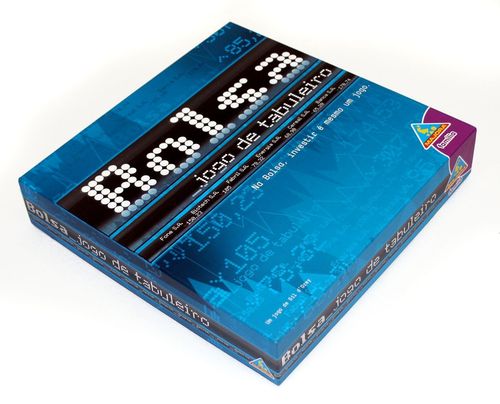
BOLSA: the board game
BOLSA: the board game Rulebook
Table of Contents
Table of Contents
- Objective of the Game
- Game Components
- Preparing to Play
- Turn Order
- Step 1 – Roll the Trend Dice
- Step 2 – Place the Trend Cubes (Red and Green)
- Step 3 – Only at the End of Each Quarter: Prices Are Set With the Blue Marker
- Step 4 – Plan Orders of Sale, Buy Shares and Invest in the Newspaper Finance & Stock Cards – Just 30 Seconds
- Step 5 – Completing Sales (All Players) – Placing the VIRTUAL Yellow Marker
- Step 6 – Making Purchases (All Players) – Move the VIRTUAL Yellow Marker
- Step 7 – Lottery of Shares (Only if Necessary) – Move the VIRTUAL Yellow Marker
- Step 8 – Replacing the VIRTUAL Yellow Marker With the Blue Marker
- Step 9 – Using the Finance & Stock Cards – Moving the Blue Marker
- Step 10 – Placing Blue Markers in the Next Month – Equal to the End Price of the Previous Month
- End of Year / Final Round
- Important Rules That Should Not Be Forgotten and Tactics to Play Better
Objective of the Game
The winner is the player who manages to collect the most money over 12 months (January to December). The game ends after the end of the December turn and all players receive their dividends from shares they have and then convert them into cash at the December closing price.
Game Components
- This rule book
- One 30 second timer
- Money in various denominations
- 6 company boards
- 6 trend dice and self-adhesive stickers. Setting up to play the first time, affix 6 stickers of the same colour to each of the dice.
- 10 shares per company. If this is your first time playing, punch out the shares (even those which are blank).
- 60 newspaper cards "Finance & Stock"
- 6 screens. Each screen has a front and a back. For the first time you play, fold the creases toward the back so that it covers the player card.
- 6 player cards (see Fig. 01: the player card sits under the screen)
- 6 yellow markers
- 102 blue markers
- 54 green cubes
- 54 red cubes
Preparing to Play
Give each player a screen, a player card (see Fig. 01) and 5 blue markers. A turn order summary is on the face of the screen. On the reverse side is a range of values. This scale will be used during the game, placing the various shares purchased in front of the value so you don't forget the amount it cost for each share.
Depending on how many players the quantity of shares and companies that enter the game varies. To find out which companies and the number of shares that come into play, consult Tables 1 and 2.
Table 1
| Number of players | 2 | 3 | 4 | 5 | 6 |
|---|---|---|---|---|---|
| Number of companies at the start of the game | 3 | 4 | 5 | 6 | 6 |
| Number of shares of each company at the start of the game | 6 | 7 | 8 | 9 | 10 |
| Number of shares distributed to each player at the beginning of the game | 6 | 6 | 6 | 6 | 6 |
Table 2 – Companies to use, depending upon the number of players. The companies are shown as tiles on the table. Low risk company = yellow tile. High risk company = green tile. Medium risk companies = red, blue, purple and black tiles.
| Number of players | Companies in play |
|---|---|
| 2 | Low risk (yellow), high risk (green), and one medium risk (red) |
| 3 | Low risk (yellow), high risk (green), and medium risk (red, blue) |
| 4 | Low risk (yellow), high risk (green), and medium risk (red, blue, purple) |
| 5 or 6 | Low risk (yellow), high risk (green), and medium risk (red, blue, purple, black) |
Place the boards that represent each company within reach of all players. Place the blank shares in the box (they are for later use, see p. 9). The remaining shares are shuffled face down. Each player chooses their six shares and places them behind their screen to be concealed from other players.
Place the remaining shares face up on the boards of the respective companies in the area where it says "SHARES AVAILABLE".
Give each player 200 Euros as follows: 1 €100, 1 €50, 4 €10 and 2 €5.
Shuffle the Newspaper cards and place them face down next to the company boards.
Put a blue marker on the 30 euro box for January on each company board.
Fig. 1: The blue value marker is placed in the 30€ space on the board for ENERGY SA company. The shares left over after the initial draw are placed in AVAILABLE SHARES. In this case there were 3 shares remaining. It could be more or less.
Roll the trend dice for companies in play. The dice indicate numbers -3 to +3 (these figures indicate the number of levels that each share value may go up or down). Adjust the price of each share as indicated by the value of their dice. Do this by using the blue marker that is found in the box with a value of 30 Euros.
Fig. 2: The trend dice for this company (with scarlet sides) was rolled. It shows a value of -2. The blue marker moves down 2 levels, indicating that the initial value of the shares of this company is 26 Euros. The game is ready to start.
Turn Order
The game is played over 12 rounds (12 months of the year). Each turn is composed of a series of actions. These actions are described briefly on the front of screens. It is essential to adhere to this order.
- Roll trend dice.
- Place trend cubes (green and red).
- Only at the end of each quarter – set prices with the blue marker on the basis of the balance of the trend cubes.
- Plan sale orders, buying and invest in the newspaper Finance & Stock cards – only 30 seconds.
- Implement sales (all players) – place VIRTUAL yellow marker.
- Buy shares (all players) – move VIRTUAL yellow marker.
- Lottery for shares (only if necessary) – move yellow marker.
- Replace yellow marker with blue marker.
- Apply Finance & Stock card(s) – adjust blue marker.
- Place blue markers in the new month – equal to the ending price of the current month.
Step 1 – Roll the Trend Dice
At the beginning of the turn, a player launches the trend dice; one for each company in this game.
Step 2 – Place the Trend Cubes (Red and Green)
On the board of each company, place the cubes corresponding to the result of its individual die roll:
- +1 = 1 green cube
- +2 = 2 green cubes
- +3 = 3 green cubes
- -1 = 1 red cube
- -2 = 2 red cubes
- -3 = 3 red cubes
The cubes are placed within the respective month of the quarter (the "1st month", "2nd month" or "3rd month" box of the Quarterly Trend).
Fig. 1: In April the trend die for the company CEREAL SA (die with the yellow faces) was rolled. Result +3. As April is the first month of the second quarter, 3 green cubes are placed in the "1st month" box in the Quarterly Trend. Note that the value of the share does not change by placing the cubes. These only indicate the monthly trend. In this case positive.
Fig. 2: In May the trend dice are rolled. Result -1. As May is the second month of the second quarter, put 1 red cube in the "2nd month" box in Quarterly Trend. Again the value of the roll does not change the placement of the blue marker. It only indicates a monthly trend. In this case negative.
Step 3 – Only at the End of Each Quarter: Prices Are Set With the Blue Marker
Where turns correspond to the end of the quarter (March, June, September and December), and after Steps 1 and 2, equity prices are immediately adjusted by the balance of the cubes placed over the 3 months.
Each single green cube is cancelled by a single red cube. This continues until only a single colour (green or red) or no cube remains. The share price is immediately adjusted:
- Upwards (if the cubes are green)
- Downward (if red)
- Does not move (no cube)
The number of levels that the price will rise or fall depends on the cubes that remain:
- 0 cubes = 0 levels
- 1 cube = 1 level
- 2 cubes = 2 levels, and so on.
A share can climb up to 9 levels (if all three months the result is +3) or down a maximum of 9 levels (if all three months the result is -3).
Fig. 1: Play comes to June – final month in the second quarter. Upon completion of Steps 1 and 2 the die indicates +1, so a green cube was placed in the 3rd month box. So, all three areas of Quarterly Trend are filled with cubes. As it is the end of a quarter, it's time to adjust prices according to the cubes present. There are 4 green cubes less 1 red cube gives a balance of three green cubes. This shows how the marker moves three levels.
Fig. 2: The blue marker is adjusted and all of the trend cubes are collected and returned to the box. After this is done for each of the companies, follow Step 4 in the Turn Order.
Step 4 – Plan Orders of Sale, Buy Shares and Invest in the Newspaper Finance & Stock Cards – Just 30 Seconds
Each player has a player card, a blue screen and 5 markers. The players will use the markers on the player card to mark their intentions of selling and buying of shares in any of the companies involved. Furthermore, they can also try to obtain the right to play a Finance & Stock card.
It is important for the dynamics of the game that no player is aware of the planning of other players. This should be kept secret until they actually play.
When placing markers on their card, each player has three possibilities:
- Sell shares they own.
- Buy shares.
- Place a number of blue markers in the "Read the newspaper Finance & Stock" area in order to try to win the right to play a newspaper card.
The player places 1 blue marker for each share they want to sell or buy for companies in the areas corresponding to these actions. Can place 5 markers in this way.
Needless to say, players are limited in what they can do by the number of blue markers that are available.
On the other hand, if a player wishes to invest to play a Finance & Stock card, there will be fewer blue markers to buy or sell shares.
A player can never plan to sell and buy shares of the same company in the same turn. Doing so they will be forced to choose the one action they want to actually accomplish. The markers placed in the same area are simply removed from the current play, which means the player will have the possibility to do fewer things this turn.
Players may not trade shares amongst themselves.
Players may only sell shares that they actually own at the beginning of the turn.
Players are not required to use all the markers. You may even choose to put no blue markers on your player card.
The players have 30 seconds to plan their actions (once the timer is turned over). At the end of 30 seconds, all players must stop planning and reveal their player card. The player who fails to do this will be excluded this turn.
Fig. 1: In this example, after 30 seconds the player chooses to use only 4 blue markers. Two in the area of the newspaper, one action in the sale of ENERGY SA and another in the purchase of a share of the Phone S.A.
Fig. 2: In this example, the player made an error. He is selling and buying simultaneously BIOTECH SA shares so will have to choose if he buys or sells; he cannot do both.
Step 5 – Completing Sales (All Players) – Placing the VIRTUAL Yellow Marker
With the players' cards in plain sight, one starts by completing all of their proposed sales (from left to right), starting with the company CEREAL SA. Carry out the following steps:
- Shares sold by a player are placed in the "Available Shares" space on the respective company board. The players receive the amount due, which is calculated by multiplying the rate (indicated by the blue marker) by the number of shares sold.
- Place the VIRTUAL yellow marker the number of levels below the blue marker identical to the number of shares sold by players.
Note: For optimum control of this operation (especially when the number of players is higher), please do this player by player.
Example: There are three players wanting to sell the BIOTECH SA shares. The price of BIOTECH SA indicated by the blue marker is 36.
Fig. 1: The first player sells two shares. Put them in the "Available Shares" space on the board. They receive 72 Euros (indicated by the blue marker price x number of shares sold), and the VIRTUAL yellow marker is placed two levels below the blue, with the price 30 Euros in the same month. The blue marker stays at 36 Euros.
Fig. 2: The second player sells only one share of BIOTECH S.A., puts the share in the area and receives 36 Euros. The yellow marker moves down one more level and is set at 27 Euros. The blue marker remains at 36 Euros.
Fig. 3: Finally the third player sells three shares. Places the shares in the area and receives 108 Euros (price x 3 shares sold). The yellow marker moves three levels lower and is at 18 Euros. The blue marker remains at 36 Euros.
In all, six shares were sold (2 by the first player, 1 by the second and 3 by the third). The yellow marker is six levels below the blue.
The sales phase began and ended with the blue marker in the 36 Euros. In this phase do not move the blue marker.
Regardless of the difference in the price grids, the procedure for all companies is always the same: the price goes down a number of levels equal to the number of shares sold.
The yellow marker is only used if there are sales of shares in that company. If for some companies there are no sales, then the yellow marker is not placed and you keep only the blue.
Step 6 – Making Purchases (All Players) – Move the VIRTUAL Yellow Marker
If the number of outstanding shares of a company equals or exceeds the number of shares declared that all players want to buy, each player removes from the board of the company(ies) the share(s) they declared they wanted to purchase and pays the respective value (price indicated by the blue marker x number of shares).
Conceal the shares in the space behind the screen in front of the number corresponding to the cost of the shares (to help you remember later what price was paid for those shares).
The yellow marker increases the number of levels equal to the number of shares purchased. If one was already placed (i.e., from the sale of shares in that company), then it starts from that position. If you have not yet placed one, it starts in the same position as the blue marker.
As in the other stage of the sale, it is recommended for better control of this operation (especially when the number of players is higher) that you do this player by player.
The reference price for use in calculating the cost of purchase is always indicated by the blue marker, not the yellow.
Example (continuation from the Sale Example): There are only 3 players who want to buy SHARES: 2 want to buy the BIOTECH SA and 1 wants INDUSTRIAL SA (for which there was no sale of SHARES in the previous phase).
Fig. 1: The price of BIOTECH SA, indicated by the blue marker, is 36 Euros. The first player buys 2 shares. Remove them from the "Available Shares" area. They paid 72 Euros (price indicated by the blue marker x shares purchased). The yellow marker goes up 2 levels (2 shares purchased) and is placed on the price 24 Euros, the same month. The blue marker remains at 36 Euros.
Fig. 2: The second player takes only one share. They remove the share from the area and pay 36 Euros. The yellow marker moves up one more level and is placed at 27 Euros. The blue marker remains at 36 Euros.
Fig. 3: The share price for INDUSTRIAL SA is 26 Euros, indicated by the blue marker (in this case the yellow marker has not yet been used). Finally, the third player purchases two shares of INDUSTRIAL SA. They take the shares from the "Available Actions" area [printed as such; the shares are taken from the Available Shares space] and pay 52 Euros (price at blue marker x 2 shares purchased). Place the yellow VIRTUAL marker 2 levels above the blue, that is, the 30 Euros. The blue marker remains at 26 Euros.
Step 7 – Lottery of Shares (Only if Necessary) – Move the VIRTUAL Yellow Marker
If the number of outstanding shares of a company is less than the number of shares stated that all players want to buy, a lottery is held:
Take the shares available in this company and add to it the number of blank shares necessary to equal the total number of shares for all Buy intentions of the different players.
Place all shares face down on the company card and mix them so that you cannot identify which are the real shares of the company and which shares are blank.
The players take turns removing one share (without looking) for each blue marker they placed to show that they intend to purchase the stock. Play rotates to the left (counter clockwise).
The first player to draw is the one with the most Buy intentions. If more than one player has an equal number of Buy intentions, then they should decide who goes first. If no agreement is reached, draw randomly the player who goes first.
For each share taken, players remove one of their blue markers from the Buy area of their player card. The remaining markers indicate how many shares a player can still take.
The first player takes one share from the group and turns it over to reveal whether the share is real or not. Place that share face up in an area visible to everyone (do not put it together with their other shares).
When all the shares have been drawn, the players pay according to the actual shares they received (number of shares x the price indicated by the blue marker). The blank shares are returned to the box.
Example: There are three shares available from BANCA SA. Between the players, there is a total of 7 Buy intentions:
- Player A wants to buy 4 (there are 4 blue markers on the player card, in the area of Buy BANCA SA).
- Player B wants 1.
- Player C wants 2.
Take 4 blank shares and mix them with the real shares, face down. Mix them together so no one knows which shares are real and which are blank.
The 7 shares are mixed together face down. Which ones will be real?
- Player A is first since he is the one who wants to buy the most shares. A removes 1 share without looking at them, then shows everybody. He drew a blank share and places it in front of his screen so that it is visible to all. A also removes one of his blue markers off his player card. He wanted to buy 4 shares to start, so now has 3 blue markers.
- To the left of Player A is Player B. They repeat the same procedure. Player B draws a share and it is revealed as a real share. He places it in front of his screen, the same as Player A. He removes the blue marker from his player card. Since he wanted to buy just 1 share, he now has no blue markers in the Buy area for BANCA S.A.
- Player C takes 1 share and draws a real share. Placing it before him, he removes 1 blue marker. He still has 1 remaining.
- Player A repeats the procedure; player B has already finished because they have no remaining blue markers on Buy, and Player C can still get 1 more share.
- In the end, each player has 1 real share, so that each pays the respective value (1 share x price at the blue marker), and places that share with the others they already have.
- Blank shares are returned to the box.
- As 3 shares were sold [printed as "sold"; in context these are shares bought], the yellow marker is placed 3 levels above its previous position. If the VIRTUAL yellow marker had not yet been used in the Sell phase, it is placed three levels above the blue marker.
Step 8 – Replacing the VIRTUAL Yellow Marker With the Blue Marker
After all sales and purchases, the yellow markers indicate the change in relation to the original price (prior to sale), i.e., in relation to the blue marker. At this time, the blue marker is moved and replaces the virtual yellow marker, thus indicating the new price of each company after the Sell and Buy steps are completed.
Step 9 – Using the Finance & Stock Cards – Moving the Blue Marker
Check which player put the most blue markers in the "Read the Finance & Stock newspaper" area on the player card.
That player draws 3 cards from the Finance & Stock Exchange deck and chooses one to play. The other two are returned to the bottom of the deck without being revealed to the other players. The chosen card is revealed and its effects are applied by moving the blue marker for the affected businesses.
If the card is "Suspend Trading", put the card on the board of the affected company. In the next turn, shares of that company cannot be bought or sold.
If there is a tie between players with the most blue markers, then all of these players perform the procedure described above. Just be sure to reveal the chosen cards at the same time so as not to influence anyone's choice.
If no player chooses to place a blue marker in the "Read the Finance & Stock newspaper" area, then simply turn over the top card of the Finance & Stock Exchange deck and apply its effects.
Whenever a card is turned over that has ONLY companies that are not in play, draw another card.
The application of Finance & Stock Exchange card(s) is the final price adjustment of a turn. The blue markers indicate the final price for the month.
Step 10 – Placing Blue Markers in the Next Month – Equal to the End Price of the Previous Month
The turn ends by preparing for the beginning of the next turn, i.e., by placing a blue marker at the same price it ended at in the current turn but in the following month.
The blue marker which marks the last stock price of each turn, that is, each month, remains on the board. In the course of the game over the months, it shows the trend of the share price for each company throughout the game.
End of Year / Final Round
At the end of December, and after performing all the steps 1-9 described above (as in a normal month, except step 10), the price of each share is considered closed.
After the closing quotation, the dividends are distributed:
1 – Receive Dividends
On each company's board, in the "End of Year" column there is a grid of dividends. For each price listing there is a corresponding Dividend value.
Example: In this example, at the end of December the price of BIOTECH SA is 33. For each share a player holds they receive 11.
For every SHARE in their possession, each player receives the amount of dividends indicated in the dividends column, depending on the final price of SHARES in December. Obviously, those who do not have shares receive nothing.
2 – Sell All Shares
After receiving the dividends, all players convert all of their shares into cash, depending on the final price for each company.
After converting all shares to cash, all players count their money. The winner is the player with the most money.
Important Rules That Should Not Be Forgotten and Tactics to Play Better
The price of a share can never go above or below the limits of the grid on the company board. If purchases or sales or playing a Finance & Stock Exchange card would cause this, then the price is at its maximum or its minimum.
From the moment when the player cards are revealed, players cannot correct any planning errors. The player will have to live with what they marked on their card.
If a player has planned something that they cannot perform (for example, sell a stock they don't own, buy shares when they don't have enough money, etc.), then quite simply this particular action is without effect: the share does not sell, and the purchase the player intended does not go through [the printed sentence here is garbled: "not I wanted to buy the shares"; this is the sense given by the rest of the paragraph]. The player is at a disadvantage because his play was less efficient, i.e., blue markers wasted in actions that could not be completed.
Each player is an individual investor and must act as such. There must be no collusion between two or more players to subvert the laws of the market. If this happens, the players in question are excluded from this turn.
If players want to play a shorter version of the game, they can agree to end the game, but always at the end of a quarter (for example in June).
If it is the first time you are playing, you can just use the hourglass (the limit of 30 seconds) starting in April.
Note that companies may have different investment risks. Knowing how to manage their investments according to the risk of several companies is important.
To make money you need to take some risk. Those who do not invest anything normally do not win the game.
Do not lose sight of the values you paid for the shares. Use the value scale on the back of your screen.