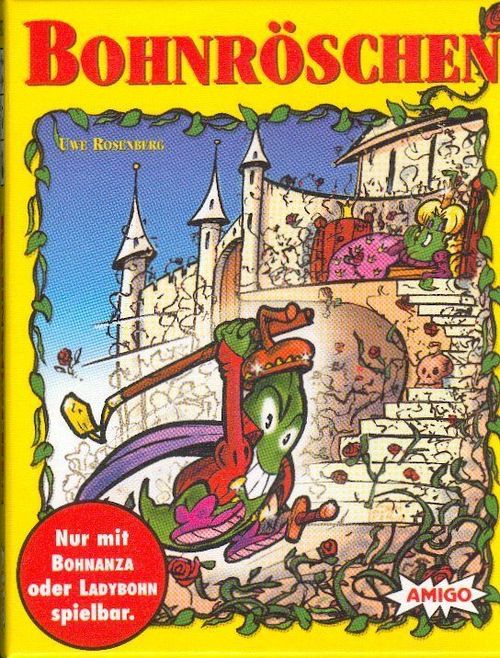
Bohnröschen
Bohnröschen Rulebook
Table of Contents
Table of Contents
Components
- 28 vine cards (Rankenkarten)
- 1 castle card (Schlosskarte)
- 4 "3rd bean field" cards
- 6 bean figures in six colours
Setup
All cards from Bohnanza are needed. Therefore the setup is identical to the setup of Bohnanza.
When playing with six players, the same rules apply as for five players. Among the cards of this expansion are additional 3rd bean field cards with special rules on their back. They are only used when playing with Ladybohn.
The castle card is separated from the vine cards. The vine cards are shuffled and placed face down in the middle of the table as a draw pile. The castle card goes last, as the bottom card of the pile. Four cards are turned face up and laid out in a row. Each player chooses a bean figure and places it on the first vine card (see illustration). Figures that are not needed go back into the game box. To shorten the game, players may remove eight vine cards from the game.
Playing the game with 3–6 players
The sequence of play follows the familiar four phases and their corresponding actions from Bohnanza or Ladybohn. New are an intermediate phase and vine cards with tasks that the players must fulfil.
The tasks on the vine cards
At any time during the game, regardless of whose turn it is, players may fulfil tasks. A player can only fulfil the task on the vine card where his figure stands. Once he has fulfilled the task, he immediately moves his figure one card forward. He says "Stop" and shows the other players how he has fulfilled the task.
The vine cards contain tasks that can only be fulfilled during certain phases. For example, the vine card "In phase 1, play two identical beans in front of you!" can only be fulfilled in phase 1 (see also Example 1). Other cards can be fulfilled through actions such as planting or harvesting. For example, the vine card "You sell one bean harvest for two gold coins." is fulfilled through the harvesting procedure whenever the player's figure stands on the card, no matter which phase it is; the player may keep the two gold coins. If a player has three bean fields available, then for the vine card "Have exactly one bean on every bean field." he must have one bean on each of the three fields.
Paying tribute on your own turn
If a player cannot or does not want to fulfil a task, he instead pays one gold coin as tribute and then moves his figure forward one vine card. The coin is placed bean side up on the discard pile. If he pays several gold coins in tribute, he may move forward several vine cards.
Players may not change the order of their coin stack; they must always pay with the coins lying on top.
Tip: A player should pay tribute whenever the task on the vine card where his figure stands is difficult or no longer possible for him to fulfil. For example, he stands at the vine card "Buy a 3rd bean field." and he already owns the 3rd bean field card.
A player may pay tribute at any time on his own turn, even before playing a bean card in phase 1. The other players may not react to this. The last opportunity for a player to buy himself free of a task alone is in phase 4, before drawing the three cards. Only in the following intermediate phase may all players pay tribute.
Tribute in the intermediate phase
When the active player has finished his turn by drawing the three cards, an intermediate phase begins. Now all players, including the player whose turn it was, may pay tribute. No bean field may be harvested during the intermediate phase.
Paying tribute during the intermediate phase happens without any fixed order, and it may happen several times. The intermediate phase ends when no player wants to pay any more tribute, or it is skipped if nobody wants to pay tribute. Then the next player is active.
New vine cards
A) Three more cards should always lie face up in front of the frontmost bean figure. New vine cards are turned up from the draw pile and placed at the end of the row. This happens immediately after a new figure has been moved forward. If necessary, room must be made for the new card.
B) Vine cards that all players have moved past are removed from the game.
Tip: So that the players can better judge when the game will end, it is recommended that the last 3–5 vine cards, including the castle card, be laid out face down at the end of the row as soon as the draw pile has been emptied accordingly. These cards are then turned face up when needed.
Examples of fulfilling tasks
It is possible to fulfil several vine cards in one turn and to pay tribute in between.
Example 1: The active player has two green beans at the front of his hand. He places them on one of his bean fields on which a green bean already lies. He fulfils the vine card "In phase 1, place two beans on one or two bean fields that already exist!", pays tribute for the following vine card, and then fulfils "In phase 1, play two beans of the same kind in front of you!", because he is still in phase 1.
The players should observe the known phases 1–4 and therefore should not plant beans they have acquired by trading during the trading phase, but only during the planting phase.
Example 2a: The active player's figure stands on the vine card "Have blue beans lying on one field", and the next card is "Some player has planted at least two red beans." In phase 2 the active player acquires a blue bean by trading. In phase 3 he plants the blue bean (one blue bean is enough for the task on the first vine card) and moves his figure one card forward. Now an opponent harvests his two red beans. Nevertheless, the active player may move his figure one more card forward, because he already had his figure on the vine card "Some player has planted at least two red beans." before the opponent harvested his two red beans.
The same situation with one important difference:
Example 2b: In phase 2 the active player has acquired a blue bean by trading. An opponent harvests his two red beans still in phase 2. The active player plants the blue bean in phase 3 and moves his figure one card forward. Now the vine card "Some player has planted at least two red beans." remains unfulfilled, because the red beans were already harvested in phase 2.
The vine card "All other bean figures stand in front of your figure." can only be fulfilled by the player whose figure is clearly the last one in the row.
Example 3: Four bean figures stand on the vine card described above. This means that three players must pay tribute in order to be allowed to place their figure on the next card. Only the fourth player fulfils the task of the card and does not have to pay tribute to move on to the next card.
End of the game
In BOHNRÖSCHEN the draw pile may be used up more than three times. The game ends only when a player fulfils the last vine card, or pays tribute for it, and at the same time can show that he holds at least five gold coins. For this he may still harvest and sell his bean fields.
As a sign that he has the required number of gold coins, he places his bean figure on the castle card.
If a player does not yet have the required number of gold coins, his figure remains at the castle card and the game continues normally until he has five gold coins, which immediately ends the game.
It can happen that another player fulfils the last vine card later, but holds the minimum of gold coins earlier. That player then ends the game.
When the game has ended, all other players also harvest their bean fields and pay as many gold coins in tribute until they too have their figure on the castle card. They do not have to hold five gold coins, as was required of the first player.
The player who has the most gold coins in the castle wins. If several players have the most gold coins, they have all won.
Example 4: Player Green has fulfilled the last vine card and moves his figure onto the castle card. He has four gold coins. He sells one bean harvest and receives two gold coins. Now he has six gold coins, moves onto the castle card and thereby ends the game. Now all the other players also harvest their fields.
Player Red pays exactly four gold coins in tribute for four vine cards, in order to be allowed to place his figure on the castle card as well, and has four gold coins left over.
Player Yellow has only five gold coins and therefore does not manage to reach the castle.
Player Green has won the game.
Two-player game
- The garden beans are removed from the game.
- Bean fields may only be harvested on your own turn.
- A 3rd bean field may only be bought on your own turn.
- The intermediate phase is omitted; tribute is only allowed on your own turn.
- The gold coins with which the 3rd bean field is bought and those with which tribute is paid are removed from the game entirely.
- The players agree whether to lay out all the vine cards face down at once, as is necessary in the solo game (see there).
The turn consists of the following phases:
Phase 0: The active player decides whether to place, in any order, the beans that his opponent has left lying in the middle of the table (see phase 3) on his own bean fields or on the discard pile. If he decides to plant a kind of bean, he must do so with all beans of that kind. If the opponent has not left any beans over, this phase is omitted.
Phase 1: The player plays his frontmost hand card, or optionally his second card. Before or after playing a bean card, he may place any one card from his hand on the discard pile.
Phase 2: The player turns up three cards from the draw pile and lays them side by side in the middle of the table. Beans of the same kind are placed together. Then, for as long as the topmost bean card of the discard pile (if there is one) matches one of the revealed kinds of bean, he takes it and adds it to the revealed beans.
Phase 3: The player must now decide which beans he wants to plant and which he leaves for his opponent. Beans of the same kind must either all be placed together on the same bean field, or all be left for the opponent. This is important for vine cards such as "Have exactly one bean on every bean field!"
Phase 4: The player draws two cards and takes them into his hand at the back. With the drawing of the cards the turn is over, and he can no longer pay tribute.
Note: In BOHNANZA the draw pile always runs out for the first time during the turn of the non-starting player, namely after he has turned up his three cards in phase 2. He still takes the matching cards from the discard pile; then the draw pile is shuffled.
If the first of the two players reaches the castle with the required five gold coins, the other player may still harvest his bean fields and must pay tribute until he reaches the castle.
Solo game
There is no phase 0. Otherwise, all the rules of the two-player game apply. The vine cards and bean figures are set up as shown in the illustration alongside. The violet and the red bean figures are neutral. Only the first four vine cards are face up. The castle card is placed as the eighth player card in the fourth row. In the solo game the figures are placed on the vine cards, so the player's figure always stands on the card that has been fulfilled.
Before phase 1, the violet figure is always moved forward to the right. When it has reached the end of a row, it begins again at the left in the next row. If it is in the first row of vine cards, it is moved forward one vine card. In the second row it is moved forward two cards, and in the third or fourth row three cards. The red figure is already in front of the fourth row at the start of the game. It is moved forward one card if, after the violet figure has been moved, the violet figure is ahead of the player's figure. Otherwise the red figure is not moved.
At the end of phase 3, the cards that the solo player does not want are placed on the discard pile.
The vine cards are always turned face up so that exactly four more cards lie face up in front of the solo player's figure. The position of the black [sic: the source text says "schwarzen" (black); the figure is named as violet everywhere else in the rules] and the red figure plays no role in this.
The solo player's aim is to reach the castle, passing all the cards in front of the violet and the red figure, with the minimum of five gold coins.