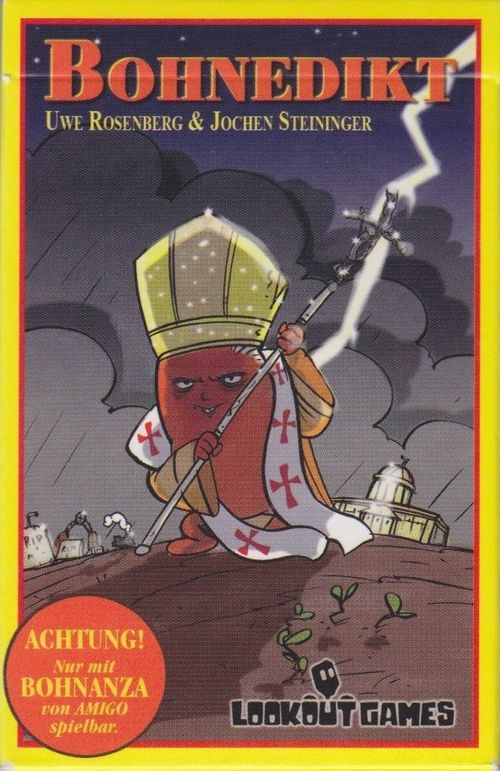
Bohnedikt (2009 Lookout)
Bohnedikt (2009 Lookout) Rulebook
Table of Contents
Table of Contents
- Spielidee und Spielmaterial (Game Idea and Components)
- Spielvorbereitung (Setup)
- Die Bohnedikte und Phase 2: Handeln und verschenken (The Bohnedikte and Phase 2: Trading and Giving Away)
- Anmerkungen (Notes)
- Bisch-Hof und Gottes Acker (Bisch-Hof and God's Field)
- Phase 1: Bohnenkarten ausspielen (Phase 1: Playing Bean Cards)
- Phase 4: Neue Bohnenkarten ziehen (Phase 4: Drawing New Bean Cards)
- Das 3. Bohnenfeld und die Schutzregel (The 3rd Bean Field and the Protection Rule)
- Wenn der Nachziehstapel zum zweiten Mal leer wird (When the Draw Pile Is Empty for the Second Time)
- Spielende und Gewinner des Spiels (End of the Game and Winner)
- Zweipersonenversion (Two-Player Version)
Spielidee und Spielmaterial (Game Idea and Components)
Bohnedikt is a variation of the card game classic Bohnanza, played on special bean fields.
Each player has a Bisch-Hof, on which, besides a bean type, they can also plant Bohnedikte as a kind of "joker beans". The "Bohn-Edikte" are bean cards and also act as decrees that change the trading.
The second bean field is Gottes Acker (God's Field). Each player has 1 sacrifice card (Opferkarte) in hand, which instructs them to plant 2 bean cards on their Gottes Acker – completely independent of the bean type that has already been planted on the field. The most recently planted bean determines the type with which the field is planted from then on.
For both bean fields the following applies: at harvest, the Bohnometer of the most recently planted bean card is always used. Because of the special properties of the bean fields, one must decide carefully which beans to plant on which bean field.
The game contains 5 bean field cards, 16 Bohnedikte and 12 sacrifice cards. Bohnedikt can only be played together with the card game Bohnanza (AMIGO Spiel+Freizeit). These rules assume knowledge of the Bohnanza rules. First the game is explained for 3 to 5 players. The rules for the two-player game follow on page 2.
Spielvorbereitung (Setup)
Each player receives a bean field card, which they place in front of themselves. The bean field card shows 2 special bean fields: on the left the Bisch-Hof, and on the right Gottes Acker. (The remaining bean field cards are not needed and return to the game box.)
The Bohnedikte are shuffled together with the bean cards. This forms the face-down draw pile for bean cards.
The starting player is determined by lot. Depending on the number of players, the number of cards each player receives is as follows:
- Three players: The starting player receives 4 bean cards in hand, their left neighbour 5 bean cards, and that player's left neighbour 6 bean cards.
- Four players: The starting player receives 3 bean cards, their left neighbour 4 bean cards, the next player 5 bean cards, and the fourth player 6 bean cards.
- Five players: The starting player receives 2 bean cards, their left neighbour 3 bean cards, the next player 4 bean cards, the fourth player 5 bean cards, and the fifth player 6 bean cards.
(Rule of thumb for this distribution: the right neighbour of the starting player always receives 6 bean cards in hand.)
Then the sacrifice cards are shuffled. This forms the face-down draw pile for sacrifice cards. Each player receives 1 sacrifice card and takes it into their hand, at the back.
Die Bohnedikte und Phase 2: Handeln und verschenken (The Bohnedikte and Phase 2: Trading and Giving Away)
The Bohnedikte are bean cards that may only be planted on the bean field "Bisch-Hof". Each shows 1 decree (Edikt), which takes effect if and only if the card is revealed at the beginning of Phase 2 of the turn, the trading phase: then the decree is read aloud and applies to the trading phase of the current turn. (When the turn ends, the decree also loses its validity.)
Attention! No distinction is made between trading and giving: a gift counts as a 1:0 or 0:1 trade.
Example: With the decree "You may only trade in this turn if, in doing so, you give up 1 face-up bean," it is not permitted, as the active player, to have 1 bean given to you.
Anmerkungen (Notes)
- There are 8 decrees (Edikte) that are positive and 8 that are negative. They can be recognised by the corner of the mouth of the depicted bean and by the colour of the lettering banner.
- If Bohnedikt cards are played, traded from hand, or drawn onto the hand, the decrees on those cards have no effect.
- Since always 2 bean cards are revealed, it can happen that more than 1 decree takes effect at the same time.
Bisch-Hof und Gottes Acker (Bisch-Hof and God's Field)
Bohnedikt is played entirely as normal Bohnanza. What is new is that the two bean fields with which the players start have a special meaning.
Because of this special meaning, the bean fields often show different bean types. At harvest the following applies: the Bohnometer of the most recently planted card always applies. The Bohnometer of the most recently planted card then determines the value of all the planted bean cards of that bean field, regardless of which bean types they individually are.
A bean field with Blue Bean, Blue Bean and Fire Bean is, for example, worth 1 bean taler.
The most recently planted bean cards are converted into bean talers according to the Bohnometer.
In the example, the bean taler would be shown with the Fire Bean if the bean field is harvested.
Der Bisch-Hof (The Bisch-Hof)
The Bisch-Hof is a completely normal bean field, on which – alongside one bean type – Bohnedikte can additionally be planted. Bohnedikte may only be planted on the Bisch-Hof.
Example: On a Bisch-Hof, first 1 Bohnedikt and then 1 Gartenbohne (garden bean) are planted. The player harvests the Bisch-Hof and shows 2 bean talers (see the Bohnometer of the Gartenbohne).
Attention! Bohnedikte have no Bohnometer. (If a Bisch-Hof is harvested and the most recently planted card on it was a Bohnedikt, the Bisch-Hof is therefore not worth any bean talers.)
Gottes Acker (God's Field)
God's Field is a special bean field. Each player may at any time, including during another player's turn, play 1 sacrifice card (Opferkarte):
-
✝ Play it from hand (regardless of which position the sacrifice card is in), if the player has in possession both bean cards depicted on the sacrifice card. These bean cards may be face-up, traded, or somewhere in the hand; the beans must just not yet be planted. Whoever plays a sacrifice card must immediately plant both bean cards depicted on it, in any order, on their God's Field. This happens regardless of which beans have already been planted there. The player does not need to harvest their God's Field for the sacrifice. (The planted bean type may change in the course of planting a field.)
-
✝ Discard it onto the sacrifice discard pile, if the sacrifice card is at the front of the hand and the player still has at least 1 bean card in hand. (See also "Phase 1: Playing bean cards" in the Bohnanza rules.)
-
✝ Draw from the sacrifice draw pile and take it into the hand at the back, if the player no longer has a sacrifice card. This is only allowed if the player still holds at least 1 bean in hand. (A player may sacrifice several times in succession, as long as they always draw 1 new sacrifice card immediately.)
Played and discarded sacrifice cards go onto the sacrifice discard pile. As soon as the sacrifice draw pile is empty, the discard pile is shuffled and becomes the new draw pile.
Anmerkungen (Notes)
- ✝ Empty God's Fields can be opened both by planting a normal bean and by planting 2 beans from a sacrifice.
- ✝ A God's Field may consist of several sacrifices.
- ✝ On an existing God's Field, only a bean card of the type most recently placed on the field may always be planted.
- ✝ Bohnedikte cannot be planted on God's Fields.
For the following example, the rule from the base game is important: all beans traded in the trading phase (Phase 2 of the turn) are only planted in the planting phase (Phase 3 of the turn).
Example: The player has already planted 1 Blue Bean on their God's Field. They have 1 Red Bean and the sacrifice Red Bean/Brechbohne in hand. They trade for a Brechbohne, but do not yet plant it, and so do not yet fulfil their sacrifice. Instead they first try to obtain a few more Blue Beans. Boldly they make promises for future trades and actually obtain 2 Blue Beans. They plant these in Phase 3 of their turn and only then fulfil their sacrifice: they first plant the traded Brechbohne, then the Red Bean from their hand. The God's Field Blue Bean, Blue Bean, Blue Bean, Brechbohne, Red Bean is harvested according to the Bohnometer of the Red Beans, and they show 4 bean talers.
Phase 1: Bohnenkarten ausspielen (Phase 1: Playing Bean Cards)
Sacrifice cards are not bean cards.
A player who holds a sacrifice card at the front of the hand and who must play their frontmost bean card in Phase 1 of their turn must first discard or fulfil that sacrifice card, so that they can reach a bean card at all.
(A player who holds the sacrifice card in position 2 of the hand must discard or fulfil the sacrifice card only if, after the first bean card, they also want to plant a second bean card. In this special case the "second bean card" would then be in position 3 of the hand.)
A player who at the start of Phase 1 has only 1 sacrifice card and no bean card may not discard the sacrifice card.
Phase 4: Neue Bohnenkarten ziehen (Phase 4: Drawing New Bean Cards)
At the end of their turn the player draws 4 bean cards (instead of 3 beans as in the base game).
Das 3. Bohnenfeld und die Schutzregel (The 3rd Bean Field and the Protection Rule)
Nothing changes in the rules for the 3rd bean field: with the 3rd bean field the player acquires a completely normal additional bean field. It costs, as in the base game, 3 talers; in the five-player game only 2 talers. Bohnedikte cannot be planted on the 3rd bean field.
The rule that a bean field with exactly 1 bean may only be harvested if the player has no other bean field on which they have planted at least 2 beans remains in force. This rule applies to the Bisch-Hof, God's Field and the 3rd bean field.
Wenn der Nachziehstapel zum zweiten Mal leer wird (When the Draw Pile Is Empty for the Second Time)
So that the garden beans can come back into play once more, and so that the length of the game is matched to the number of players, each player shuffles his bean talers as soon as the draw pile is empty for the second time. Afterwards each player must pay exactly as many bean talers as there are players in the game. A player who does not have enough bean talers must keep harvesting until they have the talers together. (A player who has harvested everything and still does not have enough bean talers is lucky and pays correspondingly less.)
The paid bean talers are shuffled into the discard pile so that no one can tell which bean cards have returned to the game. The shuffled card stack becomes the third draw pile for bean cards.
Spielende und Gewinner des Spiels (End of the Game and Winner)
The game ends as in the base game, as soon as the draw pile is empty for the third time. In contrast to the base game, the players now also plant all beans they hold in hand. They must play the beans in the order in which they hold them in hand. In between, they may harvest bean fields and play sacrifice cards (or discard them, if they are at the front of the hand) and draw new sacrifices.
In the end, the player with the most bean talers wins.
In the event of a tie there may be several winners.
Zweipersonenversion (Two-Player Version)
Both players start with 3 bean fields: the Bisch-Hof, God's Field and one completely normal 3rd bean field. (It is not permitted to acquire an additional 3rd bean field during the game.)
Both players receive 6 bean cards in hand and 2 sacrifice cards, which they tuck behind the bean cards.
Der Spielzug besteht aus 5 Phasen (The Turn Consists of 5 Phases)
- The active player places the beans from the offer that the opponent did not use, each one either on one of their own bean fields or on the open discard pile.
- The active player reveals 3 bean cards from the draw pile, which he has no access to at first. These cards form the offer. He pushes them over to his opponent. The decrees (texts) on revealed Bohnedikte play no role.
- Now the opponent is briefly up. With the help of the revealed beans he may fulfil at most 1 sacrifice card. At most 1 bean he needs for the sacrifice he may take from the revealed beans; the other bean he must take from his hand. Then he pushes the remaining 2 to 3 beans back to the active player.
- The active player plants the beans he can use from the revealed beans. The others he leaves lying for his opponent (see Phase 1 of the turn).
- The active player draws 3 bean cards and takes them into hand at the back.
Each player may at any time, including during the opponent's turn, use 1 sacrifice card:
- ✝ Fulfil it from hand. The sacrifice may be fulfilled:
- in Phase 1 of one's own turn, with beans that were not used by the opponent;
- in Phase 4 of one's own turn, with beans from the offer;
- at any time, with 2 beans from one's own hand;
- in Phase 3 of the opponent's turn.
- ✝ Discard it, if it is at the front of the hand (and the player still holds at least 1 bean card in hand).
- ✝ Draw and take into hand at the back, if the player has fewer than 2 sacrifice cards in hand. This is only allowed if the player still holds at least 1 bean in hand.
The game ends when the draw pile is empty for the first time. Both players then play out all beans in the order in which they hold them in hand. In between, they may harvest bean fields and fulfil sacrifice cards and draw (or discard and draw, if the card is at the front of the hand). The player with the most bean talers wins.
Variante zur Zweipersonenversion (Variant of the Two-Player Version)
The players may agree to trade, in Phase 4 of a turn, with beans that have not yet been planted. In this case sacrifices may also be fulfilled with traded beans.