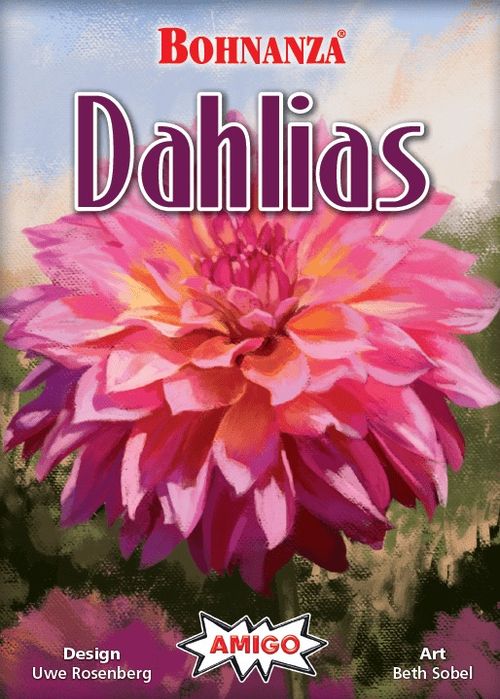
Bohnanza: Dahlias
Bohnanza: Dahlias Rulebook
Table of Contents
Table of Contents
Components
- 104 Flower Cards (see below)
- 5 flower field mats (see below)
- 5 Phases of the Game cards
- 1 Starting Player Card
- This rulebook
Frequency of each dahlia variety in the game
- 6 Pumpkin
- 8 Lights Out
- 10 Islander
- 12 Brother
- 14 Cafe Au Lait
- 16 Bumble Rumble
- 18 Gloria
- 20 Moon Fire
There are 104 cards showing 8 different kinds of dahlia. The large number printed on each card tells you how many cards with this kind of flower are in the game.
Market Price
Each variety's Market Price is printed at the bottom of its cards. It tells you how many gold coins you get for a given number of that flower harvested.
- Pumpkin (6): 2, 3
- Lights Out (8): 2, 3, 4, 5
- Islander (10): 2, 4, 5, 6
- Brother (12): 2, 4, 6, 7
- Cafe Au Lait (14): 3, 5, 6, 7
- Bumble Rumble (16): 3, 5, 7, 8
- Gloria (18): 3, 6, 8, 9
- Moon Fire (20): 4, 6, 8, 10
Contents & Setup
Give one of the flower field mats to each player. These mats have one side showing three fields and one side showing two fields.
- If there are three players, use the mats with the three three-field side up.
- If there are four or five players, start with two-field side up.
Pick a starting player and give them the starting player card. Also, each player receives an overview card with the different phases of the game.
Shuffle all the cards and deal five cards to each player.
Attention! This is the most important rule of the whole game!
You cannot change the order of the cards in your hand at any point during the game! The first card you are dealt is the first card in your hand. It's completely visible to you. Put all other cards you receive behind it, in the order drawn. You may never sort your cards by type or for any other reason.
Put the remaining cards in the center of the table as a draw pile, coin side up. During the game, you will create a discard pile next to it.
Playing the Game
The starting player is the first active player. After that, players take turns going to the left.
Note: Don't pass the starting player card. It stays with the starting player for the whole game (see "The End of the Game").
When it is your turn, you play through these four phases in order:
- Plant Flower Cards from Your Hand
- Turn Over and Trade Flower Cards
- Plant Turned-over and Traded Flower Cards
- Draw Flower Cards
Important Rules for Planting Flower Cards: You can only plant one kind of dahlia in each field at a time. You are allowed to plant the same kind of dahlia in two different fields at the same time, but not two kinds of dahlia in the same field. Put the dahlia cards in your field on top of each other.
Phase 1: Plant Flower Cards from Your Hand
You must plant the first card in your hand (i.e. the one that is completely visible) in one of your fields.
After that, you may choose to plant one more card - the one that is now completely visible - in one of your fields. You can't plant a third flower.
When planting, you start or extend the column of cards in the field.
If you have to plant a kind of dahlia you don't have space for, you must harvest a field first (see "Harvesting Flowers").
If you don't have any cards in your hand at the start of phase 1, skip it and go straight to phase 2.
Phase 2: Turn Over and Trade Flower Cards
Turn over the top two cards from the draw pile and put them next to it face-up for all players to see.
The turned-over cards belong to you. You can plant them in your fields or use them to trade with the other players.
Example #1: Timon has turned over a Brother and a Moon Fire. He keeps the Moon Fire, but there is no space for the Brother in his fields, so he offers it up for trade to the other players. He asks: "Would anyone like this Brother? I'd like to trade it for a Lights Out."
Rules for Trading Flowers:
- Only the active player is allowed to trade with the other players. The other players can't trade with each other.
- You may all trade using your hand cards, no matter where they are in your hands.
- The active player can use the two turned-over cards for trading in addition to their hand cards.
- You cannot trade cards you've received in a trade.
- You cannot trade the cards in your fields, either.
- You are allowed to trade any number of flowers for any number of other flowers (e.g., two Moon Fires for one Pumpkin).
Example #2: No one wants to trade with Timon, so he ups his offer: "I'll give you the turned-over Brother and a Gloria from my hand for a Lights Out."
Note: Only remove flowers from your hand once the trade has been agreed on. Both players have to agree to the trade. This way, you can avoid discussions about where the card was in your hand after having taken it out of order too soon!
Put any flower cards you receive in trade next to your flower fields horizontally for now. Do not add them to your hand!
Example #3: Nina accepts Timon's offer of the Brother and the Gloria and gives him the desired Lights Out. Timon puts it next to his fields horizontally. Nina does the same with the Brother and the Gloria.
Note: As a special form of trade, you can also give another player cards. Players receiving gifts have to agree to take them, though. If they refuse, you cannot give them the cards.
You may continue trading for as long as you like, even after the turned-over cards are gone. When you want to stop, tell the other players. This ends phase 2.
Phase 3: Plant Turned-over and Traded Flower Cards
All players who have horizontal cards next to their flower fields now have to plant them. As the active player, you'll also have to plant any turned-over cards you have not traded away. You can plant your new cards in any order you choose.
Example #4: Timon plants the Lights Out that was traded, and the Moon Fire that was revealed. Nina plants the Brother and the Gloria in her two fields.
If you have to plant a kind of dahlia that doesn't match the flowers you already have in your fields, you'll have to harvest a field before you can plant your new flowers (see "Harvesting Flowers").
Phase 4: Draw Flower Cards
End your turn by drawing three cards, one after the other, from the draw pile. Put them in the back of your hand, behind the last card, in the order you draw them. Then, the player to your left becomes the new active player.
Harvesting Flowers
You may harvest flowers from your fields at any time during the game, even when you're not the active player.
Each kind of flower has its own "Market Price". This tells you how many gold coins you get for a given number of flowers you harvest.
Note: Some harvests may not earn you any coins!
The Bumble Rumble's Market Price tells you: If you harvest 1 or 2 Bumble Rumbles, you don't get any gold coins. For 3 or 4 Bumble Rumbles, you earn one coin. 5 or 6 flowers earn you two coins, for 7 flowers you get three gold coins, and 8 or more Bumble Rumbles pay out four coins.
When you harvest flowers, follow these steps:
- Count the number of cards in the field you want to harvest.
- Check the top card's Market Price.
- Turn over as many of those cards as you get coins (according to the Market Price) so that their coin sides show.
- Put these cards on your coin pile (next to your flower field mat).
- Put the remaining cards from your field face-up on the discard pile.
- After you harvest, the field must be empty - you cannot harvest only part of a field.
Example #5: Keno has 3 Glorias in one of his fields. The Gloria's Market Price tells him that these three flowers are worth 1 coin. Keno turns one card over to its coin side and puts it on his coin pile. Then, he puts the remaining two Glorias on the discard pile.
The Dahlia Protection Rule
If there is only one flower card in one of your fields, you cannot harvest it as long as you have another field containing more than one flower card.
If the Draw Pile Is Empty
When you draw the last card from the draw pile, re-shuffle the discard pile. Turn it over and put it back in the center of the table as the new draw pile.
The End of the Game
The game ends when the draw pile runs out for the third time. If this happens during phase 2, "Trading Flower Cards", complete phases 2 and 3 of your turn (even if you could only turn over one card instead of two), then the game ends.
At the end of the game, harvest all of your flowers and give yourself the appropriate number of coins. Cards in your hand do not count towards your total.
Count the cards in your coin pile. Each card is worth one coin. The player with the most coins wins the game!
If there is a tie, the tied player who sits the furthest away from the starting player (going around the table clockwise) wins the game.
About Dahlias
"September is dressing herself in showy dahlias..." -Oliver Wendell Holmes Sr.
Dahlias have been known to the Western world since the 16th century, with descriptions of the plant being used for food and for medicinal purposes. The stem of the dahlia imperialis, which can grow to 10 meters/30 feet in height, was even used as a water pipe!
Dahlias belong to the same family of plants as daisies, sunflowers, and chrysanthemums. There are more than 4 dozen species of dahlia, and the plants that are available commercially are hybrids that provide a wide variety of colors, shapes, and sizes.
The dahlia has an interesting biological feature that plays into their variety and popularity. They are octoploids - where most plants have only two sets of homologous (paired) chromosomes, the dahlia has eight sets (and they often feature transposons, which means that bits of their genetic makeup tend to shift around). This helps to explain the wide variety of dahlias that exist; over 57,000 different cultivars have been registered.
Dahlias grow from a tuberous root, designed to store sugars for spring growing, and to protect the plant's core. To plant a dahlia, you use a tuber that has been carefully cut from a tuber clump, making sure that the neck of the tuber is not broken, and that it has a healthy "eye" at its top (which will grow into a sprout).
Dahlias are indigenous to Mexico and South America, and are sensitive to frost. Dahlias can be tricky to grow - simply bringing them indoors through the winter isn't enough, as they require special attention. Still, some types are hardy enough to simply be buried deep, laying dormant through cold (though not freezing) temperatures. Typically, they're planted in the spring after the danger of frost has passed. They like sun, but also require some protection from wind. They bloom in late summer and early fall.
Our thanks go out to Triple Wren Farms, who have been our fact-checkers and mentors as this game took shape. To learn more about dahlias, visit their website at https://www.triplewrenfarms.com/.
Special Thanks:
Paul and Barb Bloomquist (Bloomquist Pumpkin, Bloomquist Brother) Ted and Margaret Kennedy (Hollyhill Gloria) Swan Island Dahlias - http://www.dahlias.com
Photos courtesy of Triple Wren Farms.
© AMIGO Spiel + Freizeit GmbH, D-63128 Dietzenbach, 1997-2023. Version 1.0.