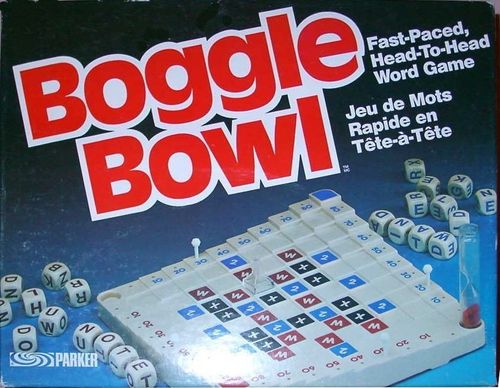
Boggle Bowl
Boggle Bowl Rulebook
Table of Contents
Table of Contents
Object of the Game
To make words using more letter cubes than your opponent in order to move a token across the board to your scoring area. The first player or team to score a total of 100 points or more is the winner.
Equipment
- 1 Boggle Bowl 3-D play selection and scoring board
- 2 sets of 11 Boggle Bowl cubes (1 set with red letters and 1 set with blue letters)
- 1 playing token
- 4 scoring pegs
- 1 10-second timer
Setup
- Choose who will be the RED player or team and who will be the BLUE.
- Place the BOGGLE BOWL play selection and scoring board on the table between the players. Players play facing the board, as illustrated.
- Place the sand timer into either of the round openings located on two corners of the game board.
- Place the four scoring pegs into the 4 blank holes. They will be used later.
- Place the playing token on the Blank Space located in the center of the board.
- Give the RED player or team the RED letter cubes, the BLUE player or team the BLUE letter cubes.
- If you are playing in teams, each team choose its player who will control the letter cubes for the first round of play. After that, team members take turns controlling the letter cubes while the other team members suggest words.
Playing
Both players, or teams, begin to play at the same time.
On each round of play do the following:
-
ROLL YOUR LETTER CUBES. Cup all of your letter cubes in your hands and shake them up. Roll them onto the table. Letter cubes are NEVER put on the Boggle Bowl board.
-
MAKE WORDS. Using the letters that appear on the tops of your cubes, begin to make the word or words called for by the space occupied by the token on the Boggle Bowl play selection and scoring board. (See EXPLANATION OF BOARD SPACES AND ROUND SCORING.)
If you don't like your letter assortment, you can RE-ROLL ALL YOUR LETTER CUBES as many times as you want. However, your opponent does NOT wait for you. Re-rolling cuts into your word-building time.
-
TURN OVER THE TIMER. When you believe you have made a word or words containing the most letter cubes possible, announce to your opponent that you are turning over the timer. Your opponent must finish his/her word or words before the 10-second timer runs out.
YOU CANNOT TOUCH YOUR LETTER CUBES ONCE YOU TURN OVER THE TIMER.
Strategy hint: Sometimes it's a good idea to make shorter words quickly and turn the timer over to put even more pressure on your opponent.
-
MOVE THE TOKEN.
A. Tell your opponent when time has run out. Game play then stops. Players count the number of cubes they used. In order for your cubes to count you must have correctly completed the word arrangement called for. For example, if the round called for two words, you must have made two complete separate words and spelled them correctly.
If there is a tie the round is played over. Otherwise, the player who used the most cubes is the winner of the round.
B. The winner moves the token the number of spaces equal to the difference between the number of letter cubes he/she has used and the number of letter cubes used by the opponent. For example, if the winner's word or words has two additional letters, that player moves the token two spaces. (See EXPLANATION OF MOVING THE TOKEN.)
The Next Round
Players begin the next round by forming the type of word or words indicated by the space on which the token has landed. The player who moves the token announces aloud what kind of space it has landed on.
Explanation of Board Spaces and Round Scoring
Blank Space: The object is to use as many of your letter cubes as possible to make one word.
Scoring example:
- Red: SOUNDED = 7 letters
- Blue: REGRET = 6 letters
- Difference: 1. RED moves token 1 space.
Wild Space (W): The object is to use as many of your letter cubes as possible to make one or more words.
Scoring example:
- Red: SEE, AIDE, TONE = 11 letters
- Blue: FRONT, SLAM = 9 letters
- Difference: 2. RED moves token 2 spaces.
2 Space: The object is to use as many of your letter cubes as possible to make two words.
Scoring example:
- Red: PARADE, TO = 8 letters
- Blue: GLASSES, THEM = 11 letters
- Difference: 3. Blue moves 3 spaces.
X Space: The object is to use as many of your letter cubes to make two words that cross each other, using one common letter.
Scoring example:
- Red: PRONTO crossed by FROM (the vertical word shares the letter O) = 9 letters
- Blue: STEADY crossed by TREE (the vertical word shares the letter T) = 9 letters
- Difference: 0. The token is not moved.
(REMEMBER: IF A SCORE IS TIED AFTER A ROUND, THE TOKEN IS NOT MOVED. REPLAY THAT ROUND.)
Explanation of Moving the Token
The player who wins the round moves the token the appropriate number of spaces toward his/her scoring area on the BOGGLE BOWL board. For example, players with red cubes move toward the red scoring area. The token is moved in either of the following ways:
- In a straight line: the token moves along a straight diagonal row of spaces toward the scoring area.
- In a zig-zag pattern: the token moves along a zig-zag path of spaces toward the scoring area.
The token can also be moved in a combination of zig-zags and straight lines.
The token can NEVER be moved diagonally.
Strategy of Token Movement
Since the object of the game is to score 100 points, try to move the token towards the higher numbers in your scoring area on the BOGGLE BOWL board. In addition, try to move the token onto those types of spaces where your word-building is the strongest and your opponents' is the weakest.
Scoring Points
You score points when you move the token onto one of the numbered spaces in your scoring area. This does not have to be done by exact count.
Place a peg into the hole in the square on which the token has landed and return the token to the center start space on the board.
- Move 4, score 70: the token is moved 4 spaces onto the 70 space. Place a peg in the 70 and return the token to the center.
- Move 2 out of a possible 4, score 80: the token is moved 2 spaces onto the 80 space. Place a peg in the 80 and return the token to the center.
If you move onto your scoring area for a third time and still have not reached 100 points, add your score together and put your peg or pegs into the appropriate numbered holes.
Example:
- If you have scored 20 and 40 and then score 20 again, remove your pegs and place one in the 80. (20 + 40 + 20 = 80)
- If you have scored 20 and 40 and then 30, leave one peg in the 20 and move the other peg up to 70. (30 + 40 = 70). (20 + 40 + 30 = 90; there is no 90 on the board.)
Winning
The first player or team to score 100 or more points wins the game.
3-Player Game
A 3-player game is played exactly as a 2-player game. Two players play as a team against a single player.
Word Building Rules
-
The following words are not allowed:
- Capitalized words
- Hyphenated words
- Words using apostrophes (such as contractions or possessives)
- Abbreviations or symbols
- Prefixes or suffixes
- Foreign words not found in your dictionary
- Single-letter words (such as "a")
-
If a word is misspelled, it is unacceptable, even if a smaller word can be found within it.
-
A DICTIONARY MAY BE USED ONLY TO VERIFY A CHALLENGED WORD. To avoid a dispute, use the same dictionary for the entire game. There is no penalty for wrongly challenging your opponent's word.