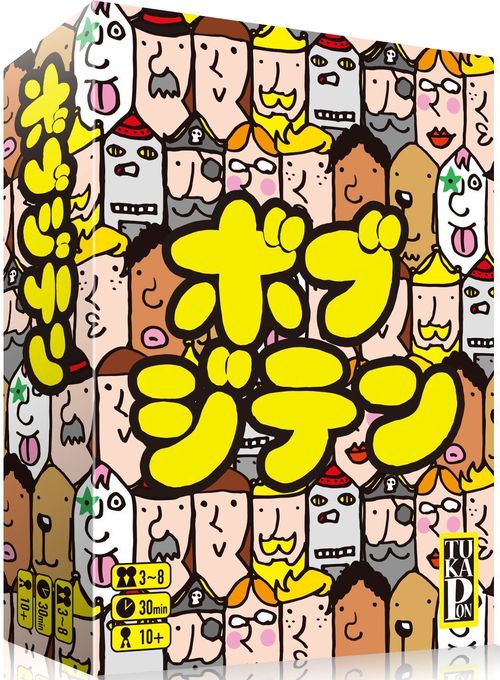
ボブジテン (Bob Jiten)
ボブジテン (Bob Jiten) Rulebook
Table of Contents
Table of Contents
Overview
- Players: 3 to 8
- Play time: about 30 minutes
- Age: 10 and up
Contents
- Topic cards (お題カード): 36
- Front: 6 kinds of topics (six topic words)
- Back: a number from 1 to 6
Setup
- Shuffle all the topic cards well and make a face-down draw pile.
- The player who considers themselves Bob's best friend starts. (If there is no best friend of Bob, decide the start player by a suitable method.)
Game Procedure
- The start player turns over the top card of the topic card pile and holds it in hand as their hand card, so that the other players cannot see the topic.
- Six topics are written on the card. Which topic is used is determined by the number on the top card of the topic card pile (the number on its back matches the number of the topic). (Illustration: "Topic number 3".) Explain the topic so that the other players understand, without using any katakana words at all.
- Each player has only one chance to answer. It may be at any timing. The player who guesses the topic first scores.
- The player who gave the topic takes the card in hand as a scoring card. The player who guessed the topic takes the top card of the topic card pile as a scoring card. Place scoring cards in front of each player.
- The player who guessed the topic gives the next topic. (Repeat steps 1 to 4 of the game procedure.)
- When the topic card pile has one card or fewer remaining, play out that topic through to the answer; the game then ends.
If a katakana word is used...
If you notice that a katakana word has been used, the surrounding players should point it out. The player who first points it out takes the card in the hand of the player who gave the topic as a scoring card, and it becomes that player's turn to give the next topic.
If nobody can answer correctly...
The topic card is put in the discard pile, and the same player turns over a new card and tries again.
What Are Katakana Words
- Foreign words, or abbreviations of them. (Examples) ゲーム (game), チョコレート (chocolate), テレビ (TV)
- Japanese-made English. (Examples) サラリーマン (salaryman), ペットボトル (PET bottle)
- Kanji applied to a transliteration of English. (Examples) 珈琲 (coffee), 煙草 (tobacco)
Words written in katakana that are Japanese are not considered katakana words. (Examples) メガネ (glasses), イス (chair), スイカ (watermelon)
Example: Topic "ビール" (beer)
- "An adult's malt drink"
- Here, katakana words such as 「アルコール」 (alcohol) and 「ドリンク」 (drink) cannot be used.
Special Card "Tony Has Come" (トニーが来た)
Tony, like Bob, is studying Japanese. Tony also joins in making the Bob Jiten. Tony also tries to translate katakana words well into Japanese, but in fact his Japanese is not yet as good as Bob's. Explaining by lining up words is the best he can do.
When the card with 「トニーが来た」 written on it comes up, the player must explain by lining up words only. Particles such as 「てにをは」 cannot be used.
Example: When the 「トニーが来た」 card comes up and the topic is "パンダ" (panda).
- "China, black-and-white, bear"
- Here, particles (助詞) such as the 「の」 in "中国の動物" ("an animal of China") cannot be used. Put simply, a particle is something that has no concrete meaning by itself and attaches to other words.
Scoring
Each card obtained is worth 1 point. The player with the highest total score wins.
In case of a tie, the player who lives closer to Bob's home country, America, wins.