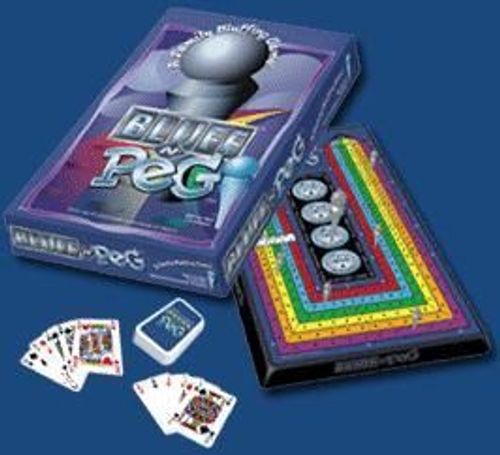
Bluff 'n' Peg
Bluff 'n' Peg Rulebook
Table of Contents
Table of Contents
Poker Hand Rankings
Poker hands listed in order of worst to best:
No Pair
These are rated by the highest card held. (Ex.: A-high hand beats K-high hand.) If both hands have the same highest card then look to the next highest card in both hands.
One Pair
If more than one hand has a pair, the hand with the highest pair wins. (Ex.: two 10's beat two 7's.) In case of a tie, highest card remaining breaks the tie.
Two Pair
If more than one hand has two pair, the hand with the highest pair wins. (Ex.: two J's and two 4's beat two 10's and two 9's.)
Three of a Kind
If more than one hand has three of a kind, the hand with the highest three of a kind wins. (Ex.: three A's beat three K's.)
Straight
Five cards in sequence in more than one suit. In case of a tie the highest straight wins.
Flush
Five cards of the same suit not in sequence. In case of a tie, the flush with the highest card wins.
Full House
Three of a kind and a pair in the same hand. In case of a tie, the hand with the highest three of a kind wins.
Four of a Kind
If more than one hand has four of a kind, the hand with the highest four of a kind wins. (Ex.: four K's beat four Q's.)
Straight Flush
Five cards in sequence of the same suit. In case of a tie the highest straight flush wins.
Royal Flush
A straight flush consisting of A, K, Q, J, 10. This is the highest hand possible.
Note: If an Ace is used as a 1 in a straight or a straight flush, it is considered the lowest card in the tie breaker.
Contents
Game board, 6 playing pegs, 1 bluffing peg, Bluff 'N' Peg card deck, and instructions.
Object
To be the first player to peg into the winner hole at the end of the columns or have the most points when someone lands in the "out the back" hole.
Set Up
Each player picks a playing peg and places it in the hole at the start position for the colored column of their choice. The large peg is placed in the 1X hole in the bluffing zone. All players draw a card and the player with the highest card is the starting dealer.
To Play
The dealer deals 5 cards to each player. Each player, starting with the player to the dealer's left, may discard up to 3 cards. The dealer will then deal to all players the same number of cards that they discarded so that they end up with 5 cards in their hand. (Each player is trying to make the best poker hand.)
Next, the player to the dealer's left must either play a card face up or fold their hand. (When a player folds their hand, they turn in their cards and are out of play until the next deal.) Play continues to the left and each player in turn must either fold their hand or play one card after another until they have the best poker hand showing face up. A player may end up playing several cards on a single turn to beat the best poker hand showing. The strategy is in how you lay your cards.
Bluffing Zone
When and only when a player plays their third card face up, they may declare "double or fold." (They do not necessarily have to be finished laying cards on their turn when they declare double or fold.) The other players in turn may accept the declaration or they may fold their hand. If the declaration is accepted by any of the players, the peg in the bluffing zone is advanced to the next highest position and the points are doubled. (The "double or fold" declaration may be made up to a maximum of three times per hand but only once by any one player. A player in the "last chance" area may not declare "double or fold" but may accept a "double or fold" declaration.)
Play continues with each player playing their cards as before. The hand is won by the player who played the highest poker hand without folding. To start the next hand, the deal is passed to the left and that player is the new dealer. The peg in the bluffing zone must be reset to the 1X hole.
Scoring
The player who wins the hand receives the number of points indicated directly under the peg in the bluffing zone (5, 10, 20 or 40).
The losing players lose 1 point for each card they played face up times the number directly above the peg in the bluffing zone (Ex: If the bluffing peg is in the second hole, the number directly above the bluffing peg is 2X. The player would lose two points for each card played.) When a player folds their hand, they use the number directly above the peg in the bluffing zone at the time they folded. If a player folds their hand as a result of a "double or fold" declaration, that player uses the number directly above the peg in the bluffing zone before it is advanced.
The points are recorded on the board for each player. When a player wins points, they advance that many holes in their column toward the "winner" hole. When they lose points, they move backward toward the "out the back" holes.
In the event that two or more players have identical winning hands, those players will each win the same number of points as they would if they were the only winner.
Last Chance
There are three holes in the "last chance" area for each column. When a player moves backward and lands in the first "last chance" hole, they stop there for that hand. While in the "last chance" area, a player may only move backward 1 hole per hand. If they win, they may advance the number of points that they won.
Out the Back
If a player lands in the "out the back" holes, the hand is played to completion and the player with the most points is the winner. If there is not a clear winner at this point, the players who are tied for first must play 1 additional hand to break the tie.
Variations
If you want to change your luck, try making all 2's wild. The game is played the same except 5 of a kind is now the best hand possible.