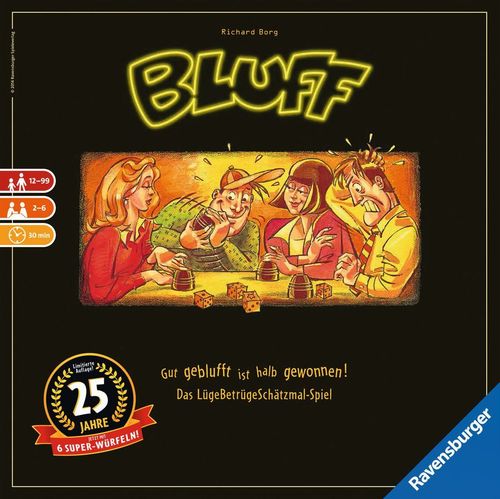
Bluff Jubiläumsausgabe
Bluff Jubiläumsausgabe Rulebook
Table of Contents
Table of Contents
Components
1 game board, 6 dice cups, 24 yellow dice, 6 orange super dice, 1 red indicator die.
Author: Richard Borg • Illustration: Martin Lodewijk/Art Connection • Design: DE Ravensburger • Photos: H.P. Hoff, Becker Studios • Editing: Stefan Brück
Let's Get Started!
The game board is placed in the middle.
Each player receives 4 yellow dice and 1 orange die, plus a cup. With fewer than six players, the remaining cups and dice are not needed.
The orange "super dice" count double, i.e. the number or star they show is counted twice.
The game runs over several rounds. Each round in turn is divided into three consecutive phases:
- Shake it! (rolling)
- Make it! (betting)
- Take it! (lifting the cups)
Shake It!
At the start of a round, all players shake their dice in their cup and then set it down in front of themselves. This is done so that the cup stands over the dice and keeps them hidden.
A player may look at their own dice as often as they like — ideally shielded by a cupped hand, so that curious fellow players cannot peek.
Changes are not allowed! The dice must stay as they lie until the end of the round. If, after setting the cup down, they end up tilted or stacked on top of each other, the player shows this by lifting the cup and then rolls again.
Make It!
The first bet of a round is always placed by the player who was successful with the last bet of the previous round. To do this, they place the red indicator die on the game board. The very first round is started by the youngest player.
Two betting options are available; players may switch between them freely from turn to turn:
Number Bet
With this bet, a player claims that any face value between 1 and 5 appears at least as often as they state, face-up, among the dice of all players. The star counts as a wild in this case. It always takes on the value of whichever number is currently being bet on.
Example: If a player has bet on threes, every yellow star counts as a three and every orange star counts as 2 threes. If the next player bets on fives, every star now counts as a five, or a double five, and so on.
To indicate a number bet, a player places the red indicator die with the corresponding number face-up on the desired yellow number space.
The arrow shows the direction of movement for the indicator die. The face-up side of the die shows which number is meant. The number on the space shows the bet quantity. Here: "6 twos."
Star Bet
A player may also bet on stars alone. They claim that the dice of all players together show at least as many stars as they guess. To do this, they place the red indicator die with the star side face-up on the desired orange star space.
Here: "3 stars"
After the first bet, play continues clockwise around the table. Every player whose turn it is must use one of the two following options, A or B. Passing is not allowed.
A. Raising the Bet
This can be done in three different ways:
Raise the face value: The red indicator die stays on the same number space but is turned to a higher face value. E.g. from 3 to 4, or 5 at most.
Here: "6 threes" becomes "6 fives"
Raise the dice quantity: The red indicator die is moved to any higher number space in the direction of the arrow. The face value may be freely chosen; it may therefore also be lower than before. E.g. from 5 fives to 6 twos, or from 2 stars to 5 fours.
Here: "5 fives" becomes "6 twos"
Choose a higher star space: The red indicator die is moved with the star face-up to any star space in the direction of the arrow. E.g. from 3 stars to 4 stars, or from 8 fours to 5 stars.
Here: "8 fours" becomes "5 stars"
B. Challenging the Bet ( = Take It! )
If a player believes that their predecessor's bet is higher than the actual number of matching dice, they challenge it. They say loudly and clearly: "Cups up!"
All players now lift their cup and push the dice matching the last bet a little forward toward the middle of the table. These are then counted.
Three outcomes are possible when comparing the bet with the actual number of matching dice:
Bet lower: If the bet is lower than the actual quantity, the player who challenged loses.
Bet equal: If the bet is equal to the actual quantity, everyone loses except the player who placed the bet.
Bet higher: If the bet is higher than the actual quantity, the player who placed the bet loses.
The loser of a bet must then give up as many of their own dice as the difference between the actual quantity and the bet. If the quantity is equal, every player — except the one who placed the bet — must give up one die each.
Example 1: A bet of 10 twos is challenged; in fact there are 8 twos and 4 stars among all the dice, i.e. 12 in total: the "challenger" loses and must give up 2 (= 12 minus 10) of their own dice.
Example 2: A bet of 8 stars is challenged; in fact there are exactly 8 stars in play in total: everyone except the "bettor" must give up 1 die.
The lost dice go onto the "dice graveyard" in the middle of the game board. They are thereby out of the game and are no longer counted for further bets.
Note: When giving up dice, an orange die also counts double, i.e. as 2 dice. Note: If a player must give up 1 die and has only their orange die left, they must give it up; they get nothing back.
A player without dice is out. They set their cup down open in front of them and watches for the rest of the game.
New Round, New Luck!
After the scoring and the associated giving-up of dice, a new round begins: the players roll their remaining dice, the winner of the previous bet takes the indicator die and places the first bet of the new round... the bluffing continues!
End of the Game
The winner is whoever, after many hot rounds and even more cool bets, is finally the only one left with at least one die.
Variant for Ultra-Cool Gamblers!
The main element of this additional rule is the option to re-roll even during a round. This increases the chance of improving your own bet.
Immediately after placing their bet, a player may — but does not have to — carry out the following additional actions:
1. Set dice aside
The player sets aside as many of their dice as they like, face-up; at least one, however, must remain in the cup to be re-rolled. The dice that are set aside may not be changed and may show any number or the star.
For example, a player can back up their bet with matching dice. If they have no matching die, they can set aside any die in order to improve their chances through the following re-roll.
2. Re-roll
This must happen if at least one die was set aside beforehand. The remaining dice in the cup are immediately re-rolled and kept hidden under the cup as usual.
Dice that have been set aside count normally when a bet is scored and then go back into the cup for the next round.
Anyone who prefers can of course also play by the usual rules: here the orange dice are simply always counted like yellow dice.