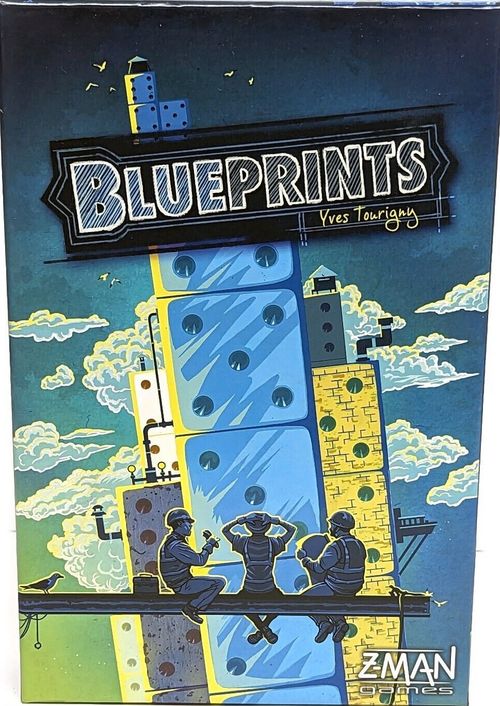
Blueprints
Blueprints Rulebook
Table of Contents
Table of Contents
Components
- 1 rulebook
- 32 dice (8 each of 4 colors)
- 24 Blueprint cards
- 9 Award cards
- 12 Prize cards
- 4 screens
- 1 scoreboard
- 1 cloth bag
- 4 scoring markers
The four dice colors represent the four building materials: Glass (clear), Wood (orange), Stone (black) and Recycled (green).
Blueprint Cards
Each Blueprint card shows one building in both top-down (left) and isometric (right) views. The dice (building materials) are placed directly on the spaces of the top-down view. The number in each space indicates the height (in dice) of the building in that space. Dice may not be placed in the hatched spaces.
Setup
- Place all 32 dice in the cloth bag.
- Place all Award and Prize cards in face-up stacks near the scoreboard.
- In a three-player game, only the Gold and Silver Awards are used; return the Bronze Awards to the box.
- In a two-player game, only the Silver Awards are used; return the Gold and Bronze Awards to the box.
- Shuffle the Blueprint cards and create a face down draw deck.
- Give each player a screen and the corresponding scoring token.
Gameplay
The game is divided into three rounds. Once all three rounds are complete, the game is over and a winner is determined.
A Game Round
Get Ready
Pull two dice from the bag and place them in the "In-Demand Materials" spots on the scoreboard. The two dice must be different colors. (If you draw two dice of the same color, return one to the bag and redraw until you draw one of a different color.) These dice colors will serve to break ties during the scoring portion of the round.
Deal one Blueprint card randomly to each player. Each player keeps their own card face up behind his or her screen.
Draw a certain number of dice from the bag. Depending on the number of players, draw:
| Players | Dice |
|---|---|
| 2 players | 8 dice |
| 3 players | 9 dice |
| 4 players | 7 dice |
Roll them and sort them by value. These dice form the pool of available materials.
Determine Turn Order
In the first round, the player who most recently visited a building under construction goes first. In the second and third rounds, the player whose building scored the least number of points in the previous round goes first. In all rounds, play moves clockwise from the first player.
Build
On your turn, select one die from the pool of available materials and place it on your Blueprint card (see Placement Rules below). Then, draw a replacement die from the bag, roll it, and add it to the pool of available materials. Play proceeds clockwise until each player has drawn 6 dice from the pool. Note: See the Two-Player Game section for the 2-player game.
Placement Rules
Dice may be placed either:
-
a On an empty space of your Blueprint card (the hatched spaces are unavailable).
or
-
b On top of a previously-placed die of equal or lower value. (For example a '3' may only be placed on a '1', a '2', or on another '3'.)
-
If you cannot legitimately place a die, it is removed from play.
-
Each placement is final; you may not move a die once it has been placed.
-
You may never change the value of a die.
Score
After each player has drawn and placed 6 dice, reveal all of the buildings and score them. Note that this score is solely used to determine which players receive Awards. The score points are NOT victory points and the scoring markers are reset at the end of the round.
Blueprint Bonus
Every player whose building perfectly matches their Blueprint card immediately scores 6 points.
Materials
Each material is scored differently. To speed up the process, go through each material in order and score every die of that color in every building. Record each player's score on the scoreboard using the scoring markers.
ORANGE (wood): Score each orange die individually; score 2 points per die adjacent to the orange die being scored. Dice are adjacent if they share a face.
GREEN (recycled): Score a total of 2/5/10/15/20/30 points for using a total of 1/2/3/4/5/6 green dice.
BLACK (stone): Score each black die individually; the black die being scored is worth 2/3/5/8 points for being on the 1st/2nd/3rd/4th (or higher) level of a building.
CLEAR (glass): Score each clear die individually; the clear die being scored is worth the value of its top face. Note: These dice score even if covered by other dice.
Awards
Hand out Award cards to players according to the chart below:
| 2-player game | 3-player game | 4-player game | |
|---|---|---|---|
| GOLD | highest score | highest score | |
| SILVER | highest score | 2nd highest score | 2nd highest score |
| BRONZE | 3rd highest score |
Breaking Ties: In-Demand Materials
If two or more players are tied for an Award, give the Award to the tied player with the most dice of the first "In-Demand Materials" color. If players are still tied, give the Award to the tied player with the most dice of the second "In-Demand Materials" color. If players are still tied, give the Award to the tied player who acted last in turn order in this round.
Prizes
Only one Prize of each type is awarded each round. If no buildings meet the criteria for a Prize, that Prize is not won. A single building may earn more than one Prize in a given round. If more than one building meets the criteria to win a certain Prize, use In-Demand Materials to break ties (see above).
Important: Prize and Award cards are kept face down and are revealed at the end of the game.
The Prizes
SKYSCRAPER PRIZE — The building must have a height of 5 or greater.
STRUCTURAL INTEGRITY PRIZE — The building must include 4 or more dice with an identical value.
GEOMETER'S PRIZE — The building must include dice with all values 1 through 6.
MATERIALS PRIZE — The building must include 5 or more dice of the same color.
Scoring Example
Player A
| BLUEPRINT BONUS: | 6 |
| WOOD: 1 die with 2 adjacent dice = | 4 |
| RECYCLED: 3 dice = | 10 |
| STONE: none = | 0 |
| GLASS: 1 die with a 1 on top and 1 die with a 2 on top = | 3 |
| Total | 23 |
Player B
| BLUEPRINT BONUS: | 0 |
| WOOD: 1 die with 2 adjacent dice and 1 die with 3 adjacent dice = | 10 |
| RECYCLED: 3 dice = | 10 |
| STONE: 1 die = | 3 |
| GLASS: none = | 0 |
| Total | 23 |
In-Demand Materials (green and black in this example): Ties are resolved with the in-demand materials. The player with the most of the 1st in-demand material (and if still tied, the 2nd) wins the tie. In this example, A and B are tied for green dice. B wins with 1 black die.
End of the Round
Once Awards and Prizes have been given out, the round is over. If three rounds have been completed (this can be easily confirmed by noting that there are no Awards remaining to be handed out), then the game is over; proceed to Game End. Otherwise, return all dice to the bag, discard each player's used Blueprint card, remove the scoring markers from the score board, and begin a new round.
Game End
After the third round, reveal each player's Award and Prize cards and compare the total number of points (shown in the upper left-hand side corner). The player with the highest score is the winner of the game!
In case of a tie, the winner is the tied player with the most Prizes. If it is still a tie, the winner is the tied player with the most Gold Awards. If it is still a tie, the winner is the tied player with the most Silver Awards. If it is STILL a tie, the one with the most Bronze Awards. If it is STILL a tie, shake hands and share the victory.
Two-Player Game
A two-player game is played normally, with one exception:
On your turn, select one die for your building as normal and select another die from the pool to discard. Draw and roll two replacement dice from the bag, instead of one as normal.