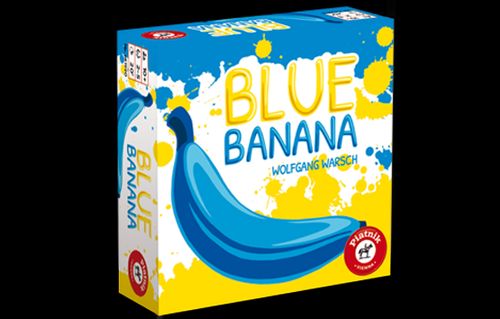
Blue Banana
Blue Banana Rulebook
Table of Contents
Table of Contents
Contents
- 109 motif cards (usable on both sides)
- 1 game mode card
- 1 rulebook
- 20 penalty chips (15 small, 5 large)
- 1 blue banana figure ("Blue Banana")
Objective
The goal is to have collected the most cards by correctly recognizing the sought-after characteristics at the end.
Setup
- Before the first game, the chips must be carefully pushed out of the punch board.
- The motif cards are shuffled well. 16 cards are counted out from these, laid aside as a separate task deck, and covered with the game mode card, showing the green check mark face up.
- The remaining cards are used to form 8 roughly equal-height stacks, placed in a circle in the middle of the table, easily reachable for everyone. They form the card display.
- The Blue Banana is placed in the middle of the circle.
- Each player receives one small penalty chip. The remaining chips are placed ready next to the card display.
The Motif Cards
Each card side shows a motif. Each motif is usually associated with a very specific color:
banana, frog, whale, flamingo, eggplant, strawberry, basketball, top hat
However, the motif cards show the motifs in colors that don't match the motifs at all. The card backs each show the corresponding "negative."
Example:
The card front shows a strawberry — but the correct color for it is not red but blue! Because who would want to bite into a blue strawberry? The color blue belongs to the whale.
That's why the back of the blue strawberry shows a matching "negative" — a red whale.
More examples:
- green flamingo -> pink frog
- blue banana -> yellow whale, etc.
The back of each card is at the same time the solution to the posed task.
The 8 Motifs in Their Correct Colors
The 8 motifs in the correct colors are (this page may be kept open during play):
- yellow banana
- green frog
- blue whale
- purple eggplant
- pink flamingo
- red strawberry
- orange basketball
- black top hat
Course of Play
Blue Banana is played over 8 rounds. After each round there is a scoring. Whoever last ate a banana is the starting player of the first round. A round proceeds as follows:
The starting player takes the two bottommost cards of the task deck and lays them side by side, clearly visible to all players, next to the card display. The two task cards show which colors and motifs are being sought.
Note: When revealing the task cards, care must be taken that all players see the cards at the same time, so that no one has an unfair advantage. If two identical cards happen to be revealed, one of the cards goes back into the deck and a new card is turned up instead.
Immediately, everyone plays simultaneously! The aim is to snatch as many cards as possible, as quickly as possible, from the stacks of the display that show the sought-after characteristics. This calls for lateral thinking: which colors do the motifs on the two task cards normally have? And which motifs actually belong to the depicted colors?
Note: Only ever collect with one hand!
Cards already snatched may not be put back into the card display.
Each task card shows 2 characteristics, of which at least one must be met:
- a color — that normally belongs to the depicted motif
- a motif — that belongs to the depicted color
Example:
Task cards revealed: a pink flamingo and a blue banana.
Cards from the display that show one of the following characteristics are sought:
- a motif in pink — the correct color of the flamingo
- a frog in any color — the correct motif for green
- a motif in yellow — the correct color of the banana
- a whale in any color — the correct motif for blue
Which characteristics are being sought is revealed by the respective backs of the task cards — but the solution is only given at the end of a round, in the course of scoring!
From the pictured display, players may snatch the orange whale, the pink frog, the red frog, and the yellow flamingo. If a matching card turns up underneath one of those, it may likewise be snatched by a player.
Through collecting cards, new options keep arising over the course of a round. Where a card was snatched away, the card lying beneath it may come to light and possibly show a sought-after characteristic.
Note: Should a stack run out during a round, play simply continues normally with fewer stacks.
Example:
If a player has snatched the green strawberry in the example above, that is unfortunately a mistake, since that card corresponds to none of the sought-after characteristics. This card is neither pink nor yellow, nor does it show a frog or a whale.
Incorrectly collected and surrendered cards are removed from the game and put back in the box.
As soon as a player believes that no more matching card is present in the display, they may snatch the Blue Banana from the middle of the circle. This ends the round, and the scoring follows.
Whoever snatches the Blue Banana receives a bonus if there is indeed no longer a matching card in the display. They may additionally take the two task cards of this round in addition to their collected cards. Otherwise the two cards are removed from the game.
Scoring
The two task cards of this round are turned over to reveal the sought-after characteristics shown by the "negatives."
Players now check whether the motifs and colors of their collected cards correspond to the revealed "negatives."
For each mistake, the player must give up won cards.
The following count as MISTAKES:
- an incorrect card was collected, one that shows neither a sought-after color nor a sought-after motif. For each incorrectly collected card, one won card per penalty chip must be given up.
- the Blue Banana was snatched too early, i.e. there was still a matching card present in the display. For each mistake, one won card per penalty chip must be given up.
If the collected cards of the current round are not enough to "pay" for one's own mistakes, cards that may have already been won in previous rounds must be given up. One may not, however, fall below zero.
Distributing the Penalty Chips
Now all players count their cards. The cards of this round, as well as those won in previous rounds, are added together. Whoever has collected the most cards overall receives an additional small penalty chip. In case of a tie, all tied players receive a small penalty chip. Players with more penalty chips must now pay even closer attention, since they must give up correspondingly more cards.
Once a player already has 4 small penalty chips and receives a fifth, they exchange these for a large penalty chip. The large penalty chip counts as 5 small ones. As soon as a player reaches the 5, they receive no more chips.
Each player places their penalty chips on the stack with their collected cards. They are not needed again until the next scoring.
Beginning a New Round
The player who snatched the Blue Banana starts the next round. The cards in the display remain lying as they are, the Blue Banana is placed back in the middle of the circle. Two new cards are revealed from the bottom of the task deck, and collecting cards with the sought-after characteristics can continue!
End of Game
The game ends after the scoring of the 8th round, when the task card deck is used up. Each player adds up all of their collected cards. Whoever has won the most cards wins. In case of a tie, there are multiple winners.
Game Variants
For an even greater challenge, the following two variants are offered, with the game setup remaining the same for both variants.
Variant 1
The game is played with the back of the game mode card, the red X. In this variant, thinking must go exactly the opposite way: it is not the colors and motifs indicated by the task cards that are sought, but rather all those cards with motifs or colors that do NOT apply. So, exactly the reverse.
Example:
If the task cards are, as in the previous example, a green flamingo and a blue banana, then all cards are correct that show NEITHER pink (the correct color of the flamingo) NOR yellow (the correct color of the banana) as a motif, and show NEITHER frog (the correct motif for green) NOR whale (the correct motif for blue).
The players must therefore collect the red strawberry, the purple flamingo, the blue banana, and the blue basketball here.
In this variant, although often more cards can be collected per round, one must also pay even closer attention.
Variant 2
For true Blue Banana professionals, there is a particularly demanding variant: the game mode card is flipped after every round.
Play begins with the standard variant, the green check mark. For the second round, the game mode card is flipped to the red X, and it is then played according to the rule described under Variant 1. For the third round, the game mode card is flipped back to the green check mark again, and so on, until the game ends after 8 rounds.