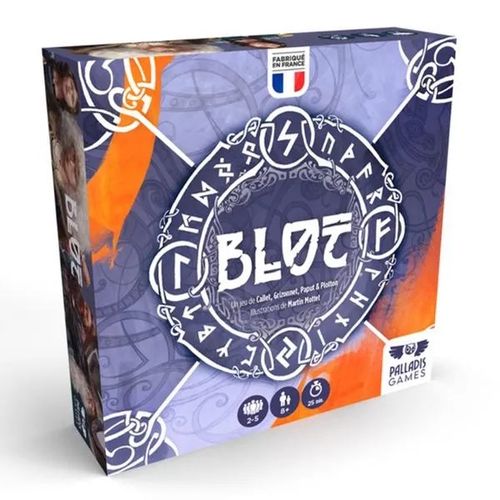
BLOT
BLOT Rulebook
Table of Contents
Table of Contents
Components
- 40 Offering cards
- 4 Divinity cards (double-sided)
- 4 Ceremony tiles (double-sided)
- 1 Count card
Setup
- 5 players: use all the Offering cards.
- 4 players: remove the Offering cards of value 1 and 2.
- 3 players: remove the Offering cards of value 1, 2, 3 and 4.
- 2 players: see the variant on page 11 (Rules for 2, below).
Place the 4 Ceremony tiles in the center of the table, dark side face up.
Arrange the 4 Divinity cards on a randomly chosen face, in the following order: Balder, Loki, Odin and Thor.
During each round, one of the Divinity cards will be covered. Place the Count card on the Divinity card indicated below:
| 1st round | 2nd round | 3rd round | 4th round |
|---|---|---|---|
| Balder | Loki | Odin | Thor |
Deal eight Offering cards to each player.
For the first round, whoever most recently performed a sacrifice starts the game. If no one has ever performed a sacrifice, randomly determine a first player.
Gameplay
A game of BLOT is played over four rounds. Each round is made up of an Offerings phase, followed by an End of Round phase during which Devotion points are counted. At the end of these four rounds, whoever has the most points wins the game.
Note for experienced trick-taking players: the usual terms are given in parentheses and in blue to help you learn the rules of BLOT.
1. Offerings Phase
On your turn, you may choose to:
-
Start a Ceremony (lead a trick) by placing a card from your hand on one of the Ceremony tiles. This card indicates the color of the next offerings that must be placed there (referred to here as the requested color). It is forbidden to start a Ceremony by playing a card of the same color as the Ceremony tile, unless you have no choice. To prove your good faith, your opponents may ask you to show your cards. Do so by hiding the values with your hand.
The first card played on a Ceremony tile is placed straddling it. After that, the other cards are played around the tile and placed in the direction of play.
-
Play an Offering card of the requested color (with a card value of your choice — not necessarily a higher value).
-
If you cannot play an Offering card of the requested color, you may:
- play an Offering card of the Affinity color, indicated by the color of the Ceremony (cut), or
- play an Offering card of another color, even if you hold the Affinity color (sluff).
Note: you may play an Offering card on the Ceremony of your choice, whether or not Offering cards are already there. You may take part in a Ceremony you have already taken part in.
Then move on to the next player in clockwise order. The Offerings phase ends when all cards have been played.
Resolving a Ceremony
When there are as many cards as players around a Ceremony tile, it is immediately resolved.
Check whether there are Offering cards of the Affinity color (that is, the color of the Ceremony tile): whoever played the highest-value Affinity card wins. If there are none, whoever played the highest-value Offering card in the requested color (the first card placed on the Ceremony tile) wins.
Note: it is possible to trigger the resolution of a Ceremony without winning it.
When you win a Ceremony, collect all the Offering cards played on it, then place them face up in front of you, separate from the other Offering cards won in previous Ceremonies.
Example: in this three-player game, the South player started the Ceremony with a green 6. West then plays a green 9. Later, East decides to play a blue 4 to resolve the Ceremony. West, having the highest-value card in the requested color, wins the trick.
-
If the Ceremony tile is on its dark side, it is flipped to its light side and becomes available again for a new Ceremony.
-
If the Ceremony tile is on its light side, the player who won the Ceremony (not the one who triggered its resolution) assigns the Ceremony tile to a divinity that does not already have one. Each divinity can only be assigned one Ceremony tile per round.
Note: when the very last Ceremony is won, it is not assigned to any divinity.
Example: West has won the last Ceremony tile of the round (the red tile). All divinities having already received a tile, she cannot assign it. Move on to the end-of-round count.
When all Ceremonies have been won, move to the end of the round. If this is not the case, the game continues in turn order.
2. End of Round
If you have not won any Ceremony, you are excluded from the counts. The Gods have eyes only for the faithful.
At the end of a round, calculate your Devotion points by counting:
- +3 points per Ceremony won.
- The bonuses/maluses of the divinities (see below).
Note: it is possible to end up with a negative score from this count.
Once this is done, move the Count card to the divinity on its right, then flip the other Divinity cards to their other side.
Example: the first round is over. The Count card moves from Balder to Loki, then the three divinities that are still visible are flipped.
At the end of a round (except the last), whoever won the final Ceremony may decide to start the next round or to give the lead to another player of their choice.
Divinities' Bonuses/Maluses
Each Divinity card has two sides. At the end of a round, look at the color of the Offering associated with the divinity, and the following bonuses and maluses are applied:
BALDER
- +2 pts per pair of Offerings of the associated color
- -2 pts per pair of Offerings of the associated color
LOKI
- -3 pts for the player who won the most Offering cards of the associated color
- -3 pts for the player who won the fewest Offering cards of the associated color
ODIN
- +2 pts per Ceremony won (trick) containing the associated color
- +2 pts per Ceremony won (trick) not containing the associated color
THOR
- +4 pts for the player who won the most Offering cards of the associated color
- +4 pts for the player who won the fewest Offering cards of the associated color
Loki and Thor: in case of a tie, each player involved receives the full bonus or malus.
3. End of Game
At the end of the fourth round, a final count is made. The player with the most Devotion points wins the game.
In case of a tie, whoever won the final Ceremony wins, if they are among the tied players. Otherwise, the player who obtained the highest score during one of the four rounds wins.
In case of a further tie, you will all have your place in Valhalla.
Example score count: it's the end of the first round, in this four-player game. In total, Martin scores 16:
- +9 pts of Devotion for his 3 tricks,
- -3 pts from Loki, because he is the player with the most yellow cards,
- +6 pts from Odin, that is +2 pts per trick containing green,
- +4 pts from Thor, because Martin is the player with the most red cards.
Variants
Rules for 2
Follow all the rules, except for the following points:
Setup
The offerings of value 1 and 2 are removed.
At the start of each round, randomly remove eight additional cards from the deck, face down.
The remaining Offerings are dealt (that is, 12 cards per person).
Offerings Phase
During the first turn of a round, the first player plays one card.
Then, on your turn, you will play two cards in two different Ceremonies. If only one Ceremony remains, you will have to play both your cards there.
Finally, during the last turn of the round, the last player will play a single card.
Resolving a Ceremony
A Ceremony is completed as soon as 3 cards have been played on it.
2 vs 2 Variant
Follow all the rules for 4 players, except for the following points.
Setup
Members of the same team sit diagonally across the table from each other.
Resolving a Ceremony
The cards (tricks) won by each team are pooled together.
Glossary
For the benefit of those familiar with trick-taking games.
- Ceremony: trick.
- Affinity: trump.
Potentially, all cards are trumps, depending on the Ceremony in which they are played.
You may not lead a trick with a trump (unless it is the only color you have left in hand).
You must follow suit if possible.
If you do not have the requested color for the trick, you may cut with a trump or sluff.
You are not obliged to overtrump.