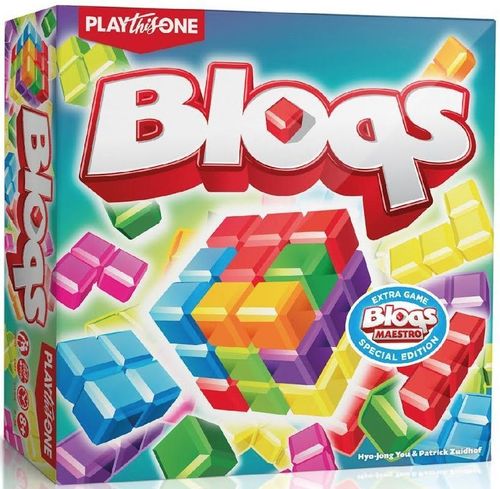
Bloqs
Bloqs Rulebook
Table of Contents
Table of Contents
Contents
- 32 cube parts (4 of each of the 8 types, made up of a different number of blocks). Colors may vary.
- 16 cube discs.
- 4 action discs (2x steal, 2x build).
- 1 game board.
- 1 sheet of stickers.
- 4 prawns (counters).
- 1 dice.
- 54 cards (Bloqs Maestro version).
- 1 game rules booklet.
Before the first game, place the 20 stickers from the sheet of stickers on the 20 discs (one sticker per disc).
Game Concept
A player builds a perfect cube of three layers (3 by 3 by 3 blocks) with no holes or blocks sticking out. If this is not possible you must try to build as high as possible. Here too, all layers must be complete.
Short Game Play
Players take turns to throw the dice and move their counter over the 20 discs. A disc covering a circle is turned over so that the picture is revealed. The disc then remains face up. These pictures indicate which cube part you must take from the middle in order to build with. You must also steal cube parts from opponents or swap with them. The player who is the first to build a perfect cube of 3 by 3 by 3 wins the game. The game also ends if all the cube parts have been used or if all the discs are turned over.
Preparation
Pile up all the cube parts in the middle of the board on the storage sections indicated.
Shuffle all the discs and place them with the images face down on the circles indicated.
Each player chooses a counter and places it on the starting circle in his/her colour.
Each player claims the building site in his/her colour.
(The cards are only used for Bloqs Maestro.)
Game Play
Each player throws the dice. The player with the highest throw begins the game. Then the other players play in turn, going clockwise.
The player whose turn it is throws the dice and moves his/her counter clockwise along the discs, in accordance with the number of spots. If you land on a disc that is face down, it is turned over. The disc then remains face up for the rest of the game.
Three situations are now possible:
- If you land on a cube or action disc without any other players' counters, you either take the piece shown on the disc or perform the action on the disc, whichever is shown. It does not really matter if you just turned over the disc -or- if it was already turned over earlier.
- If you land on a cube disc with other players' counters, then you must swap cube parts with these players (see Swap rule below). After doing this, you do not carry out the cube disc action.
- If you land on an action disc with other players' counters, you must then swap pieces with these players (see Swap rule below) and then perform the action on the disc.
Performing a Cube Disc
There are eight different shapes. Each shape appears twice on the discs. The depicted cube part must be taken from the middle of the board and then used to build on your own building site. Cube parts which have already been used for building may not be rebuilt.
If the cube part is no longer available, you can't play and your turn is over.
Performing an Action Disc
There are two different types of actions. Each type appears twice on the discs. The actions are Steal (image with 2 figures) and Build (image with 1 figure and 1 cube pile). You must carry out the action shown on the disc.
Steal
You must steal one cube part from a random player and build it into your cube. Cube parts which have already been used for building may not be rebuilt.
You must remove the stolen cube part from the outside of a cube and you may not cause the other parts to collapse or move.
Special situation: at the start of the game there may not be any parts to steal yet. In this case you can't play and your turn is over.
Build
You must take a random cube part from the middle and build it into your own cube. Cube parts which have already been used for building may not be rebuilt.
Swap
It is obligatory to swap a cube part if you land on a disc with another counter. The player whose turn it is chooses which cube part he/she gives away and which part he/she takes. If several players are on the same disc, you must swap parts with all these players. You decide the order in which to do so.
You must remove the swapped cube part from the outside of a cube and you may not cause other parts to collapse or move. You must build the cube part you have taken into your own cube. Parts which have already been used for building may not be rebuilt.
End of the Game
The game can end in three ways:
- A player builds a perfect cube of three layers (3 by 3 by 3 blocks) with no holes or parts sticking out. This player has won.
- There are no cube parts left in the middle of the board. The player finishes his/her turn and the winner can be determined.
- All the discs on the board have been turned over. The player finishes his/her turn and the winner can be determined.
Determining the Winner
If no one has built a perfect three-layer cube, then the winner is determined as follows:
The winner is the player who has built the most complete layers.
If several players have built the same number of layers, the player who has used the most cube part blocks in the incomplete layer wins.
If this is also the same, there are several winners.
Example:
None of the players has managed to build a perfect three-layer cube.
Julie has just turned over the last disc, bringing the game to an end.
Daisy has a cube of four layers and on the fifth layer she has three blocks.
Julie has a cube of four layers and five blocks.
Richard has a cube of three layers and seven blocks.
In this case Julie has won. Together with Daisy she has the most layers, but she has built in two more blocks than Daisy.
Tactical tip: If you see that it is not possible to build a cube with three layers, change your strategy and try to build as many complete layers as possible.
Variations
-
Bloqs Turn2: After you have thrown the dice, you determine in which direction you will move your counter: clockwise or anticlockwise. This way you can try to have more control over the game.
-
Bloqs Maestro: With Bloqs Maestro, the game becomes more tactical and there are more possibilities to plan ahead. The cards are now used in the game. See the Bloqs Maestro section below.
Bloqs Maestro
Short Game Play
The game play follows the basic game. But now players may have an opportunity to play one or two cards in order to influence the game.
Preparation
The preparation is the same as for the basic game.
Shuffle the cards and deal three cards to each player. The remaining cards are placed on the box intended for this purpose on the game board.
Types of Card
There are 4 types of card:
- Dice card: Play this card instead of throwing the dice. The dice card indicates precisely how far you must move with your counter.
- Cube card: Play this card if you land on a disc with the same cube part. You may now take a random cube part from the middle of the of the board.
- Teleportation card: Play this card instead of throwing the dice. You swap your counter with another player's counter. Carry out the action indicated on the disc which your counter moved to.
- Defence card: Play this card on another player's turn. This way you can prevent one of your cube parts from being stolen or swapped, or prevent your counter from being teleported.
Game Play
The game play follows the basic game. However, you can now also use the cards (sometimes instead of throwing the dice, sometimes after you have thrown it and sometimes during an opponent's turn).
Additional Game Rules
- You can decide whether you move your counter clockwise or anticlockwise (both when throwing the dice and with the dice card).
- You can play up to two cards per turn. You can only do this by playing a dice card with a cube card or a teleportation card with a cube card.
- You get a new card if you build a complete layer in your cube. One complete layer means one new card, two complete layers means two new cards.
- You lose a card if one of your complete layers is no longer complete through stealing or swapping. For each incomplete layer you lose one card: for one incomplete layer one card, for two incomplete layers two cards. The player to your left takes this card/these cards. He/she then places them on the discard pile on the game board.
- If the pile of cards is finished, all the discarded cards are shuffled to make a new pile.
Example:
Julie steals a cube part from Daisy, thus turning two complete layers into incomplete layers. Daisy loses two cards. Julie takes two cards at random from Daisy and places them on the discard pile. If Daisy later uses a cube part to build and makes the two layers complete again, she may draw two new cards: one for each layer.
End of the Game
In addition to the three basic game play methods, the game can also end in the following way:
A player builds a perfect double cube of six layers (6 by 3 by 3 blocks) with no holes or parts sticking out. This player has won. He/she is a super bloqs builder.