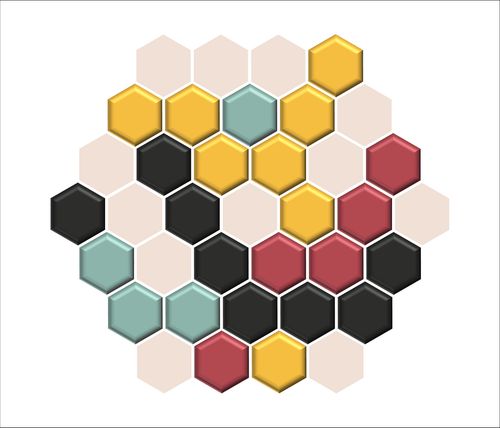
Blooms
Blooms Rulebook
Table of Contents
Table of Contents
Components
- 1 hexagonal board (available in three sizes: 4 spaces per side, "beginner"; 5 spaces per side, "standard"; 6 spaces per side, "advanced"). Larger boards, up to 10 spaces per side, are also supported.
- Stones in 4 colors, 2 per player:
- Player 1: yellow stones and red stones.
- Player 2: teal stones and black stones.
- A scoring track (printed on the board) to record captures.
Definitions
- Bloom: a bloom is a single stone, or an entire group of connected stones of the same color.
- Fenced: a bloom is fenced when there are no empty spaces adjacent to any of its stones.
Gameplay
Each player owns 2 colors of stones. To start, Player 1 places 1 stone of either of her colors on any empty space.
From then on, starting with Player 2, the players take turns. On your turn, you must place 1 or 2 stones onto any empty spaces. If you place 2, they must be different colors. After placement, capture all fenced enemy blooms.
You win when you've captured X stones in total, or your opponent concedes (conceding when you can no longer win is encouraged — it's more fun to start a new game than to carry on a lost game).
New players should start on a board with 5 cells per side and set X = 20. If you enjoy it, try larger boards and higher scoring targets, where the game is longer and more strategic.
For hexagonal boards with sides of 5, 6, 8, and 10 cells, the recommended values of X are 20, 25, 40, and 50, respectively.
Sacrificing stones
Important: New players don't sacrifice stones enough. To sacrifice, let your opponent capture a small bloom of yours (usually 1, 2, or 3 stones). Here's why: your opponent must use turns and stones to capture a small group. While she's doing that, it frees you to build an advantage on other, more pivotal parts of the board.
It's common for players to get 10 or more points down in games played to 25, and still win. This is important because new players often don't see the value of sacrifice.
Living blooms
Another important point to master is the conditions for blooms to live (being impossible to capture), which are similar to those found in Go, the main difference being that, in most cases, 3 eyes (liberties fully surrounded by stones from the same group) are required instead of only 2.
Game length
Different board sizes allow for different lengths of the game. Expect on average 15, 25, and 45 moves each for games on 5-, 6-, and 8-sided boards, respectively.
Tips for Beginners
- New players tend not to sacrifice stones enough. To win, you often need to let the opponent capture strategically placed stones. While they're busy doing that, you can establish a strong position. Beware though: this only works when the number of stones you need to capture to win is set fairly high. When it's low, you can't afford to sacrifice stones as much.
- Consider sacrificing one of your colors to keep the opponent from establishing a strong position, while trying to create a dominant bloom in your other color.
- If some of your opponent's stones are doomed but not yet captured, don't rush to capture them. Instead attack elsewhere and only capture the doomed stones if/when you need to create more space around your blooms. This advice is doubly important when some of your opponent's doomed stones are occupying spaces next to other opponent stones of the opposite color.
- More generally, a player's colors can interfere with each other by taking away space from each other. Try to force your opponent into positions where that happens.
- When attacking, be cautious about attacking both of your opponent's colors at once. It's often better to focus on attacking one opponent color while containing the other.
Print-and-Play
Printable boards (with scoring tracks) are available in three sizes: 4 spaces per side, 5 spaces per side, and 6 spaces per side.
When printed at full size, these boards accommodate pieces 1.75 inches in diameter (standard backgammon-sized pieces). Those pieces are large and expensive, so you may want to find smaller pieces and print the boards at smaller sizes — for example, print a board onto a regular sheet of paper and use M&Ms as pieces.
Face-to-face play guidelines from the designer:
- You should play outdoors, preferably in a garden. If it's cold, buggy, or wet outdoors, you should play in a greenhouse or winter garden.
- You should play in the morning.
- You should drink excellent coffee while playing.