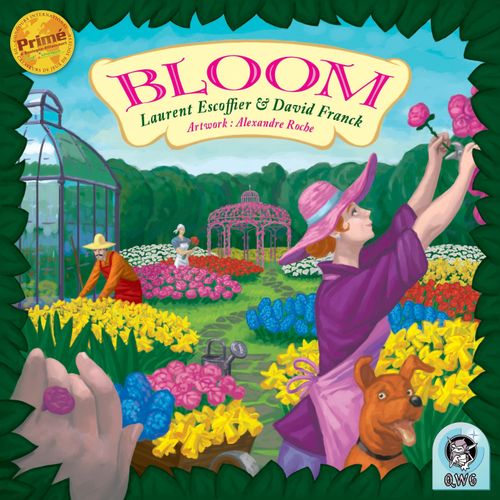
Bloom (QWG Games)
Bloom (QWG Games) Rulebook
Table of Contents
Table of Contents
Game Setup
The players can play two variants of Bloom:
- Family version: The game proceeds in clockwise direction, which is preferable for occasional players and for games with 5 players. This guarantees smooth-flowing game play. If one chooses this version, one does not need to read the rules marked "Tactical version".
- Tactical version (for experienced players): The game proceeds clockwise only during the first round. Afterwards, after each turn the player with the fewest flower beds in the garden takes the next turn. This rule increases game tactics.
Setup:
- Each player chooses a colour and takes the corresponding 3 pawns and 9 cards. For a game with 5 players, each player gets only 8 cards. (The cards with only one flower bed space are discarded.) For a game with 2 players, one has to read the special rules at the end of the manual.
- One player is chosen to manage the general stock, the money and the flower tokens during the game.
- The start player, chosen at random, plays one of his cards by placing it in the middle of the table. From now on, we call this "the garden". He places his gardener on one of the flower bed spaces. Then the next player in clockwise direction takes his turn.
Game Components
- 15 pawns: 5 gardeners, 5 animals, 5 ornaments.
- 45 cards (9 in each colour). Each card has 9 spaces with a flower bed or a lawn.
- 75 flower tokens: rose (pink), white arum, blue hyacinth, yellow daffodil, red tulip.
- 70 coins: values 1, 5 and 10.
Game Progress
The player performs each of the following actions successively:
Tactical version: the player with the fewest flower bed spaces in the garden performs each of the following actions successively.
- Card's pose: He places one of his cards on the table, partly covering the other cards in the garden. Tactical version: He counts all his flower bed spaces in the garden. If he still has the fewest number of flower bed spaces, he repeats this action.
- Flower's picking: For each covered flower bed space, he receives a corresponding flower token. These tokens are stored in front of him, clearly visible for all. We call this his "wheelbarrow".
- Bouquet's selling: If his wheelbarrow is full, he sells bouquets to earn money.
- Token's placement: He places his gardener and, if possible, his animal and ornament in the garden.
To Play a Card
A card is always placed partially covering one or more already played cards.
It is forbidden to cover 9 spaces at once, irrespective if these are flower beds or lawns. To state it in a different way: a played card must always directly touch the table.
Gardeners, animals and ornaments protect the spaces they stand on. These spaces cannot be covered by cards. However, a player is never hindered by his own gardener or animal. To clarify this, it is advisable to remove your gardener and your animal before playing a garden card.
To Collect Flowers
Every time a flower bed in the garden is covered during the game by playing a card, the active player collects a flower token in the corresponding colour. Even if a player covers his own flower bed, he collects a flower token in his own colour. A player does not collect anything by covering a lawn space.
Each player places his collected flower tokens in front of him on the table, which we call the "wheelbarrow". The maximum capacity of the wheelbarrow depends on the number of players:
- With 2 players, the maximum capacity is 3 flowers.
- With 3 players, the maximum capacity is 4 flowers.
- With 4 players, the maximum capacity is 6 flowers.
- With 5 players, the maximum capacity is 8 flowers.
Hint: as long as a wheelbarrow is not full, it is best to keep flower tokens in order to compose more expensive bouquets.
If a wheelbarrow is full after the collection of flowers, a player has to sell bouquets.
Tactical version: if a wheelbarrow is full after the collection of flowers, a player has to sell bouquets, except if it is his turn again. In this case, he may postpone selling till the end of his consecutive collections.
To Sell Bouquets
A player has to sell bouquets or discard flowers as soon as his wheelbarrow is full. A bouquet contains at least 2 flowers of different colour. The more colourful the bouquet, the more expensive it will be sold.
- One single flower is not worth anything.
- A bouquet with 2 different flowers earns 1 point.
- A bouquet with 3 different flowers earns 3 points.
- A bouquet with 4 different flowers earns 6 points.
- A bouquet with 5 different flowers earns 10 points.
A bouquet that earns the maximum price is called a big bouquet (e.g., in a game with 3 players, a big bouquet earns 3 points).
All flower tokens used to compose and sell a bouquet are discarded and return to the general stock. During the game, one can also choose to discard flower tokens without selling instead of selling bouquets at lower prices.
Example (calculation of the score after collecting 6 flowers): a bouquet of 3 different flowers (3 points), a bouquet of 2 different flowers (1 point) and a single flower (0 points) = 4 points.
To Place Pawns
Important: each player may change the positions of his gardener and his animal during his turn according to the following rules. One may never place more than one pawn on the same space.
-
The gardener: Is the only pawn a player has at the start of the game. It is placed on a flower bed space with the same colour as its owner.
-
The animal: Is placed directly on the table (not on a garden card), adjacent to a garden space (flower bed or lawn). The adjacent spaces may have colours different from the player's colour. A player may play his animal as soon as he has 10 or more flower bed spaces in the garden. These 10 flower bed spaces do not need to be connected. If later on a player has fewer than 10 flower bed spaces in the garden, he still keeps and plays his animal.
-
The ornament: May be placed once the owner has 15 or more flower bed spaces in the garden. He may place his ornament immediately in the garden or postpone it to another turn. However, he always has to check whether he has 15 or more flower bed spaces in the garden. If he has fewer than 15 flower bed spaces in the garden during another turn, he may not place his ornament. It is perfectly possible that a player will not be able to place his ornament during the whole game.
An ornament is placed on two adjacent spaces, a flower bed (in the same colour as the ornament) and a lawn. Once the ornament is placed, it cannot be moved during the game. So, it is impossible to place a garden card on these spaces during the rest of the game. Even the owner of the ornament may not cover these spaces with a card. During the final scoring, a player earns half a point for each connected lawn space.
Furthermore, it is forbidden to place an ornament on a lawn already occupied by another ornament. In contrast, lawn spaces connected to an ornament may be covered by playing a garden card in order to decrease (or increase) the total surface of the lawn. It might occur that several lawns are connected by playing a garden card. If this is still the case at the final scoring, all the owners of the ornaments on the lawn share the total amount of points.
(Tactical Version) To Determine the Next Active Player
During the first round, the game proceeds in clockwise direction. From the second round until the end of the game (thus as soon as every player has played 1 garden card) one checks after each turn which player has the fewest flower bed spaces in the garden. He will be the next active player.
If several players tie for the fewest flower bed spaces in the garden, the player closest to the active player, in clockwise direction, will be the next active player.
When the active player ties with another player for the lowest number of flower bed spaces, the other player becomes the next active player. It might occur that a player plays several turns one after the other (see example).
Example of a Turn
Rose has the lowest number of flower bed spaces in the garden (2), so she starts her turn. Her wheelbarrow contains 1 hyacinth.
All players count their number of flower bed spaces in the garden. Rose still has the lowest number of spaces and plays another turn. She places a garden card to collect 3 flowers.
Rose takes her gardener and her animal out of the garden. She places a garden card to collect 4 flowers. Now her wheelbarrow is full. Rose sells 2 big bouquets earning her 6 points and she keeps 2 flowers in her wheelbarrow. She places her gardener and animal back on the board. Then it is Arum's turn as she has only 2 flower bed spaces in the garden.
Final Scoring
After a player places his last garden card, he finishes his turn normally (collect flowers, place pawns) and continues to the final scoring.
- He sells the most colourful and thus the most expensive bouquets with the flowers in his wheelbarrow.
- He counts all his own flower bed spaces in the garden and scores 1 point for each flower bed space.
- He counts all lawn spaces connected to his ornament and scores half a point for each lawn space (rounded down). When several players have their ornament on the same lawn, they share the total number of points.
Finally, there are some bonuses to award:
- Yield bonus: When all players have played their last card, the player with the largest flower bed (flower bed spaces are not connected by corners, only by sides), earns the yield bonus with a value of a big bouquet (3, 3, 6 or 10 points for a game with 2, 3, 4 or 5 players, respectively). In case of a tie, the second largest flower bed is considered, then the third largest flower bed, and so on. In case of a total tie, the yield bonus is shared.
- Freshness bonus: In a game with "x" players, the first player who finishes his turn receives x-1 points, the second player x-2 points and so on. The last player receives nothing. Tactical version: there is only one freshness bonus, equal to the price of a big bouquet (3, 3, 6 or 10 points for a game with 2, 3, 4 or 5 players, respectively), granted to the first player placing his last garden card.
The player with the highest total score wins the game.
Example of the Final Scoring
Rose has played her last garden card. She earns 18 points (13 for all her flower bed spaces in the garden and 5 from the lawn with her ornament) which she totals with her points from selling bouquets during the game. When all players have played their last garden card, Arum receives the yield bonus for her flower bed of 14 connected white spaces.
Rules for 2 Players
A third colour is chosen. This virtual player (we call him Maurice) is played alternately by both players, starting with the player who placed the first garden card.
- The first round: player A starts the game by placing a card in the garden and subsequently places his gardener. Then player B takes his turn. When both players have completed their turns, player A plays a card of Maurice (third colour) and collects flowers if possible. Then he places Maurice's gardener. Tactical version: Players A and B count their total number of flower bed spaces in the garden. If Maurice has the lowest number, player B takes Maurice's turn.
- So Maurice works alternately for both players. All flowers collected by playing Maurice's cards are placed in the wheelbarrow of the player completing Maurice's turn. (Note: in a 2 player game, wheelbarrows are full with only 3 flowers.)
- Maurice's gardener and animal are placed in the garden at the end of each of his turns, chosen by the player playing Maurice's turn.
- Maurice's ornament is never placed on the board. It just indicates who will perform Maurice's next turn and is passed as soon as a player plays the turn of Maurice. Tactical version: It may occur that Maurice plays two turns in a row, but never performed by the same player.
- When a player has to play after having completed Maurice's turn (or vice versa: he has to play Maurice's turn after having completed his own turn), he may first collect all flowers before placing his (and Maurice's) pawns and before selling bouquets.
- Maurice is never considered for earning bonuses.
- The player who has already played his last garden card may not perform another turn of Maurice. The other player plays all Maurice's following turns.