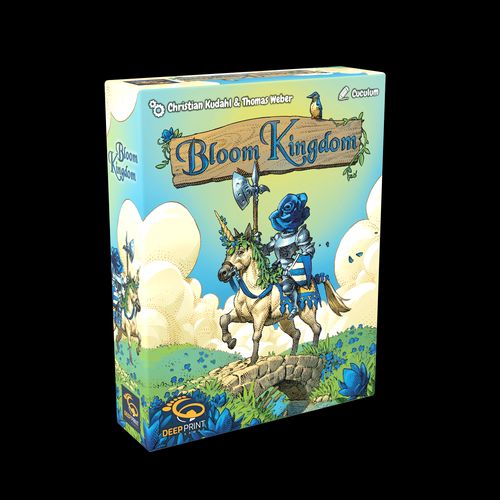
Bloom Kingdom
Bloom Kingdom Rulebook
Table of Contents
Table of Contents
Components
100 Character Cards – 10 copies of each character: Jester, Queen, Knight, Noble, Dragon, King, Unicorn, Farmer, Wizard, Fortune Teller.
Character Card Breakdown
- Character icon: identifies which of the nine characters the card belongs to.
- Initiative: Some cards show an initiative number above the character. It determines the order in which instant effects resolve. First, add all cards without an initiative number to the display, then add all cards with initiative in ascending order (highest initiative last).
- Instant effect: Half of the cards show an instant effect below the character. Resolve it when the card is added to the display.
- Scoring effect: Each card shows at the bottom edge how it scores if it is kept as a scoring card.
10 Reference Cards — On the reference cards, you can look up all instant and scoring effects of the characters at any time.
Setup
Shuffle all character cards and deal 6 hand cards to each player face down. Place the remaining cards face down to form a draw deck. Leave enough space for a 9-column display (one per character except the Jester, who is placed into other characters' columns). In two-player games, instead deal 8 hand cards to each player face down.
Everyone takes a reference card.
Have pen and paper handy to record your points after each round (or use the digital scoring sheet in the Deep Print Games App). To record and tally your scores, we recommend the Deep Print Games App. Here, you can find virtual scoring pads for this and many more of our games. Get it for free on the App Store and on Google Play at https://scoreapp.deep-print-games.com
Playing the Game
A game of Bloom Kingdom is played over three rounds, each with multiple turns. At the end of each round, when you have just two cards left in hand, you score those cards. After scoring, you'll draw a new hand and begin the next round, while the cards in the display remain there for the rest of the game.
1. Play Cards
At the start of each turn, choose a card from your hand and place it face down in front of you. Once everyone has done so, reveal your cards simultaneously.
2. Add the Played Cards to the Display
Add the played cards to the common display, forming a separate column for each character type. If a character type is already in the display, add additional matching character cards to the same column. Place the cards in such a way that the total number of cards is always visible.
First, add all cards with no initiative number to their columns. Then add all cards with an initiative number in ascending order to their columns. When a card with an instant effect is added, its player resolves that effect immediately.
Once all cards have been added, the next turn begins.
The round ends when everyone has only two cards left in hand.
Example: These 5 cards were played. First the Farmer and the Unicorn are added to the display. Then the Wizard and the Fortune Tellers follow in ascending initiative order.
The Instant Effects
- Unicorn (no initiative): Draw one card from the deck into your hand. Then choose a card in your hand and return it face down to the box. Note: All players that played a Unicorn can perform its instant effect simultaneously, drawing their cards in no particular order.
- Knight (10–19): You may remove one Dragon from the display and place it back in the box. Note: If there are any Jesters in the Dragon column, place one of those Jesters back in the box instead.
- Wizard (20–29): You may remove any card from the display and place it back in the box. Note: If there are any Jesters in the chosen column, place one of those Jesters back in the box instead.
- Jester (30–39): Place the Jester in any column that already contains at least one card. It now counts as a character of that column. Special case: If there are no characters in the display yet, place the Jester back in the box. Note: Place Jesters under the existing cards so that the actual character remains fully visible, while keeping the total number of cards in each column discernable.
- Fortune Teller (40–49): Choose a player and select one of their hand cards at random. Look at it secretly, then return it to that player.
End of a Round and Scoring
The round ends at the end of the turn when you have only two cards left in hand. These two cards are your scoring cards, for which you now receive victory points (VP).
Each scoring card shows a scoring effect, which scores the cards in the display in its own way. Determine the victory points for each of your scoring cards and record them. Then place your scoring cards back in the box.
The Scoring Effects
- Jester: If at least one King is among the other players' scoring cards (not your own!), score 4 VP per King in the display.
- King: If there are no Jesters among the other players' scoring cards (not your own!), score 4 VP per King in the display.
- Queen: Score 3 VP per Queen + King pair in the display.
- Unicorn: If no column has more cards than the Unicorn column, score 3 VP per Unicorn in the display.
- Knight: Score 5 VP for each Knight + Queen + Unicorn trio in the display.
- Farmer: If there are at least as many Farmers as Knights in the display, score 3 VP per Farmer in the display.
- Noble: If there are at least as many Farmers as Nobles in the display, score 4 VP per Noble in the display.
- Wizard: Score 3 VP per Wizard + Noble pair in the display.
- Dragon: Score 4 VP per Dragon in the display.
- Fortune Teller: Score 2 VP per Fortune Teller and 2 VP per Dragon in the display.
Don't forget: Each Jester in the display counts as a character of that column and is included in scoring.
Scoring example: The display looks like this at the end of the round. Robin, John, and Marie reveal their scoring cards:
Scores shown: 0 VP, 6 VP, 8 VP, 0 VP, 8 VP, 0 VP.
Robin receives 0 VP for her Noble because there are fewer Farmers than Nobles in the display. There are two Noble + Wizard pairs in the display, so she receives 2 x 3 = 6 VP for her Wizard.
John receives 4 VP for each Dragon in the display for his Dragon, so 8 VP in total. For his King, he receives 0 VP because Marie has a Jester as a scoring card.
Marie speculated well with her Jester because John has a King as a scoring card. She receives 4 VP for each King, so 8 VP in total. For the Unicorn, she receives 0 VP because there are columns in the display that have more cards than the Unicorn column.
After you have all recorded your victory points, the round ends. If you haven't played three rounds yet, deal everyone 6 new hand cards from the deck (8 with two players) and start the next round. All cards in the display remain where they are.
End of the Game
The game ends at the end of the third round. Whoever has the most victory points in total wins. If tied, the tied players share the victory.