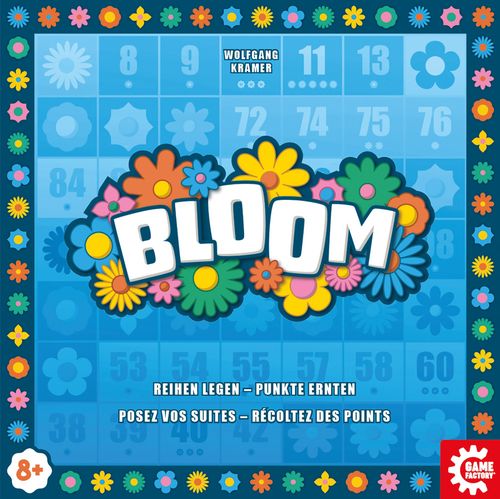
Bloom (Game Factory)
Bloom (Game Factory) Rulebook
Table of Contents
Table of Contents
Goal of the Game
Lay the best and longest sequences, steal good tiles from your opponents, and be the first to get rid of your own tiles.
The player with the most points after two rounds wins the game!
Contents
- 1 bag
- 1 board
- 104 wooden tiles (numbers 1 to 100 + 4 jokers)
- 20 Reward Tokens (2× 1 to 5 points & 1× 6 to 15 points)
Set Up
- Set up the board within easy reach in the middle of the table, then place all the Reward Tokens on the spaces corresponding to their values.
- Place a Joker tile on one of the four Joker spaces on the board.
- Shuffle all remaining tiles and place them face down in a supply in the center of the table.
- Note: To save space, put the tiles in the bag and shuffle them. Instead of drawing from the supply, simply draw tiles from the bag.
- Turn over tiles from the reserve and place one face up on each of the 8 spaces at the bottom of the board: these form the floor. If you turn over a joker, place it on a joker space: they are never part of the floor of 8 tiles.
- Each player draws 13 tiles from the supply and places them face up in front of them, without showing them to the others. This is your hand.
- Have a sheet of paper and a pencil ready.
Game Sequence
The last player to pick a flower starts. Play continues clockwise.
On your turn, you must perform only one of the following 3 actions:
- Draw 1 or 2 tiles
- Play a sequence and earn a Reward Token
- Extend a sequence
1. Draw 1 or 2 Tiles
Choose up to 2 tiles from the field and/or the reserve and add them to your hand. Your hand can contain as many tiles as you like; no tile limit. If you took tiles from the field, replace them with tiles from the reserve at the end of your turn, so that there are 8 tiles again. If you draw wild tiles, place them on the wild tile spaces instead of on the field and continue drawing to replenish the field back up to 8 tiles.
Attention: Players are not allowed to take a joker during the Draw 1 or 2 tiles action. They are only accessible by laying a certain type of sequence (see "Jokers", p. 4).
Then it's the next player's turn.
2. Lay Down a Sequence and Win a Reward Token
Place as many tiles as you like from your hand to form a single new sequence in your own player area in front of you.
A sequence must always contain at least 3 tiles, and the difference between any two values must never exceed 2.
(Illustration: 14, 16, 17, 18, 20, 21 as one sequence.)
A sequence that exceeds 100 cannot wrap around down to 1. (Illustration: 97, 99, 1, 2.)
Stealing: Each time you choose the Play 1 or 2 tiles action, you can also steal tiles from an already played sequence instead of using only tiles from your hand. In this case, take 1 or 2 tiles from a played sequence and complete it with tiles from your hand to play a newly-formed sequence in front of you.
Important: After you have stolen a tile from a sequence, that sequence, as well as the new one you place, must continue to comply with the placement rules, namely: to contain at least 3 tiles with a value difference of no more than 2.
Example: You steal tiles 17 and 19 from the sequence which you complete with three tiles from your hand. (The illustration shows the sequence 14, 16, 18 with 17 and 19 taken out, and the new sequence 17, 19, 21, 22, 23 played in front of the player, 21–23 being the three tiles from the hand.)
After playing a sequence, earn a Reward Token. Add up the number of flowers on the tiles in that sequence and check if the Reward Token of the corresponding value is still available.
If it is, take it and place it in front of you, face up.
If it is not, take the tile with the next lowest value and place it in front of you, also face up. If no more tiles of a lower value are available, unfortunately you leave empty-handed.
Example: This set (65, 66, 68, 70) includes 11 flowers. You win Reward Token 11. If it is no longer available, you win Token 10, and so on…
Then it is the next player's turn.
3. Extend a Sequence
Place as many tiles as you want from your hand and add them to a single sequence already laid. You can add each tile to the beginning, end, or middle of the sequence.
(Illustration: on the sequence 14, 16, 17, 19, 20, tiles 12 are added at the beginning, 15 between 14 and 16, and 18 between 17 and 19.)
Attention: You do not earn a Reward Token by extending a sequence! However, this action can help you to be the first to get rid of your tiles to avoid losing points.
Then it is the next player's turn.
Note: If a player is no longer able to draw tiles, they may be forced to pass since they are unable to perform any action. Passing voluntarily is not allowed.
Jokers
The game's four jokers can replace any value and therefore may be placed in any position when laying or extending a sequence. Joker tiles do not have flowers; as a result, they do not count towards earning a Reward Token.
If you lay a sequence of exactly three tiles, without stealing, you may take a Joker tile from the board (if any remain) and add it to your hand. You can use it starting on your next turn.
A joker in a sequence can be replaced by a numbered tile of a corresponding value. Replacing a joker does not count as an action and can be done at the beginning of your turn. In this case, the joker can be used immediately.
Example: In this sequence (21, joker, 25, with 24 below the joker), you can replace the joker with tiles 23 or 24, and then add it to your hand.
Reminder: Each time a joker is drawn when completing the playing field, place it on a Joker space instead of one of the 8 numbered spaces.
End of a Round and Scoring
The round ends immediately as soon as a player has played the last tile from their hand or all players have passed. Then count the points:
- Each person adds up the points from their Reward Tokens.
- Lose 1 point for each flower on any tiles remaining in your hand at the end of a round.
- Record the results. If only one round has been played, begin a second round. The player with the fewest points starts.
End of the Game
The game ends after 2 rounds. Add the points from both rounds. The player with the most points wins!
In case of a tie, the winner is the player who scored the most points in the second round. If the tie persists, the players share the victory.