Bloody Mary: Further Intrigue in the Tudor Court
Bloody Mary: Further Intrigue in the Tudor Court Rulebook
Table of Contents
Table of Contents
Introduction
Bloody Mary is a game for four to eight players about mid-Tudor history. The game starts at the accession of Edward Tudor, son of Henry VIII. It ends in Turn five. Each Turn represents five years.
Each player controls a Faction competing for influence at the Sovereign's court. Each Faction consists of several Characters. The Faction controlling the Sovereign is known as the Sovereign's Faction (funny, that). It receives special benefits.
The aim of the game is have the Faction with the highest total Influence. Quite probably, this means that you control the Sovereign.
In these rules, 2d means roll two dice and 1d means roll one die.
Influence is shown on the various cards in the red box at lower right.
Components
- A set of Character cards.
- A set of Court cards. You use these to conduct an Endeavour in your Turn, or to Support your own Endeavour, or to support or hinder another player's Endeavour.
- A set of cards showing Offices (Bishop, Secretary, etc) and Titles (Duke, Marquess, etc).
- Special Endeavour cards, such as The Secretary Orders the Rack. Keep these to remind you of an Office's special functions.
- A Board.
- A set of Markers.
The Board contains a track round the outside to keep note of total Faction Influence. It's not essential to game play, but it's nice to know who's winning.
How to Win
The winning Faction is the one with most Influence at the end of the game.
You keep track of this on the Influence Track on the outside of the Board.
Setup
Assign Faction Markers
Each player takes two Faction Markers. Place one in front of each player to remember their identity. Place the other on the Influence track.
Setup the Board Tracks
| Board | Value |
|---|---|
| Game Turn Track | Turn 1 |
| Tower of London: Imprisoned Characters | Thomas Howard, Edward Courtenay |
| Tower of London: Arrested Characters | Empty |
| Beyond the Realm | Mary Stuart, Margaret Douglas, Reginald Pole |
| Vacant Offices | All, except those on the 'At Start' characters |
| Titles | All, except those on the 'At Start' characters |
| Rebellion Box | Empty |
| The Realm's Religion | P2. (Edward Tudor, the Sovereign, is a rabid Protestant.) |
| Unrest Track | One (1) |
| Court Deck | All court cards |
| Sovereign Box | Edward Tudor |
| Sovereign's Faction marker | Give this to the Faction with Edward Seymour (which will also have Edward Tudor). See below. |
Deal initial Characters and Cards
- A Character labelled '6+ Players' is only used in a game with six or more players. Discard them if you have less than 6 players.
- Characters are randomly allocated to players in three batches. To ensure a fair distribution, the most important characters are dealt out, then all the others. Characters who start in the Tower or Beyond the Realm are allocated to Factions.
- 2a. Allocate the Characters marked 'At Start [Major]' as evenly as possible to each player. These are the most powerful dudes. This ensures everyone has at least one good character. The designation 'Major' has no other effect in the game.
- 2b. Allocate the remainder of the 'At Start' Characters. Factions who missed out on a Major Character in step 2a should be given an extra Character now to compensate.
- Exception: Do not allocate Edward Tudor (the Sovereign). Edward Tudor is given to the player with Edward Seymour. This player then becomes the Sovereign's Faction.
- 2c. Allocate characters marked with an entry Turn, such as 'Enters on T2' (as opposed to "At Start"). Place them face down with the Faction. They will activate and join their Faction at the beginning of that Turn.
- Assign each character their initial Title or Office card.
- Each player adds up their total Influence. Place markers on the track around the Board to denote total Faction Influence.
- Give each Player five Court Cards.
Designer's note: You may have other ideas about an equitable initial distribution. Please yourself.
"At Start" Characters who have Titles or Offices
Not all of these may be in play.
| Character | Title | Office |
|---|---|---|
| John Dudley [Major char] | Earl of Warwick | Chamberlain |
| Henry FitzAlan [Major char] | Earl of Arundel | |
| Henry Grey [Major char] | Marquis of Dorset | Lord High Steward |
| Henry Hastings | Knight | |
| William Herbert | Knight | |
| Thomas Howard [Major char] | Duke of Norfolk | |
| Henry Neville | Earl of Westmoreland | |
| William Parr [Major char] | Marquis of Northampton | |
| William Paulet [Major char] | Baron | Lord Great Seal, President of the Council |
| Thomas Percy | Baron | |
| Edward Seymour [Major char] | Duke of Somerset | Protector, Lord Treasurer |
| Thomas Seymour | Baron | |
| Thomas Wriothesley (pronounced Riz-lee) [Major char] | Earl of Southampton | Lord Chancellor |
| Thomas Cranmer [Major char] | Archbishop of Canterbury | |
| George Day | Bishop of Chichester | |
| Stephen Gardiner | Bishop of Winchester | |
| Nicholas Heath | Bishop of Worcester | |
| Cuthbert Tunstall | Bishop of Durham | |
| William Paget | Secretary | |
| William Petre | Knight | |
| John Russell | Baron | Lord Privy Seal |
| Reginald Pole | Beyond the Realm |
Characters
Each Faction consists of a hand of Character cards. Every Character has an Influence rating. A Faction can add to its Influence by winning over Heirs and other Characters.
Every Character is also rated for Ability, Religion and Guile. In general, Guile gets you places; but Ability keeps you out of trouble. Whether being Catholic or Protestant is good depends mainly on the Sovereign's religion. Being of the same religion as the Sovereign helps. Religion is rated RC (Catholic) or P (Protestant).
Designer's note: A Character acquires Influence by getting an Office and/or Title. The higher the Ability or Guile the better.
Nobles and Commoners
A Noble is anyone with a Title card, such as Duke of Norfolk; or any Tudor. The Lord High Steward presides at their trials. Everyone else is a Commoner. The Lord Privy Seal presides at their trials.
Designer's note: Bishops and Archbishops are Commoners.
Heirs
Some Characters are designated as Heirs.
Heirs have an Heir Credibility. The higher the Credibility, the easier it is to make them King or Queen by Proclamation, but the easier it is to arrest them.
Designer's note: No Sovereign wants credible heirs hanging around. Everyone else does!
Minors
A minor is not a 'minor character', but someone who has not attained their majority (eighteen, or whatever it was in the mid 1500s). The Character card shows in which Turn they obtain their majority.
A Minor cannot be executed, imprisoned as a result of a Trial, or attainted.
Designer's note: A minor can be arrested and sent to the Tower.
Ambassadors
The Ambassadors never die. They have Sovereign Privileges.
Designer's note: While they have high Influence, they will get you in trouble if someone plays an Evidence of Foreign Conspiracy Support card!
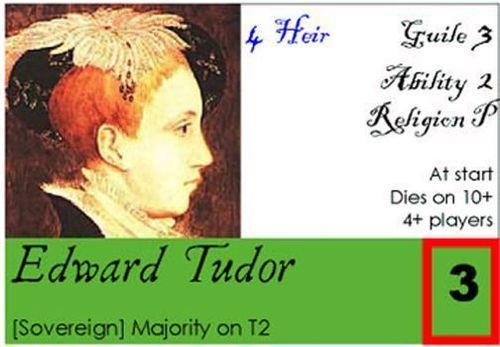
Example Character Card
Henry Hastings has an Influence of 1. He has the lowest Guile of 0, and a low Ability of 1. In short, he is a harmless idiot. His Religion is Protestant.
The card also shows the character's turn of entry (At start in this case), the die roll that will see him die (on a 16 or more), and the size of game he is used in (4 or more players).
Henry is also an Heir with a value of zero. He does not reach his majority until the start of Turn 2. He has a special ability: +1 is added to his Action Points if he attempts to receive a Title.
Game Sequence
The game consists of a series of Turns, each Turn representing five years.
- Player Rounds. The Sovereign's Faction is the first player in a round. The player plays an Endeavour, to which other players may respond. Play moves to the next Player.
- Court Segment
- A. Determine which Characters die
- B. Characters Beyond the Realm may Return
- C. Remove all Law Suit cards
- D. Turn over new Characters and acquire Court Cards
1. Player Rounds
A Turn consists of at most five Rounds. A Round consists of each player playing one Endeavour. The first player in the Turn is the Faction with the Sovereign, then clockwise.
A Round ends when each Faction has played one Endeavour.
You must play an Endeavour in your part of the Round, or discard. You cannot hoard Endeavours.
Important Exception: Instead of playing an Endeavour, the Sovereign's Faction can re-assign an Office in play to another Character who is not of the Sovereign's Faction.
Designer's note: A player sad enough to be stuck in a Law Suit cannot play any Endeavours. They may keep their cards for Supports. This gives a reason for Players to be friendly to that Player.
Completing the Rounds
Rounds end when no one has any Endeavours to play.
Designer's note: Some players may run out of cards before others because they have used some as Support cards.
Playing Endeavours in a Round
Play is conducted in Rounds. Starting with the Sovereign's Faction at the start of the Turn, a Player may play a single Endeavour, plus any number of Support cards.
The next player can then play a Support card, and so on back to the original player. Support cards are played until no one wants to play any further cards. A Support card can only be played with the Endeavours listed at the bottom of the card.
The Endeavour is then resolved.
Play then proceeds to the next Player, who plays one Endeavour, and so on.
Designer's note: There will be at most five Rounds in a Turn, one for each card in the initial hand. The number depends on how many Court cards are used as Support cards instead of Endeavours. If everyone is lavish in their use of Support cards, there will be fewer Rounds.
Resolving Endeavours
You can play an Endeavour on any Character in the game, in your own Faction or another's.
Every Endeavour has a Difficulty. Your Endeavour succeeds if you gain at least a number of Action Points equal to the Difficulty.
Calculate your Action Points for the Endeavour. Action Points are made of:
- A 1d roll.
- Endeavours often require you to add or subtract the Ability, Guile or Religion of the Character you are targeting.
- Support card modifiers. These are shown on the Support Card's upper right. Modifiers may make the Endeavour easier or harder to achieve. Both you and other players may play Support cards to help or hinder you. Note: With some cards, the player may choose whether they are plus or minus.
- If you have a My Lord's Man, you must use his Ability minus 2. (This could be negative).
- If you have the Sovereign, you must add or subtract Action Points according to the Unrest Track.
Designer's note: Some Endeavours are also modified by the Sovereign's Religion, or by the Unrest Modifier. Support cards can only be used with the Endeavours listed at the bottom of the card. Any Support Cards used are lost after play. You may be stuck with an idiot henchman. If the nation is restive, the Sovereign has more difficulty getting people to do their will.
Endeavour Example: Arrest
You play an Arrest Warrant on Henry Hastings (the Target Character). According to the card, you can only do so if (1) You or someone else simultaneously plays an Evidence Support or if (2) Henry already has an assigned Investigation card.
Henry, let us say, is not under Investigation. A friendly Faction plays an Evidence: Plotting for the Throne as a Support card. This also gives you a +3 to your Action Points (upper-right value). The Endeavours that can be used with this Support card with are noted on the bottom of the Evidence card. If they wished, your friend could have saved this card and used it with a Trial, Rack or Investigation Endeavour.
Note that Evidence: Plotting for the Throne can only be played on a Character who is an Heir. Henry Hastings is an Heir, so the card is playable.
The Endeavour's Difficulty is 3. You must gain at least 3 Action Points (the Endeavour's Difficulty) for the Endeavour to succeed.
Now for the modifiers. The card says you take into account the current Unrest Modifier, and whether the Character is of the Sovereign's religion. Let us say that Mary Tudor, a Catholic, is Queen; and that the nation is restive: the Unrest Level is 2.
The Modifiers are:
- Henry Hastings's Ability: -1
- Evidence: +3
- Henry is not of the Sovereign's religion: 0
- Unrest Level: +2
This is a total of four Action Points. You only need three (its Difficulty), so the result is guaranteed. You roll a dice of two, making a total of 6. He's arrested!
Designer's note: This Evidence card is very powerful. Most other Evidence cards are only 1 or 2 in value. If Henry had been a Catholic, Queen Mary would be less likely to arrest him.
2. Court Segment
Important: There is no Court Segment in the last Turn of the game.
A. Determine which Characters die
Roll for each character to see if they die. As Characters age through the game, they have a greater chance of dying.
A character dies if a 2d roll ≥ Death Number.
Modifiers:
- Add the Current Turn number.
Important: There is no Death Segment in the last Turn of the game.
Designer's note: Example: Thomas Howard has a Death Number of 9. It is Turn 3. He will die if 2d + 3 ≥ 9, that is, a roll of 6 or more.
B. Characters may return from Beyond the Realm
Characters can optionally return from Beyond the Realm. You move Beyond the Realm to avoid bad things, like arrest.
Designer's note: The disadvantage of staying Beyond the Realm is that the Character does not count for your Influence.
C. Remove all Law Suit and Investigation cards
D. Turn over new Characters and assign Court Cards
- Characters due to appear this Turn are turned over and join their Faction.
- Every Faction receives 5 (five) cards. Reshuffle the deck if there are insufficient cards.
Designer's note: The Treasurer's faction receives one extra card.
Court Cards
The Court Cards are the heart of the game.
Each player receives five Court cards each Turn. These are the player's resources. Each Court card has two halves: an Endeavour half and a Support half.
During your Round, you can play a single Court card as an Endeavour to do some action. You can also use one or more of your Court cards as Support cards to assist your Endeavour. Every other player can also play a Court card as a Support Card to aid or hinder you.
Designer's note: You can only use a Court card as one or the other, not both. It is extremely important to understand that you can play any Endeavour to aid yourself or to aid or hinder any other player. For example, normally you would play a Proclamation on yourself to make one of your own Characters the Sovereign. But there are bad consequences if this Endeavour fails. So you may find it useful to play it on one of your opponents, knowing it will fail and ruin them.
An Example Court Card
A Court card has two halves. The left is the Endeavour card side (Licence of Release), and the right is the Support card side (Obstruction). You can play a card as either an Endeavour or a Support. Once played, the card is returned to the deck.
Endeavour Portion
You can only play the Endeavour portion in your Turn. It has a Difficulty (6 here). There are three modifiers. When you play it, you also add the target Character's Guile to your Action Points. If the Character is the same religion as the Sovereign (RC or P), you get another Action Point. Finally, you subtract the current Unrest Modifier from your Action Points.
Designer's note: You can use this Support card only with the Endeavours listed here. In this case, you can play the card with any Endeavour.
Support Portion
You can play a Support in anyone's Turn, including your own. The effect of this particular Support card (Obstruction) is to nullify whatever Endeavour has just been played.
Assigned Cards
A card with this symbol must be assigned to a character. Place it under the character. All other cards are discarded once played.
With the exception of Investigation and Law Suit the card stays there until removed by another Endeavour.
Spy Cards
If a card with this symbol is removed from a player's hand using the Fee'd Men card, it may be immediately played against the player losing the card. They have been harbouring dark secrets. Play as a normal Endeavour. Support cards may be added.
Designer's note: Fee'd Men were servants paid a fee to act as spies in noble households.
Notes on Endeavours
Unrest Track
The middle track on the board is the Unrest Level. There are three components:
- Unrest Modifier. This is the modifier used on some Endeavour cards, such as Deprived of Office.
- Unrest Level. This is the number changed by a card such as Kett's Rebellion. It drives the other components.
- Sovereign's Faction Unrest Modifier. The Sovereign's Faction must use the Sovereign's Faction Unrest Modifier in all its Endeavours.
Designer's note: If the nation is restive, the Sovereign has more difficulty getting people to do their will.
Trial Card
Action point modifiers for this card are:
- Plus/minus 1: Trial President. This is at the discretion of the Player controlling the Trial President.
- Minus Heir's Credibility (if an Heir is on trial). For Heirs with a negative Heir Value, the net result is to make it more likely they will be found guilty.
- Plus any modifiers from a previous Racking.
Designer's note: A Minor, those Beyond the Realm, and those with Sovereign Privileges cannot be tried. If you have no Action Point modifiers for a Trial, you will need to roll a 6 to get any sort of conviction. Moral: Get some Evidence support cards, and make sure the Trial President is on your side.
My Lord's Man
This card converts a Character in a Faction to a My Lord's Man in the same Faction.
Designer's note: The faithful retainers, clients, assistants, and what we would call executive employees, of the great families were known as my Lord's men.
If you have a My Lord's Man (henchman), you MUST also add their Ability minus 2 to every Endeavour you play.
Naturally, you will try to get an able My Lord's Man. But someone else may play an Endeavour saddling you with an idiot My Lord's Man.
You can have several My Lord's Men.
The card is lost if a My Lord's Man is Persuaded to join another Faction.
Designer's note: If you don't have a good henchman available for yourself, play this on an opponent's idiot. For example, you may be stuck with someone with an Ability 1. Then you would lose one Action Point (1-2 = -1) in every Endeavour you play! A Character with Sovereign Privileges cannot be made a My Lord's Man.
Beyond the Realm
A character in the Beyond the Realm box is immune from Arrest, Investigation, Attainder, Persuasion, Secret Marriage or Trial. But the character does not count toward Faction Influence, and they cannot use any special powers conferred by their Office.
A character can voluntarily return from Beyond the Realm at the end of a Turn.
Designer's note: Beyond the Realm is a safe place to be if you think a Character may be arrested. On the other hand, they do not count towards you winning the game!
Arrest and Imprisonment
In both cases, Characters lose any Office and do not count towards Faction Influence. Both sad conditions are referred to as being 'in the Tower'.
Someone under arrest is awaiting Trial, Attainder, or a License of Release.
You only become imprisoned as a result of a Trial. You will languish there until executed or if a new Sovereign lets you out under an Amnesty.
A Character in the Tower cannot be awarded an Office or Title.
A Character with Sovereign Privileges or Beyond the Realm cannot be Arrested or Imprisoned.
Designer's note: A Character in the Tower still belongs to his or her original Faction.
Act of Attainder
An Act of Attainder was a form of parliamentary execution.
Execution is bad, but attainder is worse. If one of your Characters is attainted, a randomly selected member of your Faction gets the jitters and deserts you for the Faction playing the card.
A Character who is a minor or who is Beyond the Realm cannot be Attainted.
Designer's note: Use the Act of Attainder endeavour as an alternative to a Trial. It has a low Difficulty, and the only modifiers are the Target's Ability (the more able a potential victim is, the harder it is to get an Attainder) and the Sovereign's religion. Attainder is also a possible result from a Trial.
Proclamation
Proclamation lets you stage a coup d'etat. You must have an Heir to play the Proclamation on.
Designer's note: This is how Mary Tudor gained the Throne.
You cannot play a Proclamation on an Heir in the Sovereign's Faction. All these people are loyal to their Sovereign.
Offices and Titles
Offices
One important way to gain Influence is to gain an Office.
An Office that is lost returns to the Vacant Offices box.
A Character can have any number of Offices.
An Office cannot be awarded to:
- A woman or minor.
- Those with Sovereign Privileges.
- Someone in the Tower.
Designer's note: Example of an Office Card. You place this card under the Character. It gives the Character an extra 1 Influence, as shown in the rectangle at lower right. The Secretary also gets one free Rack Endeavour each Turn (not each Round). Keep the special Secretary's Rack card to denote this.
List of Offices
See below for table. Most Offices have a corresponding Endeavour or Support card. Play the Endeavour or Support when you want to use the Office's special function.
| Office | Notes |
|---|---|
| Sovereign | It's good to be the Sovereign. Can only be awarded to an Heir. |
| Chancellor | His faction cannot be subject to a Law Suit. |
| President of the Council | May play one Arrest Warrant Endeavour each Turn. |
| Lord Keeper of the Great Seal | May play one Investigation Endeavour each Turn. |
| Lord High Treasurer | One extra Court Card each Turn. |
| Lord Privy Seal | Presides at Trials of all except those presided over by the Lord High Steward. |
| Principal Secretary | One Fee'd Men Endeavour each Turn. |
| Lord High Steward | Presides at Trials of Nobles and Tudors. |
| Chamberlain of the Household | Can void the Play of any one Endeavour card each Turn [Support card] |
| Protector | When an Endeavour utilises the Sovereign's religion, ability, etc, instead use the Protector's. When a Character assumes this Office, the Unrest Level increases by one (it was not a popular office). Only available if the Sovereign is a minor. When the Sovereign comes of age, the Protector card is removed from the Character. |
Religious Offices
Bishops and the archbishop cannot receive a Title. They can hold other Offices.
A Character can have at most one religious office.
A Religious Office cannot be awarded to:
- A woman or minor.
- A character with a Title.
- An Heir.
- Those with Sovereign Privileges.
- Someone in the Tower or Beyond the Realm.
Titles
The order of Titles is Duke, Marquess, Earl, Baron, Knight.
A Title can be awarded to a male character who has no higher Title. A Character can advance only two ranks at a time. Commoners may advance to directly to Baron.
A Character who receives a higher Title loses his lesser one.
A Title cannot be awarded to:
- A Character with a religious office.
- A woman or minor.
- Those with Sovereign Privileges.
- Someone in the Tower or Beyond the Realm.
The Sovereign and Sovereign Privileges
Sovereign Privileges
Three characters enjoy special privileges: the Sovereign, and the two Ambassadors.
They are not subject to Arrest, Trial, Execution, My Lord's Man, Rack, Travel Beyond the Realm, Secret Marriage, Attainder, or Investigation. They cannot receive an Office or Title.
Designer's note: Use your commonsense here.
The Sovereign's Faction
The Sovereign's Faction is the faction that has the Sovereign as a Character.
It's good to be the Sovereign: King or Queen. The Sovereign's Faction has 7 added to its Faction Influence.
It must also add or subtract the Sovereign's Faction Unrest Modifier (+1 to -2) to its action Points, as determined by the Unrest Level track on the board. When Unrest is 0, the Faction receives a bonus Action Point (+1). As Unrest climbs, the Faction finds government more difficult and must subtract from its Action Points.
The Sovereign's Faction also has the option of re-assigning an Office to a Character not of their Faction instead of playing an Endeavour.
Designer's note: You should try to control the Sovereign. Other players have an incentive, therefore, to cause Unrest in the Realm.
The Sovereign's Religion
Some Endeavours are modified by the Sovereign's religion (denoted by "Sov Rel" on the card). In general, Characters who are the same religion as the Sovereign are more likely to have good things happen to them (such as Ennoblement) and less likely to have bad things happen (like Arrest).
Designer's note: There are two religions: RC and P.
When the Sovereign Dies: Choosing a New Soveriegn
Immediately the Sovereign dies, play is halted. The Sovereign's Faction loses its marker and decreases its Influence by seven.
Players must then choose a new Sovereign.
- If a Character has a Devize, that Character immediately becomes the Sovereign. (This is how Jane Grey was made Queen.)
- Otherwise, the Players vote, using their total Influence. A majority of votes is required. Play remains halted until a new Sovereign is chosen. (This is how Elizabeth Tudor became Queen.)
Important: When the Sovereign is dead, there is no Sovereign's Faction. It does not gain any votes Influence for voting!
Designer's note: A Character in the Tower or Beyond the Realm can be made Sovereign. The Sovereign can also be changed by playing a Proclamation Endeavour, which is effectively a coup. (This is how Mary Tudor made it.)
Procedure After a New Sovereign is Chosen
- Remove all Rebellion cards from the Rebellion box.
- Remove the new Sovereign from the Beyond the Realm box, or the Tower if they are there. Place the Character in the Sovereign Box. Give the appropriate marker to the new Sovereign's Faction player.
- Set the Unrest Level to zero and modify as follows (cumulative):
- Sovereign's religion not the same as the Realm's Religion: +1
- Sovereign succeeds by Devize: +2
- Sovereign succeeds by Proclamation: +1
- Then move the Realm's Religion marker one box towards the Sovereign's Religion.
- Amnesty: The Sovereign's Faction may now release any Characters from the Tower (arrested or imprisoned). This is a once-off opportunity which must be exercised (or not) before play resumes.
- Spoils of Office: The Sovereign's Faction may now award vacant Offices as it sees fit. It may receive no more than one Office itself. Within this restriction, it may award (or not) as it sees fit.
Designer's note: The Realm may or may not be upset over the new Sovereign's religion, leading to a change in the Unrest level. Regardless, the Realm moves one in the Sovereign's direction. For example, if the Realm is a P1, and Elizabeth comes to the Throne, it moves to a P2.
List of Endeavours
Note: You will have to make 1, 2 or 3 copies of each sheet as noted on the particular sheet. A card marked "(Spy)" carries the Spy symbol described under Spy Cards.
| Card | Notes | Difficulty |
|---|---|---|
| Act of Attainder | Execute a Character in the Tower (either Under Arrest or Imprisoned). Any Title is removed from play (they would have already lost any Office). One frightened member of the unfortunate Faction defects to the Ffaction playing this card (random choice). Cannot be played on: Minors. | 2 |
| Act of Repeal | Move the Realm's Religion one in the direction of the Sovereign's (even if this makes the Realm more extreme than the Sovereign). And subtract two from Unrest. | 4 |
| Act of Uniformity | Move the Realm's Religion one in the direction of the Sovereign's (even if this makes the Realm more extreme than the Sovereign). Sorry, no effect on Unrest. | 3 |
| Arrest Warrant | You can only play this on a character already under Investigation, or together with a Evidence support card. Character goes to the Tower and remains there until Released, Tried or Attainted. Character loses any Office. Character does not count towards Faction Influence total. President of the Council gets one Arrest each Turn. Cannot be played on: Those Beyond the Realm, and those with Sovereign Privileges. | 3 |
| Assume Office | Assume an Office, including one already occupied. If the Office is already occupied, subtract that Character's guile from the Action Points when you make the Endeavour. Cannot be played on: Minors, those Beyond the Realm, women, Characters on the Tower, and those with Sovereign Privileges. | 5 |
| Coinage Debased | Add two to Unrest Level | 2 |
| County Lieutenancies | Subtract one from the Unrest Level. | 5 |
| Deprived of Office | Character is incompetent. Remove one Office of your choice (which may be religious). | 3 |
| Devize | Assign the Devize card to an Heir. This Character will inherit the Throne when the Sovereign dies. Note: The Heir must be of the same religion as the Sovereign. | 3 |
| Ennoblement | Take a Title from the Titles box. Characters may be augmented only two ranks at a time. Only a Barony may be awarded to a commoner. Any inferior Title is lost. Cannot be played on: Minors, Characters in the Tower, those Beyond the Realm, and those with Sovereign Privileges. | 5 |
| Epidemic | Roll 1d to obtain a number n. Randomly choose n Characters. Each must make a Death Roll, as per Influenza. | 2 |
| Execution (Spy) | Execute one character imprisoned (not just arrested) in the Tower. Cannot be played on: Minors, those Beyond the Realm, and those with Sovereign Privileges. | 2 |
| Expedition | Increase Unrest by 1. No-one liked foreign wars. An able Sovereign won't do it, which is why the modifier is minus the Sovereign's Ability. | 1 |
| Fee'd Men (Spy) | The great families of Tudor England maintained people, Fee'd Men, in each other's households. They were a cross between a lobbyist, a spy, and an ambassador. Lose two cards. If a card is marked with the Spy symbol, pick a victim from the losing Player's hand and apply card to that char, if desired. | 2 |
| Forty Two Articles | Move the Realm's Religion one to the Protestant side. Note: The Sovereign or Archbishop of Canterbury must be a Protestant. | 2 |
| Heretics to the Stake | If the Sovereign is the same religion as the Realm, move the Realm's Religion one further toward the Sovereign's (the people like burning heretics). If the Sovereign is not of the same religion as the Realm, add 1 to Unrest Level (they aren't heretics the Sovereign is burning). | 1 |
| Inflation | Add two to the Unrest Level | 1 |
| Influenza (Spy) | Roll immediately for death, with +3 to dice roll. (Remember to add the current Turn number!) Add an extra one if the Character is in the Tower. | 2 |
| Investigation (Assigned Spy) | An Arrest Warrant can later be played on this character. Lord Keeper of the Great Seal gets one Investigation per Turn. Card stays on character until arrested or the end of the Turn. Cannot be played on: Characters with Sovereign Privileges. | 2 |
| Kett's Rebellion | Add three to the Unrest Level. Place the card in the Rebellion box. Note: The Sovereign must be of a different religion to the Realm. | |
| Law Suit (Assigned) | All your resources are embroiled in a Law Suit. You cannot play any more Endeavours this Turn, but you can keep your cards for Supports. This is an exception to the normal Rounds rules. Card is removed at the end of the Turn. You may play Supports. Cannot be played on the faction with the Chancellor. | 2 |
| License of Release | Release one character under Under Arrest (not imprisoned) in the Tower. | 6 |
| My Lord's Man (Assigned) | The Character will assist (or hinder) the Endeavours of the player who owns this Character. The owner must add their Ability, minus two, to every Endeavour. This may be negative. | 4 |
| Persuasion | Persuade a character to join your faction. Any My Lord's Man card the Character has is lost. The Sovereign can be persuaded. | 3 |
| Poor harvest. | Add one to the Unrest Level | 2 |
| Proclamation | Proclaim an Heir as the new Sovereign. The Heir must be of a different religion to the Sovereign. The card cannot be played on the Sovereign's Faction. If successful, Heir becomes Sovereign; and the old Sovereign and one randomly chosen member of the old Sovereign's Faction is placed under Arrest (and loses any Office). Then follow rules for a new Sovereign. If it fails, the Heir and one randomly chosen member of the Faction is placed in the Under Arrest box in the Tower (and loses any Office). Exception: An Heir who is Beyond the Realm cannot be arrested. | 7 |
| Protect the Sovereign | Remove one Office from each of two Characters of your choice. Note: The Sovereign must be a minor. | 2 |
| Rack | Can be used on any arrested (not imprisoned) Character. There are varying levels of Difficulty. 5: Implicates two others in the same faction. Place them under Investigation. 3: Confesses. +2 APs at Trial. 2: Implicates self. +1 AP at Trial. 1 or less: Won't talk. No effect. Secretary gets one Rack each Turn, at easier values. Cannot be played on: Minors, those Beyond the Realm, and those with Sovereign Privileges. | 2, 3 or 5 |
| Rebellion in Devon/Suffolk/the North | The Sovereign must be of a different religion to the Realm. In the case of Rebellion in the North, the card can only be played if the Sovereign is a Protestant. Add one or two to the Unrest Level. Place the card in the Rebellion box. | 2 |
| Repeal Taxes | Subtract two from the Unrest Level | 5 |
| Secret Marriage (Spy) | Playable only on an Heir. Place in the Under Arrest box in the Tower. They remain there until Released, Tried or Attainted. Cannot be played on: those with Sovereign Privileges. | 2 |
| Suppress Rebellion | Play on any one rebellion in the Rebellion box. If the Endeavour succeeds, reduce Unrest Level by two. If it fails, increase Unrest Level by one. | 7 |
| Travel Beyond the Realm | Place the Character in the Beyond the Realm box. Character does not count towards faction influence. An Officer can travel, but cannot use any special powers. The Character is immune from Arrest, Investigation, Attainder, Persuasion, Secret Marriage or Trial. Cannot be played on: a Character in the Tower, and those with Sovereign Privileges. | 4 |
| Trial (Spy) | There are three levels of Difficulty. 10: Executed and attainted (Follow the rules in the Act of Attainder Endeavour). 8: Executed. 6: Place Character in the Imprisoned Box in the Tower. 5 or less: Not Guilty. Return the Character to their Faction. Minors, those with Sovereign Privileges, and those Beyond the Realm cannot be tried. Lord High Steward presides at trials of Nobles and Tudors. Lord Privy Seal all others. | 6, 8 or 10 |
| Wyatt's Rebellion | Add three to the Unrest Level. Place the card in the Rebellion box. Note: The Sovereign must be of a different religion to the Realm. |
List of Support Cards
Remember that Support Cards are usually only applicable to the Endeavours listed on them.
| Support Card | Notes | AP Modifier |
|---|---|---|
| Duplicity | -2 or -1 | |
| Evidence: Foreign Conspiracy | Playable only on a faction with an Ambassador. | +3 |
| Evidence: Heretical Beliefs | Playable only on a Character who is not of the Sovereign's religion. | +2 |
| Evidence: Plotting for the Throne | Playable only on an Heir. | +3 or +2 |
| Favoured Courtier | ±2 or ±1 | |
| Fee'd Men | +2 or +1 | |
| German Mercenaries | ±2 | |
| God's Will | The current Endeavour succeeds automatically. Cancels and cancelled by Obstruction. | |
| Household Troops | +2 or +1 | |
| Lord Mayor's Support, Raise the Apprentices | +2 | |
| New Year | Turn ends immediately, regardless of when played. Any Endeavour in progress is aborted. | |
| Obstruction | The current Endeavour fails automatically. Cancels and cancelled by God's Will. All Support Cards played so far are lost. | |
| Parliamentary Petition | ±2 or ±1 | |
| Perfidy | -2 or -1 | |
| Popular Support | +1 | |
| Raise the Apprentices | +2 | |
| Scandal | -2 or -1 | |
| Treachery | +2 or +1 |